
What if the biggest obstacle to your future family isn't the legal paperwork or the medical science, but the impersonal, corporate-first model of the traditional surrogacy industry? You likely already feel the weight of high financial barriers and the nagging fear of encountering providers who don't fully embrace your identity. It's a heavy burden to carry when all you want is to bring a child into a loving home. We understand that LGBTQ friendly surrogacy journey planning requires more than just a checklist; it requires a community that understands the nuances of our lives.
This guide is your strategic roadmap for 2026, designed to help you master the complexities of modern family building while protecting your rights and your future. We'll walk through the latest legal protections, including 2026 updates to parentage legislation and legal frameworks that secure parental rights, ensuring your path to parentage is secure from the start. You'll learn how to navigate the process by accessing a vetted community of donors and gestational carriers, moving from the uncertainty of a DIY approach to the confidence of a supported, professional journey that prioritizes your peace of mind.
Key Takeaways
- Learn how to transition from expensive corporate agency models to a community-supported framework that offers more control and transparency.
- Master the five essential pillars of LGBTQ friendly surrogacy journey planning to ensure your legal, medical, and emotional milestones progress without delay.
- Gain a practical checklist for vetting clinics and attorneys to ensure every member of your professional team is truly queer-competent and inclusive.
- Discover how Storge PLUS provides a secure bridge to a vetted community of donors and gestational carriers dedicated to helping you build your family.
- Understand the critical steps for securing your parental rights under 2026 legal standards to protect your family legacy from the very beginning.
The Foundation of LGBTQ+ Surrogacy Planning in 2026
LGBTQ friendly surrogacy journey planning is the intentional assembly of a team where every professional, from the fertility clinic to the courtroom, is vetted for queer competency. It's not a generic service. It's a specialized framework designed to protect your identity and your future children. In 2026, the industry has shifted away from the traditional agency monopoly toward community-supported models. This evolution in LGBTQ friendly surrogacy journey planning means you no longer have to choose between a cold, corporate agency and an unguided solo path.
Specialized planning is vital because laws regarding parentage vary significantly across state lines. You need a team that knows which jurisdictions offer the strongest protections for same-sex or trans-led families. In this affirming context, the term Intended Parent is more than just a legal designation. It's a recognition of your legitimacy and the foundation of your future family. By aligning your medical and legal needs early, you create a sense of order and safety for everyone involved.
Why Inclusivity is a Planning Requirement, Not an Option
Choosing a provider who lacks deep experience with our community isn't just a minor inconvenience; it's a liability. Non-inclusive medical or legal teams can inadvertently create hurdles during the birth or parentage process. They might use clinical language that erases your identity or overlook critical steps in securing parental rights. Prioritizing inclusivity within your planning prevents these legal hurdles and ensures that your rights are respected from the very first consultation.
There's also a profound emotional benefit to this approach. When you work with gestational carriers and donors who specifically choose to help LGBTQ+ parents, the relationship is built on mutual respect and shared values. This connection transforms a clinical process into a shared human experience. It ensures that your carrier isn't just a participant in a transaction, but a partner who celebrates your path to parenthood.
The Evolving Landscape of Family Building
The landscape of parenthood has transformed. Technological advancements and broader social acceptance in 2026 make surrogacy a more viable and accessible option than ever before. We've seen a rise in Assisted Reproductive Technologies for LGBTQ+ Families, which provides more diverse paths to biological connection. These medical shifts are mirrored by the growth of vetted digital communities that offer a sense of belonging and access to high-quality, verified information.
Modern family building relies on these trusted networks to bridge the gap between a dream and reality. These platforms allow you to find specialized legal and medical help without the traditional agency markup. LGBTQ+ surrogacy planning is the strategic alignment of medical, legal, and community resources to build a secure future. It's about finding the right partners who see your family for exactly what it is: a beautiful, intentional reality.
The Five Essential Pillars of Your Surrogacy Roadmap
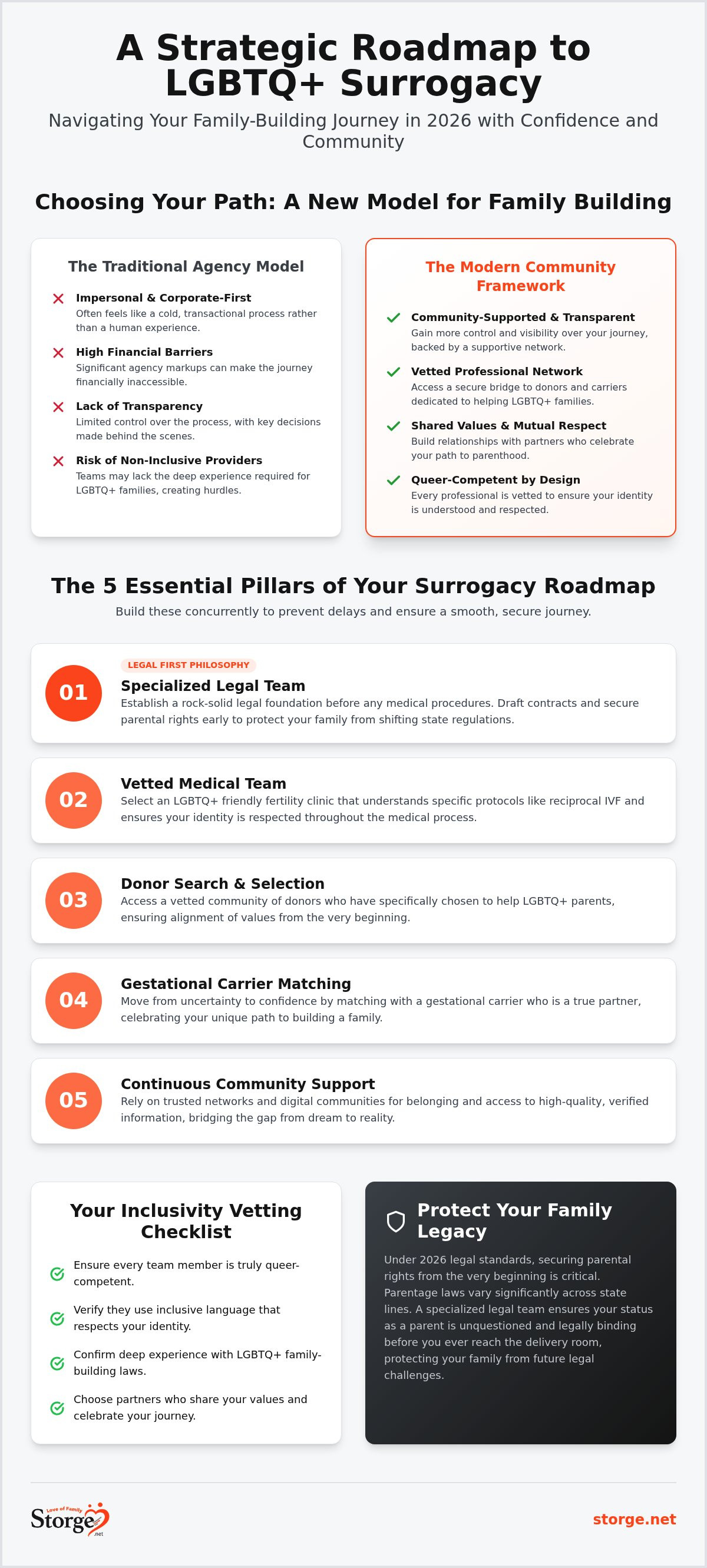
Successful LGBTQ friendly surrogacy journey planning doesn't happen in a linear vacuum. You can't wait for one phase to finish before starting the next. Instead, think of your roadmap as a symphony of five moving parts: Legal, Medical, Donor Search, Carrier Matching, and Community Support. Building these pillars concurrently prevents the common delays that often frustrate intended parents. When these elements work in harmony, you create a stable environment for your future child to enter the world.
We advocate for a Legal First philosophy. Before a single medical procedure occurs, your legal foundation must be rock solid. Understanding Surrogacy for LGBTQ+ Families highlights the emotional and social weight of these decisions. Securing parental rights early protects your family from shifting state regulations. This strategic approach ensures that by the time you reach the delivery room, your status as a parent is unquestioned and legally binding.
Pillar 1 & 2: Specialized Legal and Medical Teams
Finding an LGBTQ friendly fertility clinic is your first medical priority. You need a clinic that doesn't just tolerate queer families but understands the specific protocols for reciprocal IVF or donor cycles. Simultaneously, a specialized surrogacy attorney will draft contracts that explicitly define your intent as parents. Even in states with favorable laws, we often recommend second-parent adoption or a confirmatory adoption. It's an extra layer of security that ensures your parentage is recognized globally, regardless of where your life journey takes you.
Pillar 3 & 4: Finding the Right Match
Your search for biological connections begins by exploring the LGBTQ donor community. Whether you need an egg or sperm donor, vetting for medical history and personal values is essential. When it comes to matching with a gestational carrier, look beyond the medical screening. You want a partner who shares your family values and vision for the journey. Check for comprehensive insurance coverage and a personality fit that feels like a natural partnership. This relationship is the heart of your journey, so take the time to find a carrier who feels like a steady companion.
The final pillar is community support. Surrogacy is a marathon, not a sprint. Integrating mental health support and peer networks into your roadmap provides a safety net for the inevitable highs and lows. If you're feeling overwhelmed by these moving parts, joining a vetted community of peers can provide the steady guidance and shared understanding you need to move forward with confidence.
Agency vs. Community-Led Surrogacy: Choosing Your Path
Deciding how to structure your path to parenthood is one of the most significant choices you'll make. Historically, the industry pushed a one-size-fits-all agency model that often felt like a corporate hurdle rather than a supportive bridge. Today, LGBTQ friendly surrogacy journey planning has evolved to offer a distinct alternative: the community-led model. While both paths aim for the same beautiful result, the way you get there differs in cost, control, and the depth of your personal connections.
The core difference lies in the "Agency Markup." Traditional agencies act as intermediaries, charging substantial coordination fees to manage every interaction. In a community-led framework, like Storge PLUS, these administrative costs are removed. This allows you to redistribute those savings directly into your family's future, such as high-quality legal protections or specialized medical care. By choosing a community-led path, you trade the hands-off agency experience for a more personalized, less clinical connection with your gestational carrier and donors.
The Traditional Agency Model
The traditional model is designed for a concierge-style experience. Agencies provide hands-off management, handling everything from escrow services to pre-vetted lists of providers. This can be a relief for parents with high budgets and very little time to dedicate to the daily logistics of a journey. However, this convenience comes with trade-offs. You'll likely face extremely high fees and long waitlists as you compete for limited agency resources. For some, the process can feel transactional, leaving little room for the authentic, human-centric relationships that many queer families value.
- Pros: Hands-off management, escrow handling, and access to pre-vetted lists.
- Cons: Substantial administrative fees, long wait times, and a potentially clinical atmosphere.
- Ideal for: Intended parents with high budgets who prefer a managed, concierge-level service.
The Community-Led Model (The Storge Approach)
The Storge approach prioritizes empowerment and transparency. This model is the cornerstone of modern LGBTQ friendly surrogacy journey planning because it puts the "Intended Parent" back in the driver's seat. Through Storge PLUS, you gain direct access to a vetted community of donors and gestational carriers without the agency middleman. This results in significant cost savings and allows you to build a team of specialized attorneys and clinics that truly fit your family's specific needs. While it requires more active involvement, the result is a journey that feels more legitimate, connected, and supportive.
- Pros: Significant cost savings, direct connection to carriers, and access to a trusted community.
- Cons: Requires more active involvement and coordination from the parents.
- Ideal for: LGBTQ+ parents who want to be deeply involved in their journey and save on administrative overhead.
Choosing between these models isn't about finding the "right" way, but finding the way that respects your values and your vision. Whether you prefer a managed path or a community-driven one, your peace of mind remains the priority. We're here to ensure you have the resources and the verified information needed to make that choice with confidence.
Vetting Your Team: Ensuring True LGBTQ+ Inclusivity
Vetting your professional team is perhaps the most critical stage of LGBTQ friendly surrogacy journey planning. While many providers display inclusive imagery, true queer competency goes much deeper than a website's aesthetic. You're looking for partners who have restructured their entire practice to respect and protect diverse family structures. This means looking beyond "rainbow washing" and seeking out providers who have specialized staff, inclusive intake protocols, and a documented track record of success with our community. When every member of your team truly understands your needs, the entire process feels safer and more legitimate.
In the digital age, verified badges and community reviews are your best defense against superficial inclusivity. Don't rely solely on what a clinic or law firm says about themselves. Instead, look for platforms that offer peer-vetted resources where other intended parents share their honest experiences. This community-led verification ensures that the "inclusivity" promised is the inclusivity delivered. This level of scrutiny extends to the final stages of your journey, such as verifying if a hospital is truly LGBTQ hospital birth inclusive. A supportive medical environment during delivery is essential for your peace of mind and the long-term success of your family building efforts.
Questions to Ask Every Potential Partner
When you interview a potential clinic or attorney, come prepared with questions that test their practical experience. Don't settle for vague assurances. Ask directly: "How many same-sex or trans-led families have you successfully helped?" This number gives you a concrete sense of their actual expertise. You should also inquire if their intake forms and medical protocols are gender-neutral and inclusive. If a clinic still uses binary-only paperwork, it's a sign that their systems haven't been updated for modern family building. Finally, ensure they have established relationships with LGBTQ-specialized legal counsel to handle the specific complexities of your case.
The Role of Professional Referrals
Navigating the legal landscape requires precision and specialized knowledge. Using a trusted directory to find an LGBTQ family law attorney ensures you're working with someone who understands the nuances of parentage orders and confirmatory adoptions. Similarly, fertility clinic referrals that have been vetted by other queer parents carry more weight than a generic search result. The most reliable vetting often comes from within the community itself, where shared values and lived experiences create a higher standard of care. To start building your own trusted team, you can access our vetted network of LGBTQ-competent professionals today.
Building Your Family Legacy with Storge PLUS
Storge PLUS serves as the essential bridge between your personal dream and the practical reality of parenthood. While the previous sections outlined the theoretical pillars and vetting processes, this platform provides the actual environment where those connections happen. It's designed to facilitate LGBTQ friendly surrogacy journey planning within a high-trust, low-pressure space. By joining, you move beyond the high-cost agency model into a community-led framework that prioritizes your family's long-term success and emotional well-being.
The membership fee is a small investment that grants you access to a specialized ecosystem. Within this space, you'll find a referral network of attorneys and clinics already vetted for their queer competency. This removes the guesswork from your search. Instead of spending months searching for providers who might be inclusive, you gain immediate access to professionals who have a proven track record of supporting diverse families. This resource-sharing model ensures that your path is guided by high-quality information and mutual support.
Accessing a Vetted Network
The vetting process within the Storge community is rigorous and human-centric. We don't just list names; we ensure that every gestational carrier and donor understands the specific needs and values of our community. This facilitates safe, direct communication between intended parents and their potential matches. It allows you to build a relationship based on shared values rather than a clinical transaction. For many, this is the gold standard for surrogacy for gay couples and the wider LGBTQ+ community. By removing the traditional agency middleman, we allow the authentic human connection to lead the way.
Your Next Steps Toward Parenthood
Beginning your journey starts with finding the right companions. When you join the Storge PLUS community, you can immediately begin your donor or gestational carrier search with confidence. The platform also includes specialized hospital search tools and attorney referrals to ensure your birth experience is as inclusive as your planning phases. These resources are designed to demystify the process, breaking it down into manageable steps that respect the emotional weight of your decision. We provide the steady guidance and verified resources needed to turn your vision of a family into a reality.
LGBTQ friendly surrogacy journey planning is a significant undertaking, but you don't have to navigate this complex path alone. Your legacy begins with a single, supported step toward a community that sees you and respects your goals. We're here to walk alongside you, offering the partnership and understanding you deserve as you build your future. Together, we can bridge the gap between your dream and the beautiful reality of your new family.
Your Future Family is Within Reach
Mastering the complexities of parenthood requires a shift from the traditional corporate model to a framework built on shared values and community support. By prioritizing a legal-first roadmap and vetting every provider for true queer competency, you create a safe environment for your child's arrival. This strategic approach to LGBTQ friendly surrogacy journey planning ensures that your rights are protected while you focus on the emotional joy of building your family. You've learned that the most reliable vetting comes from within our community, where shared experiences lead to higher standards of care.
To bridge the gap between your dream and reality, we invite you to Join Storge PLUS: Access Our Vetted LGBTQ+ Family Building Community. Our platform offers a vetted network of gestational carriers and donors, alongside specialized legal and clinic referrals tailored to your needs. This community-first approach removes the agency markup and puts you in control of your legacy. You don't have to navigate these intricate steps alone. We're here to guide you with the empathy and professional reliability you deserve as you take this beautiful step forward.
Frequently Asked Questions
Is surrogacy legal for LGBTQ+ couples in every state?
Surrogacy isn't governed by federal law, so legality depends on the state where the child is born. In 2026, many states like California, New York, and Hawaii have established clear, inclusive pathways for LGBTQ+ parentage through statutes like Hawaii's Act 298. However, some jurisdictions remain restrictive or require specific legal maneuvers. We recommend working with specialized attorneys to navigate these regional differences and ensure your family's protection from the start of your journey.
How much does surrogacy typically cost for a gay couple in 2026?
In 2026, industry data suggests total costs typically range from $120,000 to $180,000. For gay male couples, these estimates often increase to $140,000 or $200,000 because of the added need for an egg donor. These figures include medical procedures, legal fees, and carrier compensation. By utilizing a community-led model instead of a full-service agency, many parents find they can manage these expenses more effectively while maintaining high standards of care and transparency.
What is the difference between a traditional surrogate and a gestational carrier?
A traditional surrogate has a genetic connection to the child because her own egg is used. In contrast, a gestational carrier has no genetic link; the embryo is created using an egg donor or an intended parent's egg. Most modern LGBTQ friendly surrogacy journey planning focuses on gestational surrogacy because it offers clearer legal protections for the intended parents. This model is widely considered the gold standard for building secure, queer-led families in 2026.
How do I ensure both parents are legally recognized on the birth certificate?
Securing legal recognition usually involves obtaining a pre-birth order in a surrogacy-friendly state, which allows both parents' names to be placed on the original birth certificate. Even with a pre-birth order, many legal experts recommend a confirmatory or second-parent adoption to ensure your rights are recognized globally. This multi-layered approach protects your family's legacy regardless of future travel or relocation, providing permanent security for both parents and the child in an evolving legal landscape.
Can single LGBTQ+ individuals use surrogacy to start a family?
Yes, single LGBTQ+ individuals frequently use surrogacy to build their families, accounting for approximately 25% of surrogacy arrangements in 2026. The process follows the same essential pillars as it does for couples, requiring a dedicated team of medical and legal professionals. Whether you're a single man, woman, or non-binary individual, the community-led model provides the same access to vetted donors and gestational carriers to help you achieve your dream of parenthood.
How long does the average surrogacy journey take from planning to birth?
The average journey typically spans 18 to 24 months from the initial planning phases to the birth of the child. This timeline accounts for finding a match, legal contracting, medical screenings, and the pregnancy itself. While some stages can move quickly, others require patience to ensure every detail is handled correctly. Starting your LGBTQ friendly surrogacy journey planning early allows you to build a stable foundation and manage expectations throughout each phase of the process.
What should I look for in an LGBTQ-friendly fertility clinic?
Look for a clinic that demonstrates deep queer competency rather than just basic tolerance. This includes having gender-neutral intake forms, inclusive medical protocols, and a proven track record of success with reciprocal IVF or donor cycles. You should also ask about their experience with specific legal requirements for LGBTQ+ families. A truly inclusive clinic will feel like a partner in your journey, offering a sense of safety and belonging from your very first consultation.
How does Storge PLUS help me find a gestational carrier safely?
Storge PLUS connects you with a vetted community of gestational carriers and donors who have specifically chosen to help LGBTQ+ families. Unlike a simple database, our platform facilitates safe, direct communication and provides a high-trust environment where you can build authentic connections. We also provide referrals to specialized attorneys and fertility clinics, helping you assemble a queer-competent team without the high markup of a traditional agency. It's a supportive bridge to your future family.


