

What if the legal security of your future family depended on whether your lawyer understood the subtle difference between a second-parent adoption and a parentage order? For many queer parents, the search for legal counsel often feels like a second job where you're the one doing the teaching. It's exhausting to walk into a consultation and realize you're spending your own time and money explaining your family structure to someone who should already be an expert. Learning how to find an LGBTQ family law attorney who truly understands your life is the first step toward lasting peace of mind.
We know that the uncertainty of state-by-state legal variances can feel heavy, especially with over 500 anti-LGBTQ+ bills introduced in 2026 alone. This guide will help you identify, vet, and partner with a specialized legal expert who understands the unique nuances of LGBTQ+ family building. We'll provide a clear checklist for vetting attorneys and show you how to access a vetted network of experts. By the end, you'll have the tools to ensure your family is legally protected, allowing you to focus on the joy of the journey ahead.
Key Takeaways
- Learn why a specialized expert in ART law is essential for navigating the complex intersection of queer family rights and evolving state statutes.
- Identify critical legal milestones, such as second-parent adoptions and parentage orders, that ensure your parental rights are fully protected across state lines.
- Use our specific interview checklist to master how to find an LGBTQ family law attorney who holds the right experience and professional credentials.
- Access trusted directories from national organizations to find legal professionals who are deeply committed to serving the LGBTQ+ community.
- Discover how Storge PLUS provides a supportive shortcut to a verified network of legal experts who truly understand the intended parent journey.
Why You Need a Specialized LGBTQ Family Law Attorney
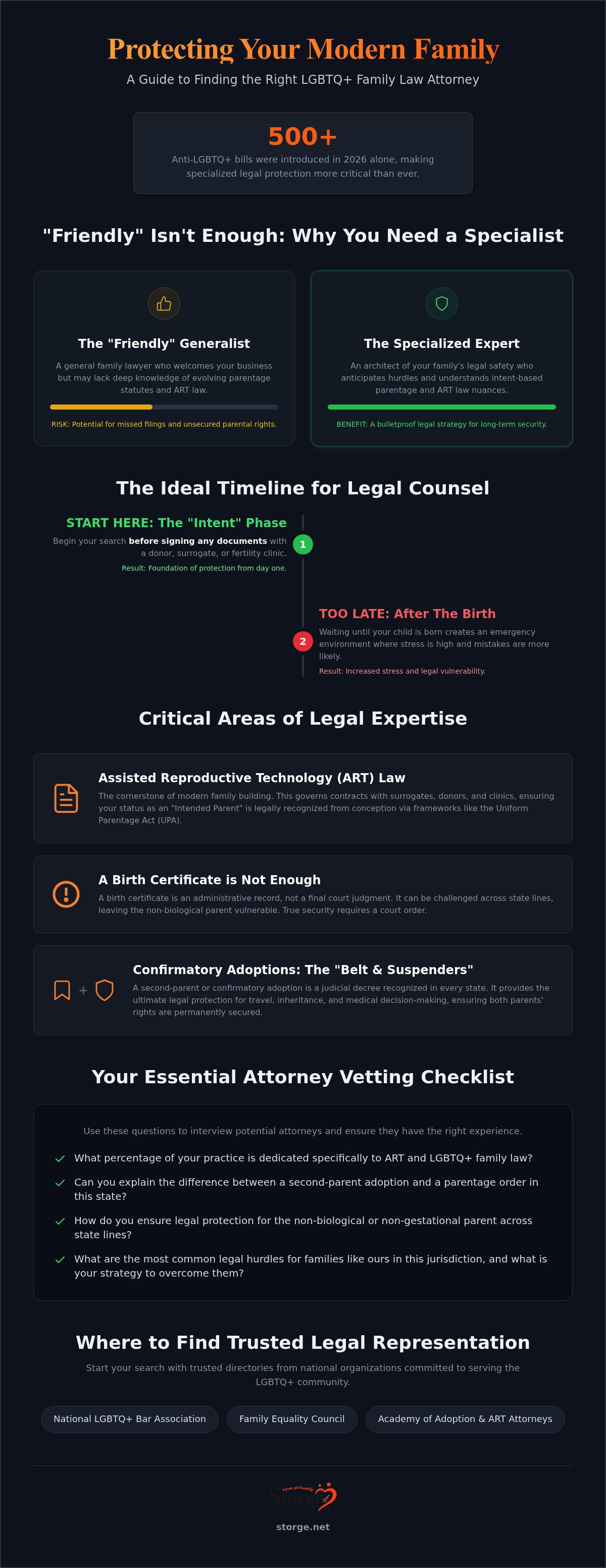
LGBTQ family law is more than just a legal category; it's a specialized intersection where civil rights meet Assisted Reproductive Technology (ART) law. While marriage equality was a landmark victory, it didn't automatically secure parental rights for every queer family. The current legal landscape regarding LGBTQ rights in the United States remains a patchwork of state-level protections and restrictions. With over 500 anti-LGBTQ+ bills considered in 2026 alone, the stakes for your family's stability are higher than ever. A specialized attorney acts as your primary protector, ensuring your family structure is recognized and respected regardless of who carries the child or where you live. They serve as a steady guide through a process that can often feel overwhelming.
Relying on a "friendly" generalist can be a risky gamble. A general family lawyer might understand divorce or standard adoption, but they often lack the deep knowledge required for evolving parentage statutes that affect queer parents. These nuances matter because a small oversight in a contract or a missed filing can leave a non-biological parent without legal standing. Understanding how to find an LGBTQ family law attorney who specializes in these intricacies is the difference between a secure future and a legal nightmare. Your attorney is not just a document preparer; they are the architect of your family's long-term legal safety.
The Difference Between LGBTQ-Friendly and LGBTQ-Specialized
Being "friendly" means a firm welcomes your business. Being "specialized" means they anticipate your specific hurdles before they arise. Specialized attorneys understand "intent-based parentage," where the law recognizes parents based on their shared goal to raise a child rather than just biological ties. In many jurisdictions, biology-based parentage remains the default, which can leave non-biological parents vulnerable if the proper legal bridges aren't built. A specialist also knows the local court climates and which judges are most familiar with modern family structures. This expertise ensures your legal strategy isn't just inclusive; it's bulletproof.
When to Start Your Legal Search
The best time to begin learning how to find an LGBTQ family law attorney is before you sign a single document with a donor or surrogacy agency. Securing legal counsel during the "intent" phase allows you to build a foundation of protection from day one. You need a partner who can review agency contracts to ensure they align with your long-term goals. Waiting until a child is born creates an "emergency" environment where mistakes are more likely and stress levels are peaked. By partnering with an expert early, you ensure that every contract reflects your rights and that your path to legal parentage is clear before the journey even begins.
Key Areas of Expertise Your Attorney Must Have
Building a family through assisted reproduction involves a specific set of legal tools that differ significantly from traditional family law. While many firms prioritize conflict and litigation, your journey requires a specialist focused on creation and protection. When researching how to find an LGBTQ family law attorney, you should look for a professional whose practice is built around the "joyful" side of the law. This includes deep expertise in donor contracts, surrogacy agreements, and the complex path to legal parentage.
Assisted Reproductive Technology (ART) Law
ART law is the cornerstone of modern family building for the LGBTQ+ community. This field governs the legal transfer of parental rights in surrogacy and ensures that your status as an "Intended Parent" is recognized from the moment of birth. A qualified attorney will be intimately familiar with the Uniform Parentage Act (UPA). This framework provides the legal basis for establishing parentage in many states. They'll ensure that every contract, whether with a surrogate or a fertility clinic, clearly defines your rights. This proactive approach prevents future disputes and creates a clear, documented path for your child's legal identity.
Confirmatory Adoptions and Parentage Orders
A common misconception is that being named on a birth certificate provides total legal security. In reality, a birth certificate is an administrative record, not a final legal judgment. To achieve "belt and suspenders" protection, most experts recommend a confirmatory or second-parent adoption. This judicial decree is recognized in every state. It's vital for travel, inheritance, and medical decision-making. Your attorney must understand how to secure these orders even in states with varying levels of legislative support. They'll guide you through obtaining a court order that solidifies your parental bond forever.
Beyond these core areas, your legal partner should be skilled in drafting sperm, egg, and embryo donation agreements. These multi-party contracts are essential for defining the donor's lack of parental rights and your absolute authority as a parent. Because these laws are constantly shifting, having a steady guide is essential for your peace of mind. If you are feeling overwhelmed by the search for how to find an LGBTQ family law attorney, Storge PLUS offers a streamlined way to access vetted attorney representation referrals within our trusted community.
Vetting Your Attorney: The Essential Interview Checklist
Finding the right legal partner is a deliberate process. When you begin researching how to find an LGBTQ family law attorney, the initial consultation is your most powerful tool. It's a chance to see if their expertise matches the gravity of your journey. You aren't just looking for a lawyer; you're looking for a steady guide who can translate your family's dreams into a secure legal reality. This interview is a two-way street where you determine if their experience aligns with your specific needs.
Start by asking: "How many LGBTQ+ family-building cases have you handled in the last year?" A high number indicates they aren't just dabbling in this field. Also, check for membership in the Academy of Adoption & Assisted Reproduction Attorneys (AAAA). This organization requires rigorous vetting and continuing education, ensuring its members are true specialists in ART law. Because laws are fluid, ask how they track state and federal parentage changes. They should also have a methodical process for coordinating with fertility clinics and agencies to ensure no detail is lost during the medical phase of your journey.
Technical Questions to Ask
Specific legal mechanisms require local mastery. Ask if they have successfully secured Pre-Birth Orders (PBOs) in your state recently. This document is essential for ensuring your names go directly on the birth certificate at the hospital. Inquire about their approach to donor agreements. The legal risks differ significantly between "known donors" and "anonymous donors," and your attorney should be able to articulate those differences clearly. Finally, request a transparent fee structure. Many specialized firms offer flat-fee packages for contract reviews, while others bill hourly for court-related work. Knowing these costs upfront allows you to plan your budget with confidence.
Assessing Cultural Competency
Your comfort level is just as important as the attorney's resume. Pay attention to the small details from the moment you join a consultation. Are the firm's intake forms inclusive of diverse gender identities and family structures? Do they use affirming language naturally, or do you find yourself constantly correcting them? You deserve a legal team that views your family building as a celebration, not just a case file. Feeling seen and respected isn't a luxury; it's a requirement for a successful partnership. When you understand how to find an LGBTQ family law attorney who truly "gets" your family, the entire process becomes less intimidating and more hopeful.
Where to Search for Trusted Legal Representation
Searching for the right advocate requires a mix of professional verification and community wisdom. Knowing how to find an LGBTQ family law attorney involves more than a simple web search; it requires looking into specialized networks that prioritize queer family building. By starting with established professional organizations, you ensure that your candidate has the baseline expertise required to handle complex parentage matters. This methodical approach transforms a daunting task into a series of manageable, clear steps.
Leveraging National Directories
The National LGBTQ+ Bar Association maintains a directory of the Family Law Institute (FLI), which is a joint initiative with the National Center for Lesbian Rights. This is a primary resource for identifying specialists who are not only "friendly" but are actively involved in the legal evolution of queer rights. When using these maps, you can filter specifically for family law and ART specialties to narrow your search to those with the most relevant experience. Another gold standard is the Academy of Adoption & Assisted Reproduction Attorneys (AAAA). Their directory allows you to find fellows who have passed rigorous standards of practice in reproductive law.
Before you commit to a consultation, it is also wise to perform a quick administrative check. You can visit your state's bar association website to verify that an attorney is in good standing and has no history of disciplinary actions. This layer of due diligence provides an extra level of security as you begin to narrow down your list of potential partners.
The Power of Community Referrals
While directories provide credentials, your peers provide the narrative. Peer experience is often the most valuable data point when you are learning how to find an LGBTQ family law attorney. Asking other LGBTQ+ parents in your network can reveal the "real" story of what it's like to work with a specific firm. You want to know if the attorney was responsive, if they communicated with empathy, and if they successfully navigated the specific hurdles of that family's journey. Attorneys who are active in the queer community, perhaps by sponsoring local events or providing pro bono support, often have a deeper emotional investment in their clients' success.
Peer recommendations can also highlight which lawyers are most effective at coordinating with fertility clinics and surrogacy agencies. Our Gay Surrogacy Guide: Building Your Family in 2026 provides a comprehensive look at the specific legal milestones you'll encounter on that journey. If you want to skip the trial and error of a manual search, you can access our vetted community through a Storge PLUS membership to find representation that is already verified by parents like you.
Streamlining Your Search with Storge PLUS
The search for legal protection can feel like a heavy burden when you're already navigating the emotional highs and lows of family building. Many intended parents face "search fatigue" after hours of vetting firms that might not fully grasp the nuances of their journey. Learning how to find an LGBTQ family law attorney doesn't have to be a solitary or exhausting process. Storge PLUS serves as a sanctuary for those who want to bypass the trial and error of traditional searches by connecting them directly with a community of verified professionals. This membership isn't just a list; it's a partnership designed to provide safety and belonging during a complex life transition.
Accessing Vetted Legal Referrals
Storge acts as a vital bridge between your family dreams and the practical legal reality required to protect them. By joining Storge PLUS Membership: Your Vetted Path to LGBTQ+ Family Building, you gain access to a network where attorneys, fertility clinics, and donors are already aligned with your values. This holistic approach ensures that your legal representation isn't just competent; they're an integrated part of a team that understands the "intended parent" perspective from day one. When your clinic and your attorney speak the same language of "intent-based parentage," the entire process moves with a steady, reassuring cadence. You won't have to explain your family structure or justify your path; instead, you'll work with experts who have already been vetted by parents who have walked this road before you. This community-driven verification process removes the guesswork, ensuring that every professional you meet is committed to the long-term success of queer families.
Taking the Next Step in Your Journey
Moving from the research phase to taking concrete action is a significant milestone. It's the moment when "what if" becomes "how we will." Partnering with a specialized attorney through our referral network provides the peace of mind that comes from knowing your rights are protected by a professional who anticipates every hurdle. This legal security is the foundation upon which you'll build your family's future, allowing you to focus on the joy of the process rather than the fear of legal loopholes. Understanding how to find an LGBTQ family law attorney through a trusted community means you never have to feel alone in this transition. You deserve a legal partner who views your family as a legitimate and beautiful reality. We are here to guide you toward that expert, providing the clarity and support needed to turn your personal dream into a practical reality.
Storge PLUS simplifies the professional search for new parents by providing a curated gateway to community-vetted legal experts who specialize in queer family building.
Securing Your Family's Future
Your journey toward parenthood is a profound transition that deserves the highest level of legal protection. By focusing on specialized ART law and using a methodical interview process, you ensure that your parental rights are recognized and secure. Understanding how to find an LGBTQ family law attorney who truly understands your life is the foundation of your family's peace of mind. You've learned how to look beyond friendly labels to find experts who anticipate your specific needs and navigate complex parentage statutes with ease.
You don't have to navigate these legal waters alone. We invite you to join Storge PLUS to access our vetted network of LGBTQ-inclusive attorneys and fertility resources. Our platform provides human-centric, affirming support and verified professional referral services that bridge the gap between your personal dreams and legal reality. You'll also gain access to a trusted community of donors and carriers, all within a space designed for your safety and belonging. Your family is a beautiful reality; let's work together to ensure it's protected for a lifetime.
Frequently Asked Questions
Do I really need a lawyer if my name is already on the birth certificate?
Yes, you still need a lawyer because a birth certificate is an administrative record and not a final legal judgment of parentage. While it's a vital document, it doesn't offer the same level of protection as a court order. A court order is recognized in all states and internationally. This ensures your parental rights are secure during travel or in the event of a legal challenge.
How much does an LGBTQ family law attorney typically cost?
Costs for legal services in this field vary significantly based on the complexity of your case and the attorney's experience. Some firms offer flat-fee packages for contract reviews or adoptions, while others bill hourly for litigation or complex negotiations. It's best to request a clear fee schedule during your initial consultation. This helps you plan your family-building budget without unexpected financial surprises.
What is the difference between a second-parent adoption and a confirmatory adoption?
Both processes serve to protect non-biological parents, but they are used in different legal contexts. A second-parent adoption allows a person to adopt their partner's child without the partner losing their own rights. A confirmatory adoption is a streamlined version often used in states that already recognize the parentage of a spouse. Both result in a court order that provides permanent, portable legal security for your family.
Can one attorney represent both the intended parents and the surrogate?
No, each party must have their own independent legal counsel to avoid a conflict of interest. Representing both the intended parents and the surrogate would compromise the attorney's ability to advocate solely for your interests. Having separate lawyers ensures that the resulting contract is fair, ethical, and legally enforceable. This dual representation is a standard requirement in professional ART law to protect everyone involved in the process.
Is it better to find a local attorney or a national specialist?
You generally need an attorney who is licensed in the state where the child will be born or where the legal proceedings occur. Family law is governed at the state level, so local expertise is essential for navigating specific court climates. However, many parents seek national specialists who collaborate with local counsel. Learning how to find an LGBTQ family law attorney with this dual focus provides the best protection for your family.
What happens if we don’t have a formal legal agreement with our sperm or egg donor?
Without a formal agreement, you risk a donor later claiming parental rights or being held responsible for child support. A written contract clearly establishes the donor's intent to relinquish rights and your intent to be the sole legal parents. This document is vital for securing a parentage order later. Proactive legal planning prevents future disputes and ensures your child's legal identity is clear from the start.
How do I know if an attorney is truly LGBTQ-inclusive or just "rainbow washing"?
Look for evidence of active participation in organizations like the National LGBTQ+ Bar Association or the Family Law Institute. A truly inclusive attorney will use gender-neutral language on intake forms and have a clear history of handling queer family-building cases. When researching how to find an LGBTQ family law attorney, pay attention to their specific track record. Their website should reflect a deep understanding of intended parent journeys rather than just generic slogans.


