

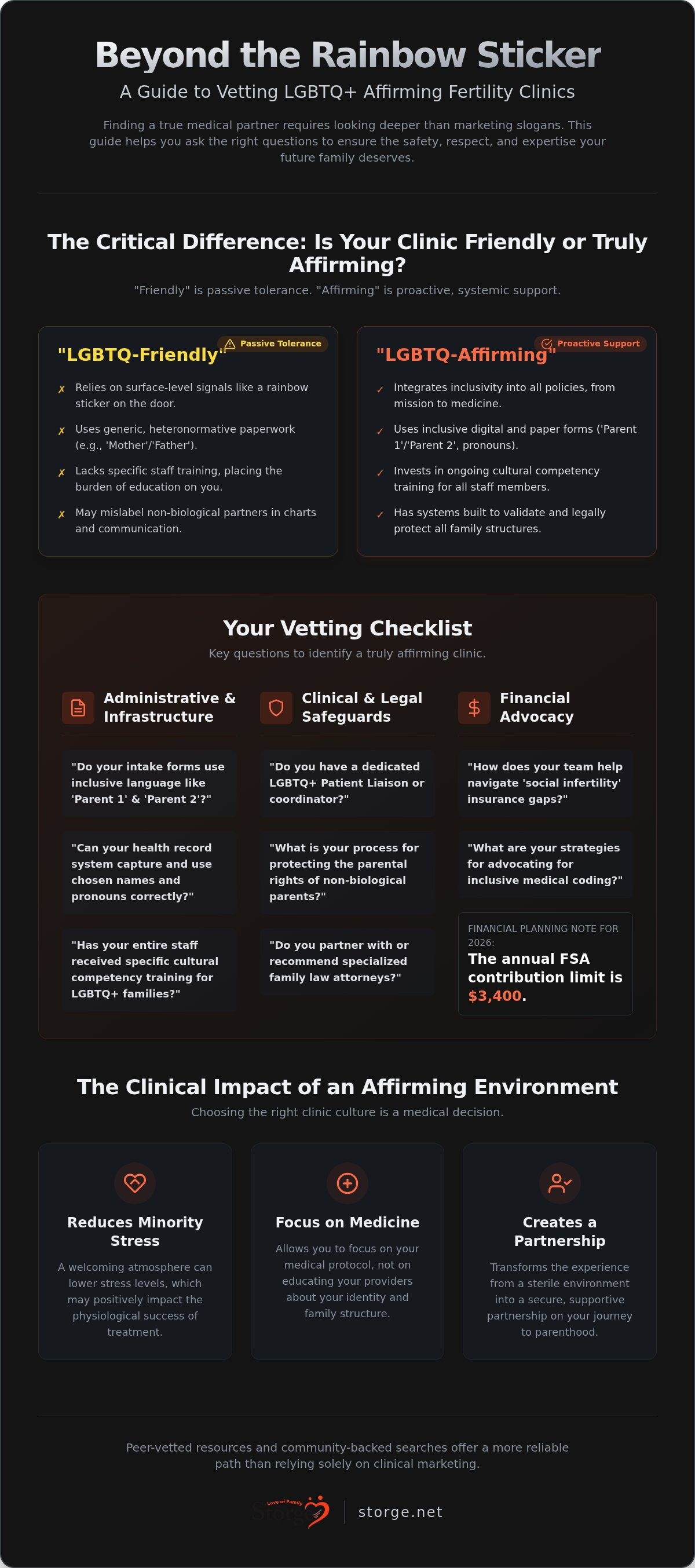
What if the rainbow sticker on a clinic’s front door is the only inclusive thing about their entire practice? It is a heavy question that many in our community carry into every first appointment. You shouldn't have to spend your consultation correcting a provider's assumptions or worrying if your non-biological partner will be treated as a legal stranger. Finding the right medical partner in 2026 means looking much deeper than a marketing slogan. This guide provides the specific questions to ask LGBTQ friendly fertility clinic staff to ensure they offer the safety and expertise your future family requires.
We understand that the path to parenthood often feels like a maze of financial hurdles and "social infertility" insurance gaps. Whether you are navigating the new California SB 729 mandates or managing the $3,400 FSA limits for 2026, the logistics can feel overwhelming. We are here to help you find a steady way forward. This comprehensive vetting guide empowers you to verify a clinic’s infrastructure, from their administrative paperwork to their medical success rates for diverse family paths. You will gain the confidence needed to choose a provider that offers a secure, legally protected path to bringing your child home.
Key Takeaways
- Learn the difference between passive "friendliness" and active LGBTQ-affirming care to ensure your medical team truly understands queer family building.
- Discover the specific questions to ask LGBTQ friendly fertility clinic staff regarding intake paperwork and diversity training to identify authentic inclusivity.
- Understand how to vet clinic partnerships with specialized family law attorneys to protect the parental rights of non-biological parents from day one.
- Gain strategies for navigating "social infertility" insurance gaps and advocating for inclusive medical coding during your financial consultations.
- See why peer-vetted resources and community-backed donor searches offer a more reliable path than relying solely on clinical marketing.
Defining True Inclusivity: Why "Friendly" Isn’t Enough in 2026
The journey to parenthood is deeply personal, and for our community, it often requires a level of vulnerability that can feel exposing. In 2026, we've moved past the era where a simple rainbow logo on a website is enough to guarantee a safe experience. True inclusivity requires a shift from "LGBTQ-friendly" care, which is often passive, to "LGBTQ-affirming" care, which is proactive and intentional. Specialized knowledge of queer family structures isn't a luxury anymore; it's a medical and legal necessity for a successful outcome. Understanding the nuances of assisted reproductive technology for LGBTQ people ensures that your providers aren't just tolerating your presence, but actively championing your right to a family.
Cultural competency isn't just about using the correct terminology. It involves a medical team that understands the physiological impacts of minority stress and the logistical complexities of multi-party reproduction. When a clinic is truly affirming, they've already done the work to dismantle heteronormative barriers before you even walk through the door. This preparation allows you to focus on your medical protocol rather than acting as an educator for your own doctors. It transforms the clinic from a sterile environment into a supportive partnership.
The Difference Between Tolerance and Affirmation
Tolerance is staying silent when a non-biological parent is mislabeled on a medical chart; affirmation is ensuring the clinic's digital records prevent that mistake from ever happening. When preparing your list of questions to ask LGBTQ friendly fertility clinic teams, start with their mission statement. Does it specifically mention diverse family building, or is it a generic template? Performative marketing is often thin, while systemic inclusivity is woven into every policy, from donor screening to legal paperwork. LGBTQ-affirming care is a holistic approach that validates all family structures as inherently legitimate and worthy of the highest standard of medical excellence.
The Impact of Clinical Culture on Your Journey
The atmosphere of a clinic can significantly influence your emotional well-being and even your physiological response to treatment. High stress levels from feeling "othered" can impact the success of a cycle, making the emotional environment a clinical factor. You should look for a dedicated Patient Liaison who understands the specific hurdles of queer family building. Some clinics now offer a specialized "LGBTQ+ Department" with coordinators who manage the unique timelines of donor cycles and surrogacy. These roles provide a steady hand, helping you move from the visionary dream of a child to the practical steps of achieving it without the added burden of clinical friction.
The Administrative Vetting: Questions for the Front Desk and Beyond
While the medical success of a clinic is paramount, the administrative experience often determines the emotional weight of your journey. It's in the quiet moments of filling out a form or checking into a patient portal where many families feel either seen or sidelined. Identifying the right questions to ask LGBTQ friendly fertility clinic representatives starts at the front desk. Administrative inclusivity is a reflection of a clinic's core values, ensuring that your identity is respected long before you enter the exam room. When a clinic invests in inclusive infrastructure, they're following the ethical standards set forth in the ASRM ethics committee opinion, which advocates for non-discriminatory access to reproductive care.
Intake Forms and Identity Validation
The first hurdle you'll encounter is often the "Intake Form Test." You should directly ask: "Do your medical forms accurately reflect my family structure and gender identity?" In 2026, relying on "Mother" and "Father" designations is outdated and can create legal friction for non-biological parents. Look for "Parent 1" and "Parent 2" labels instead. This isn't just about semantics; it's about ensuring the clinic's Electronic Health Record (EHR) correctly captures chosen names and pronouns. When a clinic’s digital infrastructure is built for queer families, it reduces the risk of being misgendered during high-stress procedures. Check if their online portal and automated appointment reminders use inclusive language, as these touchpoints are vital for your peace of mind.
Staff Training and Sensitivity Protocols
Inclusive forms are only effective if the people handling them are properly trained. You need to know: "What specific training does your medical and administrative staff receive regarding LGBTQ+ family building?" A truly affirming clinic will be transparent about their diversity and inclusion schedule, rather than offering vague promises. They should have a clear, zero-tolerance policy for bias or misgendering. If a staff member seems defensive when you ask about training frequency, it may indicate that their inclusive stance is only surface-level. Beyond the staff, observe the physical environment. Gender-neutral facilities and inclusive signage are clear indicators of a space designed for everyone. If you're looking for a community that has already vetted these administrative details, exploring a national network of inclusive providers can save you significant emotional labor.
Admin vetting isn't just about the lobby decor; it's about how the clinic advocates for you when you aren't in the room. A clinic that has modernized its administrative workflow shows a commitment to the medical and legal safety of your future family. By asking these questions early, you ensure that your partnership is built on a foundation of mutual respect and sophisticated understanding.
Clinical and Legal Safeguards: Protecting Your Future Family
Building a family requires more than just medical expertise; it demands a clinical environment that understands the legal vulnerabilities unique to our community. When you compile your list of questions to ask LGBTQ friendly fertility clinic providers, the clinical protocols must be vetted alongside the legal safeguards they recommend. It's vital to ensure the clinic doesn't operate in a medical vacuum but works closely with LGBTQ family law attorneys. This collaboration is the only way to guarantee that your parental rights are established and protected before a child is even conceived. A clinic's commitment to your safety is visible in how they manage these external partnerships and respect the gravity of your personal decisions.
Medical Protocols for Queer Families
You should ask: "How many Reciprocal IVF or gestational surrogacy cycles do you perform annually?" Experience matters. A clinic that performs these procedures once a month has a different level of proficiency than one that manages them daily. Ask for success rates specifically tailored to LGBTQ+ paths, as general clinic data can sometimes obscure the results for third-party reproduction. Vetting their specialized third-party team is essential. They should be experts in the logistics of co-maternity and the nuanced hormonal synchronization required for R-IVF. Beyond the numbers, inquire about their donor and carrier screening processes. These programs must be inclusive and transparent, ensuring that every person involved in your journey is treated with dignity and respect.
Legal Referrals and Parental Protections
A clinical success is only a partial victory if the legal foundation is shaky. Ask: "How do you ensure both partners are legally protected as parents from the start of the process?" For many, this involves understanding the specific surrogacy for gay couples legal frameworks that vary across the country in 2026. Establishing co-maternity through legal documentation is a step that cannot be skipped, regardless of whose name is on the birth certificate. The clinic should have a streamlined process for referring you to outside legal counsel who specializes in donor agreements and second-parent adoptions. Protecting your family from day one means having the right paperwork in place to prevent any future challenges to your parental status. This proactive approach transforms a complex legal maze into a manageable, steady path toward your goal. Reliable documentation isn't just a hurdle; it's the shield that keeps your future family safe.
Financial Advocacy: Navigating Insurance and "Social Infertility"
Financial planning for queer family building often feels like navigating a system designed to exclude you. The primary barrier is "social infertility," a term describing the inability to conceive due to social or structural factors rather than a diagnosed medical pathology. Historically, insurance companies required a year of heterosexual intercourse before covering care. In 2026, while legislative changes like California’s SB 729 are expanding access, many national plans still lag behind. You need a clinic that doesn't just accept your insurance but actively fights for your coverage. When preparing your list of questions to ask LGBTQ friendly fertility clinic billing teams, focus on their willingness to challenge restrictive coding and their experience with modern benefit providers.
The financial burden is often compounded by the 2026 FSA limit of $3,400, which barely scratches the surface of advanced treatments. A supportive clinic understands these constraints and offers specialized counseling to help you maximize every dollar. They should act as a bridge between your personal dream and the practical reality of funding it, providing a sense of order during an expensive and emotional transition. To find a clinic with a proven track record of financial advocacy, you can browse our vetted network of inclusive fertility providers.
Insurance Coding and Claim Advocacy
You should ask: "How does your billing department advocate for patients who do not meet the traditional medical definition of infertility?" This question reveals if the staff is prepared to handle "Prior Authorization" requests that push back against outdated insurance denials. A truly affirming clinic will be familiar with inclusive fertility benefit providers like Progyny or Carrot, which often bypass the social infertility barrier. They should also be transparent about how they code procedures like Reciprocal IVF to ensure you aren't hit with unexpected denials later. Their expertise in medical coding is a vital form of advocacy that protects your financial health.
Transparency in Third-Party Costs
One of the biggest stressors in this journey is "bill shock" from unquoted expenses. Ask: "Can you provide a comprehensive fee schedule that includes donor agency fees, legal costs, and storage?" A clinic should offer a detailed financial roadmap that accounts for the complexities of the LGBTQ donor community searches and surrogacy arrangements. This transparency should extend to:
- Long-term embryo or gamete storage fees.
- Legal coordination fees for third-party contracts.
- Medication costs that may fall outside of standard clinic quotes.
The Power of Community Vetting: Why Storge PLUS is Your Best First Step
Clinical marketing is designed to shine, often highlighting high success rates and state-of-the-art facilities. However, these brochures rarely capture the lived experience of a queer couple in the waiting room or the way a clinic handles a complex legal hurdle. Peer-reviewed experiences are the most reliable way to gauge a provider's true culture. While your list of questions to ask LGBTQ friendly fertility clinic staff is a powerful tool, having the answers from those who walked the path before you is transformative. It allows you to move past the sales pitch and into the reality of the care you'll receive.
The Storge PLUS Membership is built on this principle of collective wisdom. We don't just provide a list of names; we offer a vetted gateway to a community that has already done the heavy lifting of verification. By leaning on shared experiences, you can enter your first consultation with a level of insight that clinical websites simply cannot provide. This partnership ensures that your energy is spent on your family's future, not on second-guessing your medical team's intentions.
Accessing a Vetted Network
Our platform filters for clinics that meet rigorous standards of inclusivity, moving far beyond basic tolerance. Storge PLUS provides access to a trusted community of donors and carriers who are specifically committed to helping LGBTQ+ families. This pre-vetted database eliminates the stress of wondering if a donor program will be welcoming or if their screening processes are heteronormative. Using community feedback helps you identify "red flag" clinics that might use inclusive branding but lack the administrative or legal infrastructure to support your specific needs. This level of vetting is a medical necessity in 2026, ensuring you don't waste precious time or resources on providers who aren't fully equipped for your journey.
Taking the Next Step with Confidence
A membership-based community provides a layer of safety and quality that public forums often lack. It creates a steady, methodical roadmap that guides you from the initial search to the moment you bring your child home. Having access to verified referrals for both clinics and specialized attorneys means you're building your family on a foundation of proven expertise. This collaborative approach turns a daunting process into a series of manageable, supported steps. You aren't just a patient; you're a member of a community that values your dream as much as you do.
Your path to parenthood is valid, and the right medical partners are out there waiting to support you. By combining your own vetting process with the power of community knowledge, you can move forward with absolute confidence. The journey may be complex, but with a trusted companion by your side, the reality of achieving your dream is closer than ever. Your family's story is just beginning, and we're honored to help you write the first chapter.
Your Roadmap to a Protected and Affirming Future
Choosing a fertility clinic is one of the most significant decisions you'll make for your future family. By using these specific questions to ask LGBTQ friendly fertility clinic teams, you've moved from being a seeker to an empowered advocate. You now know how to look past surface-level marketing to verify a clinic’s administrative infrastructure, legal safeguards, and financial transparency. This diligence ensures that your path to parenthood is built on a foundation of respect and specialized medical expertise. You deserve a team that doesn't just tolerate your presence but actively champions your family structure.
You don't have to navigate these complex choices alone. Our national community of intended parents is here to share their lived experiences and provide the clarity you deserve. With access to a vetted donor and carrier database and our expert legal referral network, you can move forward with absolute peace of mind. Join Storge PLUS: Access Our Vetted LGBTQ+ Fertility Community and take the first step toward a safe, affirming, and successful family-building journey. Your dream of parenthood is valid, and the right partners are ready to help you achieve it.
Frequently Asked Questions
How do I know if a fertility clinic is truly LGBTQ friendly?
A truly affirming clinic goes beyond marketing by integrating inclusivity into its administrative and clinical bones. Look for gender-neutral intake forms that use "Parent 1" and "Parent 2" and ask about their staff's diversity training frequency. You can also evaluate their Electronic Health Record systems to see if they accurately capture chosen names and pronouns. These specific questions to ask LGBTQ friendly fertility clinic staff help you distinguish between performative slogans and genuine, systemic support.
Does insurance cover fertility treatments for same-sex couples?
Coverage varies significantly by state and employer, but 2026 has seen major progress with mandates like California’s SB 729. Additionally, the Aetna national settlement now requires equal coverage for same-sex couples. However, many plans still require a medical diagnosis of infertility, which creates a barrier for those experiencing social infertility. Always ask the clinic’s billing department for a prior authorization review to see if your specific plan has inclusive language for diverse family building.
What is reciprocal IVF and do all clinics offer it?
Reciprocal IVF, or co-maternity, involves one partner providing the eggs while the other partner carries the pregnancy. While many modern clinics offer this, it requires specialized hormonal synchronization and specific legal expertise that not all providers possess. You should ask about the number of co-maternity cycles they perform annually to gauge their proficiency. Choosing a clinic with a dedicated third-party reproduction team ensures that the complex logistics of your journey are handled with professional care.
What legal documents do I need before starting fertility treatment?
You generally need a signed donor agreement or surrogacy contract before any medical procedures begin. These documents establish clear parental rights and financial responsibilities from the start. Even if you are married, legal experts recommend additional protections like second-parent adoption or a court order of parentage, depending on your state's laws. Working with specialized attorneys ensures that both partners are legally recognized as parents, providing your future child with a secure and stable legal foundation.
How do we choose between an anonymous and a known donor?
Choosing between a known and anonymous donor depends on your desire for future contact and your comfort with legal complexity. Known donors allow for a biological connection to friends or family but require rigorous legal contracts to waive parental rights. Anonymous donors from a bank offer a streamlined process with pre-screened medical histories but limit future identity information. Consider your long-term family goals and consult with a counselor to decide which path feels most supportive for your specific situation.
What is "social infertility" and how does it affect my care?
Social infertility refers to the inability to conceive due to a person’s social circumstances, such as being in a same-sex relationship or being a single parent. This designation is critical because many insurance policies traditionally only cover "medical" infertility, which is defined by heterosexual intercourse. In 2026, more advocates are pushing for inclusive definitions that trigger coverage for LGBTQ+ individuals. A clinic that understands this concept can better advocate for your insurance claims and help you navigate financial hurdles.
Can a clinic deny treatment based on sexual orientation or gender identity?
While ethical guidelines from the American Society for Reproductive Medicine strictly oppose discrimination, legal protections vary by state. Some clinics may attempt to deny care based on religious or personal objections, though this is becoming increasingly rare as more states pass non-discrimination laws. If you encounter a clinic that feels unsupportive, it is a clear sign to look elsewhere. Your family deserves a medical partner who treats your path to parenthood with the same dignity and legitimacy as any other.
How can a community like Storge help me find a clinic?
Storge acts as a steady guide by connecting you with a vetted network of clinics that have proven their commitment to the LGBTQ+ community. Our platform allows you to access peer-reviewed experiences, helping you avoid the emotional labor of teaching your own doctors. By joining our national community, you gain access to a curated database of donors, carriers, and specialized attorneys. This partnership moves you from a place of uncertainty to a clear, supported roadmap for your family building journey.


