

What if a clinic’s promise of inclusive care only becomes clear once you’re in the room? Looking for Fertility clinic support for transgender parents means weighing more than treatment options. You may also be wondering whether staff will use your name and pronouns, ask only relevant questions, and respect how your medical history informs your choices.
Those concerns are reasonable. A welcoming website is a starting point, but forms, conversations, and everyday interactions can give you a clearer sense of a clinic’s approach. You deserve straightforward information and care that responds to your goals, without assumptions about your body or path to parenthood.
This guide explains how to assess a clinic’s communication and processes, prepare for a first appointment, and ask about options that may fit your circumstances. It also covers clinical, legal, and community resources. Storge offers fertility clinic referrals to help people explore possible clinic connections; treatment decisions and medical care remain between you and qualified healthcare professionals.
Key Takeaways
- Affirming care respects your stated identity and reproductive goals, while recognizing that every person’s path to parenthood is different.
- Discuss how your personal history, goals, and timing may relate to fertility options with qualified clinicians.
- Use practical questions about communication, intake forms, privacy, and follow-up to assess whether a clinic’s practices match its inclusive message.
- Prepare for a first conversation by identifying your goals, gathering relevant history, and asking why requested information is needed.
- Fertility clinic support for transgender parents can include referrals and community resources, but medical advice and care come from qualified healthcare professionals.
Fertility clinic support for transgender parents: what affirming care can look like
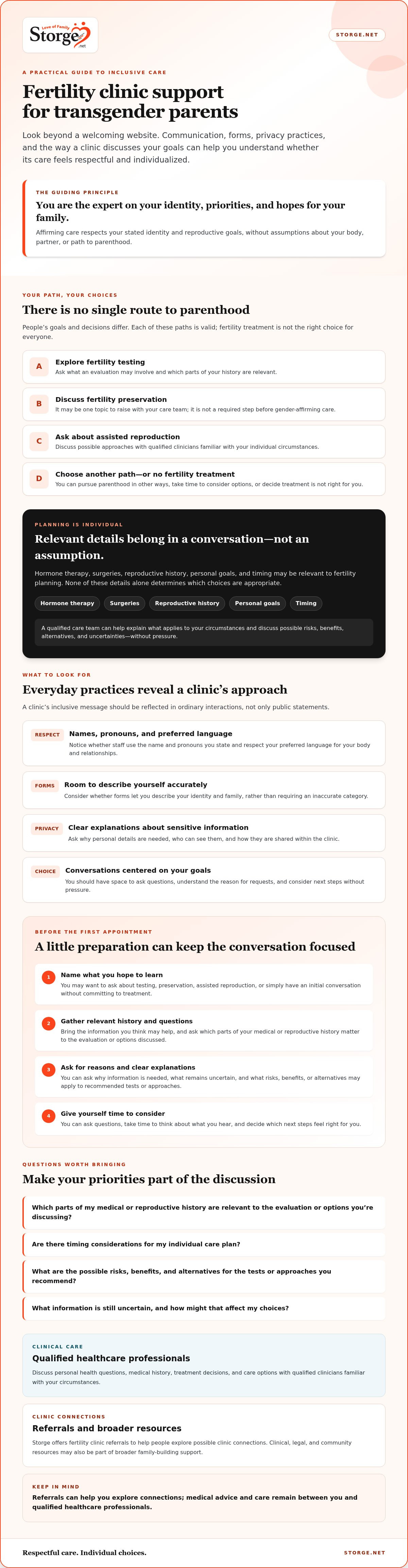
Affirming fertility care starts with a simple principle: you are the expert on your identity, priorities, and hopes for your family. Transgender people may explore fertility testing, preservation, or assisted reproduction, pursue parenthood in other ways, or decide fertility treatment isn’t right for them. None of these choices makes a person’s path more or less valid.
Affirming fertility clinic support is respectful, individualized care that honors each patient’s stated identity and reproductive goals. It shows up not only in public statements, but in how staff communicate, what information forms request, and whether conversations make room for your questions without assumptions about your body, partner, or family role.
What transgender-inclusive fertility care means in practice
Respectful communication includes using your name, pronouns, and preferred language for your body and relationships. Forms and staff interactions matter too. A form that lets you describe your identity and family accurately may feel more welcoming than one that requires you to choose an inaccurate category.
Ask how sensitive details are collected, who can see them, and how they’re shared within the clinic. Before providing information that feels personal or unrelated to your goals, you can ask why it’s needed. A thoughtful response should explain the reason clearly and give you space to discuss your concerns.
Start with your own family-building goals
Before contacting clinics, identify what you hope to learn. You might want to ask about fertility testing, discuss preservation options, or explore assisted reproduction. You may simply want an initial conversation without committing to treatment. Naming your priorities can help keep the appointment focused on what matters to you.
Your transition history doesn’t, by itself, determine which choices you’ll make or whether you can become a parent. Discuss relevant medical details and individual circumstances with qualified clinicians, who can explain what they may mean for your options. For background on pregnancy-related topics, including how fertility planning may intersect with gender-affirming care, see Transgender pregnancy. Use general information as a prompt for questions, not as a substitute for personalized medical guidance.
Fertility clinic support for transgender parents should leave room for your goals to change. You can ask questions, take time to consider what you hear, and decide which next steps feel right for you.
How gender-affirming care and fertility planning may intersect
Fertility planning can be part of a conversation about gender-affirming care, but it doesn’t follow one standard timeline or lead to the same choices for everyone. Hormone therapy, surgeries, reproductive history, and personal goals may be relevant to a discussion, but none of these details alone determines which options are appropriate. Your care team should help you understand what applies to your circumstances rather than make assumptions based on your identity or transition history.
Fertility planning is most useful when a qualified care team considers your individual history, goals, and timing, and explains options without pressure. Fertility preservation may be one topic to raise, but it isn’t a required step before gender-affirming care. The ASRM ethics committee opinion discusses access to fertility services for transgender and nonbinary people and can provide context for your questions.
Questions to discuss about your medical history and goals
You can ask the clinician to explain why a particular detail matters before sharing it. Consider bringing questions such as:
- Which parts of my medical or reproductive history are relevant to the evaluation or options you’re discussing?
- Are there timing considerations for my individual care plan?
- What are the possible risks, benefits, and alternatives for the tests or approaches you recommend?
- What information is still uncertain, and how might that affect my choices?
Questions about your health and treatment belong with qualified clinicians familiar with your care. You’re entitled to clear explanations and time to consider what you hear.
Coordinate care without surrendering your choices
If more than one clinician is involved in your care, ask whether the fertility clinic can coordinate with them and what information would be shared. You can also ask whether your consent is needed before records or updates are exchanged. Coordination may help your clinicians understand your goals, but you remain part of decisions about your care.
Before agreeing to a test or procedure, ask what it involves, why it’s being suggested, and what alternatives may be available. General information can’t determine whether a specific treatment should be started, paused, or changed. Discuss those decisions with the professionals responsible for your care.
Thoughtful Fertility clinic support for transgender parents makes room for informed, individual decisions. If you’re beginning to look for a clinic, Storge offers fertility clinic referrals to help you explore possible connections. Clinical advice and care remain between you and your healthcare professionals.
How to compare fertility clinic support for transgender parents
A clinic may describe its care as inclusive, but specific examples help you understand what that means in practice. Compare how staff communicate, how forms collect information, how privacy is explained, and whether your questions receive clear, respectful answers. Fertility clinic support for transgender parents is easier to assess by looking at observable practices rather than relying on a label alone.
What to look for in clinic communication and processes
Ask how your name, pronouns, and preferred terms for family relationships are recorded and used by staff. Find out whether forms let you describe your identity and relevant relationships accurately, or whether you can explain anything that doesn’t fit the available options. If a staff member uses the wrong term, notice whether they respond respectfully when corrected and make an effort to get it right.
How to assess privacy, referrals, and care coordination
Ask how personal information is handled, who may access it, and how the clinic explains confidentiality. If other healthcare professionals are involved in your care, ask whether the clinic can discuss coordination or referrals and what information would be shared. To compare clinics, record their answers and note what feels clear, what needs follow-up, and whether staff explain the next step.
| What to assess | What to ask | What a clear response might include |
|---|---|---|
| Names, pronouns, and language | How can I share my name, pronouns, and preferred terms with staff? | An explanation of where this information is recorded and how staff are informed. |
| Forms and intake | Can I describe my identity and relationships if the form doesn’t reflect them? | A practical way to provide relevant information without forcing inaccurate answers. |
| Privacy | Who can access my information, and how is that explained to patients? | A straightforward explanation of information handling and how to ask follow-up questions. |
| Questions and coordination | Can I discuss unanswered questions or coordination with other clinicians? | A direct response about what the clinic can discuss and what the next step would be. |
No single answer tells you everything about a clinic, but patterns matter. A thoughtful team will take your questions seriously, explain what it can and can’t do, and avoid treating your identity as a problem to solve. For more prompts to use in your research, see questions to ask an LGBTQ-friendly fertility clinic.
Prepare for a first fertility clinic conversation with confidence
A first appointment can help you understand a clinic’s approach and decide whether it feels like a good fit. You don’t need to arrive with every answer or agree to a test or treatment during the conversation. A little preparation can help you use the time for the questions and priorities that matter most to you.
Build a personal consultation checklist
Before the appointment, write down what you hope to learn and mark the topics you most want to cover. You might bring:
- Your family-building goals, including what you’re exploring and what you’re not considering right now.
- Relevant medical or reproductive history, plus questions about why the clinic needs specific details.
- Questions about how options are explained, possible next steps, follow-up, and referrals.
- Accessibility or communication preferences, such as written information or extra time to process details.
Share only what you’re comfortable discussing. If a question feels too personal or unclear, ask why the information is needed and how it will be used. You can also ask whether a support person may join you if having someone there would help you feel grounded or remember details.
Evaluate the clinic after the conversation
Afterward, note what you observed while the experience is fresh. Did staff listen without interrupting? Did they use your name and preferred language? Were answers clear, or did important questions remain open? If the clinic promised to send information or follow up, record what was promised and whether it arrived.
Compare the visit with your own priorities, not just the clinic’s description of itself. A useful next step might be to request clarification, schedule another conversation, or speak with a different clinic. Take time to consider your options before deciding whether to proceed.
Preparing this way can make it easier to recognize whether Fertility clinic support for transgender parents aligns with your needs. If you’re looking for possible clinic connections, explore fertility clinic referrals through Storge. Referrals can help you consider where to reach out; clinic choice and medical care remain between you and qualified healthcare professionals.
Find fertility clinic referrals and broader family-building support
Finding a clinic can take time, especially when a website doesn’t show how a team works with transgender patients day to day. A referral resource may help you explore possible clinic connections and decide whom to contact. It’s a starting point, not a guarantee that a clinic’s services, policies, or approach will fit your needs. Confirm those details directly with the clinic, and discuss medical questions with qualified healthcare professionals.
When a referral platform may be useful
A referral can offer another route when searching independently feels overwhelming or clinic information is hard to compare. Storge offers fertility clinic referrals, while the clinic remains responsible for explaining its services and providing medical care. Before deciding whether to proceed, ask about current policies, the types of care available, and how the clinic approaches your individual needs.
Family building may involve other kinds of support too. Depending on your plans, you might explore donor egg or sperm searches, gestational-carrier searches, hospital searches, or attorney representation referrals. These are distinct referral resources, not bundled medical or legal services. Storge doesn’t provide fertility treatment, direct medical procedures, or in-house legal services.
Choose the next support that matches your needs
Your next step doesn’t have to answer every question at once. You might arrange a clinic conversation, learn about community resources, or explore a professional referral. It’s okay to focus on one need, gather information, and decide later whether you want additional support.
Storge connects LGBTQ+ people and couples with family-building referrals and a community through Storge PLUS. Read more about the Storge PLUS family-building community to understand the resource, then consider whether it feels relevant to your path. Check current membership scope and eligibility details directly before making decisions.
For Fertility clinic support for transgender parents, a referral can help you identify a place to start, while your own questions and conversations help you assess fit. Explore Storge’s family-building resources at your own pace, and take the next step when you feel ready.
Take the next step on your terms
Finding affirming care begins with conversations that respect your identity, priorities, and questions. Look beyond inclusive messaging: notice how clinic staff communicate, explain privacy, and respond to your needs. A prepared first consultation can help you understand possible options and decide whether a clinic feels like the right fit, without committing before you’re ready.
Fertility clinic support for transgender parents can also include help exploring where to start. Storge offers fertility clinic referrals and connections to donor, gestational-carrier, hospital, and attorney resources. Through Storge PLUS, members can access an LGBTQ+ family-building community. These resources can support your search, while medical care remains between you and qualified healthcare professionals, and legal advice comes from an attorney.
If you’d like to explore support and resources for your family-building journey, visit Storge at your own pace. Your path is yours to shape, one thoughtful step at a time.
Frequently Asked Questions
What does an affirming fertility clinic do for transgender patients?
An affirming clinic listens to your goals, uses your stated name and pronouns, and explains how its processes work. Fertility clinic support for transgender parents should be visible in everyday interactions, not only in an inclusion statement. Ask how forms collect information, who may access it, and whether staff can coordinate with other clinicians. Practices differ, so direct questions can help you understand what to expect.
Can transgender people use fertility clinics to become parents?
Yes, transgender people may explore fertility care and family-building options, depending on their individual goals, circumstances, and clinical advice. A clinic can discuss the evaluations or services it offers and explain what may be relevant to you. There isn’t one pathway that applies to everyone. An initial consultation can be a chance to gather information and ask questions; it doesn’t obligate you to pursue treatment.
How do I find a fertility clinic that supports transgender parents?
Review what a clinic says about inclusive care, then ask how staff use names and pronouns, handle intake forms, explain privacy, and coordinate with other care professionals. Notice whether answers are specific and respectful. Compare clinics against your priorities, keep track of questions that need follow-up, and confirm current services and policies directly. A referral resource may help you explore possible clinic connections.
Should I discuss gender-affirming hormones or surgery with a fertility clinic?
Discuss relevant medical history with the clinician and ask which details matter for your goals and proposed care. Questions about hormones, surgery, fertility preservation, and timing depend on your individual circumstances, so a qualified professional familiar with your care is best placed to answer them. Don’t start, pause, or change treatment based on general information. Talk through any decisions with the healthcare professionals responsible for your care.
Can a fertility clinic help with fertility preservation before gender-affirming care?
A clinic may discuss fertility preservation as one possible topic, but whether it fits your goals and circumstances is an individual decision. Ask what options the clinic offers, what each process involves, and whether it can coordinate with other clinicians involved in your care. A qualified professional can explain possible benefits, limitations, and timing in your situation. Exploring the topic doesn’t mean you have to choose a procedure.
What should I ask a fertility clinic at the first appointment?
Ask how the clinic handles names, pronouns, intake forms, privacy, and communication with other care professionals. You can also ask which evaluations or options may relate to your goals, how recommendations are explained, and what follow-up involves. A written question list can help you remember what matters most. Ask for clarification, take time to consider recommendations, and decide what information you’re comfortable sharing.
Does Storge provide fertility treatment for transgender parents?
No. Storge offers fertility clinic referrals and LGBTQ+ family-building resources, but it doesn’t provide fertility treatment or medical procedures. A referral can help you explore possible clinic connections, but it isn’t a substitute for individualized clinical advice or a guarantee that a clinic is the right fit. Confirm services and care details directly with the clinic, and discuss medical questions with qualified healthcare professionals.


