

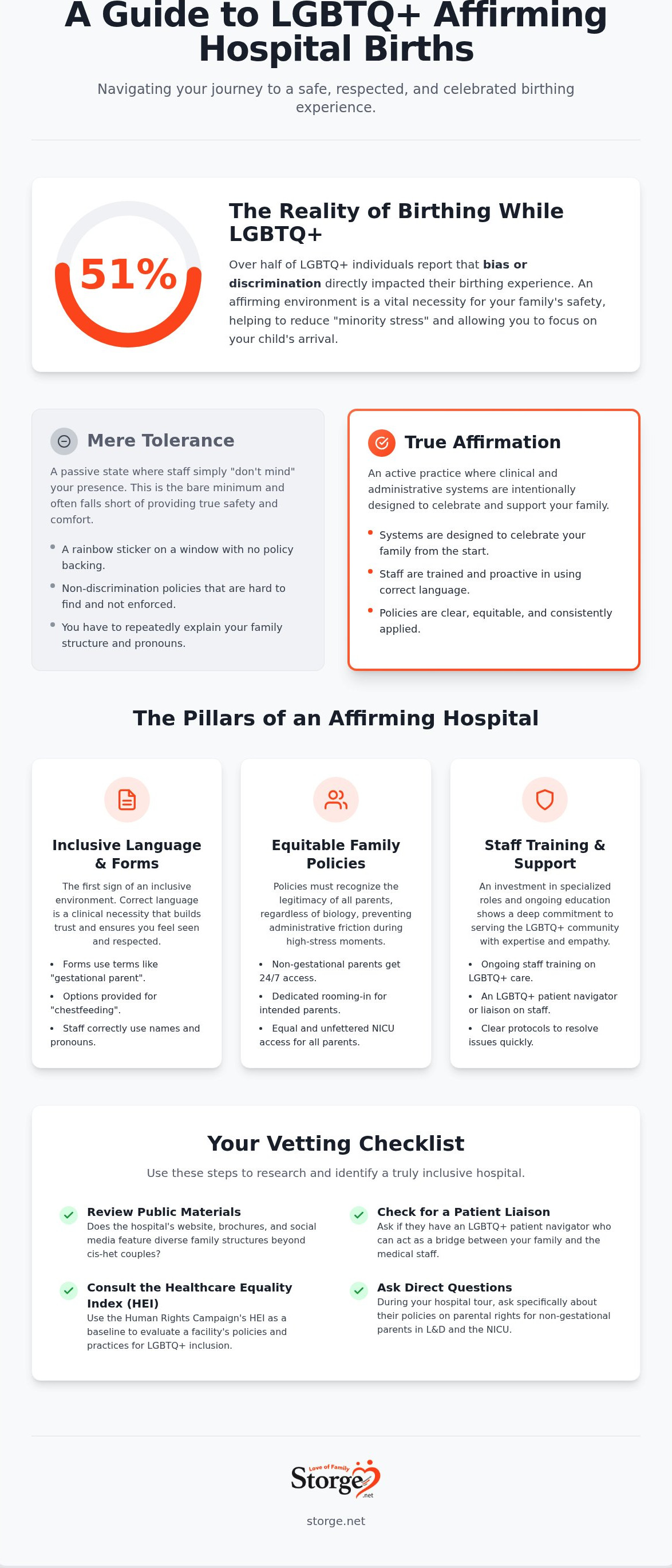
Over 51% of LGBTQ+ individuals report that bias or discrimination directly impacted their birthing experience, according to the AAMC Center for Health Justice. With state laws and federal regulations shifting rapidly in 2026, finding an LGBTQ hospital birth inclusive environment is no longer just a preference; it's a vital necessity for your family's safety. You shouldn't have to spend your labor explaining your pronouns or defending your partner's right to be in the room. It's exhausting to prepare for a life-changing event while simultaneously bracing for potential mistreatment from the very people meant to care for you.
We understand that this transition brings a unique blend of hope and protective anxiety. You deserve to focus on the arrival of your child, not on whether the intake forms will respect your identity. This guide provides a clear roadmap for identifying truly inclusive care, ensuring your family is celebrated from admission to discharge. We'll walk you through a detailed vetting checklist, actionable strategies for handling administrative pushback, and ways to ensure your non-gestational partner is never treated like a visitor in their own child's life.
Key Takeaways
- Learn to distinguish between mere tolerance and true clinical affirmation to ensure every staff member respects your family's identity from admission to discharge.
- Discover how to use the Healthcare Equality Index and internal policy reviews to identify an LGBTQ hospital birth inclusive facility that prioritizes your safety.
- Get actionable strategies for navigating the "Administrative Gap" and securing parental rights on hospital paperwork before you ever arrive for labor.
- Build a powerful advocacy toolkit and birth plan that clearly defines your family roles, pronouns, and chosen support system for the medical team.
- Access a community-vetted network of hospitals and legal experts through Storge PLUS to simplify your journey toward a celebrated and secure birth experience.
What Does LGBTQ-Inclusive Hospital Care Actually Look Like?
True inclusivity in a hospital setting goes far beyond placing a rainbow sticker on a window or having a single non-discrimination policy buried in a handbook. It's a holistic commitment that weaves affirmation into every layer of the patient experience, from the first intake form to the final discharge papers. For a facility to be considered truly LGBTQ hospital birth inclusive, it must move past mere tolerance. Tolerance is a passive state where staff simply don't "mind" your presence; affirmation is an active practice where the hospital's clinical and administrative systems are intentionally designed to celebrate your family structure.
This distinction is a matter of medical safety. Research consistently shows that discrimination and bias lead to significant LGBTQ health disparities, often causing patients to delay care or withhold vital information from providers out of fear. In a labor and delivery ward, this stress can physically impact the birthing process. An inclusive environment removes the "minority stress" of having to explain your identity repeatedly, allowing you to focus entirely on the birth of your child.
The Role of Gender-Affirming Language
Language is often the first indicator of whether a hospital is prepared for your family. When intake forms offer options like "gestational parent" or "chestfeeding," they signal that the institution understands the diversity of the birthing community. Correct pronoun usage isn't just about etiquette; it's a clinical necessity that builds the trust required for high-quality care. When staff are trained to use your correct name and pronouns without being prompted, it reduces the psychological burden on the patient. This creates a safer clinical environment where you feel seen, respected, and empowered to advocate for your needs.
Equitable Policies for All Family Structures
Inclusive care requires policies that recognize the legitimacy of all parents, regardless of biological connection. This is especially critical for non-gestational parents and families using a gestational carrier. A truly LGBTQ hospital birth inclusive facility ensures that:
- Visitation Rights: Non-biological parents are recognized as immediate family with 24/7 access, never restricted to "visitor" hours.
- Rooming-In: Intended parents in surrogacy cases are provided with a dedicated space to bond with their newborn, separate from the gestational carrier's recovery room.
- NICU Access: Both parents have equal, unfettered access to the NICU or nursery, with their legal and emotional roles fully acknowledged by the neonatal team.
These policies prevent the administrative friction that can occur during high-stress moments. When a hospital's internal rules are clear, it stops staff members from making individual, potentially biased decisions about who belongs at the bedside. It's about creating a predictable, supportive environment where your family's right to exist is never up for debate.
How to Vet a Hospital for LGBTQ Inclusivity
Finding an LGBTQ hospital birth inclusive environment requires moving beyond marketing materials and looking at the systems actually in place. While many facilities claim to be welcoming, true inclusivity is evidenced by concrete policies and staff readiness. You can start your search by analyzing a hospital's public-facing materials. Do their brochures and websites feature diverse family structures, or is the imagery limited to cisgender, heteronormative couples? Representation is often a window into the institution's internal culture. If you don't see your family reflected in their materials, it's a signal that you may need to dig deeper into their specific protocols for health care rights and patient protections.
Beyond visual cues, check for the presence of an LGBTQ+ patient navigator or liaison. These professionals act as a dedicated bridge between your family and the medical staff, ensuring that your birth plan is respected and that any administrative friction is resolved quickly. If a hospital hasn't invested in this type of role, it may indicate that they lack a specialized framework for handling the unique needs of queer and trans parents. For a more streamlined experience, you can use the community-vetted hospital search on Storge to find facilities that have already been reviewed by parents with similar lived experiences.
Decoding the Healthcare Equality Index (HEI)
The Human Rights Campaign’s HEI is a vital baseline for your research. Hospitals that earn the "Leader" designation have met rigorous criteria across four core pillars: foundational care, patient services and support, employee benefits and policies, and patient and community engagement. A "Top Performer" designation is also a strong indicator of quality, though it may mean the facility is still refining certain areas. Remember that a high HEI score is the floor, not the ceiling. It proves the hospital has the right policies on paper, but you'll still want to verify how those policies translate to the bedside during active labor.
The Pre-Admission Interview Strategy
Scheduling a tour or an interview with the labor and delivery manager is the best way to gauge the actual atmosphere of the ward. Don't hesitate to ask direct questions about staff training frequency. Cultural competency isn't a "one and done" seminar; it requires ongoing education to stay current with evolving language and legal protections. If your journey involves surrogacy for gay couples, ask specifically how they handle rooming-in for intended parents and if they have experience with pre-birth orders. Their comfort level with these questions will tell you exactly how much advocacy you might need to do on the day you arrive.
- Review non-discrimination policies: Ensure they explicitly include both sexual orientation and gender identity or expression.
- Analyze the paperwork: Ask to see a sample of their birth certificate worksheets and intake forms.
- Seek community feedback: Use trusted platforms to read honest reviews from other LGBTQ+ families who have birthed at the facility.
Navigating Legal and Administrative Hurdles During Your Stay
Securing an LGBTQ hospital birth inclusive experience requires more than just picking the right facility; it demands rigorous administrative preparation. It's a common misconception that a welcoming bedside manner translates to seamless paperwork. While your nurses may use your correct pronouns and celebrate your new arrival, the records department might still present you with forms that only offer "Mother" and "Father" checkboxes. This "Administrative Gap" occurs when a hospital's internal culture of affirmation meets the rigid, often outdated requirements of state law. While the Healthcare Equality Index provides a strong baseline for policy, it cannot always override the structures of state-mandated vital records. You must be prepared to bridge this gap with your own documentation.
To protect your family's legitimacy, you should carry a comprehensive "legal folder" throughout your stay. This folder should include healthcare power of attorney documents for both parents and clear parentage agreements. If you encounter pushback regarding "Parent 1" and "Parent 2" designations on internal forms, remain steady. Politely remind the staff that while the state's final birth certificate form may be fixed, the hospital's internal intake and bedside records should reflect your actual family structure. Having these conversations before you're in active labor prevents unnecessary stress during your recovery.
The Legal Prep Checklist
Your advocacy begins months before your due date. It's essential to learn how to find an LGBTQ family law attorney who can draft a formal "hospital letter." This document explicitly outlines your parental rights, the legal standing of a non-gestational parent, and any pre-birth orders or surrogacy contracts. Sending this letter to the hospital's legal and risk management departments weeks in advance ensures that their team has already vetted your documents before you arrive. This proactive step transforms the hospital staff from potential gatekeepers into informed partners in your care.
Managing Birth Certificate Paperwork
The birth certificate process is often the most emotionally charged administrative hurdle. In many states, the electronic systems used to generate these documents haven't caught up with modern family structures. If the form isn't gender-neutral, ask to speak with a hospital social worker. These professionals are often the most skilled at navigating the intersection of hospital policy and legal requirements. They can facilitate the "Second Parent Adoption" conversation if necessary and help ensure that both parents are correctly identified on the initial worksheet, even if the state's final printed version requires later amendment. Their role is to advocate for your peace of mind, ensuring that the administrative reality of your birth is as respectful as the clinical care you receive.
Creating Your Inclusive Birth Plan and Advocacy Toolkit
While systemic changes in healthcare are moving forward, your personal agency is your most immediate tool for a safe delivery. An LGBTQ hospital birth inclusive experience is something you can actively cultivate by bringing a structured advocacy toolkit into the labor room. You shouldn't have to carry the burden of education while in active labor, but having a clear plan ensures that your support team can step in and manage the environment for you. This toolkit transforms your birth plan from a list of medical preferences into a protective shield for your family's dignity.
Your advocacy team is the frontline of this strategy. Whether it's a partner, a specialized doula, or a trusted friend, these individuals should be fully briefed on your pronouns, family roles, and legal rights. One of the most tactical moments during your stay is the nursing shift change. These handovers happen every twelve hours and are a common point where information about your family structure can be lost. Use this transition as a strategic moment for a quick, friendly re-introduction. A simple, "Hi, I'm the gestational parent, and this is my partner who will be making medical decisions if I'm unavailable," sets a clear, authoritative tone for the next twelve hours of care.
To help you prepare for these moments with confidence, you can explore our community-driven hospital search to see which facilities have a proven track record of respecting queer birth plans.
The LGBTQ-Specific Birth Plan
A standard birth plan often fails to address the nuances of queer and trans identities. Your plan should be explicit about language and physical roles. If you prefer the term "chestfeeding" over "breastfeeding," or "gestational parent" over "mother," list these terms in a dedicated section at the top of the document. Specify who is allowed to hold the baby first; this is especially vital for non-gestational parents to establish immediate bonding. Clearly defining these roles in writing prevents staff from making heteronormative assumptions during the high-emotion moments following birth.
In-the-Moment Advocacy Strategies
If you encounter bias or repeated misgendering, you have the right to intervene. Start by politely but firmly correcting the staff member. If the behavior continues, don't hesitate to use the hospital's internal chain of command. You can request to speak with the Charge Nurse or the Patient Advocate. Every hospital has a "Patient Bill of Rights" that guarantees respectful care regardless of sexual orientation or gender identity. If a specific provider is not providing inclusive care, you have the right to request a different nurse. Your peace of mind is a clinical priority, not an inconvenience.
- Identify your advocates: Ensure your support team knows the "Chain of Command."
- Use the Patient Bill of Rights: Keep a copy in your legal folder for quick reference.
- Be explicit: Use bold text in your birth plan for names and pronouns.
How Storge PLUS Simplifies the Search for Inclusive Care
Finding a facility that is truly LGBTQ hospital birth inclusive can feel like an overwhelming task when you're also managing the emotional weight of a growing family. While standard metrics like HEI scores provide a helpful foundation, they don't always capture the nuanced lived experience of a trans parent or a same-sex couple in a specific delivery ward. Storge PLUS bridges this gap by offering a community-driven hospital search that prioritizes real-world feedback over theoretical policy. We believe that your energy should be spent on your newborn, not on vetting every medical professional you might encounter.
Our platform goes beyond a simple directory. It serves as a comprehensive ecosystem designed to support you from the first spark of a dream to the moment you bring your baby home. Members gain access to curated guides, including specific questions to ask LGBTQ friendly fertility clinic and delivery centers. This ensures you're never starting from zero; you're building on the collective wisdom of a community that has already navigated these paths. We act as a bridge between the dream of a family and the practical, safe reality of achieving it.
Accessing a Vetted Network
Joining the Storge PLUS Membership provides an extra layer of security that general search engines simply can't offer. Our network is built on verified referrals, connecting you with professionals who don't just tolerate your family but actively celebrate it. This is particularly vital for families navigating complex surrogacy births, where legal and clinical coordination must be flawless. Through our community, you can find hospitals that have successfully handled these arrangements before, reducing the risk of administrative errors during your stay. You'll also find direct referrals to inclusive family-law attorneys, ensuring your parentage is protected before you ever set foot in a hospital.
Your Journey, Our Priority
At Storge, we're committed to a methodical and reassuring guidance style. We understand that life transitions are complex, especially when they involve medical and legal systems that weren't originally built for us. Our goal is to demystify these processes, breaking them down into manageable phases that respect your peace of mind. To get started, you can explore our membership options to gain full access to our hospital directory and vetted professional network.
You deserve a birth experience that honors your family structure and protects your dignity. We're here to ensure that your journey to parenthood is defined by joy and security, not by the hurdles of advocacy. Let us help you find the safe, inclusive care your family deserves in 2026. Your success is our mission, and we're honored to be a steady guide on your path.
Empowering Your Path to a Safe Delivery
Preparing for your child's arrival is a profound milestone that deserves to be celebrated without the shadow of administrative fear. By combining rigorous vetting with proactive legal planning and a structured advocacy toolkit, you can ensure your family structure is respected the moment you enter the delivery ward. Finding an LGBTQ hospital birth inclusive environment is about more than just checking a box; it's about building a supportive community that understands and validates your unique journey. You've done the hard work of dreaming and planning, and now it's time to ensure the final steps of your journey are handled with the care you deserve.
You don't have to navigate these complex systems alone. We've built a platform specifically to connect you with the resources and professionals who prioritize your safety and dignity. Join Storge PLUS to access our vetted community of inclusive hospitals and legal resources, where you'll find our comprehensive national database and referrals to specialized family law attorneys. Every resource we provide is verified by the LGBTQ+ community to give you the highest level of confidence.
Your family's story is beautiful, and your birth experience should reflect that truth. With the right preparation and a steady guide by your side, you can step into the hospital with peace of mind, ready to welcome your baby into a world of affirmation and love.
Frequently Asked Questions
What does 'LGBTQ-inclusive' mean in a hospital setting?
In a hospital setting, true inclusivity means that the facility’s clinical, administrative, and social systems are intentionally designed to affirm diverse identities. This includes using gender-neutral intake forms, providing staff with ongoing cultural competency training, and ensuring equitable visitation policies. An LGBTQ hospital birth inclusive environment ensures that every family member is recognized and respected from the moment of admission through the final discharge process.
How do I find out if my local hospital is LGBTQ-friendly?
You can begin by checking the Human Rights Campaign’s Healthcare Equality Index to see if the facility has earned a "Leader" or "Top Performer" designation. However, paper policies don't always reflect the bedside experience. It's often more effective to look for community-vetted reviews. Platforms like Storge PLUS provide a searchable database of hospitals that have been reviewed by other queer and trans parents who have shared their first-hand birthing experiences.
Can both parents be on the birth certificate at the hospital?
Whether both parents can be listed on the birth certificate at the hospital depends heavily on your specific state’s laws and the nature of your path to parenthood. While many hospitals provide gender-neutral worksheets, the final legal document is governed by state vital records departments. In some cases, a second-parent adoption or a court order may be required after the birth. Consulting a specialized family law attorney before your due date is the best way to secure your rights.
What if the hospital staff refuses to use my correct pronouns?
If a staff member repeatedly uses incorrect pronouns, you or your advocate should politely but firmly correct them immediately. If the behavior continues, you have the right to escalate the issue through the hospital’s internal chain of command. Request to speak with the Charge Nurse or a Patient Advocate. Every patient is entitled to respectful care under the Patient Bill of Rights. You can request a different nurse if the current one is not providing inclusive care.
Do I need a lawyer for a hospital birth if I am using a surrogate?
Yes, having legal representation is vital when navigating a surrogacy birth in a hospital setting. An attorney will help you secure a pre-birth order or other necessary parentage documents to ensure you are recognized as the legal parents from the moment of delivery. This legal preparation prevents administrative delays and ensures the hospital’s risk management department has vetted your contract. Storge can provide referrals to experienced LGBTQ family law attorneys who specialize in these complex transitions.
Is there a difference between a 'friendly' hospital and an 'inclusive' one?
The difference lies in the transition from passive tolerance to active affirmation. A "friendly" hospital might have individual staff members who are kind but lack a systemic framework for queer care. An LGBTQ hospital birth inclusive facility has integrated affirming practices into its core operations. This includes everything from electronic health records that support chosen names and pronouns to facility-wide non-discrimination policies that are backed by mandatory, recurring staff training and clear accountability measures.
What should I do if my partner is denied access to the delivery room?
If your partner is denied access, immediately present your healthcare power of attorney and any legal parentage documents from your legal folder. Remind the staff that federal regulations and hospital non-discrimination policies generally prohibit the exclusion of support people based on sexual orientation or gender identity. If the situation isn't resolved, ask for the Patient Advocate or the hospital’s administrator on call. Having these documents prepared in advance is the most effective way to handle sudden gatekeeping.
How can a birth doula help with LGBTQ advocacy in the hospital?
A birth doula who is experienced with LGBTQ families acts as a vital buffer between you and the medical system. They can handle the labor of correcting pronouns, explaining family roles during shift changes, and ensuring your birth plan is followed. This allows you to focus entirely on the physical and emotional process of birthing. Doulas are trained to navigate hospital hierarchies and can advocate for your needs without escalating tension, ensuring a calmer and more affirming environment for your family.


