

Choosing to become a parent through surrogacy isn't just a medical or legal transaction. It's a profound act of community that transforms your entire life. You've likely spent hours worrying if high-cost agencies are truly on your side or if you'll find a gestational carrier who respects your values as a queer couple. It's natural to feel overwhelmed by the shifting legal landscape and the weight of such a massive personal decision. You deserve a path that feels safe, seen, and supported by those who truly understand your journey.
We believe that building your family should be a hopeful experience rather than a source of constant anxiety. This guide provides a clear, community-driven roadmap for surrogacy for gay couples in 2026, ensuring you move forward with confidence instead of confusion. We'll walk through the essential timeline, how to find a vetted support network of professionals, and the practical steps to securing your parental rights with total peace of mind. Your dream of fatherhood is valid, and the right partnership makes the reality of achieving it much closer than it seems.
Key Takeaways
- Gain a clear understanding of why gestational surrogacy is the gold standard for gay men and how to emotionally prepare for the transition to fatherhood.
- Learn how community-based matching for surrogacy for gay couples provides a more personal, value-aligned alternative to traditional agency search methods.
- Identify the "Big Three" costs of your journey and learn how to navigate insurance policies to protect your budget and your future family.
- Discover the essential legal safeguards, including pre-birth orders and separate counsel, that ensure your names are securely on the birth certificate.
- Understand how a vetted community model allows you to bypass traditional agency limitations and connect with high-quality, LGBTQ-friendly professionals.
Understanding the Path: What Surrogacy for Gay Couples Looks Like Today
The year 2026 marks a pivotal moment for surrogacy for gay couples. We've moved past the era where these journeys felt like clinical, cold transactions. Today, the focus has shifted toward relationship-based surrogacy, where the connection between the surrogate and the fathers is built on mutual respect and shared goals. This evolution is supported by landmark legislative updates that have streamlined parental rights for queer families in more jurisdictions than ever before. You're entering a landscape that finally recognizes your family as a standard, not an exception.
Stepping into this process means embracing a new identity. The emotional transition to fatherhood often begins long before a pregnancy is confirmed. It starts with the decision to trust another person with your most precious dream. By moving away from high-pressure agency models and toward vetted, community-led support, you can focus on the joy of the milestone rather than the stress of the logistics.
Gestational vs. Traditional Surrogacy
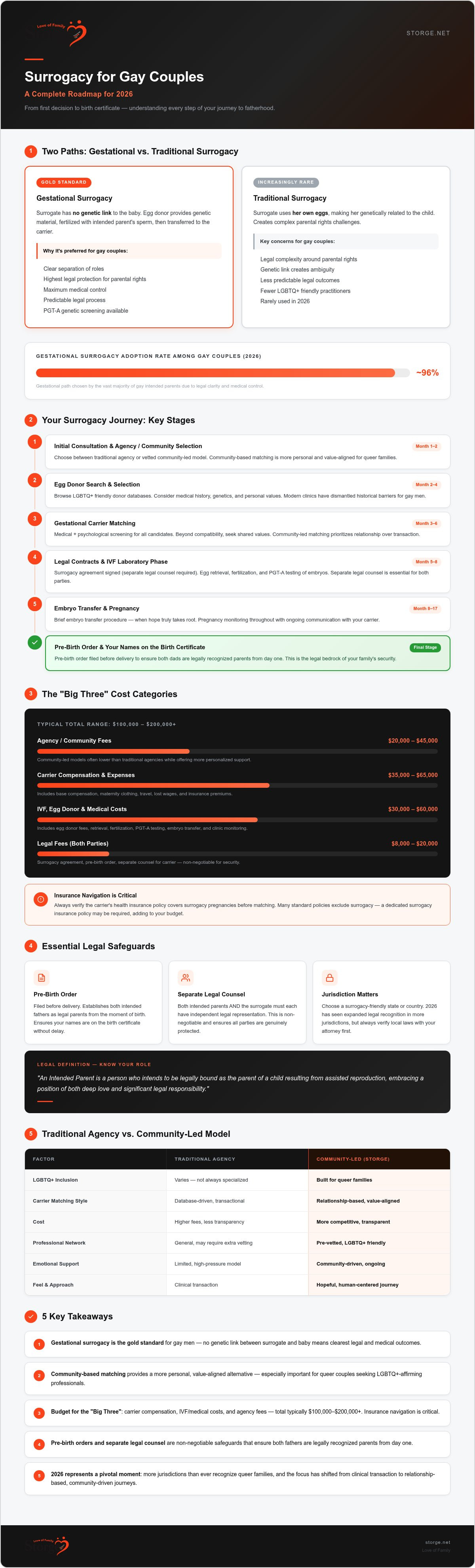
When exploring surrogacy for gay couples, understanding the medical distinction between gestational and traditional paths is the first step toward security. Gestational surrogacy is the gold standard for our community because the surrogate has no genetic link to the baby. An egg donor provides the genetic material, which is then fertilized with sperm from one or both intended parents and transferred to the surrogate. This clear separation of roles offers the highest level of medical control and legal protection.
Traditional surrogacy, where the surrogate uses her own eggs, is increasingly rare due to the legal complexities it creates regarding parental rights. For most gay men, the gestational path is preferred because it allows for a predictable legal process. Establishing clear boundaries and expectations from day one ensures that everyone involved feels protected and valued throughout the pregnancy.
The Power of the LGBTQ+ Perspective
The experience of building a family changes entirely when you work with queer-inclusive professionals. You shouldn't have to explain your family structure or defend your right to be a parent. Modern technology and specialized fertility clinics have dismantled historical barriers, allowing gay men to navigate egg donor searches and embryo transfers with the same ease as any other family. This supportive environment allows you to focus on the emotional weight of the journey.
Within this framework, your role is clearly defined. An Intended Parent is a person who intends to be legally bound as the parent of a child resulting from assisted reproduction, embracing a position of both deep love and significant legal responsibility. This definition is the bedrock of your journey. It bridges the gap between the medical reality of IVF and the personal reality of becoming a dad. Choosing a path that prioritizes your specific needs as a queer parent ensures that your transition into fatherhood is met with the dignity and celebration it deserves.
The Essential Components: Carriers, Donors, and the IVF Process
Moving from the visionary stage of your journey into the practical building blocks requires a shift in focus. This is where your dream begins to take a physical form. The process of surrogacy for gay couples involves several moving parts that must align perfectly: your genetic material, an egg donor, a gestational carrier, and the expertise of a fertility clinic. Each of these components is a pillar supporting your future family, and choosing them with intention ensures a smoother path toward fatherhood.
The IVF laboratory phase is where the science of connection happens. After your egg donor completes a retrieval, the laboratory creates embryos using your sperm. In 2026, most intended parents opt for PGT-A (Preimplantation Genetic Testing for Aneuploidy). This screening helps identify embryos with the best chance of a healthy pregnancy, reducing the risk of miscarriage and providing you with much-needed peace of mind. Once your embryos are ready and your carrier is medically prepared, the transfer process takes place. It’s a brief, relatively simple medical procedure, but for intended parents, it’s the moment when hope truly takes root.
Vetting Your Gestational Carrier
Finding the right carrier is about more than just medical compatibility. While every surrogate undergoes rigorous medical and psychological screening to ensure a safe pregnancy, the human connection is what defines the experience. You’ll want to find someone who shares your values regarding communication, the birth experience, and even post-birth contact. This relationship is a partnership based on trust and mutual respect. To help you find someone who truly aligns with your family’s vision, the Storge PLUS Membership provides a safe, vetted environment to connect with carriers who are specifically looking to help queer families.
Choosing the Right Egg Donor
Selecting an egg donor is a deeply personal decision that balances physical traits with health history and personal values. Many gay families now consider "known" donors, where there is an agreement for future contact, as this can be beneficial for the identity development of donor-conceived children. Others prefer anonymous donors through established databases. Regardless of your choice, it’s vital to use an LGBTQ-affirming lens during your search. This ensures that the donor and the agency respect your family structure from the very beginning. As you weigh these options, remember that you are not just looking for a genetic match, but a foundation for your child’s story. If you're feeling stuck on where to begin, starting a donor egg search with a community-focused guide can provide the clarity you need to move forward.
Financial Realities: Navigating Costs and Budgeting for Your Journey
Discussing money can feel uncomfortable when your primary goal is as beautiful as starting a family. However, a realistic financial plan is the foundation of a stress-free experience. For surrogacy for gay couples, the financial structure typically rests on three primary pillars. First, you have the search and community fees associated with finding your team. Second, there are the medical and IVF laboratory costs, which cover everything from egg retrieval to the final transfer. Finally, you must account for the surrogate’s compensation, which honors her time, dedication, and the physical commitment of carrying your child.
In 2026, the insurance landscape has evolved to be more inclusive. "Surrogacy friendly" policies have become a game changer, often covering significant portions of the carrier’s medical care that were once paid entirely out of pocket. Alongside insurance, specialized legal representation is a non-negotiable expense. You need an attorney who understands the nuances of queer family law to ensure every agreement is airtight. To keep these various payments organized and secure, most intended parents use an escrow management service. This neutral third party protects your funds throughout the year-long process, ensuring that your surrogate and providers are paid accurately and on time.
Budgeting for the Unexpected
While a primary budget covers the basics, successful parents always plan for variables. It is wise to set aside a contingency fund for scenarios like multiple embryo transfers or potential medical complications that require extra care. You should also consider smaller, fluctuating costs such as travel for the birth, lost wages for your surrogate during recovery, and maternity support. Transparency in costs is the first step toward financial peace. By acknowledging these possibilities early, you remove the element of surprise and can focus on the emotional milestones of the pregnancy.
Grants and Financing for LGBTQ+ Parents
The path to parenthood should not be reserved for a select few. Today, more organizations offer fertility grants specifically designed to support the queer community in their surrogacy for gay couples. Additionally, many modern employers have integrated surrogacy benefits into their Diversity, Equity, and Inclusion (DEI) programs, providing direct financial assistance or insurance coverage for employees. Community-led resources and vetted networks can also help you find more affordable paths by cutting out the massive overhead costs of traditional agencies. Leveraging these financial tools allows you to build your family with a sense of security and professional backing.
Legal Safeguards and Ethics: Protecting Your Future Family
Establishing a secure legal foundation is perhaps the most critical step in surrogacy for gay couples. This isn't just about paperwork; it's about ensuring your child’s future is protected across every border and jurisdiction. A comprehensive surrogacy contract acts as the roadmap for your partnership, detailing everything from medical decisions to financial expectations. For this agreement to be truly ethical and legally sound, separate legal counsel for the intended parents and the gestational carrier is non-negotiable. This ensures that everyone’s rights are represented fairly and that there are no conflicts of interest during the negotiation process.
Ethical surrogacy also means prioritizing the health and autonomy of your gestational carrier. A successful journey is built on a foundation of mutual respect, where the carrier’s physical and psychological well-being is never secondary to the goal of pregnancy. By working with professionals who uphold high ethical standards, you create a positive environment for your child’s first home. This commitment to ethics not only protects the carrier but also strengthens the legitimacy of your family structure in the eyes of the law. It’s a partnership that requires transparency and a shared vision of what a supportive family building process looks like.
Navigating State Laws Nationally
The legal environment for surrogacy varies significantly from one state to another. While "surrogacy-friendly" states have established statutes that simplify the process for queer families, other regions may have restrictive laws that require more complex workarounds. Choosing the state where your child will be delivered is a strategic decision that impacts how easily your names are placed on the birth certificate. Because these laws are constantly evolving, finding an LGBTQ surrogacy attorney early in your journey is essential to avoid unforeseen hurdles and ensure your rights are secured before the birth.
Establishing Permanent Parental Rights
Securing your parental rights often involves obtaining a Pre-Birth Order or a Judgment of Parentage. These court orders ensure that you are recognized as the legal parents from the moment of birth, which is vital for making medical decisions and traveling with your newborn. Even with these orders in place, many legal experts recommend second-parent adoption as a "belt and suspenders" safety measure for surrogacy for gay couples. This additional step provides a permanent, universally recognized legal status that protects your family even if you travel to a less friendly jurisdiction. You can find specialized attorney representation referrals through our vetted network to ensure your family's security is never in doubt.
Beyond the Agency: Why Community-Led Surrogacy is the Future
The traditional agency model often creates barriers rather than bridges. High overhead costs and restrictive waitlists can leave you feeling like your family’s future is on hold indefinitely. These institutions frequently prioritize their own internal processes over the personal needs of the parents they serve. Community-led surrogacy for gay couples offers a transformative alternative by putting the power back into your hands. By stepping away from the "one-size-fits-all" approach, you can find a path that is as unique as your family.
Empowerment comes from transparency and shared identity. Vetted communities like Storge allow you to skip the gatekeepers and connect directly with professionals and peers who share your values. There is immense value in peer support; speaking with other gay dads who have successfully navigated these waters provides a level of clarity that no brochure can offer. This transition from a transactional model to a community-focused one ensures that trust and mutual respect are the foundation of your journey. You aren't just another file in a cabinet; you're a member of a network dedicated to your success.
The Storge PLUS Advantage
Accessing a curated network of LGBTQ-inclusive clinics and hospitals is the first step toward a successful match. Within a community that truly understands your life, you can find donors and carriers who are specifically looking to help queer families. The Storge PLUS membership is designed to provide high-quality, committed resources without the massive price tags associated with traditional agencies. A small membership fee ensures that everyone in the network is vetted and invested, leading to more reliable connections and a safer environment for everyone involved. This model prioritizes quality over quantity, ensuring you spend your energy on connections that actually have the potential to grow into a family.
Your First Steps Toward Fatherhood
Turning your research into action is the most significant move you can make. It’s easy to get stuck in the planning phase, but joining a trusted community provides the momentum you need to move forward. Remember to maintain a steady, methodical pace. Surrogacy for gay couples is a marathon, not a sprint, and taking things one step at a time helps you avoid the burnout that often comes with such a major life transition. Your dream of building a family is valid and achievable. With the right support and a clear roadmap, the reality of fatherhood is closer than you think. You have the strength to take this first step, and a community is waiting to walk alongside you.
Your Future Starts with Community
Building a family is a profound milestone that deserves a foundation of trust and expert guidance. You've learned that securing your legal rights through specialized counsel and choosing a community-led model are the most effective ways to navigate surrogacy for gay couples today. By moving away from the high overhead of traditional agencies and toward a network of peers who share your values, you gain control over your timeline and your peace of mind. Every step you take, from vetting a carrier to establishing parentage, brings you closer to the moment you hold your child for the first time.
You don't have to walk this path alone. Join the Storge PLUS community to find your vetted path to parenthood and gain access to a trusted network of LGBTQ-friendly carriers and top-tier attorney referrals. This supportive environment connects you with peers who have navigated these same transitions, providing the reliable information you need to move forward with certainty. Your dream of fatherhood is valid; with a steady guide and a dedicated community by your side, it's also entirely within reach.
Frequently Asked Questions
Is surrogacy legal for gay couples in every state?
Surrogacy laws aren't uniform across the United States. While many states have passed supportive legislation, others remain restrictive or lack clear statutes for queer families. It's essential to work with an attorney who specializes in surrogacy for gay couples to identify the safest delivery state. This legal expert ensures your rights are protected regardless of where you live or where your surrogate resides.
What is the average cost of surrogacy for a gay couple in 2026?
Total expenses for your journey depend on several variables, including insurance coverage and your choice of matching model. Most families budget for the primary components: professional fees, medical procedures, and surrogate compensation. Utilizing community-led matching can often reduce the high overhead associated with traditional agencies. Professional financial planners within the queer fertility space can help you create a realistic roadmap tailored to your specific resources.
How long does the surrogacy process typically take for gay men?
You should expect the entire journey to take between 18 and 24 months from your initial research to bringing your baby home. This timeline accounts for the time needed to find a compatible donor and carrier, complete medical screenings, and navigate the legal contract phase. While some stages move quickly, others require patience as you wait for the right biological and emotional connections to align.
Can both fathers be biologically related to the child?
It isn't possible for both fathers to be biologically related to the same child. Each embryo is created using one egg and one sperm source. However, many couples choose to create embryos using sperm from both partners and transfer them during different cycles. This allows both parents to have a genetic connection to their children if they choose to build a larger family over time.
How do we find a surrogate who is comfortable working with a gay couple?
Finding a carrier who shares your values is best achieved through vetted, community-focused platforms. These networks prioritize inclusive matching, ensuring that every surrogate is intentionally choosing to work with gay intended parents. This shared commitment creates a foundation of mutual respect. You can focus on building a genuine relationship rather than worrying about whether your family structure is fully embraced from the start.
What is the difference between a gestational carrier and a traditional surrogate?
The primary difference lies in the genetic relationship to the child. In gestational surrogacy, the carrier has no biological link to the baby because an egg donor is used. Traditional surrogacy involves the surrogate using her own eggs, which creates significant legal and emotional complexities. Most modern families choose the gestational path because it offers much clearer legal protections for the intended parents and the child.
Do we need to do a second-parent adoption if our names are on the birth certificate?
Even if both your names appear on the birth certificate, legal experts often recommend second-parent adoption as an extra layer of security. This court judgment is recognized in every jurisdiction, protecting your parental rights if you travel or move to a different state. It acts as a permanent safeguard that ensures your legal bond with your child can't be questioned, providing total peace of mind for your family.
What happens if the surrogate changes her mind during the pregnancy?
Legal contracts and rigorous psychological screening make it nearly impossible for a surrogate to claim parentage of the child. Modern surrogacy for gay couples relies on Pre-Birth Orders that establish you as the legal parents before the delivery happens. The women who choose to become gestational carriers are motivated by a deep desire to help others build families, and they don't have a genetic link to the baby.


