

What if the strongest support for your surrogacy journey isn’t one all-knowing professional, but a team whose members understand their roles and respect your family? Surrogacy journey support for LGBTQ parents can involve many decisions, conversations, and emotions, so it’s understandable to feel unsure about whom to trust or where to begin. You deserve guidance that recognizes your family without making you explain or defend it.
The right support network can make a complex process feel more manageable. This guide explains the emotional, practical, medical, and legal resources that may be relevant, and how to assess whether professionals communicate with care and inclusivity.
Attorneys, fertility clinics, agencies, and community connections can each contribute in different ways. Knowing what each one does, and what it doesn’t do, can help you choose useful support and keep responsibilities clear. You’ll also find questions to ask about LGBTQ+ experience, communication, privacy, and referrals. With clear roles and affirming support around you, you can focus on the next step rather than expecting one person or organization to handle everything.
Key Takeaways
- Surrogacy journey support for LGBTQ parents can include emotional encouragement, practical guidance, and specialized professional referrals.
- Build a network that reflects your needs, and keep medical, legal, and community roles distinct.
- Compare support options by what guidance they provide, how they coordinate, and what responsibilities remain yours.
- Use introductory conversations to ask about LGBTQ+ experience, communication, privacy, services, and referral pathways.
- Explore how Storge PLUS connects members with an LGBTQ+ family-building community that includes donors and gestational carriers.
What Does Surrogacy Journey Support Mean for LGBTQ Parents?
Surrogacy journey support is the emotional, informational, and professional help intended parents may need as their questions and priorities change. It can mean having someone to talk with, getting clear explanations of unfamiliar steps, and turning to professionals whose responsibilities match the issue at hand. A gestational carrier is the person who carries a pregnancy for the intended parent or parents. The term describes a role; the relationship and support needs around it are personal.
Surrogacy is one of several assisted family-building paths. For an overview of options, see Assisted reproductive technology for LGBTQ people. Whatever path a family considers, LGBTQ parents deserve practical clarity and respectful care, with support that recognizes their identities and family structure.
What support can look like at different stages
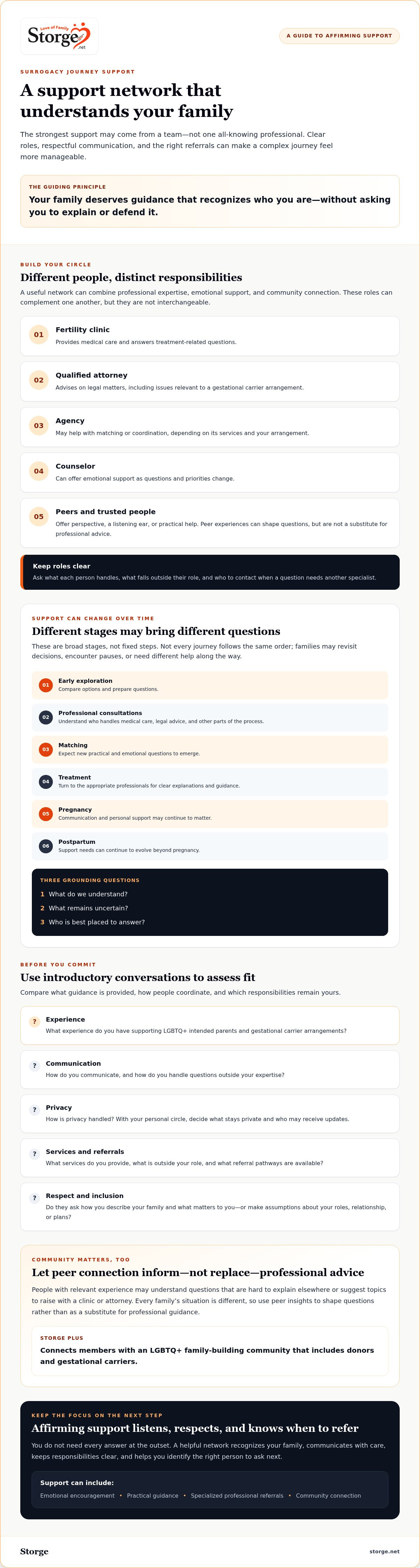
Needs may shift during broad stages such as early exploration, professional consultations, matching, treatment, pregnancy, and postpartum. These aren’t fixed steps, and not every journey follows the same order. Families may revisit decisions, encounter pauses, or need different kinds of help along the way.
Early support might help you compare options and prepare questions. During consultations, clear explanations can help you understand who handles medical care, legal advice, and other parts of the process. Matching and treatment can raise new practical and emotional questions, while pregnancy and postpartum may call for continued communication and personal support. At each stage, ask: What do we understand? What remains uncertain? Who is best placed to answer?
Why LGBTQ-affirming support matters
Respectful language and recognition of different family structures can build trust, especially in conversations about personal hopes and decisions. Notice whether a professional asks how you describe your family and what matters to you, rather than assuming your roles, relationship, or plans. Ask about their experience supporting LGBTQ+ intended parents and how they handle questions outside their expertise.
Affirming support recognizes your family as it is, listens without assumptions, and offers guidance that respects your needs and choices.
Surrogacy journey support for LGBTQ parents should account for both the shared realities of the process and your family’s individual experience. You don’t need every answer at the outset. Useful support helps you identify the next question and the right person to ask.
Build an LGBTQ-Affirming Support Network Around Your Surrogacy Journey
A useful support network isn’t one person or organization responsible for everything. It can combine personal relationships, community connection, and professionals with distinct areas of expertise. For Surrogacy journey support for LGBTQ parents, look for people who respect your family, understand when a question needs another specialist, and communicate in ways that work for you.
Which professionals may be part of the support network?
Fertility clinics provide medical care and can answer treatment-related questions. Qualified attorneys advise on legal matters, including issues relevant to a gestational carrier arrangement. An agency may help with matching or coordination, depending on its services and your arrangement. A counselor may offer emotional support. These roles can complement one another, but they aren’t interchangeable.
Ask each professional about their experience with LGBTQ+ family building and gestational carrier arrangements. Clarify what they handle, what falls outside their role, and who to contact when a question needs another specialist’s input. If you’re considering independent legal guidance, this resource on how to find an LGBTQ family law attorney can help you decide what to ask.
How community and trusted relationships can help
Peers with relevant experience may understand questions that are difficult to explain elsewhere or suggest topics to raise with your clinic or attorney. Their stories can offer perspective, but every family’s situation is different. Use peer insights to shape questions, not as a substitute for professional advice. For donor-related conversations, explore the LGBTQ donor community guide.
Your personal circle matters, too. Choose people who listen without pressuring you to share more than you want. Decide together what stays private, who may receive updates, and whether you want practical help or simply someone to talk with.
Set expectations early. With your partner or co-parent, discuss how you’ll make decisions and handle different viewpoints. With professionals, ask how they prefer to communicate, who your main contact will be, and what response process to expect. Clear agreements can reduce confusion as your needs change.
Storge is a national online LGBTQ+ family-building platform. Its Storge PLUS membership gives users access to a community that includes donors and gestational carriers, as well as resources and professional referrals. If community connection would help, explore LGBTQ+ family-building resources through Storge.
Agency, Independent Professionals, or Community: What Support Fits Your Needs?
The right support model depends on how much coordination you want, which responsibilities you prefer to manage, and where you need help. An agency, independently selected professionals, and a community resource can serve different purposes. Compare their scope before deciding, and ask exactly what is included rather than assuming similar-sounding services work the same way.
| Support model | May offer | Clarify before you commit |
|---|---|---|
| Full-service agency | Depending on the agency, coordination and assistance with parts of the surrogacy process. | Which services are included, who coordinates communication, and how support continues as needs change. |
| Independently selected professionals | Specialized medical, legal, or other professional guidance from the providers you choose. | Who manages logistics and communication between professionals, and what each provider’s scope excludes. |
| Community resources | Connections, shared perspectives, and information that may help you identify questions or resources. | Whether the resource provides referrals or community access, rather than professional care or process management. |
What an agency may coordinate, and what to ask
Agency services vary, so request a clear description of what the agency handles and what remains your responsibility. Ask who your point of contact will be, how communication is coordinated, and what support looks like at different stages. You can also ask how the agency supports LGBTQ+ intended parents and gestational carriers, including how it handles names, pronouns, and different family structures. Look for specific explanations of its practices rather than promises about a particular match or outcome.
When community access and referrals may complement professional care
A community can offer connection and help you identify questions to bring to qualified professionals. It doesn’t automatically manage matching, treatment, contracts, or pregnancy. Fertility clinics provide medical care, and qualified attorneys advise on legal matters. Confirm each provider’s qualifications, scope, and fit for your circumstances.
Storge offers community access and referrals, not agency management or in-house medical or legal services. Its Storge PLUS membership connects members with a community that includes donors and gestational carriers. Learn more in the Storge PLUS membership guide. Support models can also be combined: for example, you might choose professionals independently and use community resources for connection. For Surrogacy journey support for LGBTQ parents, look for clear boundaries and support that reflects your preferences. You can also explore Storge’s LGBTQ+ family-building platform as a community resource.
How to Assess Surrogacy Journey Support Before You Commit
Introductory conversations can help you assess whether a professional or organization fits your family. You don’t need to know every detail of the process before asking questions. Notice whether answers are clear, respectful, and honest about what the provider does and doesn’t handle. These questions can help you compare options without relying on reassuring language alone.
A practical evaluation process
- Ask about relevant experience. How have you supported LGBTQ+ intended parents and gestational carrier arrangements? Who on your team would work directly with us?
- Check inclusion in everyday communication. How do staff learn and use each family member’s name, pronouns, and preferred terms? What happens if someone uses the wrong language?
- Clarify the communication plan. Who will be our main contact, how will updates be shared, and how can we raise a concern? Ask what response process to expect rather than assuming availability.
- Discuss privacy and information sharing. What information do you collect, who may see it, and how do you handle requests to limit sharing? Ask how your preferences are documented.
- Request a plain-language scope of services. Which services are provided directly, which are referrals, and what falls outside the provider’s role? Ask how referrals are made and what limitations to understand before moving forward.
- Confirm how concerns are escalated. If you feel unheard or an issue needs attention, whom should you contact? Ask what steps are available if the first conversation doesn’t resolve the concern.
For clinic-specific questions about communication, care, and LGBTQ+ inclusion, use this guide to questions for an LGBTQ-friendly fertility clinic. For legal matters, ask a qualified attorney familiar with the relevant state law to explain how it applies to your circumstances. A referral can be a starting point, but confirm the attorney’s qualifications and fit directly.
Plan for support to change
Before sharing updates, decide which trusted people you want involved and what you’d prefer to keep private. You might want practical help from one person and a listening ear from another. Revisit those boundaries as circumstances shift, especially at major transitions. It’s okay to ask for less input, more help, or a different kind of support.
Review support as your needs change, not only at the start. A provider who welcomes questions and explains how concerns are handled can help you make informed choices, even when the process doesn’t unfold as expected.
If you’re looking for LGBTQ+ family-building connections and referrals, explore Storge’s community and resources.
How Storge Can Connect LGBTQ Parents With Community and Resources
Support for a surrogacy journey doesn’t have to come from one place. Storge is a national online platform for LGBTQ+ family building that connects members with community and resources. For intended parents seeking Surrogacy journey support for LGBTQ parents, it can be a place to explore community connections and professional referrals, while medical care, legal advice, and other professional responsibilities remain with the people qualified to provide them.
What Storge PLUS and its referrals can support
Storge PLUS membership gives users access to a community that includes donors and gestational carriers. This can help members explore relevant connections and learn about other family-building experiences, but it doesn’t promise a match or a particular outcome.
Storge also connects members with referrals for attorney representation and fertility clinics, along with hospital search resources. These can help you explore possible providers and options, but they don’t replace your own assessment of a professional’s qualifications, experience, services, and fit. Treat a referral as a starting point for questions, not a guarantee of suitability.
Storge isn’t a full-service surrogacy agency, medical provider, or law firm. It doesn’t manage the surrogacy process, provide medical procedures, or offer in-house legal services. Medical decisions belong with your care team, and legal advice should come from an attorney who can consider your circumstances and relevant law.
A next step that respects your pace
Before exploring membership or referrals, consider what would be most useful right now. Are you looking for community connection with gestational carriers, a fertility clinic referral, attorney representation, or hospital search resources? Naming your priority can make it easier to assess whether the platform’s scope matches your needs.
Your needs may change, and there’s no single timeline for deciding what support feels right. Explore resources at your own pace and ask questions before choosing a next step. Community connection and professional referrals may complement your existing support, without replacing care and guidance from the specialists you choose.
If community access and resource connections fit what you’re looking for, explore the Storge LGBTQ+ family-building community.
Choose Support That Grows With Your Family
Surrogacy journey support for LGBTQ parents works best when it reflects your needs and respects your family. Community connection can offer understanding, while fertility clinics provide medical care and qualified attorneys advise on legal matters. Before committing to a provider, ask about LGBTQ+ experience, communication, privacy, and exactly which services they handle.
Support doesn’t have to come from one source, and your priorities may change as your journey unfolds. Storge is a national online LGBTQ+ family-building platform that connects members with a community of egg donors, sperm donors, and gestational carriers. It also offers attorney and fertility clinic referrals, along with hospital search resources. These connections can help you explore options, while your chosen professionals remain responsible for their own care and advice.
If community access and referrals could help your family, explore the Storge LGBTQ+ family-building community. Move at a pace that feels right for you, and choose support that gives you clear next steps while respecting your family.
Frequently Asked Questions
What support do LGBTQ parents need during a surrogacy journey?
Support may include emotional encouragement, clear information, and guidance from professionals with distinct responsibilities. Needs can change as you explore options, speak with providers, consider a match, proceed through treatment, and prepare for postpartum life. Surrogacy journey support for LGBTQ parents should also feel affirming: professionals and loved ones should respect your family structure, language, privacy, and decisions rather than make assumptions about your plans.
Can LGBTQ intended parents use a community platform instead of a surrogacy agency?
A community platform can offer connections and resources, but it isn’t automatically a substitute for an agency’s services or for medical and legal professionals. Storge is a family-building platform, not a full-service surrogacy agency. Its Storge PLUS membership provides access to a community that includes donors and gestational carriers, and the platform offers professional referrals and search resources. Ask what each resource covers, and arrange any professional services your journey requires separately.
How do I find LGBTQ-affirming surrogacy professionals?
Ask prospective professionals about their experience with LGBTQ+ intended parents and gestational carrier arrangements. Notice whether they use your names and preferred terms, invite questions without judgment, and explain their responsibilities clearly. Ask who will communicate with you, how privacy is handled, and what happens if a concern needs to be escalated. For medical and legal guidance, confirm the provider’s qualifications and suitability directly rather than relying on an introduction alone.
Is surrogacy law the same in every U.S. state?
No. There is no single federal surrogacy law, and rules can vary by state. The law relevant to your arrangement may depend on where key parts of the process take place, so don’t rely on general online information to answer a specific legal question. Speak with a qualified reproductive attorney familiar with the relevant state law. Ask how parentage and other legal issues may apply to your circumstances.
What happens if intended parents and a gestational carrier need more support?
If someone needs more support, identify the concern and the right person to address it. Medical questions should go to the care team; legal questions belong with qualified counsel. For communication or relationship concerns, ask the agency or other involved professionals what support or escalation options they provide. Clarify each person’s role and possible next steps, while respecting everyone’s privacy and agreed boundaries.
Can a fertility clinic provide emotional support during surrogacy?
A fertility clinic’s primary role is medical care, and emotional support options can differ from one clinic to another. Ask whether the clinic offers counseling or can refer you to an appropriate support professional. You may also choose a therapist or trusted peer community outside the clinic. Emotional support can complement clinical care, but it doesn’t replace medical advice from your care team or legal guidance from an attorney.
How can we tell whether a surrogacy resource is LGBTQ-inclusive?
Look for respectful, specific communication, not only a general statement of inclusion. Ask how staff learn and use names, pronouns, and preferred family terms; how they protect privacy; and what experience they have with LGBTQ+ family building. Notice whether they listen and answer directly without assumptions. Clear explanations of services, limitations, and referral options can help you decide whether the resource fits your family.


