

A rainbow sticker on a clinic door doesn't guarantee that your family's legal rights are protected or that your intake forms won't erase your identity. You might feel a lingering anxiety that a provider won't understand the nuances of reciprocal IVF or the specific legal hurdles of second-parent adoption. When you're choosing an LGBTQ friendly fertility clinic, you aren't just looking for a doctor; you're looking for an environment where your family is recognized as legitimate from the very first phone call.
It's completely normal to feel protective of your dream while moving through a medical system that wasn't originally built with our families in mind. We're here to help you look past the marketing to find a medical team that offers genuine infrastructure and safety. This guide will help you identify truly inclusive care and build a team that respects your path to parenthood. We'll explore the latest 2026 legislative shifts like California's SB 729, provide a vetted list of questions for your first consultation, and ensure you have the tools to protect your parental rights from day one.
Key Takeaways
- Learn to distinguish between clinics that are merely "LGBTQ-tolerant" and those that are truly "LGBTQ-affirming" by auditing their administrative infrastructure.
- Identify essential green flags, such as inclusive intake forms and staff proficiency with "Intended Parent" terminology, when choosing an LGBTQ friendly fertility clinic.
- Understand how to ensure your medical team works seamlessly with legal experts to protect your parental rights and support processes like second-parent adoption.
- Gain a structured vetting protocol and a specific list of questions to ask during your first consultation to bypass the trial-and-error of finding safe care.
- Discover why starting your journey with community-vetted referrals through Storge PLUS provides a more reliable foundation than standard medical directories.
Beyond the Rainbow Logo: Defining True LGBTQ+ Inclusivity
Inclusivity is often treated as a marketing checklist, but for Intended Parents, it's a matter of safety and legitimacy. A rainbow sticker in the window doesn't always translate to an understanding of how to manage a reciprocal IVF cycle or the legal intricacies of a known donor agreement. True inclusivity is an infrastructure. It requires a commitment to seeing the whole person, not just the biological process. LGBTQ-inclusive fertility care is a holistic medical and legal framework that proactively integrates diverse gender identities, relationship structures, and third-party reproduction needs into every aspect of the patient experience.
Standard IVF protocols are frequently designed around the needs of cisgender, heterosexual couples. When you're choosing an LGBTQ friendly fertility clinic, you need a team that recognizes these protocols must be adapted. Whether you're utilizing assisted reproductive technology for LGBTQ people through egg sharing or complex donor arrangements, the clinic's administrative and medical flow should reflect that reality from the first phone call. A clinic that understands reciprocal IVF, for example, will have seamless coordination between two partners' cycles without treating the process as a medical anomaly.
The Difference Between Tolerance and Affirmation
Tolerance is allowing you in the door; affirmation is redesigning the door for you. Identifying an affirming environment is vital because it significantly reduces the emotional "minority stress" that often accompanies medical transitions. In an affirming space, you don't have to "come out" at every appointment. This level of care requires deep, ongoing staff training. It isn't enough for the lead physician to be inclusive if the billing department or the lab technicians aren't aligned with the same values of respect and recognition. Every interaction should reinforce that your family is seen and valued.
Why Your Choice Matters for Your Future Family
The medical decisions you make today impact your legal parentage tomorrow, making the process of choosing an LGBTQ friendly fertility clinic a foundational legal step. If a clinic's paperwork is outdated, it can create unnecessary hurdles for second-parent adoption or the legal recognition of both Intended Parents. Beyond the legalities, there's a profound psychological benefit to being in a space where your family is the norm, not the exception. You can find more details on these early steps in our LGBTQ family building guide. Choosing the right partner means you can focus on the joy of growth rather than the stress of self-advocacy.
Essential Green Flags: Evaluating Clinical and Administrative Competency
When you begin the process of choosing an LGBTQ friendly fertility clinic, the first sign of a safe space is often found in the digital portal before you even meet a doctor. It's in the paperwork. A truly inclusive clinic has redesigned its administrative infrastructure to reflect your reality. This means intake forms that allow for two mothers or two fathers without requiring you to manually correct pre-printed text. It's about feeling seen before you ever step into the exam room.
Language carries immense weight in this journey. You'll know you're in a supportive environment when the staff uses terminology like "Intended Parent" or "Gestational Carrier" with ease. They should understand the nuances of your family structure without needing a tutorial from you. This administrative competency is a direct response to the Disparities in access to infertility care that many queer families have faced for decades. Finding a clinic with a dedicated coordinator for third-party reproduction ensures these details are handled with the gravity they deserve.
Administrative Inclusivity Checklist
As you vet potential providers, look for these specific indicators of a modernized, inclusive practice:
- Documented Non-Discrimination: A clear policy should be visible on their website and in the physical office.
- Flexible Intake Systems: Forms must include diverse gender markers and relationship statuses beyond the binary.
- Specialized Financial Coordination: In 2026, more plans are covering "social infertility," but you need a coordinator who knows how to code these claims correctly to maximize your benefits.
Medical Proficiency in Queer Family Building
Medical proficiency goes beyond standard IVF protocols. For many same-sex female couples, Reciprocal IVF (R-IVF) is a beautiful way to share a biological connection to their child. This requires precise coordination between two partners' cycles, a task that shouldn't be new to your clinical team. Similarly, the clinic should have established protocols for trans and non-binary fertility preservation that respect the individual's gender-affirming care. They should be comfortable working with diverse sperm and egg donor sources, including known donors who require specific legal and medical clearance. For a deeper dive into these specifics, review our list of questions to ask LGBTQ friendly fertility clinic.
Choosing a partner for this journey is a significant milestone. If you're feeling overwhelmed by the options, connecting with a community of Intended Parents can provide the clarity and peer-vetted insights you need to move forward with confidence.
The Intersection of Medicine and Law: Protecting Your Rights
Choosing an LGBTQ friendly fertility clinic is a decision that extends far beyond the exam room. It's a foundational step in establishing your legal parentage. Many Intended Parents don't realize that the way a clinic labels a lab order or an ultrasound report can serve as evidence in future legal proceedings. If a clinic's system is rigid, it might accidentally erase the non-biological parent, creating unnecessary friction during second-parent adoption or the issuance of a birth certificate. Your clinic should be your first line of defense in documenting your family's legitimacy.
Documentation That Defends Your Family
The most effective clinics use "Intended Parent" designations on all internal and external documentation. This ensures that both partners are recognized as equal stakeholders in the process from day one. When medical records consistently list both individuals, it creates a cohesive narrative of shared intent. This is particularly vital when navigating hospital transitions after birth. Your clinic should be prepared to provide the necessary medical letters that support your legal team's efforts. If you're just starting this part of the process, it's helpful to learn how to find an LGBTQ family law attorney who can work in tandem with your medical providers.
Third-Party Reproduction Coordination
Building a family through surrogacy or donor gametes involves a complex web of legal contracts and medical clearances. A high-quality clinic acts as a central hub, communicating seamlessly with outside agencies and attorneys. They don't just perform the medical procedure; they also stay diligent in verifying that all legal clearances are in place before a single vial of sperm is thawed or an embryo is transferred. This coordination is essential for maintaining the integrity of your legal agreements.
Known donor arrangements require even more specialized clinical protocols. Unlike anonymous bank donors, known donors involve a unique set of FDA regulations and legal intentions. An affirming clinic will have a clear, respectful process for testing and clearing known donors while ensuring that the legal boundaries of the arrangement are strictly honored. This level of coordination protects everyone involved. It ensures that the focus remains on the health and safety of the future child and the dignity of the Intended Parents. By prioritizing these legal intersections, you ensure that your path to parenthood is as secure as it is hopeful.
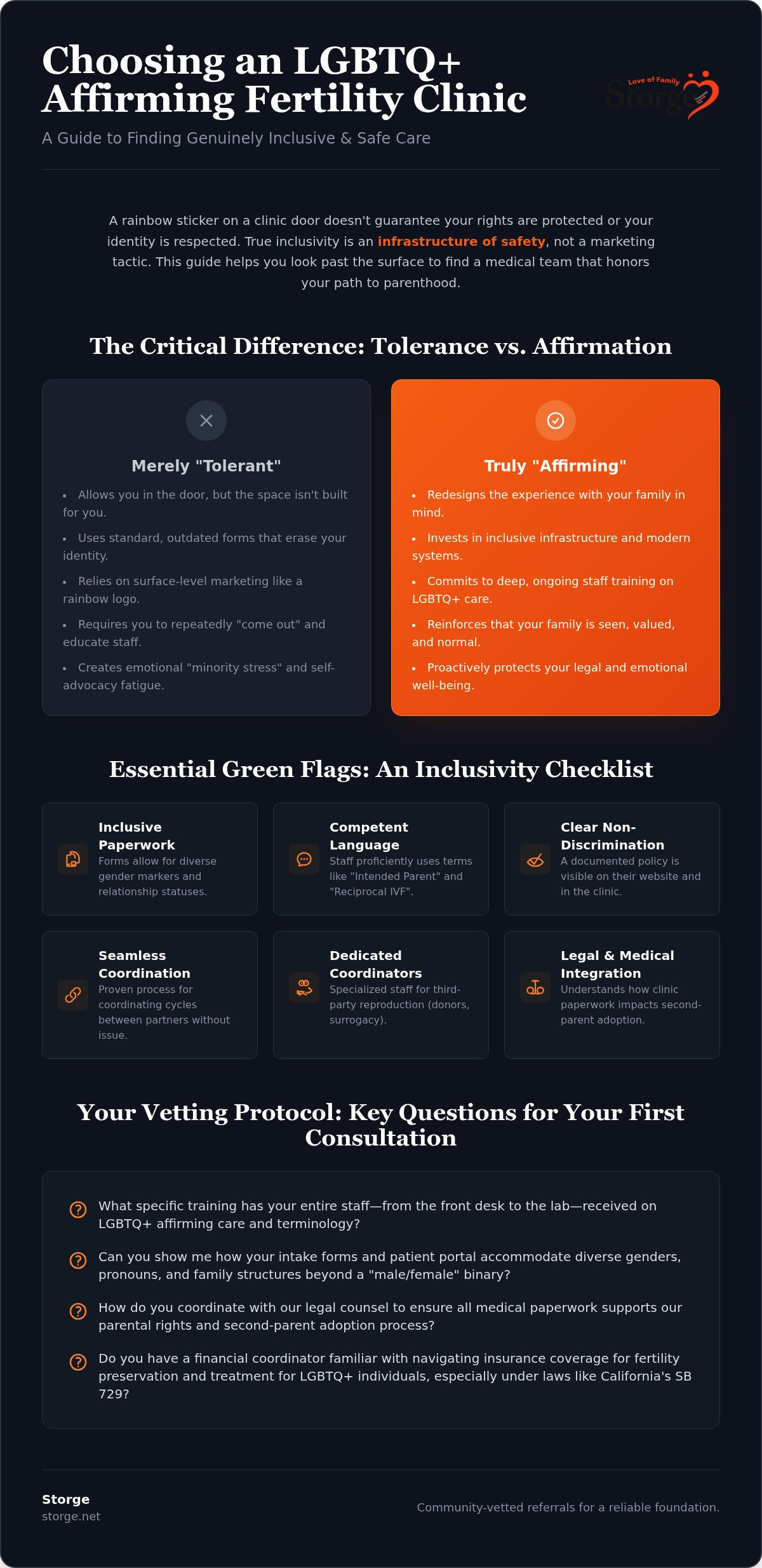
Your Vetting Protocol: Questions to Ask Before Your First Consultation
Entering a fertility clinic for the first time is a vulnerable experience. Having a structured vetting protocol transforms you from a passive patient into an empowered Intended Parent. When choosing an LGBTQ friendly fertility clinic, your goal is to look past the surface-level marketing to ensure the clinic's internal culture matches its outward promises. Start by auditing the clinic's website and physical space. Authentic inclusion is reflected in the imagery, the language used in patient portals, and even the presence of gender-neutral restrooms. These are early signals that the clinic has considered your comfort and dignity.
Before you commit to a consultation fee, consider using our vetted clinic referral service to ensure you're starting with a provider who has already earned our community's trust. This proactive step allows you to bypass the trial and error of finding a safe medical home. Once you move to the interview stage, your focus should shift to the clinic's history with third-party reproduction. Ask specifically how many reciprocal IVF cycles or gestational carrier transfers they perform annually. A clinic that handles these cases once a month is very different from one that handles them every day.
The Doctor Consultation: What to Listen For
The physician will guide your medical path, but they also set the tone for the entire team. Pay close attention to whether they use your correct pronouns and terminology without being prompted. An affirming doctor treats your partner as an equal parent in the room, not as an observer or a "support person." They should also display a baseline comfort with the legal nuances of your journey, acknowledging that your path involves specific contracts and legal clearances that differ from heterosexual patients. If they seem confused by the concept of a known donor or a second-parent adoption, it may be a sign that their infrastructure isn't fully prepared for your needs.
The "Hidden" Team: Vetting the Lab and Coordinators
The success of your journey often relies on the staff you see the least. The lab is the heart of the operation. Ask how they handle donor material from diverse banks and what their protocols are for long-term storage of embryos. Equally important is the third-party coordinator. This person is your primary point of contact for the complex logistics of your cycle. They must be responsive and knowledgeable about queer family law to ensure medical steps don't outpace legal protections. For those pursuing specific paths like surrogacy for gay couples, a coordinator who understands the timeline of legal clearances is an absolute necessity. You deserve a team that is as organized as they are empathetic.
Simplifying the Search with the Storge PLUS Community
The search for a clinic often feels like a second job. You spend hours reading reviews and decoding medical websites, hoping to find a place where your family won't just be tolerated, but celebrated. Standard medical directories often provide a list of names, but they lack the nuance of lived experience. When you are choosing an LGBTQ friendly fertility clinic, you need more than a list; you need a verification from those who have walked the path before you. This is why a community-driven approach is so vital in 2026.
Storge PLUS was created to bridge this gap. By focusing on community-vetted referrals, we move beyond the bias of self-promotion. Our members share real-world feedback about their experiences, from the way they were greeted at the front desk to the clinical team's proficiency with complex donor cycles. This collective knowledge allows you to bypass the exhausting trial and error that so many queer families have historically endured. We believe that your energy should be spent on your future family, not on defending your right to create it.
The Power of a Vetted Network
A vetted network provides a level of security that a search engine simply cannot offer. When you access our directory, you aren't just looking at medical credentials. You're seeing a history of success within our community. This includes connections to verified donor and carrier searches, as well as specialized attorney representation referrals. These professionals share your values and understand the specific legal and emotional milestones of your journey. You can learn more about how this ecosystem supports your goals through a Storge PLUS Membership. It's about building a medical and legal team that acts as a protective shield around your path to parenthood.
Your Next Steps to Parenthood
Moving from the "searching" phase to the "starting" phase is a profound shift. It begins with surrounding yourself with a support system that recognizes the legitimacy of your dream. To join the Storge PLUS community, you can sign up today and gain immediate access to our trusted directory of providers. This is the essential first step before you book your first consultation. It ensures that your time and emotional energy are invested in a team that is already prepared to protect and respect your path.
Your family is valid. Your path is unique. While the hurdles may feel high, you don't have to navigate them alone. The right medical and legal team is waiting to help you build your future, and we're here to make sure you find them with confidence. Your journey toward parenthood is a brave and beautiful transition, and it's one we're honored to guide you through as a steady, reliable companion. When choosing an LGBTQ friendly fertility clinic, remember that you are part of a larger community that has already cleared the way for you.
Building Your Future with a Team That Sees You
The journey to parenthood is one of the most significant transitions you'll ever navigate. Choosing an LGBTQ friendly fertility clinic involves looking beyond marketing to find a medical and legal infrastructure that truly protects your family. By prioritizing administrative competency, understanding the legal weight of medical documentation, and using a structured vetting protocol, you can move forward with the peace of mind you deserve. You shouldn't have to spend your energy educating your providers; you should be focusing on the joy of your growing family.
You don't have to carry the burden of research alone. Join Storge PLUS to access our vetted community of LGBTQ-friendly clinics and resources. Our platform provides you with community-verified referrals, a vetted donor and carrier network, and expert legal and medical directories designed specifically for our community's needs. This is about more than just a medical procedure. It's about building a legacy of love and legitimacy. Your dream of becoming a parent is valid, and the right team is ready to help you turn that dream into a reality. We're here to be your steady guide every step of the way.
Frequently Asked Questions
What makes a fertility clinic "LGBTQ-friendly" versus just "tolerant"?
An affirming clinic builds its infrastructure around your needs rather than just allowing you to be there. This includes intake forms with diverse gender markers and relationship statuses. When choosing an LGBTQ friendly fertility clinic, look for staff who are fluent in terminology like "Intended Parent." True friendliness means you never have to explain your family structure to the billing department or the nursing team during your appointments.
Does my insurance cover fertility treatments if I am in a same-sex relationship?
Insurance coverage depends heavily on your state's laws and your employer's specific plan. In 2026, some states have passed inclusive mandates that redefine infertility to include those who cannot conceive without medical intervention. Check if your plan requires a period of unprotected intercourse, which often excludes queer couples. Many Intended Parents find that employer-sponsored benefits are more inclusive than standard state-mandated insurance plans today.
What is Reciprocal IVF, and do all clinics offer it?
Reciprocal IVF is a process where one partner provides the eggs and the other partner carries the pregnancy. While most clinics offer standard IVF, not all are experienced in the cycle coordination and legal documentation required for this specific path. It's essential to ask about their success rates and administrative protocols for egg sharing between partners to ensure both parents' rights are protected throughout the medical process.
How do I know if a fertility clinic has experience with transgender patients?
Experience with transgender patients is signaled by a clinic's specific protocols for fertility preservation and their comfort with gender-affirming care. Ask how they handle gender markers in their medical records and whether they have experience coordinating care with hormone providers. A clinic that is truly inclusive will have a clear understanding of how testosterone or estrogen therapy may impact the timing and success of egg or sperm retrieval.
Do I need a lawyer before I pick a fertility clinic?
You don't necessarily need a lawyer before choosing an LGBTQ friendly fertility clinic, but you should have one before starting any medical procedures. Legal contracts for donor material or surrogacy must be finalized to protect your parental rights. Storge PLUS offers referrals to specialized family law attorneys who can work alongside your clinic to ensure that every medical step is backed by a solid legal foundation for both partners.
Can a clinic help me find an egg or sperm donor?
Many clinics maintain their own donor banks or have preferred partnerships with large agencies. However, these lists can sometimes feel limited or impersonal. Storge PLUS allows you to search for egg donors, sperm donors, and gestational carriers within a trusted community of individuals who share your values. This membership-based approach provides a vetted alternative to standard clinic lists, giving you more control over your family-building journey.
What are the red flags to watch out for during a fertility consultation?
Red flags often appear in the administrative details rather than the medical advice. If a clinic uses forms that only offer labels for a mother and a father, or if the staff repeatedly misgenders you, these are signs of a deeper lack of training. Another major red flag is a financial coordinator who doesn't understand social infertility or a doctor who seems dismissive of the legal hurdles unique to queer families.
Why should I join a community like Storge PLUS before starting my journey?
Joining Storge PLUS connects you with a support system that has already vetted the medical and legal landscape. Instead of relying on biased marketing, you gain access to community-verified referrals for clinics, donors, and attorneys. This membership helps you move from the overwhelming phase of searching to the active phase of starting your family with a team that is already proven to be safe, inclusive, and professionally reliable.


