

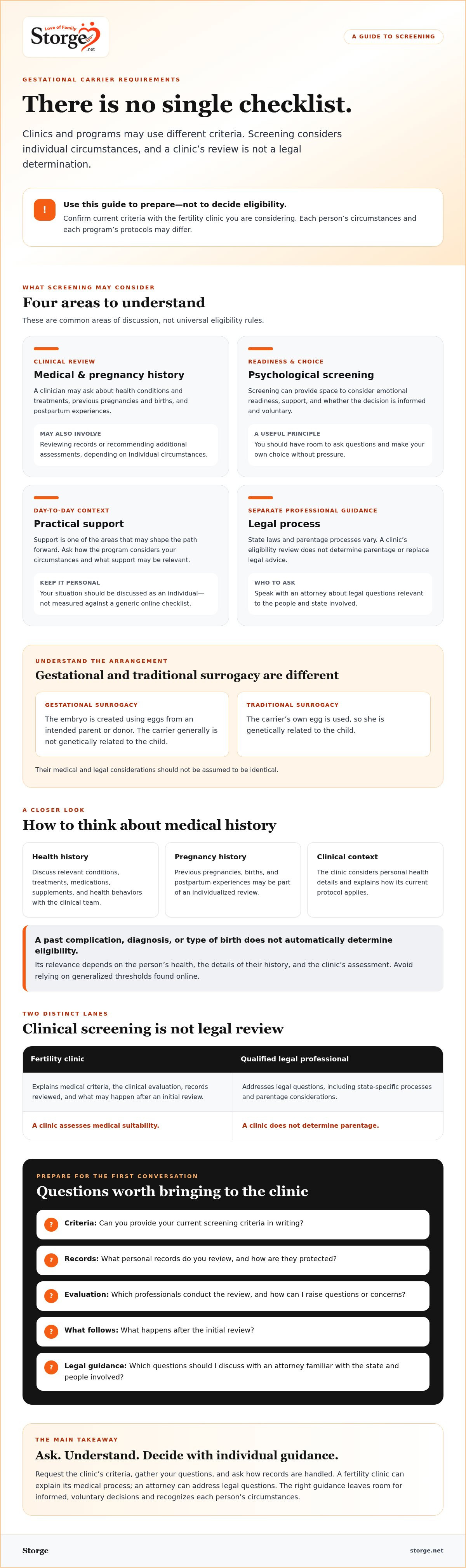
What if there’s no single checklist that determines whether someone can become a gestational carrier? Understanding gestational carrier requirements starts with that distinction: fertility clinics and programs may use different criteria, and each candidate’s circumstances are reviewed individually. If you’re considering carrying a pregnancy, or supporting someone who is, it’s natural to have questions about screening and what personal information it may involve.
Medical and pregnancy history, psychological readiness, practical support, and state-specific legal processes can all shape the path forward. This guide explains common areas a clinic may review and suggests questions to ask a fertility clinic and an attorney before making decisions. It also explains why professional guidance matters when clinical criteria and parentage processes vary. Use the information to prepare for conversations, not to decide eligibility on your own.
Key Takeaways
- Understanding gestational carrier requirements means asking about a clinic’s individual screening process, not relying on one universal checklist.
- Clinics may review medical and pregnancy history. Confirm the specific criteria directly with the clinic.
- Psychological screening can support informed, voluntary decision-making and provide space to consider readiness and support.
- Clinic eligibility and legal questions are separate. State laws and parentage processes vary.
- To prepare for a first conversation, request the clinic’s criteria, gather questions, and ask how personal records are protected.
What gestational carrier requirements generally assess in the United States
A gestational carrier carries a pregnancy for an intended parent or parents. In gestational surrogacy, the carrier generally isn’t genetically related to the child because the embryo is created using eggs from an intended parent or donor. Traditional surrogacy is different: the carrier’s own egg is used, so she is genetically related to the child. These arrangements are distinct, and their medical and legal considerations shouldn’t be assumed to be identical.
For a gestational carrier arrangement, a fertility clinic typically evaluates whether carrying a pregnancy appears medically suitable. Screening may also address informed consent and readiness for the process. A clinic’s evaluation is not a legal review and does not determine parentage. Those questions require guidance from qualified legal professionals.
There’s no single U.S. checklist that applies to every clinic or program. Criteria and protocols can differ, and each person’s circumstances matter. Understanding gestational carrier requirements is a starting point for asking informed questions, not a way to determine eligibility in advance. Confirm current criteria with the fertility clinic you’re considering.
How gestational carrier screening differs from a universal checklist
Screening may cover health and pregnancy history, emotional readiness, and whether a person can make a voluntary, informed decision. These are common areas of discussion, not guaranteed eligibility rules. A clinic may consider individual circumstances and follow its own protocols, so a criterion used by one program may not apply in the same way elsewhere.
Before beginning, ask the clinic for its current criteria in writing. Find out what records it reviews, which professionals conduct the evaluation, and how you can raise questions or concerns during screening. You can also ask what happens after the initial review, so you understand the next steps without assuming a particular outcome.
Who may be considering carrier requirements
If you’re considering becoming a gestational carrier, it’s reasonable to want a clearer picture before deciding whether to begin an evaluation. Learning about the process can help you prepare questions while leaving you room to make your own choice, without pressure from intended parents or anyone else.
Intended parents may also want to understand screening before choosing a fertility care team. This can help set expectations and support respectful conversations with a prospective carrier. LGBTQ+ people, couples, and families with many different structures may pursue this path, and each deserves clear information and care that recognizes individual needs. A clinic can explain its medical process; an attorney can address legal questions relevant to the people and state involved.
Medical and pregnancy-history factors clinics may review
A fertility clinic reviews health information to understand how a pregnancy might affect a prospective carrier’s well-being and what care may be appropriate. This is an individualized clinical assessment, not a judgment about someone’s worth or ability to support a family. The ASRM screening guidelines offer professional recommendations for practices working with gestational carriers. The clinic you choose can explain how its current protocol applies to you.
Health history, pregnancy history, and clinical evaluation
A clinician may ask about previous pregnancies, births, and postpartum experiences, as well as relevant health conditions and treatments. Depending on your circumstances, the clinic may request medical records or recommend additional assessments to understand a specific part of your history. These questions help the care team consider pregnancy-related factors and plan appropriate care.
A past complication, diagnosis, or type of birth doesn’t automatically determine eligibility. Its relevance depends on the person’s health, the details of the history, and the clinic’s assessment. Understanding gestational carrier requirements means seeking an individual review rather than relying on general age, body-mass, delivery, or cesarean thresholds found online. Ask the clinic for its current criteria and how it reviews circumstances that may need closer consideration.
Medication, substance use, and pregnancy-related safety
Clinicians may review prescription and over-the-counter medications, supplements, and health behaviors that could be relevant during pregnancy. Be candid about what you take or use so the care team can discuss potential considerations and next steps. Don’t assume that a particular medication or health behavior determines eligibility without clinical guidance.
Don’t stop or change a medication on your own. Talk with the clinician who prescribes it and ask the fertility clinic how the medication fits into its evaluation. If you’re unsure what information to share, ask how to provide it and whether the clinic needs records from your existing healthcare professional.
Before an evaluation, you can make a list of medications and gather relevant health or pregnancy records. Ask the clinic which documents it needs and how it will use them. A fertility clinic and your own healthcare professional can address medical questions specific to your situation. LGBTQ+ people and families looking for a supportive starting point can explore Storge’s fertility resources and clinic referrals. Storge doesn’t determine medical eligibility or provide medical care.
Psychological readiness, informed consent, and support
Gestational carrier screening may include counseling or a psychological evaluation, depending on the fertility clinic’s process. This conversation isn’t a test of whether someone has the “right” feelings. It can give a prospective carrier space to consider what the arrangement may involve, think through personal boundaries, and ask questions before deciding how to proceed. The ASRM guidelines for gestational carriers provide professional recommendations, while each clinic can describe its own assessment process.
Informed consent means having understandable information and the freedom to make a voluntary decision. A person should be able to raise concerns, take time to reflect, or choose not to continue without pressure from intended parents, family members, or others. Understanding gestational carrier requirements includes considering this personal dimension, not only preparing for appointments or paperwork.
What a psychological consultation may explore
A qualified professional may invite discussion about motivations, expectations, boundaries, and the carrier’s understanding of the process. The conversation might cover communication with intended parents and how the person feels about possible changes along the way. These topics can help clarify questions and preferences, but clinics may use different questions and assessment formats.
Before an evaluation, ask who will conduct it, whether the professional is independent, what information will be shared with the clinic or others, and how the assessment may inform next steps. Find out how confidentiality works, including who can access the information, so you know what to expect before you speak openly.
Building a practical support plan
Support can look different for each person, and needs may change during treatment, pregnancy, and postpartum recovery. Consider who you trust to listen, help with everyday responsibilities, or be available around appointments. A support plan doesn’t have to answer every future question. Thinking it through early can help identify where additional support or clearer arrangements may be useful.
- Discuss preferred communication, including how and when updates are shared.
- Talk about appointment involvement and who participates in decisions about the carrier’s own care.
- Identify practical help you may want during pregnancy and recovery, and whom you could ask.
Clear boundaries can support a respectful relationship between the carrier and intended parents. Each person may also benefit from separate, qualified support, with space to discuss individual questions and feelings. LGBTQ+ intended parents and families don’t need to justify their family structure as part of this conversation. The focus is respectful communication, individual needs, and voluntary participation.
Legal and practical considerations before proceeding
A fertility clinic’s decision about medical eligibility is separate from legal requirements and the process for establishing parentage. Meeting a clinic’s criteria doesn’t answer what agreements may be appropriate or how parentage could be addressed. U.S. surrogacy laws and legal processes vary by state and can change, so don’t assume a process that worked for another family will apply to yours.
Before moving forward, speak with an attorney experienced in assisted reproduction who can explain how relevant state law may affect your circumstances. No general guide can promise that an agreement will be enforceable or predict a parentage outcome. Understanding gestational carrier requirements also means recognizing where medical guidance ends and individualized legal advice begins.
Questions to raise with a reproductive-law attorney
Ask how applicable state law may affect an agreement, parentage steps, and the people involved. Clarify who will represent each party, whether each person needs independent counsel, and when that counsel should become involved. Intended parents looking for a starting point can review this LGBTQ family law attorney guide, then confirm an attorney’s experience and advice directly with them.
Useful questions include:
- Which state’s laws may be relevant to this arrangement, and why?
- Who will explain the agreement to each party and represent their individual interests?
- What parentage-related steps should we discuss with counsel, and when?
The answers depend on the people and circumstances involved. Treat online information as a starting point for questions, not as a substitute for advice from an attorney who understands your situation.
Coordinating clinic, carrier, and intended-parent expectations
Legal planning is one part of coordinating a journey. Early conversations can help the carrier and intended parents clarify communication preferences, anticipated timelines, appointment expectations, and each person’s responsibilities. Ask which professionals coordinate medical and legal steps, and who to contact when a question involves both areas.
These discussions can bring different expectations to light before they become difficult to resolve. LGBTQ+ intended parents seeking a broader overview of family-building considerations can explore this gay surrogacy guide. Each family’s legal and clinical path still calls for individualized professional guidance.
For supportive next steps, explore Storge’s fertility and attorney referral resources. Storge can connect members with professional referrals, but it isn’t a law firm or medical provider and can’t determine legal outcomes or clinic eligibility.
How to prepare for screening and find supportive guidance
You don’t have to resolve every question before starting. A practical first step is to identify a fertility clinic, request its current screening criteria, and book a consultation to learn how its process works. Bring a written list of questions so you can compare the clinic’s answers with what you need to know. Understanding gestational carrier requirements is easier when you’re working from the clinic’s actual guidance rather than applying a general checklist to your circumstances.
Before an appointment, make notes about relevant health and pregnancy history, medications, and questions about records. Share information honestly with the clinical team so it can assess your circumstances appropriately. If you’re unsure why a record is needed or who can access it, ask how the clinic collects, uses, stores, and shares your information.
Questions to ask a fertility clinic before evaluation
Ask the clinic to explain its current medical, psychological, and records-based evaluations, including which professionals are involved and what happens after the initial consultation. You can also ask how it supports LGBTQ+ intended parents and different family structures, and how it helps keep communication respectful and inclusive. This guide to questions for an LGBTQ-friendly fertility clinic can help you prepare for that conversation.
- Which evaluations and records are required, and can I receive the criteria in writing?
- How are personal records protected and shared with other professionals?
- Who can answer questions about eligibility, matching, and treatment planning?
The clinic’s answers can help you decide whether its approach feels clear and respectful. Medical eligibility, matching, and treatment decisions should be handled by the appropriate qualified professionals, not inferred from a general article or determined by a community resource.
Finding community and trusted professional referrals
Learning from people with related experiences can make an unfamiliar process feel less isolating. An affirming community may offer perspective and help you identify questions to raise. Professional guidance remains essential for decisions specific to your health or legal circumstances.
Storge is an online community for LGBTQ+ people and couples. Members can connect with a community that includes gestational carriers and access fertility clinic and legal representation referrals. Storge isn’t a medical provider, law firm, or full-service surrogacy agency, and it doesn’t determine eligibility or guarantee a match. To explore family-building resources and possible professional referrals through a community platform, explore Storge’s LGBTQ+ family-building community.
Take Your Next Step With Clarity and Support
Understanding gestational carrier requirements means recognizing that screening is individualized, not based on a universal checklist. A fertility clinic assesses medical considerations and readiness through its own current process. Questions about agreements and parentage call for advice from an attorney familiar with assisted reproduction and the relevant state laws.
Whether you’re considering becoming a carrier or preparing to build your family, start with manageable steps: ask the clinic for its criteria, bring your questions, and seek professional guidance tailored to your circumstances. You deserve clear information and space to make informed decisions without pressure.
For LGBTQ+ people and families looking for connection along the way, Storge offers a community that includes gestational carrier resources, plus referrals to fertility clinics and legal professionals. Explore Storge’s LGBTQ+ family-building community to find resources and consider what support may be helpful. Your path is personal, and you can move forward one thoughtful step at a time.
Frequently Asked Questions
What are the basic requirements to become a gestational carrier?
Basic requirements are set by the fertility clinic or program, so there isn’t one checklist that applies across the United States. Understanding gestational carrier requirements usually means learning how a clinic reviews medical and pregnancy history, psychological readiness, and informed consent. Request the clinic’s current written guidelines before starting, and discuss personal health questions with qualified clinicians. General online descriptions can help you prepare, but they can’t determine whether you meet a program’s criteria.
Is a previous pregnancy required to become a gestational carrier?
Whether a previous pregnancy is required depends on the clinic or program. Some may consider pregnancy and birth history in their screening criteria, while others may have different policies. Ask the fertility clinic what experience it expects and how it reviews individual circumstances. Don’t assume that one particular pregnancy history automatically qualifies or disqualifies you. The clinic’s qualified clinicians can assess the relevant details as part of their evaluation.
How old do you have to be to become a gestational carrier?
There isn’t one age rule that applies universally across every fertility clinic or program. A clinic may set an eligibility range based on its current guidance and protocols, and it can explain whether individual circumstances affect its assessment. Ask for the clinic’s current age criteria before relying on information from a general website. If you find a specific threshold online, confirm it with the program you’re considering.
Can someone with a previous C-section become a gestational carrier?
A previous cesarean delivery doesn’t have one universal meaning for eligibility. The fertility team may consider the number of prior deliveries, overall health history, and other clinical circumstances under its current protocols. Share relevant records and ask how the clinic evaluates your specific history. A general online answer can’t determine medical suitability, and a previous C-section shouldn’t be assumed to automatically qualify or disqualify someone.
What medical tests are required for gestational carrier screening?
The fertility clinic determines which evaluations are appropriate for each person. Screening may include a review of health and pregnancy history, medical records, and additional assessments, depending on the clinic’s process and individual circumstances. An online list may not reflect the clinic’s current requirements or be complete. Ask the clinic for a written screening outline, what each evaluation involves, when it may occur, and how results will be explained to you.
Is psychological screening required for gestational carriers?
Some clinics or programs include counseling or a psychological evaluation in their screening process, though the format and purpose can differ. Ask what to expect, who conducts the assessment, and how the information will be used. The process should support informed, voluntary decision-making, not pressure someone to proceed. If you have concerns about privacy, expectations, or the evaluation itself, raise them with the professionals responsible for your screening.
Do gestational carrier requirements vary by state?
Medical screening criteria are generally set by fertility clinics and programs, while surrogacy laws and parentage procedures can vary by state. These are separate issues, not one nationwide standard. Confirm current clinical criteria directly with the fertility clinic, and speak with an attorney experienced in assisted reproduction about the law that applies to your circumstances. Don’t assume a legal process used by another family will apply to your situation.


