
What if the legal contract for your known donor wasn't a barrier to trust, but the very foundation that allows your relationship to flourish? Choosing a friend or family member to help build your family is a beautiful, deeply personal decision. However, it often comes with a heavy weight of worry about future claims or shifting state laws. Understanding the legal process for directed egg donation for same-sex couples is the first step in replacing that anxiety with a sense of permanent security. You deserve to focus on the joy of your growing family without the shadow of legal uncertainty hanging over your nursery.
We understand that the transition from a shared dream to a binding agreement can feel overwhelming, especially when faced with complex terminology and varying state regulations. This guide provides a clear roadmap to help you secure a rock-solid legal contract that honors everyone involved. You'll learn how to navigate the path toward a Pre-Birth Order or Second Parent Adoption, ensuring your parental rights are established before your child even arrives. By the end of this article, you'll have the knowledge needed to approach your known donor agreement with total confidence and lasting peace of mind.
Key Takeaways
- Discover why legal intent is the most powerful tool for defining your parental rights in the modern landscape of directed donation.
- Identify the critical clauses your contract must include to clearly terminate donor rights and outline financial responsibilities.
- Navigate the legal process for directed egg donation for same-sex couples by following a structured, 5-step roadmap designed for your peace of mind.
- Compare Pre-Birth Orders and Second Parent Adoption to understand which legal path best secures your names on the birth certificate.
- Learn how to access a vetted network of inclusive legal professionals who understand the unique needs of the LGBTQ+ community.
What is Directed Egg Donation for Same-Sex Couples?
Directed egg donation occurs when you choose a specific individual, such as a close friend, a family member, or a match from a community platform, to provide the genetic material needed to grow your family. Unlike using an anonymous bank, this path allows for a pre-existing or intentional connection between the donors and the intended parents. For many same-sex couples, this choice is driven by a desire for a shared biological heritage or a deep emotional bond with the person helping them conceive. While the medical basics of What is Egg Donation? remain consistent across all types of donor cycles, the legal framework for a known donor is significantly more nuanced.
The legal process for directed egg donation for same-sex couples relies heavily on the "Intent Principle." In 2026, family law has increasingly shifted away from purely biological definitions of parenthood. Instead, courts prioritize the original intent of the parties involved. If the legal paperwork clearly states that you are the intended parents and the donor has no parental aspirations, the law generally upholds that agreement. Managing these legal risks requires a proactive approach that differs from anonymous donation, where the bank typically handles the termination of rights before you even select a donor.
The Rise of Known Donor Agreements in 2026
Modern families are leaning toward "open" or "directed" arrangements more than ever. This shift is largely fueled by a desire to provide future children with a clear sense of their identity and genetic history. By 2026, legal systems have adapted to recognize "Intended Parents" regardless of gender or sexual orientation, focusing on the welfare of the child. Community platforms like Storge play a vital role here, connecting families with donors who share these values of transparency and mutual respect. These connections allow for a more human-centric experience than traditional medical models.
Biological vs. Legal Parenthood
It's vital to distinguish between a biological contributor and a legal parent. An egg donor provides a vital genetic component, but they don't hold the rights or responsibilities of a parent. A formal Directed Donor Agreement (DDA) is the essential tool used to terminate any potential biological claims. For same-sex male couples using a gestational carrier, this becomes even more complex. The legal process must clearly separate the donor's role from the carrier's role to ensure the intended parents are the only ones recognized on the birth certificate. Without these protections, the lines of parentage can become blurred, leading to the very anxieties many couples hope to avoid.
Essential Legal Protections in a Directed Donor Contract
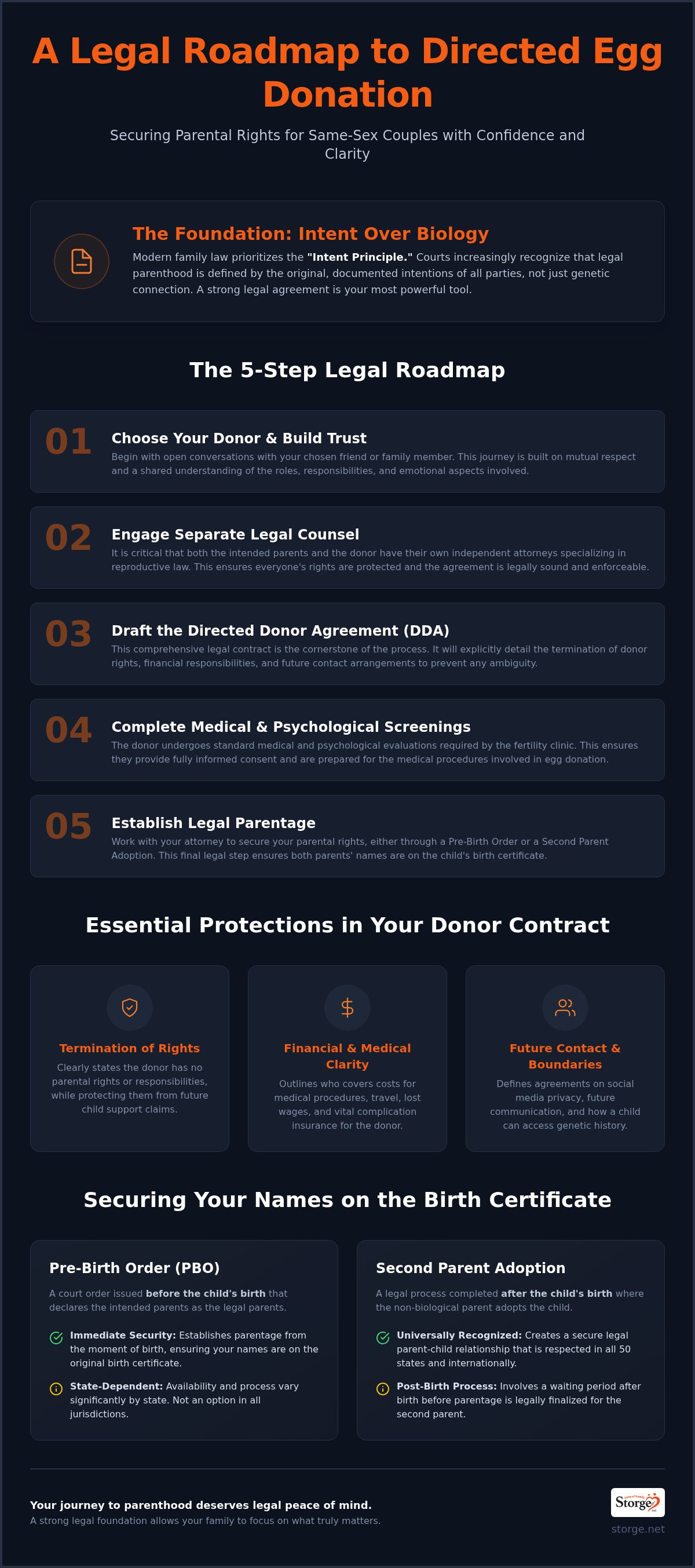
A well-crafted contract transforms a generous gift into a secure future for your child. While the emotional bond with your donor is the heart of this journey, the legal process for directed egg donation for same-sex couples requires a precise set of protections to prevent future heartache. The cornerstone of any agreement is the absolute termination of the donor's parental rights. This clause ensures that the donor is legally recognized as a biological contributor, not a parent; while simultaneously protecting them from any future claims for child support or liability.
Financial clarity is equally vital. Your contract should explicitly state that the donor has zero financial obligation to the child. It should also outline the medical risks involved, ensuring the donor provides informed consent. This protects everyone. By addressing these scenarios early, you create a space where your relationship with the donor can remain focused on connection rather than legal technicalities. Clarity is the ultimate gift you can give your future family.
Defining Future Contact and Boundaries
Directed donation is unique because the donor is often someone you know and love. Your contract should define the "rules of engagement" for the years ahead. This includes specific social media stipulations and privacy boundaries to protect your family's story. You might also include a "Right to Information" clause, outlining how and when the child can access their genetic history upon reaching adulthood. These boundaries don't reflect a lack of trust. They provide the structure needed for healthy, long-term relationships.
Financial and Medical Liability Clauses
It's standard practice for intended parents to cover all costs related to the donation. This includes travel reimbursements, lost wages, and specialized "Complication Insurance" to cover any unforeseen medical issues the donor might face. To ensure the contract is legally enforceable, the donor must have independent legal counsel (ILC). This step confirms they fully understand the terms and are entering the agreement voluntarily. If you're looking for representation, you can find specialized surrogacy and donor attorneys through our vetted network to help you finalize these essential protections.
The 5-Step Legal Process for Directed Egg Donation
Establishing your family through a known donor is a journey marked by significant milestones. While the medical aspects are often the focus, the legal process for directed egg donation for same-sex couples provides the essential framework that makes those medical steps possible. This structured approach ensures that every party is protected and that your parental rights are established with absolute clarity. Following these five steps transforms a shared dream into a legally recognized reality.
Step 1 & 2: Choosing Counsel and Negotiating
The first step involves retaining specialized representation. It's a non-negotiable requirement that you and your donor have separate, independent legal counsel (ILC). This separation is vital because it ensures the contract is enforceable and that no one's interests are sidelined during the drafting phase. If you're unsure where to begin, learning how to find an LGBTQ family law attorney is the best way to start your search for a professional who understands the unique needs of our community.
Once counsel is in place, you'll move into negotiating the Directed Donor Agreement (DDA). This phase balances the "emotional" terms, like how you'll share updates or visit, with the "legal" terms, such as the termination of parental rights. Independent legal counsel prevents duress claims in court by verifying that the donor fully understands the agreement and is signing of their own free will. These conversations might feel clinical, but they're the steady foundation that allows your relationship with the donor to remain warm and supportive.
Step 3: The Critical Letter of Legal Clearance
After both parties sign the contract, your attorneys will issue a "Letter of Legal Clearance." This document is the formal green light for your medical team. Most fertility clinics follow strict ethical and legal protocols; they won't thaw eggs, perform fertilization, or begin an embryo transfer until this letter is in their files. It serves as a verified guarantee that the legal process for directed egg donation for same-sex couples has been followed correctly and that the clinic is not at risk of future litigation regarding parentage.
Steps 4 and 5 bring the journey to its conclusion. With legal clearance secured, you can proceed with the IVF medical procedures. Finally, once a pregnancy is established, your legal team will work on obtaining a Pre-Birth Order or a Second Parent Adoption. These court orders are the final seal on your rights, ensuring that your names are the only ones appearing on the child's birth certificate from the very beginning.
Navigating Parentage: Pre-Birth Orders vs. Second Parent Adoption
"Is a contract alone enough to make us the legal parents?" This is the most common concern we encounter. While the Directed Donor Agreement is the necessary foundation for the legal process for directed egg donation for same-sex couples, it remains a private contract. To ensure that every government agency and medical provider recognizes your family, you must transition that agreement into a court-sanctioned order. This step moves your parentage from a shared intention to a legally binding reality.
The Power of the Pre-Birth Order
By 2026, more jurisdictions have embraced the Pre-Birth Order (PBO) as a streamlined path to parentage. A PBO is a court decree issued during the second or third trimester of pregnancy. It provides clear instructions to the hospital and the department of vital records to list both same-sex parents on the birth certificate immediately upon delivery. This prevents any ambiguity in the delivery room, ensuring that both parents have the immediate right to make medical decisions for their newborn. For help selecting a facility that respects your family structure, see our guide on LGBTQ hospital birth inclusive care.
Second Parent Adoption: The 'Gold Standard' for Portability
In states where PBOs aren't available, or for families seeking the highest level of legal protection, Second Parent Adoption is often the recommended path. This process involves a home study and a final judicial decree of adoption. While it might feel redundant to "adopt" your own child, an adoption decree is a final judgment that must be recognized in all 50 states and most international territories under the U.S. Constitution. This provides a level of "portability" that a birth certificate alone cannot offer, especially when traveling abroad.
Some parents worry that undergoing an adoption process somehow undermines the rights of the biological parent. In reality, it does the opposite. It secures the non-biological parent's rights without diminishing the other parent's status. Many attorneys even suggest a "confirmatory adoption" for couples who already have a PBO, just to ensure their family's legal standing is bulletproof regardless of where they move or travel. If you're ready to secure your family's future, you can connect with specialized parentage attorneys through our vetted membership network.
Building Your Legal Team with Storge PLUS
The journey toward parenthood is rarely a path you walk alone. While understanding the legal process for directed egg donation for same-sex couples is empowering, the actual execution of these steps requires a team that speaks your language. Finding an attorney who is not just legally competent, but "LGBTQ-literate," is often the greatest challenge for intended parents. You need a professional who understands the nuances of our community's family structures and the specific local trends regarding parentage orders. A generalist lawyer might understand the basics of a contract, but third-party reproduction requires a specialist who can anticipate the unique hurdles same-sex couples face.
Storge was built to bridge the gap between your personal dream and the practical reality of achieving it. We don't just offer information; we provide a partnership based on shared values. By vetting every professional in our network, we ensure you're connected with experts who prioritize inclusive practices. This approach reduces the anxiety of the legal process, allowing you to move forward with the confidence that your family's foundation is being built by those who truly care about your success.
Why Vetted Referrals Matter
Generalist attorneys often lack the deep experience required to handle the complexities of Assisted Reproductive Technology (ART) law. This can lead to oversights in contract language that might cause issues years down the line. By utilizing the Storge PLUS Membership, you gain access to a network of attorneys who specialize in exactly these scenarios. Our commitment to verified, high-quality resources means you spend less time searching and more time preparing for your child's arrival. The legal process for directed egg donation for same-sex couples becomes much simpler when your counsel has already handled hundreds of similar cases.
Next Steps for Intended Parents
If you're at the beginning of your journey, your first step is finding the right donor. Our community platform makes it easier to find a compatible egg donor for gay couple matches who already understand the legal stakes of a directed agreement. Once you've found a match, prepare for your legal consultation by listing your priorities for future contact and boundaries. This preparation ensures your time with an attorney is efficient and focused on your specific needs. Join Storge PLUS today to access our network of specialized attorneys and take the final step toward securing your parental rights with peace of mind.
Securing Your Future as a Family
Choosing a known donor is a profound act of trust that deserves the highest level of legal protection. By focusing on clear intent and securing specialized counsel, you transform a shared dream into a legally bulletproof reality. Whether you pursue a Pre-Birth Order or a Second Parent Adoption, the goal is the same: ensuring your child's future is anchored in certainty from day one. Understanding the legal process for directed egg donation for same-sex couples is the key to replacing uncertainty with confidence.
You're ready to transition from planning to action. We invite you to start your journey with a Storge PLUS Membership to access our vetted LGBTQ+ family building community. You'll gain referrals to specialized fertility attorneys and a trusted network of donors and carriers who understand the legal stakes. Your path to parenthood is a significant transition, and we're honored to be your steady guide. Your family's story is just beginning, and it's a legacy worth protecting.
Frequently Asked Questions
Can a directed egg donor change her mind and claim parental rights later?
A donor cannot successfully claim parental rights if you have followed the legal process for directed egg donation for same-sex couples correctly. The Directed Donor Agreement (DDA) explicitly terminates her rights and establishes your intent as the only parents. Courts in 2026 heavily prioritize this original legal intent over biology. However, without a formal contract, the donor could potentially be recognized as a legal parent, which is why professional documentation is non-negotiable for your security.
Do we need a lawyer if the egg donor is my sister or a close friend?
Legal representation is even more vital when working with a sister or close friend to protect your personal bond. A lawyer ensures that the "emotional" agreement you've made is translated into a binding legal structure. This prevents future misunderstandings from straining your family relationships. Having a professional framework allows you to remain a family or friends first, while the contract handles the heavy lifting of parental rights and financial liabilities in the background.
How much does the legal process for egg donation typically cost in 2026?
Legal fees in 2026 fluctuate based on the complexity of your agreement and the specific state laws involved. While we don't set these prices, you should expect to cover the drafting of the agreement, independent counsel for the donor, and court filing fees for parentage orders. Some couples also invest in specialized complication insurance for the donor. Investing in specialized counsel early helps you avoid the much higher costs of resolving legal ambiguities later.
Is a signed contract enough to get both our names on the birth certificate?
A signed contract is a vital first step, but it usually isn't enough on its own to update a birth certificate. The legal process for directed egg donation for same-sex couples typically requires a court-issued Pre-Birth Order or a Second Parent Adoption to finalize your rights. These judicial decrees provide the formal instructions that hospitals and vital records departments need to recognize both of you as the only legal parents from the moment of birth.
What happens if our directed donor lives in a different state with different laws?
When parties live in different states, your attorneys will include a "Choice of Law" clause to determine which state's regulations govern the agreement. This is a common scenario that specialized LGBTQ+ family lawyers handle regularly. It's essential to work with a legal team that understands the interstate compacts and parentage laws in both jurisdictions. This ensures your contract remains enforceable and your parental rights are protected even if you move or travel across state lines.
Does the donor need to be present for the court hearing on parentage?
In most cases, the donor does not need to be physically present for court hearings regarding parentage. Your attorneys typically handle the necessary filings and represent your interests before the judge. The donor's primary legal involvement concludes once the Directed Donor Agreement is signed and the Letter of Legal Clearance is issued. This streamlined approach allows the donor to provide their gift without the burden of ongoing legal appearances or administrative hurdles during your pregnancy.
What is 'Independent Legal Counsel' and why is it mandatory for the donor?
Independent Legal Counsel (ILC) means the donor must have her own attorney who is completely separate from yours. This is a mandatory safeguard to ensure the donor isn't under duress and fully understands the rights she is waiving. Without ILC, a court might find the contract unenforceable because the donor didn't have her own advocate. Most fertility clinics will not proceed with medical treatments until they receive proof that both parties had separate representation.
Can we use a template for a directed egg donor agreement?
Using a template is highly discouraged because they often lack the state-specific language required to withstand a legal challenge. Every family's situation is unique, and a generic form won't address specific boundaries, future contact rules, or the nuances of 2026 parentage laws. Additionally, fertility clinics require a Letter of Legal Clearance from a licensed attorney. A template cannot provide this verification, meaning your medical journey could be stalled before it even begins.


