

What if the rainbow sticker on a fertility clinic's front door is the least reliable indicator of how they will actually treat your family? For many in our community, the search for an lgbt fertility clinic isn't just about medical success rates; it's about finding a sanctuary where you don't have to explain your pronouns or defend your legal right to parenthood. You likely already feel the weight of high costs and the quiet anxiety of being misunderstood by the very people meant to help you grow your family.
It's completely valid to feel overwhelmed by the intersection of complex medical protocols and shifting legal requirements. You deserve a clear path forward that prioritizes your safety and your peace of mind. This article provides a comprehensive 5-part checklist designed to help you vet providers through the lens of clinical safety, cultural literacy, and financial transparency. We will explore how to identify true inclusive practices, ensure your legal protections are ironclad from day one, and evaluate if a clinic's infrastructure truly supports the unique needs of queer parents in 2026.
Key Takeaways
- Learn how to distinguish between superficial marketing and true clinical inclusivity by evaluating a provider's medical and social protocols.
- Master the specific questions you should ask an lgbt fertility clinic regarding their laboratory experience with reciprocal IVF and third-party compatibility.
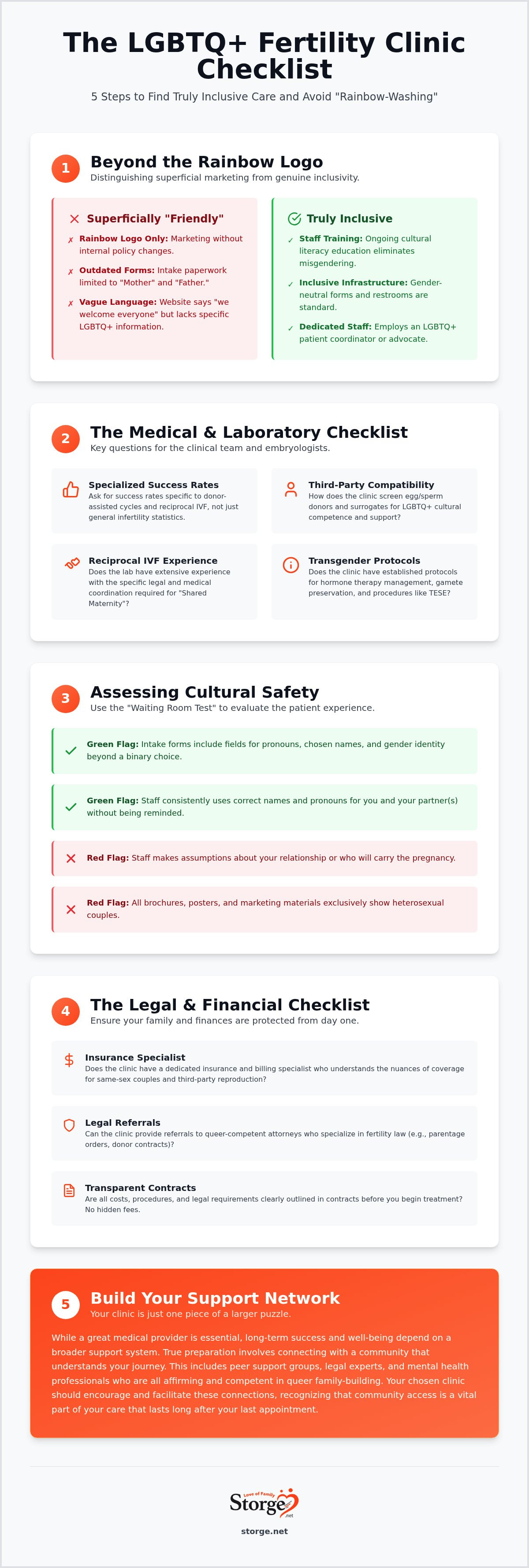
- Use the "Waiting Room Test" to assess cultural safety and ensure intake forms respect your gender identity and family structure.
- Identify essential financial and legal safeguards, such as dedicated insurance billing specialists and referrals to queer-competent attorneys.
- Understand why your medical provider is only one piece of the puzzle and how a community-led support network ensures long-term success.
Beyond the Rainbow Logo: Defining True LGBTQ+ Clinical Inclusivity
A rainbow sticker on a clinic window is a welcome sign, but it doesn't guarantee a safe experience. A truly inclusive lgbt fertility clinic goes beyond marketing by weaving queer-centric protocols into the very fabric of their practice. This integration covers the medical, legal, and social dimensions of family building, ensuring you aren't just another patient, but a respected partner in the process. When clinics engage in "rainbow-washing", claiming inclusivity without doing the internal work, they often leave families feeling invisible or mismanaged. This can lead to increased emotional distress and poor patient outcomes during an already vulnerable time.
True LGBTQ+ clinical inclusivity is the intentional shift from merely tolerating queer families to actively affirming their identities through every medical, legal, and social touchpoint.
To find a clinic that actually delivers on its promises, look for these three pillars:
- Medical Competence: Deep expertise in procedures like reciprocal IVF and specific protocols for transgender individuals.
- Cultural Literacy: Staff training that eliminates misgendering and recognizes diverse family structures.
- Legal Awareness: A clear understanding of the evolving legal landscape for same-sex and non-biological parents.
Why Specialized Care Matters for Queer Families
Queer parents face biological and social hurdles that traditional fertility models don't always address. You might be managing the complexities of donor selection or the nuances of hormone therapy while trying to conceive. Trauma-informed care is essential here. Many in our community have faced medical bias in the past, so your clinic must be a place of healing, not further stress. While a website might look polished, a clinic's reputation within the queer community usually tells the real story. A seasoned guide can help you look past the digital storefront to see if a provider actually understands our history.
The Difference Between 'Friendly' and 'Inclusive'
The distinction between "friendly" and "inclusive" is found in the details. A friendly clinic might say they welcome everyone but still hand you intake forms that only offer "Mother" and "Father" options. An inclusive clinic provides gender-neutral forms and restroom facilities that reflect your reality. High-performing clinics often employ specialized LGBTQ+ patient coordinators. These professionals act as your advocate, ensuring that every staff member you encounter understands your specific journey and respects your family's unique structure. This level of care transforms the medical environment into a space of belonging.
The Medical & Laboratory Checklist: Specialized Care for Queer Families
The laboratory is the engine room of any lgbt fertility clinic. While your doctor manages your clinical care, the embryologists and lab technicians manage your future embryos. Their expertise is the most critical factor in your success. When vetting a clinic, look beyond general success rates. Many queer families aren't experiencing medical infertility; they are using third-party reproduction. Because of this, you should ask for success rates specifically for donor-assisted cycles and reciprocal IVF. These numbers will give you a more accurate picture of what to expect for your specific journey.
Vetting the laboratory also involves checking their experience with frozen embryo transfers and gamete handling. Ask how the clinic screens third-party participants like donors and surrogates for LGBTQ+ compatibility. It's vital that everyone involved in your family-building ecosystem is comfortable and supportive of queer parenthood. This prevents discriminatory friction and ensures a smoother emotional experience for everyone. Finding the right medical partner is a significant step, but you don't have to do it alone. You can use Storge PLUS to connect with vetted professionals who prioritize your family's safety.
Specialized Protocols: From Reciprocal IVF to TESE
Reciprocal IVF, often called Shared Maternity, is a beautiful way for both partners to be physically involved in a pregnancy. However, it's more than just a medical procedure. It requires specific legal parentage coordination that the clinic should be prepared to facilitate from day one. You should also evaluate whether the clinic uses in-house donor banks or partners with outside agencies. In-house banks might offer more streamlined communication, but outside banks often provide a wider diversity of donors. For a deeper dive into these nuances, review these questions to ask LGBTQ friendly fertility clinic staff during your first consultation.
Transgender and Non-Binary Fertility Options
For transgender and non-binary individuals, fertility care must be integrated with gender-affirming treatments. A high-quality lgbt fertility clinic will have established protocols for hormone management and gamete preservation that respect your transition timeline. Ask if the clinic coordinates directly with your gender-affirming care providers to ensure your treatments don't conflict. Experience with family building after transition is a key indicator of a clinic's true inclusivity. They should offer clear guidance on how long you might need to pause certain medications and what the biological expectations are for gamete retrieval in your specific situation.
Assessing Cultural Safety: Red Flags and Green Flags in Patient Experience
While the laboratory handles the science of your journey, the clinic environment handles your humanity. Cultural safety means you aren't just tolerated; you are seen and respected. Start your evaluation with the "Waiting Room Test." Look at the brochures, digital displays, and wall art. Do they only show cisgender, heterosexual couples? An authentic lgbt fertility clinic ensures their physical space reflects the diversity of the families they serve. This representation signals that you belong before you even sit down for your first consultation.
Your first formal interaction often happens on a clipboard or a tablet. Review the intake forms with a critical eye. If the only options for parents are "Mother" and "Father," or if there is no space for chosen names and pronouns, the clinic hasn't updated its systems for queer reality. Inclusive forms should offer non-binary gender options and recognize various relationship structures. This includes acknowledging co-parenting arrangements or multi-parent families without forcing you into a box that doesn't fit.
Every staff member you encounter matters. This includes the phlebotomist who draws your blood and the front-desk coordinator who schedules your appointments. It isn't your job to educate medical professionals on why your pronouns or family structure matter. Ask the clinic about their formal grievance procedures. A safe clinic has a clear, transparent path for reporting microaggressions or discrimination. This level of accountability shows they take their commitment to the community seriously.
Green Flags: Signs of an Affirming Environment
An affirming environment is built on consistency and nuance. You'll know you're in the right place when your pronouns are documented and used correctly from your very first phone call. These clinics actively celebrate diverse families in their social proof and patient testimonials. A major green flag is when staff can explain the difference between an "Intended Parent" and a "Biological Parent" without hesitation. This terminology knowledge ensures your legal and emotional boundaries are respected throughout the medical process.
Red Flags: When to Walk Away
Heteronormative language in legal contracts or medical advice is a significant warning sign that the lgbt fertility clinic isn't prepared for your needs. If a nurse assumes a female partner is "the mother" without asking, or if the billing department seems confused by the concept of two dads, it indicates a lack of systemic training. Watch for a lack of transparency regarding the costs of third-party reproduction. If they can't provide a clear, inclusive fee schedule for donor-assisted cycles, they likely haven't handled many queer family-building journeys.
The Legal and Financial Checklist: Navigating Contracts and Costs
The financial and legal architecture of your journey is just as vital as the medical science. When you choose an lgbt fertility clinic, you aren't just paying for a procedure; you're investing in a complex logistical operation. Start by asking if the clinic employs a dedicated billing specialist for LGBTQ+ claims. Many traditional insurance policies define infertility in heteronormative terms, which can lead to denied claims for queer families. A specialist knows how to navigate these codes to maximize your coverage. They should also be aware of specific fertility grants and financing options designed for our community, helping to ease the pressure of out-of-pocket expenses.
Legal protections must be ironclad from the start. While a clinic may offer a list of preferred attorneys, it's essential that these professionals specialize in second-parent adoption and surrogacy law. You should always ensure that donor or surrogacy contracts are reviewed by independent LGBTQ+ legal counsel. This protects your rights as an intended parent and ensures there are no ambiguities regarding your relationship to your child. If you need help finding a vetted professional, Storge provides attorney representation referrals to ensure your legal foundation is secure.
Understanding the Total Cost of Family Building
The sticker price of a medical cycle rarely reflects the total investment. You must account for hidden costs like legal fees, agency fees, and donor compensation. These can add tens of thousands to your budget. It's also wise to investigate if your employer's fertility benefit is truly inclusive. Some plans require a year of "unprotected sex" before coverage kicks in, which inherently excludes many same-sex couples. Because the clinic's focus is medical, you should never rely on them for legal advice. Instead, seek an outside LGBTQ family law attorney who can provide objective guidance on your specific situation.
Legal Safeguards for Intended Parents
Your legal path depends heavily on your state's laws and your specific path to parenthood. This might involve a Pre-Birth Order (PBO) to ensure your names are on the birth certificate immediately, or a Post-Birth adoption to secure parental rights across state lines. The clinic's internal paperwork must match these legal goals perfectly to avoid future complications. This is especially critical for those exploring surrogacy for transgender parents, where legal parentage can involve additional layers of complexity regarding biological connections and gender markers on legal documents.
Building Your Support Network: Why Community Access Outlasts the Clinic Visit
The medical procedures performed at an lgbt fertility clinic are a vital milestone, but they are only one component of a much larger ecosystem. Building a family is a marathon that requires emotional, legal, and social endurance. While your clinical team focuses on the biological success of your cycle, a support network provides the lived wisdom that medical textbooks often omit. Connecting with other queer parents who have navigated the same clinic can offer invaluable insights into the day-to-day patient experience, from the bedside manner of specific nurses to the efficiency of the billing department.
This community-led approach also opens doors that traditional clinic databases might not. Many families find peace of mind by connecting with "known" donors or gestational carriers within a vetted, queer-centric community. These connections often feel more personal and aligned with shared values than the anonymous profiles found in a standard catalog. By surrounding yourself with people who understand the unique nuances of your journey, you transform a clinical process into a shared community experience. Storge PLUS acts as this essential bridge, ensuring you aren't just a patient, but a member of a thriving family-building network.
The Role of Storge PLUS in Your Journey
Storge PLUS is designed to be your parallel step alongside clinical care. It provides access to a vetted community of donors and gestational carriers who are specifically looking to help LGBTQ+ families grow. This eliminates the fear of rejection or misunderstanding that can sometimes occur in broader, non-specialized databases. Beyond the search for gametes or carriers, the platform offers hospital search tools to help you find facilities that prioritize inclusive birth experiences. This ensures that the respect and affirmation you receive at your lgbt fertility clinic continues all the way to the delivery room. Having a dedicated space for queer family building provides a sense of legitimacy and safety that is often missing from the traditional healthcare landscape.
Next Steps: From Consultation to Community
Before you step into your first consultation, use this checklist to ground your expectations and prepare your questions. Preparation is your best tool against the anxiety of the unknown. We recommend joining a support network well before you start medical procedures. This allows you to build relationships and gather resources while your mind is clear and your stress levels are manageable. Your family building team should include more than just a doctor; it should include advocates, peers, and experts who see your family's vision as clearly as you do. To begin building that team today, join the Storge PLUS Membership and connect with a community dedicated to your success.
Your Path to Parenthood Starts with the Right Partners
The journey to parenthood is as much about the people you surround yourself with as it is about the medical procedures you undergo. By vetting your lgbt fertility clinic for both cultural safety and medical excellence, you build a foundation of trust and respect from day one. You've learned how to look beyond marketing to find true affirmation, ensuring your medical, legal, and emotional needs are prioritized throughout every cycle.
Finding the right clinic is a significant milestone, but your family's long-term security requires a broader ecosystem of support. Storge PLUS provides the expert-led resources and vetted connections you need for every stage of this process. You don't have to navigate these complex transitions alone when you have a dedicated community by your side. We are here to act as a bridge between your personal dream and the practical reality of achieving it.
Join Storge PLUS: Your Vetted Community for LGBTQ+ Family Building to access our trusted network of donors, carriers, and inclusive attorney referrals. Your dream of parenthood is valid and achievable. With a steady guide and a supportive community, you can move forward with total confidence and peace of mind.
Frequently Asked Questions
Is it better to find a clinic that specializes only in LGBTQ+ fertility?
Not necessarily, but they must have dedicated protocols. It's about the depth of their experience with third-party reproduction and cultural literacy. A general clinic can be excellent if they have a specialized department or a dedicated patient coordinator. The key is finding a medical team that doesn't treat your family as an exception to the rule. You deserve a provider who integrates queer family building into their daily practice.
How much does it typically cost for a same-sex couple to use a fertility clinic?
Costs vary significantly based on the specific path you choose, such as IUI, IVF, or surrogacy. You must account for medical fees, donor compensation, and legal contracts. Because every journey is unique, you should ask the billing department for a comprehensive breakdown of all potential out-of-pocket expenses. Some clinics offer specialized financing or work with community grants to help manage these investments. Always request a clear fee schedule before starting.
Can a fertility clinic deny service to a same-sex couple?
While many states have non-discrimination laws, some private or religiously affiliated clinics may attempt to deny services based on their internal policies. It's essential to research the legal protections in your specific region before your first visit. Choosing a vetted lgbt fertility clinic ensures you are entering a space where your right to build a family is legally and ethically respected from the start. Your safety should be a non-negotiable priority.
What is reciprocal IVF and do all clinics offer it?
Reciprocal IVF allows one partner to provide the eggs while the other carries the pregnancy. While most major clinics offer this procedure, not all have the administrative experience to handle the specific legal parentage requirements it entails. You should verify that the clinic’s laboratory and legal teams have successfully managed shared maternity cycles before. This ensures both partners are protected and recognized throughout the medical process. It is a beautiful, collaborative way to conceive.
How do I find a sperm or egg donor who is comfortable with an LGBTQ+ family?
You can find affirming donors through specialized banks or community-led platforms. Many queer families prefer using a vetted community to connect with donors who are specifically looking to help LGBTQ+ parents. This approach often feels more personal and ensures the donor is fully supportive of your family structure. Platforms like Storge PLUS can help you navigate these searches by connecting you with inclusive professionals and donors who share your values.
What should I look for in a clinic's success rates as a queer person?
Look for success rates that are specific to donor-assisted cycles rather than general infertility data. Since many queer patients don't have underlying medical infertility, general rates might not reflect your actual chances of success. Ask for data on reciprocal IVF and frozen embryo transfers using donor gametes. This provides a more accurate benchmark for your specific family-building path. It helps you set realistic expectations and choose a provider with proven expertise.
Do I need a lawyer before I visit an LGBTQ fertility clinic?
You don't necessarily need a lawyer for your first consultation, but you should have legal representation before signing any medical or donor contracts. A specialized attorney ensures that your parental rights are protected regardless of biological connection. Many clinics provide referrals, but it's often wise to seek independent counsel who understands the nuances of queer family law. Securing your legal foundation early provides vital peace of mind as you begin your medical journey.
How do I know if my insurance will cover LGBTQ fertility treatments?
You should contact your insurance provider directly to ask for their specific definition of infertility. Many traditional plans require a period of "natural" attempts that inherently exclude same-sex couples. Ask if they have inclusive riders or if your employer has opted into fertility benefits that cover third-party reproduction. A dedicated billing specialist at an lgbt fertility clinic can often help you interpret these complex policy documents and maximize your coverage for your specific family needs.


