

A rainbow sticker on a clinic door doesn't guarantee your parental rights will be protected if you move across state lines. While the 2026 landscape has brought progress, like California’s SB 729 expanding access, it has also made the process of vetting LGBTQ fertility services more complex. You're likely feeling the weight of this transition, balancing the excitement of parenthood with the very real fear of "rainbow washing" or legal loopholes that could jeopardize your future. It's a heavy burden to carry when you're simply trying to start a family.
We believe you shouldn't have to be a legal expert to become a parent. You deserve a path that feels safe, seen, and supported by professionals who understand that your family is not a special case but a beautiful reality. This guide provides a clear roadmap to help you identify truly inclusive providers and avoid the common pitfalls that many face. We will walk through a concrete checklist for evaluating clinics, explain the latest standards for donors and carriers, and show you how to verify that your chosen team is ethically and legally sound.
Key Takeaways
- Understand why vetting LGBTQ fertility services requires a deep dive into legal and cultural competency rather than just looking at medical success rates.
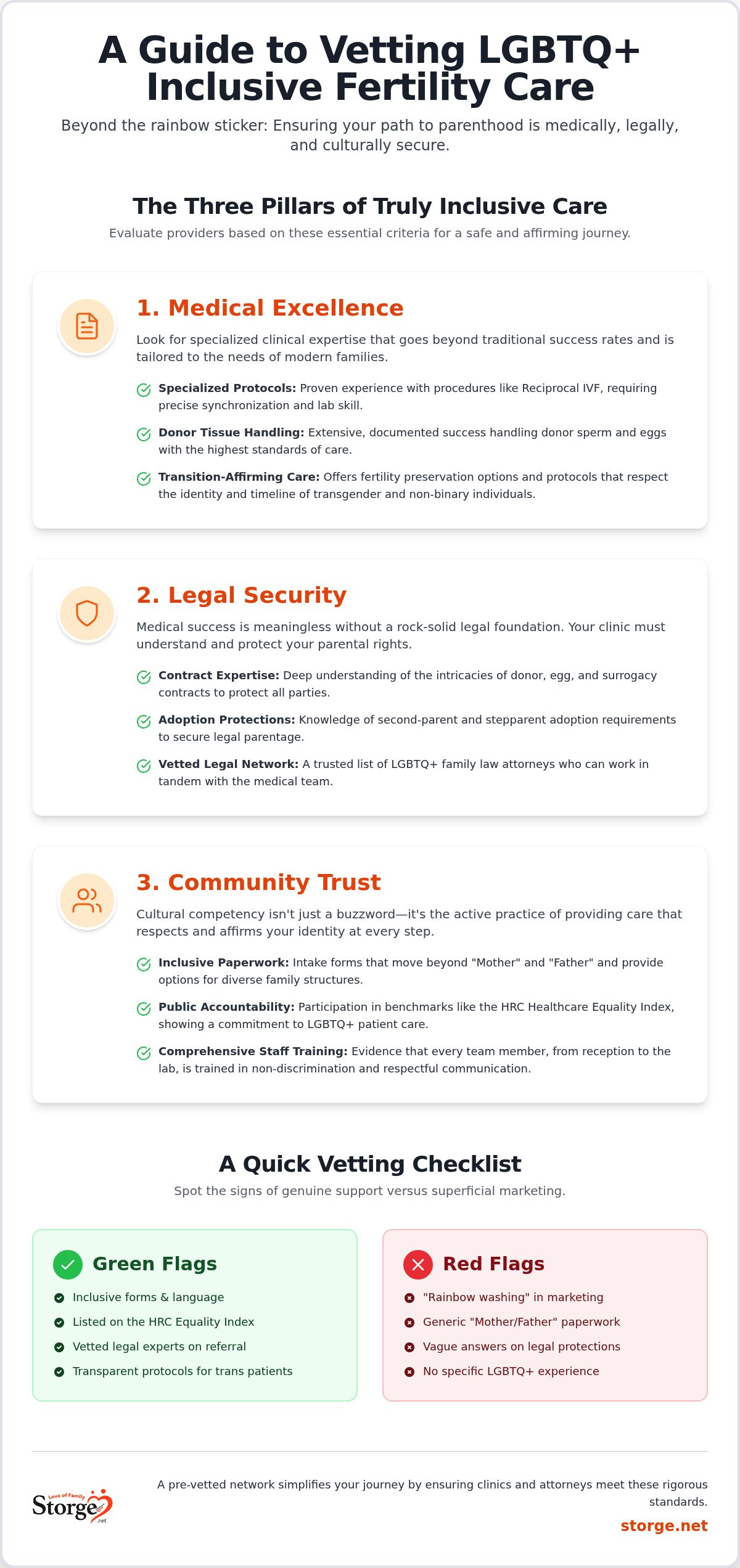
- Learn how to evaluate providers based on the three essential pillars of inclusive care: medical excellence, legal security, and genuine community trust.
- Implement a five-step framework to audit a clinic's digital presence and identify red flags before you ever book a consultation.
- Discover the specific questions to ask regarding donor contracts and parental rights to ensure your family’s legal foundation is rock-solid from day one.
- Explore how a pre-vetted network like Storge PLUS can simplify your journey by providing access to clinics and attorneys who've already met rigorous standards.
The Unique Challenges of Vetting LGBTQ+ Fertility Services
Vetting LGBTQ fertility services is a specialized process that goes far beyond checking a clinic's success rate on a government database. It's a rigorous verification of a provider's medical, legal, and cultural competency. While a clinic might excel at understanding reproductive technologies, they may lack the specific expertise required to support the unique needs of queer parents. A high success rate in traditional IVF doesn't always translate to a safe or affirming experience for a trans individual or a same-sex couple.
Many clinics today use inclusive imagery in their marketing, but this "rainbow washing" often masks a lack of deep-rooted empathy or specialized training. As of 2026, the legislative landscape for family building is shifting rapidly. While laws like California's SB 729 have expanded insurance coverage for LGBTQ+ individuals, the fragmented nature of state regulations means your parental rights can vary significantly depending on where your provider is located. True vetting ensures that your medical team is prepared for these complexities before you begin your journey.
Why Cultural Competency Matters More Than Success Rates
Cultural competency is the active practice of providing care that respects and affirms diverse identities. It's often visible before you even meet a doctor. Inclusive intake forms that move beyond "Mother" and "Father" are a primary indicator of a clinic's mindset. When a clinic fails to provide these basics, it often leads to medical errors, such as misgendering a patient during a sensitive procedure or failing to account for the specific hormonal needs of trans parents. In a 2026 fertility context, cultural competency is defined as the seamless integration of clinical excellence with a profound respect for the legal and social realities of the queer community. Without it, the process can become a source of trauma rather than joy.
The Legal Minefield of Unvetted Providers
Medical success is hollow if your legal foundation is shaky. Unvetted providers often overlook the intricacies of donor contracts or the specific requirements for second-parent adoption protections, which remain vital even in a changing legal climate. You need to know how to find an LGBTQ family law attorney who can work in tandem with your medical team. Clinics must understand the legal nuances of surrogacy and donor arrangements to ensure every party is protected. If a clinic doesn't have a vetted list of legal partners, they're leaving your future family's security to chance. This alignment between medicine and law is the only way to ensure your path to parenthood is both successful and permanent.
Essential Criteria for Evaluating LGBTQ-Inclusive Care
Vetting LGBTQ fertility services requires a shift in perspective. You aren't just looking for a doctor; you're looking for a partner who understands the medical, legal, and social nuances of your specific journey. To find this, we look at three essential pillars: Medical Excellence, Legal Security, and Community Trust. A provider might be a national leader in traditional IVF, but if they haven't mastered the specific laboratory protocols for donor tissue or the legal requirements of gestational surrogacy, they aren't the right fit for your family.
Community Trust is often the most revealing pillar. While medical data is objective, the lived experience of other queer parents tells the real story. The HRC Healthcare Equality Index is an excellent starting point for this research. It measures how healthcare facilities treat LGBTQ+ patients and their families, focusing on non-discrimination training and patient services. A clinic that proactively participates in this index shows a commitment to accountability that goes beyond simple marketing. It signals that they have done the internal work to ensure every staff member, from the front desk to the embryology lab, is prepared to support you.
Medical Protocols for Modern Families
When you evaluate an LGBTQ friendly fertility clinic, look closely at their protocols for specific procedures like Reciprocal IVF. This process requires precise synchronization between two partners. The lab must have extensive, documented experience handling donor sperm and eggs with high success rates. For trans individuals, vetting includes ensuring the clinic offers transition-affirming care and specialized fertility preservation options. These protocols should respect your identity and your timeline, ensuring that medical steps don't conflict with your personal transition goals.
Third-Party Reproduction Standards
Ethical standards in third-party reproduction are non-negotiable for a safe family-building experience. You should verify that the clinic or agency strictly adheres to the ASRM guidelines for LGBTQ+ individuals. These standards ensure that screening for donors and gestational carriers is thorough, ethical, and transparent. There is a significant difference between using a large, anonymous bank and finding a trusted sperm donor community where transparency and mutual respect are prioritized. Vetting these agencies helps you avoid "grey market" situations that could lead to legal or emotional complications later. If you feel overwhelmed by these choices, accessing a list of pre-vetted fertility referrals can provide the steady guidance you need to move forward with confidence.
Red Flags vs. Green Flags: A Vetting Framework
Vetting LGBTQ fertility services requires a structured approach that moves past surface-level marketing. It's about looking for deep alignment between a provider's clinical operations and your family's needs. To help you navigate this, we've developed a five-step research framework designed to reveal a clinic's true level of competency.
- Step 1: Audit their digital presence. Look for genuine representation. Do their patient stories and social media reflect a diversity of queer families, or is the imagery limited to stock photos of "non-traditional" couples?
- Step 2: Scrutinize legal partnerships. A clinic that's truly prepared will have established referral networks with specialized attorneys. If they seem confused by the concept of a pre-birth order, they haven't done the necessary work.
- Step 3: Interview the staff. Call the billing department and the nursing station. Ask how they handle insurance claims for same-sex couples under 2026 mandates. Their comfort level with these questions is often more telling than the doctor's initial pitch.
- Step 4: Verify their history with surrogacy. Specifically, ask about their experience with surrogacy for gay couples. This path involves specific biological and legal coordination that requires a seasoned team to manage effectively.
- Step 5: Request a financial breakdown. Ask for a transparent list of costs. This helps you identify if they're charging "administrative fees" for donor tissue processing that aren't applied to cis-hetero patients.
Green Flags: Signs of True Inclusivity
True inclusivity is woven into the clinical workflow. A major green flag is the presence of a dedicated LGBTQ+ patient coordinator or a designated "Center of Excellence." This ensures you have a single point of contact who understands the nuances of your journey. You should also look for clinics that maintain active partnerships with LGBTQ hospital birth inclusive facilities. This ensures that the supportive environment you experience during fertility treatments continues all the way through delivery. When all legal and medical documentation uses inclusive, non-gendered language, it shows the clinic has updated its systems to respect every patient's identity.
Red Flags: When to Walk Away
You shouldn't have to correct your provider on the basics of your identity. If a clinic's intake forms still rely on gendered language like "Mother" and "Father," it's a sign their systems are outdated. Be wary of any reluctance to work with your independent legal representation. A clinic should welcome the oversight of an attorney who specializes in queer family law; if they insist you only use their "in-house" resources, it may indicate a lack of transparency. Finally, keep a close eye on hidden fees. If the cost for a reciprocal IVF cycle suddenly increases because of "specialized coordination" that isn't clearly defined, it's time to find a provider who values honesty as much as you do.
Questions to Ask During Your Consultation
The consultation is your opportunity to move beyond marketing brochures and test a clinic's actual commitment to your family. It's an interview where you hold the power to ensure your future is in capable hands. Vetting LGBTQ fertility services effectively means asking questions that push for data and clear protocols rather than accepting vague promises of compassion. You're looking for a team that doesn't just tolerate your family structure but has built their practice to support it.
Prepare to take notes on their comfort level as much as their verbal answers. A provider who pauses or seems unsure about queer family law or reciprocal protocols may not have the depth of experience you need. Use the following questions to peel back the layers of their clinical and administrative operations.
Clinical and Ethical Questions
Medical transparency is the foundation of a safe journey. Don't be afraid to ask for specific numbers and established workflows. You might ask:
- "How many same-sex couples have you successfully helped in the last year?" You're looking for a provider with a high volume of queer patients, ensuring they've navigated various biological and logistical scenarios.
- "What is your protocol for reciprocal IVF monitoring?" This process requires precise synchronization between two partners; the clinic should have a standard, written protocol for this.
- "How do you vet the psychological readiness of donors for LGBTQ+ families?" It's vital to know if donors are specifically screened for their comfort and understanding of queer family building to avoid future ethical complications.
Legal and Administrative Questions
The administrative side of a clinic often reveals their true level of inclusivity. These questions help you determine if they've accounted for the legal protections your family requires:
- "Do you require a court order for second-parent adoption before discharge?" This helps you understand their awareness of local laws and whether they'll support your legal team's requirements.
- "Will our gestational carrier be treated as a partner in the medical process?" Respect for the carrier is a hallmark of an ethical clinic. They should have clear communication lines that respect everyone's role.
- "Can you provide a list of LGBTQ-vetted attorneys you work with?" A clinic that's deeply embedded in the community will have a list of trusted legal partners ready to go.
With the 2026 shifts in insurance mandates, you should also ask how the billing department codes procedures for LGBTQ+ individuals. This ensures you're receiving the full benefits of new laws without being forced to meet cis-heteronormative "medical infertility" requirements. If you're feeling overwhelmed by the thought of interviewing dozens of clinics, you can find a pre-vetted fertility provider through our network to ensure your first meeting is with someone who already speaks your language.
How Storge PLUS Simplifies the Vetting Process
Vetting LGBTQ fertility services on your own can feel like a second full-time job. You've learned how to spot red flags and which clinical questions to ask, but the emotional labor of verifying every provider is immense. This is where the Storge PLUS Membership changes the narrative. Instead of starting from zero, you step into an ecosystem where the heavy lifting of verification has already been completed by experts and peers who share your values.
The core of our approach is the "Community Vetting" model. While clinical data provides a baseline, it's the lived experience of other queer parents that reveals the true heart of a practice. Our members share honest feedback on everything from a clinic’s bedside manner during a trans-affirming procedure to how a billing department handles complex insurance mandates. Storge acts as the vital bridge between cold medical statistics and the warm, human reality of building a family.
Access to a Trusted Community
Searching for a donor or carrier on public platforms often feels transactional and risky. Storge PLUS provides access to a curated, trusted community of donors and carriers who've already undergone a thorough verification process. This isn't a public database; it's a protected space designed for safety and mutual respect. We maintain this high standard through a transparent membership fee, which allows us to offset the operating costs of rigorous vetting without relying on high-pressure tactics. You're not just buying a service; you're joining a community that understands the weight of your journey.
Your Next Steps to Parenthood
The path to parenthood doesn't have to be a lonely one. If you're ready to move from research to action, joining the Storge PLUS community is your next logical step. Once inside, you can immediately request referrals to specialized legal representation or LGBTQ-inclusive clinics that have already been vetted for cultural competency. Our attorney referral service is specifically designed to solve the anxiety of legal vetting, ensuring your parental rights are secure before you even begin treatment.
You've done the work to educate yourself on the complexities of this process. Now, let us be the steady guide that helps you cross the finish line. You don't have to vet this journey alone; we're here to offer the professional reliability and deep empathy you deserve as you build your future family.
Your Path to a Secure and Joyful Future
The journey to parenthood is one of the most significant transitions you'll ever navigate. As we have explored, vetting LGBTQ fertility services is not just about medical success; it's about building a foundation of legal security and cultural respect. By identifying genuine green flags and asking the right questions during your consultations, you move from a place of uncertainty to one of empowered action. You now have the framework to distinguish between performative marketing and the deep-rooted competency your family deserves.
You don't have to carry the weight of this research alone. Our platform offers a national network of inclusive fertility clinics and referrals to specialized LGBTQ+ family law attorneys who understand your unique needs. You can also gain access to a trusted, vetted community of donors and carriers who share your values. Join Storge PLUS to access our vetted network of LGBTQ+ fertility resources and take the next step with confidence. Your dream of building a family is valid, and with the right partners by your side, it's entirely within reach.
Frequently Asked Questions
What does "vetting" mean in the context of LGBTQ+ fertility?
Vetting LGBTQ fertility services involves a comprehensive verification of a provider's medical, legal, and cultural competency. It goes beyond checking success rates to ensure the clinic understands the specific needs of queer families. This process confirms that the staff is trained in inclusive care and that their administrative systems, such as intake forms and billing codes, respect diverse gender identities and family structures. It is about establishing a foundation of trust and safety for your future.
How can I tell if a fertility clinic is truly LGBTQ-friendly?
True inclusivity is visible in the clinic's daily operations rather than just their marketing. You should look for non-gendered language on all medical and legal paperwork and verify their participation in the HRC Healthcare Equality Index. A truly friendly clinic will also have a dedicated LGBTQ+ patient coordinator and a proven track record of successful outcomes for same-sex couples and trans individuals, showing they've moved past performative support into clinical excellence.
Is it safe to find a sperm or egg donor through an online community?
Finding a donor through an unmoderated public group carries significant risks, but a vetted community like Storge PLUS provides a much safer environment. Safety in this context means the community prioritizes mutual respect, transparency, and high ethical standards. By using a curated database rather than a public search, you connect with donors who understand the nuances of queer family building and have already undergone a thorough verification process to protect all parties involved.
What legal documents should I vet before starting surrogacy?
Before beginning any surrogacy arrangement, you must vet the gestational carrier agreement, donor contracts, and the specific requirements for pre-birth or post-birth orders in your state. It's vital to ensure these documents clearly define parental rights and financial responsibilities. You should also confirm that your clinic is prepared to work with specialized legal representation to navigate the complexities of second-parent adoption, ensuring your family's legal foundation is rock-solid from the very start.
Do LGBTQ+ fertility services cost more than traditional services?
The base medical procedures, like IVF or IUI, generally cost the same as they do for cis-hetero patients. However, queer families often face additional expenses for donor sperm or eggs, surrogacy fees, and specialized legal counsel. Some clinics may also apply administrative fees for "non-traditional" coordination. Vetting LGBTQ fertility services includes requesting a transparent, itemized financial breakdown to ensure you aren't being charged extra for inclusive care or specialized laboratory protocols.
Can a clinic refuse to treat me based on my sexual orientation or gender identity?
While some providers may attempt to refuse care, the legal landscape in 2026 offers increasing protections. Many states have enacted non-discrimination laws in healthcare, and new mandates like California’s SB 729 have expanded fertility coverage specifically for the LGBTQ+ community. If you encounter a clinic that's reluctant to treat you, it's a significant red flag. You deserve a provider that actively affirms your identity and understands the legal requirements of inclusive care.
What is the role of an LGBTQ+ fertility attorney in the vetting process?
An attorney specializing in queer family law is your primary safeguard for legal security. They vet the clinic’s contracts and ensure that all donor and surrogacy agreements comply with current state regulations. Their role is to anticipate potential legal hurdles, such as challenges to parental rights or issues with birth certificates, and resolve them before medical procedures begin. They act as a partner to your medical team, providing the legal expertise necessary for a safe journey.
How does Storge PLUS vet the resources in its community?
Storge PLUS utilizes a "Community Vetting" model that bridges the gap between clinical data and lived experience. We verify providers through a rigorous process that includes auditing their cultural competency and legal partnerships. Additionally, we incorporate peer reviews from our members, ensuring that the clinics, attorneys, and donors in our network have a proven history of treating LGBTQ+ families with respect and professionalism. This dual-layer approach ensures that every resource in our community meets our high standards.


