

What if the biggest risk to your future family isn't the medical complexity of IVF, but a single missing clause in a legal contract? As we navigate the evolving landscape of 2026, many intended parents realize that simply choosing a "friendly" professional isn't enough to guarantee total peace of mind. You deserve to feel certain that your name will be on the birth certificate from day one, without the fear of discriminatory hurdles or outdated statutes. To achieve this, you need to find LGBTQ surrogacy attorney experts who don't just know the law, but live and breathe the nuances of queer family building.
It's natural to feel a mix of hope and anxiety as you look at the shifting landscape of parentage acts and evolving legislative changes across the country. You aren't just looking for a service provider; you're looking for a steady guide who understands that your path to parenthood is deeply personal. In this article, you'll learn how to identify and vet legal representation that aligns with your values. We will also discuss how Storge PLUS can simplify this process by connecting you with pre-vetted professionals, ensuring your journey is defined by security and warmth rather than legal confusion.
Key Takeaways
- Distinguish between "friendly" and "expert" legal representation to ensure your parental rights are protected by specialists who understand the complex LGBTQ+ legal landscape of 2026.
- Gain clarity on the essential components of a Gestational Surrogacy Agreement and how to navigate the fragmentation of pre-birth and post-birth parentage orders.
- Discover the most reliable methods to find LGBTQ surrogacy attorney experts through vetted community networks and specialized legal academies rather than cold searches.
- Identify the seven critical questions to ask potential lawyers about their recent experience with queer families and their strategies for securing parentage across state lines.
- Learn how a Storge PLUS membership provides peace of mind through community-verified Attorney Representation Referrals that prioritize both legal precision and emotional safety.
Why a Specialized LGBTQ Surrogacy Attorney is Non-Negotiable in 2026
In 2026, the legal path to parenthood is more accessible than ever, but it's also increasingly technical. You might find many lawyers who describe themselves as "LGBTQ-friendly," but friendliness isn't a legal strategy. An expert in Assisted Reproductive Technology (ART) law understands the specific mechanics of your protection. While a general family lawyer might handle a divorce or a standard adoption, they often lack the depth to manage the high-stakes contracts required for gestational surrogacy. When you begin the search to find LGBTQ surrogacy attorney representation, remember that technical proficiency is what keeps your family secure.
The cost of a legal oversight can be devastating. A single error in a parentage order can lead to years of litigation or, for those navigating global surrogacy laws, significant citizenship hurdles for their child. A specialized attorney acts as your shield, monitoring shifting state laws across the country to ensure your rights remain intact regardless of where your surrogate resides or delivers. They don't just fill out forms; they anticipate challenges before they arise.
The Intersectional Nature of Queer Family Law
Every family is unique, and your legal representation should reflect that. For trans and non-binary intended parents, specific language in the Gestational Surrogacy Agreement is vital to ensure identity is respected and legally recognized. Even with national marriage equality, your marital status can still dictate whether you need a pre-birth order or a confirmatory adoption to be safe. A specialized attorney coordinates these details with your fertility clinic and agency, ensuring every piece of the puzzle fits together perfectly. If you want to find LGBTQ surrogacy attorney experts who truly see you, look for those who prioritize this intersectional approach.
Protecting the "Intended Parent" Status
The term "Intended Parent" is the cornerstone of your journey. It establishes that you are the legal parent from the moment of conception, regardless of genetic connection. Specialized attorneys work tirelessly to ensure your names are placed on the birth certificate immediately upon delivery, bypassing the need for stressful post-birth legal battles. In 2026, the Intent-Based Parentage doctrine remains the primary legal framework that recognizes individuals as parents based on their documented desire to raise a child rather than biological ties alone. This legal foundation is what allows you to walk into the hospital with confidence.
Finding a lawyer who shares your values shouldn't be a source of stress. This is why Storge PLUS provides Attorney Representation Referrals, connecting you with professionals who have already been vetted by our community. By choosing a pre-vetted path, you bypass the anxiety of cold-searching and move straight toward building your future with a trusted companion by your side.
Navigating the Legal Core: Contracts and Parentage Orders
The legal framework of surrogacy is built on two pillars: the contract that defines the relationship and the court order that establishes your parenthood. When you work to find LGBTQ surrogacy attorney representation, their primary task is drafting a Gestational Surrogacy Agreement (GSA) that leaves zero room for ambiguity. This document is the blueprint for your journey, detailing everything from surrogate compensation to the specific medical protocols of the IVF process. It serves as a mutual understanding that protects the surrogate's health and your path to becoming a parent.
For many queer couples, the donor agreement is an equally vital piece of the puzzle. Whether you are using an egg or sperm donor, a separate legal contract must explicitly terminate the donor's parental rights while securing your own. This step is non-negotiable to prevent future legal disputes and to solidify the biological connection within your family structure. A specialized attorney ensures that these agreements are harmonized with your surrogacy contract, creating a seamless legal shield for your future child.
The Surrogacy Contract: Beyond the Basics
A robust GSA in 2026 goes far beyond standard templates. It must include precise language regarding medical decision-making and selective reduction, ensuring that your values and the surrogate's health are both respected. Financial protections are another critical layer. Your attorney will oversee escrow management to ensure surrogate compensation is handled transparently and fairly, protecting you from financial mismanagement. Ensuring these contracts are enforceable across state lines is where a specialist's expertise becomes invaluable, especially as surrogates often live in different jurisdictions than the intended parents.
Securing Permanent Parental Rights
Establishing parentage is the final, most essential step in your legal journey. In surrogacy-friendly states, a Pre-Birth Order (PBO) allows your names to be placed on the birth certificate at the moment of delivery. However, the legal landscape remains fragmented. Even with a PBO, many legal experts recommend second parent adoption requirements as a safety net to ensure your rights are recognized in all fifty states and internationally. This is particularly important for families who may travel or move to jurisdictions with less inclusive parentage laws.
Using a family protection checklist helps you track these milestones, from the initial contract signing to the final court decree. Planning for the unexpected, such as a change in state law mid-pregnancy, is a standard part of a specialized attorney's practice. They provide the stability needed to focus on the joy of your growing family. If you are feeling overwhelmed by these requirements, exploring Storge PLUS can connect you with the community support and vetted referrals needed to navigate these complexities with ease.
Where to Start Your Search for Inclusive Legal Representation
Finding the right legal partner shouldn't feel like a shot in the dark. When you set out to find LGBTQ surrogacy attorney specialists, a standard search engine often prioritizes firms with the largest marketing budgets rather than the deepest expertise. In 2026, the most effective way to start is by utilizing specialized community directories. These platforms act as a filter, ensuring you connect with professionals who view your family building journey as a partnership, not just a transaction.
Once you have a list of potential names, cross-reference them with the Academy of Adoption & Assisted Reproduction Attorneys (AAAA). This organization maintains high standards for its members, requiring significant experience in ART law. Peer referrals are also vital. Firsthand accounts from other LGBTQ+ families can reveal whether a firm truly understands the nuances of your specific family structure, such as identity-affirming language for trans parents or the unique needs of single gay dads.
The Power of Community-Vetted Resources
Word of mouth remains the most reliable metric in our community. It helps you bypass "pinkwashing," a practice where firms use inclusive imagery without having the specialized legal knowledge to back it up. A Storge PLUS Membership simplifies this search by providing a curated list of verified professionals. This membership acts as a bridge, connecting you with attorneys who have been vetted by peers who share your values and high expectations for legal security.
Evaluating National vs. Local Expertise
The legal reality of surrogacy often requires a multi-state approach. You'll likely need an attorney in your home state to handle parentage orders and a second lawyer in the state where your surrogate resides to manage the contract and birth details. An expert attorney will understand how to manage this multi-state team efficiently. They should be well-versed in interstate surrogacy compacts and the specific requirements of both jurisdictions. This coordination is what prevents legal gaps from forming during the transition from the hospital to bringing your child home across state lines.
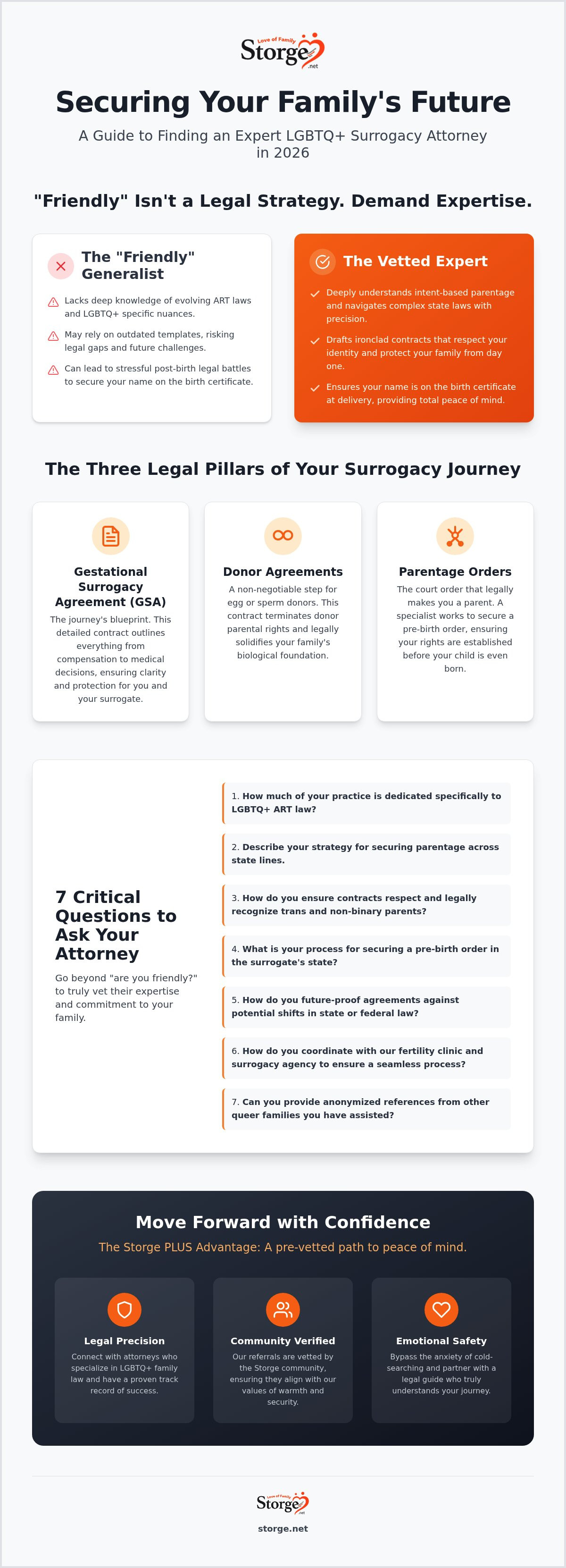
Vetting Your Attorney: 7 Critical Questions for LGBTQ Parents
Once you have a shortlist of potential partners, the initial consultation is your opportunity to move beyond marketing claims and assess true expertise. To find LGBTQ surrogacy attorney representation that offers both legal security and emotional safety, you must ask targeted questions. This phase is about ensuring your lawyer isn't just "friendly" but is a seasoned tactician who has navigated the specific hurdles queer families face in 2026.
Start with the basics of their practice. Ask: "How many LGBTQ surrogacy cases have you handled in the last three years?" This number reveals whether they are active specialists or if they only handle ART law occasionally. Follow up with questions regarding your specific journey:
- Interstate Strategy: What is your specific plan for securing our parentage if we are traveling across state lines or if our surrogate delivers in a different jurisdiction?
- Donor Nuances: How do you handle donor agreements for same-sex couples, and what are the legal differences if we use a known versus an anonymous donor?
- Financial Transparency: What are your total estimated legal fees, including the drafting of the GSA, escrow management, and securing final parentage orders?
Assessing Cultural Competency
Legal precision is vital, but so is feeling seen and respected. Pay close attention to the firm’s environment. Do their standard intake forms use inclusive, gender-neutral language? For transgender or non-binary intended parents, ask how they ensure court documents and birth certificates accurately reflect your identity. A significant red flag is an attorney who treats these requirements as "extra" or unnecessary. You deserve a partner who understands that identity-affirming legal work is a fundamental part of protecting your family.
Technical and Tactical Expertise
Inquire about their professional network. Ask if they have a working relationship with the specific fertility clinic you've chosen. This synergy can prevent administrative delays. You should also ask a very specific tactical question: "What is your established relationship with the local vital records offices to ensure our child’s birth certificate is issued correctly and without delay?"
Finally, discuss their "worst-case scenario" planning. A steady guide will have a clear strategy for contested parentage or sudden legislative shifts. If you find yourself overwhelmed by the vetting process, you can access community-vetted attorney referrals to ensure you're starting your journey with a professional who has already earned the trust of our community.
Moving Forward with Confidence: The Storge PLUS Advantage
The path to parenthood is often paved with complex legal documents and significant emotional milestones. In 2026, the safest way to traverse this landscape is by surrounding yourself with a team that values your family as much as you do. Storge PLUS bridges the gap between the dream of having a child and the practical, legally secure reality of making it happen. It's time to stop searching blindly through general directories. Instead, you can find LGBTQ surrogacy attorney representation through a platform designed specifically for our community's unique needs, ensuring every legal step is a step toward peace of mind.
Using community-vetted Attorney Representation Referrals removes the guesswork and anxiety from your search. These professionals aren't just experts in ART law; they're individuals who have been verified by other LGBTQ+ parents for their cultural competency and professional reliability. This network understands the heavy weight of your journey. They provide the steady, authoritative guidance required to navigate every contract and court order with ease, treating your family as a priority rather than a transaction.
Beyond Referrals: A Holistic Support System
Building a family requires more than just a lawyer; it requires a village of vetted experts. A Storge PLUS Membership offers a comprehensive ecosystem where you can manage every aspect of your search. This includes finding egg or sperm donors and connecting with gestational carriers in a space that prioritizes safety and belonging. It's a platform built by and for the LGBTQ+ community, ensuring that every referral and resource meets a high standard of inclusivity. Joining the Storge PLUS community today means you aren't just hiring a service; you're entering a partnership based on shared values and mutual support.
Your Next Steps to Parenthood
Before you sign your first legal retainer, take a moment to review your progress and trust your instincts. Ensure your chosen attorney has answered your critical questions and that you feel a genuine sense of safety in their expertise. Your final checklist should include:
- Verifying the attorney’s experience with your specific family structure.
- Confirming their strategy for interstate parentage orders and birth certificates.
- Establishing a clear understanding of the fee structure and escrow management.
The road ahead is filled with promise and hope. While the legalities of surrogacy in 2026 may seem daunting, remember that you aren't doing this alone. You have a community and a vetted team ready to support you at every turn. Start building your future today by exploring the Storge PLUS resources and taking the next step toward the family you've always envisioned.
Your Path to a Secure Family Future
Building a family through surrogacy in 2026 is a journey of both immense joy and technical complexity. Throughout this guide, we've explored why legal expertise is the foundation of your protection. From drafting a precise Gestational Surrogacy Agreement to navigating the fragmentation of state parentage laws, every step requires a specialized guide. You now have the framework to vet potential partners and ensure they possess the intersectional competency your unique family deserves.
The search to find LGBTQ surrogacy attorney representation doesn't have to be a source of stress. By moving away from cold searches and toward community-driven verification, you can focus on the aspirational milestones of your journey. Storge is here to act as your steady companion, providing the resources and human-centric referrals you need to move forward with absolute confidence.
Join Storge PLUS to access our vetted network of LGBTQ+ surrogacy attorneys and gain the peace of mind that comes from a platform built for your success. Your dream of parenthood is valid, achievable, and worth every effort. We're honored to walk beside you as you build your future family.
Frequently Asked Questions
Do gay couples need two different lawyers for surrogacy?
Yes, intended parents and the surrogate must have separate legal representation to ensure there is no conflict of interest. Your attorney protects your parental rights, while the surrogate’s attorney ensures her interests are represented during contract negotiations. Having two independent lawyers is a standard ethical requirement in 2026 that ensures the Gestational Surrogacy Agreement is enforceable and fair for everyone involved in your family building journey.
How much does an LGBTQ surrogacy attorney typically cost in 2026?
Legal costs for surrogacy in 2026 generally range from $8,000 to $15,000. This typically covers the drafting of the surrogacy agreement, donor contracts, and the court filings for parentage orders. When you work to find LGBTQ surrogacy attorney experts, ensure you ask for a detailed breakdown of these fees. Some firms include escrow management in their flat fee, while others may bill hourly for unexpected legal complications or multi-state filings.
Is second-parent adoption necessary if my name is already on the birth certificate?
Even if your name is on the birth certificate, many legal experts recommend a confirmatory or second-parent adoption as a safety net. While a birth certificate is an administrative document, an adoption decree is a court judgment that must be recognized in every state. This extra step provides permanent security for your family, especially if you move to a jurisdiction with less inclusive parentage laws than where your child was born.
Can we use the same lawyer as our gestational surrogate?
No, you cannot use the same lawyer as your gestational surrogate because it creates a direct conflict of interest. Each party needs an advocate who is solely focused on their specific legal and medical protections. During the negotiation of the surrogacy contract, there may be disagreements regarding compensation or medical decisions. Separate counsel ensures that both you and your surrogate have a clear, independent understanding of your rights and responsibilities.
What happens if our surrogate lives in a state with different surrogacy laws?
If your surrogate lives in a different state, you will likely need a legal team that understands the laws of both jurisdictions. Your primary attorney will coordinate with local counsel in the surrogate's state to handle the birth certificate and parentage order. This ensures that the contract is valid where it is signed and that your parental rights are fully established where the baby is born, protecting you against conflicting state statutes.
How do we find an attorney if we are a transgender couple starting surrogacy?
Transgender and non-binary couples should prioritize attorneys who demonstrate intersectional competency and use identity-affirming language. When you look to find LGBTQ surrogacy attorney specialists, start with community-vetted platforms like Storge PLUS. These resources connect you with professionals who have specific experience navigating the unique parentage hurdles trans parents face. You should specifically ask potential lawyers about their success in securing accurate gender markers on birth certificates for parents in your situation.
What is the difference between a surrogacy agency and a surrogacy attorney?
A surrogacy agency focuses on the logistical side, such as matching you with a surrogate and coordinating medical appointments. In contrast, a surrogacy attorney focuses exclusively on the legal framework. Attorneys draft the contracts, manage the escrow funds, and secure the court orders that establish you as the legal parents. While agencies provide emotional and administrative support, only a specialized lawyer can provide the legal representation necessary to protect your parental rights.
How long does the legal process of surrogacy take from start to finish?
The legal process of surrogacy typically spans 12 to 18 months, aligning with the timeline of the pregnancy and birth. It begins with several weeks of contract negotiations before the embryo transfer occurs. Once the pregnancy reaches the second trimester, your attorney starts the process for a pre-birth or post-birth parentage order. The process concludes shortly after delivery when the final birth certificate is issued and any necessary confirmatory adoptions are finalized.


