

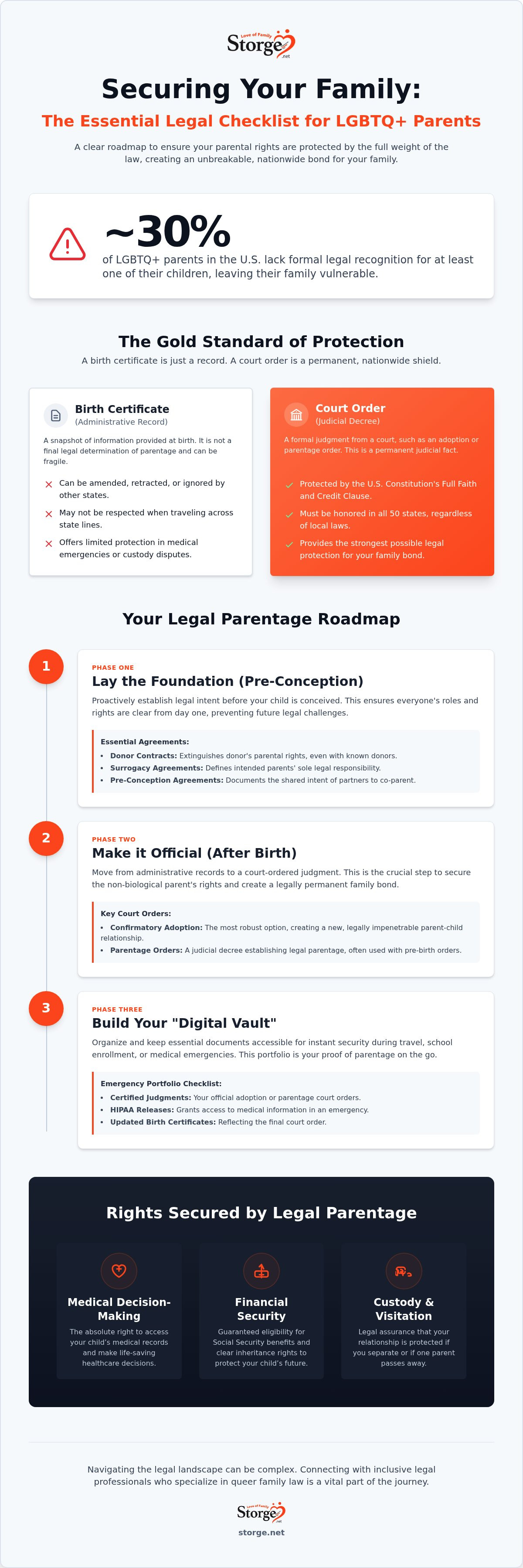
Did you know that nearly 30% of LGBTQ+ parents in the United States are currently unsure of their legal status or lack formal recognition as a parent to at least one of their children? It's a startling figure that highlights a common misconception; the idea that having your name on a birth certificate is the final word in family protection. You've poured your heart into building your family, and the thought of your rights being questioned while traveling or in a medical emergency is deeply unsettling. It's natural to feel anxious about the complexity of family law, especially when crossing state lines can feel like entering a different legal world.
We understand that you're looking for more than just paperwork; you're looking for peace of mind. This guide provides a clear, compassionate roadmap of the essential legal steps for LGBTQ parents to ensure your family is shielded by the full weight of the law. We'll demystify the difference between a government record and a court order, while exploring the latest 2026 legislative updates like the Uniform Parentage Act. By the end of this checklist, you'll have a concrete plan to secure your parental rights and the confidence that your family's bond is legally unbreakable nationwide.
Key Takeaways
- Understand why marriage equality is only the first of several necessary legal steps for LGBTQ parents, and why a court order is the only way to ensure your rights are recognized nationwide.
- Learn how to establish legal intent through donor contracts and pre-conception agreements to protect your family before your child is even born.
- Identify the specific differences between Pre-Birth Orders and confirmatory adoptions to determine the strongest path for securing the non-biological parent’s rights.
- Discover how to build a "Digital Vault" of essential documents, such as HIPAA releases and certified judgments, to provide instant security during travel or medical emergencies.
- See how joining a vetted community like Storge PLUS can connect you with inclusive legal professionals who specialize in the unique nuances of queer family law.
Why Legal Parentage Security is Your First Priority
Legal parentage is the invisible foundation upon which every other family right rests. It is the formal recognition of a parent-child relationship that carries the full weight of the law, defining who has the authority to protect, provide for, and make decisions for a child. For many, this bond feels instinctual and obvious. However, the legal reality can be more fragile than it seems. While the landmark ruling for LGBTQ rights in the United States secured the right to marry, it did not create a universal, automatic pathway to parentage for every queer family.
Taking the necessary legal steps for LGBTQ parents ensures that your role in your child's life isn't just an administrative note, but a permanent judicial fact. Relying solely on marriage or a birth certificate can leave gaps in protection, especially when traveling or if state laws shift. Judicial recognition is the gold standard because it moves beyond a simple record and becomes a court order that every other state is constitutionally required to respect.
The Difference Between a Record and a Court Order
A birth certificate is an administrative record. It's a snapshot of information provided at the time of birth, but it isn't a final legal determination of parentage. Administrative records can be amended, retracted, or even ignored in jurisdictions that don't recognize the specific circumstances of a child’s conception. In contrast, a court judgment, such as a confirmatory adoption or a parentage order, is a judicial decree. These orders are protected by the Full Faith and Credit Clause of the U.S. Constitution, meaning they must be honored in all 50 states regardless of local politics. Parentage security is the judicial confirmation of a natural or intended bond.
Rights Protected by Legal Parentage
Securing your legal status provides a shield for your family during the most vulnerable moments. Without a court order, a non-biological parent might face challenges that a birth certificate alone cannot solve. These protections include:
- Medical Decision-Making: The absolute right to access your child’s medical records and make life-saving healthcare decisions in an emergency.
- Financial Security: Guaranteed eligibility for Social Security survivor benefits and clear inheritance rights that protect your child’s future.
- Custody and Visitation: The legal assurance that your relationship with your child is protected if you separate from your partner or if one parent passes away.
Securing these rights early is one of the most vital legal steps for LGBTQ parents who want to ensure their family remains whole, no matter where life takes them. By moving from a record to a court order, you create a permanent legal connection that survives changes in residence or shifts in the political landscape.
Pre-Conception and Pregnancy: The Essential Contract Checklist
Building a family through assisted reproduction begins long before the first medical appointment. In these early stages, your most powerful tool is "intent." While biological connection is often the default in traditional law, modern family-building relies on documented, legal intention to establish who the parents are. Taking proactive legal steps for LGBTQ parents during the pre-conception phase ensures that every person involved, whether a donor, a surrogate, or a partner, understands their role and their rights from day one.
Donor contracts are essential because they explicitly extinguish the parental rights of the donor. This prevents future claims and provides clarity for the child's history. This is true even in "known donor" situations where a friend or relative is helping. Informal handshakes don't hold up in court; you need a written agreement to ensure a donor isn't legally considered a parent. Similarly, gestational surrogacy agreements must be fully executed before any medical procedures begin. These contracts define the intended parents’ sole responsibility for the child and protect the carrier by outlining expectations and support.
Drafting Donor and Surrogacy Agreements
A well-crafted agreement goes beyond the basics. It should explicitly state that the intended parents have sole legal and financial responsibility for the child. It’s also the place to define future contact, ensuring that promises of anonymity or open communication are legally enforceable. To protect everyone involved, it is vital that the intended parents and the carrier or donor have separate, independent legal counsel. This ensures there's no conflict of interest and reinforces the contract’s legitimacy if it’s ever reviewed by a judge. If you're unsure where to find an expert, you can access a vetted network of attorneys through the Storge community who specialize in these specific protections.
Parenting and Cohabitation Agreements
For unmarried couples, a parenting or cohabitation agreement serves as a crucial legal bridge. These documents record your shared intent to parent and define financial obligations during the pregnancy. They also establish "standby" roles, ensuring the non-gestational partner has recognized authority if an emergency occurs before the birth. These agreements aren't just for your own peace of mind; they serve as powerful evidence of intent in future parentage proceedings. By documenting your roles early, you create a paper trail that supports your family's legitimacy in the eyes of the court long after the pregnancy ends.
Securing Rights After Birth: Adoption and Parentage Orders
The arrival of your child is a moment of profound joy, but it's also the time to finalize the legal structures you've carefully planned. While your name may appear on the birth certificate, remember that this document is an administrative record, not a court order. To ensure your family is protected in every jurisdiction, you must follow a specific sequence of legal steps for LGBTQ parents that transform your intent into an irrevocable legal reality.
This process typically follows a three-step roadmap designed to provide maximum security:
- Step 1: Parentage Orders. In states like Michigan, which legalized compensated surrogacy in 2025, or Hawaii, which modernized laws in 2026, you can often file for a Pre-Birth Order (PBO). This allows both parents to be recognized as legal parents the moment the child is born.
- Step 2: Voluntary Acknowledgments of Parentage (VAP). Many hospitals now offer VAPs. This is a simple form that establishes a legal parent-child relationship without a court hearing. It's an excellent immediate protection, but it should rarely be your only one.
- Step 3: Confirmatory Adoption. Often called second-parent or stepparent adoption, this is the final, most robust layer of protection. It creates a judicial decree that is virtually impossible to challenge.
Even for married couples, these steps remain necessary. Marriage equality provides a foundation, but it doesn't automatically guarantee parentage for a non-biological parent in every scenario. By securing a court order, you prevent future legal challenges that could arise if you move to a state with different parentage presumptions or if federal protections shift.
The Power of Second-Parent Adoption
It can feel emotionally heavy, or even insulting, to "adopt" a child you have raised and loved from the very beginning. We recognize that weight. However, this process isn't about proving your love; it's about creating a permanent, irrevocable legal bond that travels with you. Because an adoption is a court judgment, the U.S. Constitution requires every other state to recognize it. This step is a universal shield. It protects the non-genetic parent's rights in medical emergencies, inheritance, and custody, providing peace of mind that your family's bond is recognized in all 50 states.
Voluntary Acknowledgments of Parentage (VAP)
VAPs have become a streamlined, administrative way to establish parentage at birth. As of 2026, states following the 2017 Uniform Parentage Act, including Illinois and Washington, treat a signed VAP with the same legal weight as a court order. This is a significant victory for accessibility. However, because not every state has adopted these modern standards, we still advise most families to pursue a backup adoption order. A VAP is a powerful tool for daily life and hospital access, but the confirmatory adoption remains the gold standard for long-term security. Taking these legal steps for LGBTQ parents now ensures that your family’s future is never left to chance.
The Emergency Portfolio: Documentation for Travel and Daily Life
Once you've completed the foundational legal steps for LGBTQ parents, the focus shifts from acquisition to accessibility. Having a court order is vital, but it only protects you if you can produce it when it matters most. Whether you're crossing state lines for a holiday or sitting in a local emergency room, your legal status needs to be instantly verifiable. This is where an emergency portfolio becomes your family's most practical shield. It's about ensuring that the protections you've worked so hard to secure are always within reach.
A "Digital Vault" is the most efficient way to manage this. By storing high resolution, certified copies of your family documents in a secure, encrypted cloud folder, you ensure they're accessible from any device, anywhere in the world. This digital backup should complement a physical set of documents kept in a dedicated travel folder. Beyond parentage orders, you must include HIPAA releases for both parents. These forms grant you the legal right to receive medical information and make decisions in a hospital setting, bypassing potential confusion from staff who may not understand the nuances of queer family law.
Building Your Portable Legal Kit
Your portable kit should be a comprehensive collection of your family’s legal identity. At a minimum, you should carry certified copies of your adoption decree or parentage order, the child’s birth certificate, and your marriage license if applicable. If you're traveling internationally, a specific travel authorization form signed by both parents can prevent delays at customs. When interacting with medical or educational staff, lead with confidence and your paperwork. Most hurdles are the result of unfamiliarity rather than malice. Documentation is your voice when the law is silent or confused.
Standby Guardianship and Wills
While we hope for the best, true protection means preparing for the unthinkable. Standby guardianship allows you to designate who will care for your child if both parents become temporarily or permanently incapacitated. This ensures your child remains with a trusted loved one rather than entering the state system while legalities are sorted out. It’s also crucial that your will explicitly reflects your parentage judgments to avoid probate disputes or challenges from extended family members. Naturally, finding an LGBTQ surrogacy attorney is the best way to ensure these specific, sensitive documents are drafted with the necessary precision to stand up in any court.
Building this portfolio can feel like a heavy task, but you don't have to do it alone. You can find templates and peer-vetted resources by joining our Storge PLUS membership, where we help you organize every detail of your family's legal security.
Navigating the Legal Landscape with the Storge Community
Completing a checklist is a significant milestone, but the legal steps for LGBTQ parents are often part of a lifelong journey rather than a one-time event. While the previous sections have outlined the "what" and the "why" of family protection, the "how" can still feel like a daunting hurdle. Finding a lawyer who understands that your family isn't just a case file requires a bridge between legal confusion and professional clarity. Storge serves as that bridge, transforming a complex process into a manageable, supported path.
Expert representation is non-negotiable because queer family law is a specialized field that changes rapidly. We move beyond providing information to offering a genuine partnership. By positioning Storge as the centralized hub for your family-building team, you gain access to a community that shares your values and understands the profound gravity of your personal decisions. You aren't just hiring a service; you're joining a network dedicated to the legitimacy and security of your family bond.
Finding Vetted Attorney Representation
General family law practitioners often lack the specific expertise required for modern LGBTQ-specific parentage cases. They might be unfamiliar with the 2026 revisions to the Illinois Parentage Act or the nuances of surrogacy legalization in states like Michigan. A simple mistake in a donor contract or a missed deadline for a pre-birth order can have lasting consequences. Storge’s referral system eliminates the stress of unverified searches by connecting you with legal professionals who have been carefully vetted for their expertise and inclusive approach.
This peace of mind is invaluable. Working with an attorney who affirms your family structure from the first meeting creates a sense of safety and belonging. These experts don't just fill out forms. They anticipate potential challenges and ensure your court orders are drafted to provide the strongest possible shield for your rights. Our directory is designed to ensure that every reader feels seen and respected while receiving the highest quality legal guidance available today.
Taking the Next Step with Storge PLUS
Joining a community that understands your journey can turn anxiety into confidence. Storge PLUS offers a comprehensive suite of resources that go far beyond a simple directory. Members gain access to specialized tools for donor egg and sperm searches, as well as referrals for fertility clinics and gestational carrier searches. We provide a methodical, reassuring rhythm to your family-building process, helping you transition seamlessly from emotional encouragement to practical action.
Your family’s security is too important to leave to chance or unverified providers. By becoming a member, you gain a steady guide and a compassionate expert to walk alongside you as you secure your future. We invite you to join Storge PLUS to access our vetted network of LGBTQ-inclusive attorneys and start building the legal fortress your family deserves. Together, we can ensure that your personal dream becomes a permanent, legally protected reality.
Building a Legacy of Protection for Your Family
Securing your family's future is about more than just paperwork; it is about creating an unbreakable legal shield that recognizes the depth of your bond. By moving from simple administrative records to judicial court orders, you ensure your rights remain intact regardless of where you travel or how state laws evolve. Implementing the necessary legal steps for LGBTQ parents, from donor contracts to confirmatory adoptions, transforms your shared intent into a permanent reality. This proactive approach allows you to focus on the joy of parenting, knowing that your legal foundation is secure.
You don't have to navigate this complex landscape alone. Storge is here to act as your steady guide, offering verified fertility and legal resources alongside a trusted community of donors and carriers. You can secure your family’s future with a Storge PLUS membership, gaining immediate access to our network of vetted LGBTQ-inclusive family law attorneys. Your dream of a protected, recognized family is within reach, and we are honored to walk this path with you.
Frequently Asked Questions
Is a birth certificate enough to prove I am a legal parent?
No; a birth certificate is an administrative record and does not carry the same legal weight as a court order. While it's a necessary document for daily life, it can be challenged in different jurisdictions. To truly secure your family, you need a judicial decree. This provides a permanent bond that every state must respect under the U.S. Constitution. Taking these legal steps for LGBTQ parents ensures your relationship remains protected during travel or relocation.
Do married same-sex couples still need to do a second-parent adoption?
Yes, most legal experts strongly recommend that married couples complete a confirmatory or second-parent adoption. Marriage provides a legal presumption of parentage, but that presumption can be rebutted or questioned in states with different laws. An adoption decree is a final court judgment. It's protected by the Full Faith and Credit Clause, making it the only way to guarantee your parental rights are recognized in all 50 states without exception.
What is a Voluntary Acknowledgment of Parentage (VAP)?
A Voluntary Acknowledgment of Parentage (VAP) is a simple administrative form that allows parents to establish a legal relationship with their child at the hospital. As of 2026; many states have modernized their laws to ensure VAPs are accessible to LGBTQ+ families. While it's a powerful tool for immediate recognition, it's often used alongside a court order to provide the most robust level of long-term security. This dual approach ensures your bond is recognized everywhere.
How much does it typically cost to secure legal parentage orders?
The cost of securing your rights varies significantly based on your location and the complexity of your case. For example; a second-parent adoption in Florida can range from $5,000 to $8,000, while a stepparent adoption might cost between $2,500 and $4,500. Other jurisdictions may offer more streamlined processes with lower filing fees. It's best to consult with a professional to understand the specific legal steps for LGBTQ parents in your area and prepare your family budget.
What happens if we travel to a state that doesn’t recognize our marriage?
If you travel to a state with different parentage laws, your marriage might not provide the same automatic protections you have at home. However; a court-ordered adoption or parentage judgment is a judicial decree that must be honored nationwide. This is why carrying a certified copy of your judgment is essential. It acts as a legal shield, ensuring you can make medical decisions and remain with your child regardless of local state policies or political climates.
Can a sperm or egg donor claim parental rights later?
A donor generally cannot claim rights if a properly drafted legal contract was executed before conception. These agreements are designed to explicitly extinguish the donor's parental rights and responsibilities while establishing the intended parents' sole authority. In states that have adopted the 2017 Uniform Parentage Act; these protections are even stronger. Working with a specialized attorney ensures the language in your contract is precise and enforceable in a court of law if a dispute arises.
What is a Pre-Birth Order and how do I get one?
A Pre-Birth Order (PBO) is a judicial decree issued before a child is born that declares the intended parents as the legal parents. You obtain one by filing a petition in a court that has jurisdiction over the birth; often in states like Hawaii or Michigan which have modernized their surrogacy laws as of 2026. Once the child is born, the PBO ensures your names go directly onto the original birth certificate, providing immediate legal clarity.
Do I need a lawyer if we are using a known donor?
Yes, having a lawyer is vital when working with a known donor to ensure the agreement is legally binding. Informal arrangements or handshake deals carry significant risks and may not be recognized by a court if a dispute arises later. Both the intended parents and the donor should have independent legal counsel to avoid conflicts of interest. This professional oversight ensures that the intent of all parties is clearly documented and your parental rights are protected.


