

What if the name on your child's birth certificate doesn't actually guarantee your parental rights if you cross state lines? It's a heavy question that many LGBTQ+ parents face, and the anxiety of feeling legally "invisible" is a burden you shouldn't have to carry. You've worked hard to create a home filled with love; it's only natural to want that bond recognized everywhere, from the doctor's office to the airport. Understanding the specific second parent adoption requirements is the first step toward turning that uncertainty into permanent, nationwide protection for your family.
We know the legal process can feel overwhelming, especially with differing state laws and the prospect of invasive home studies. This guide is designed to be your steady companion, offering clarity where there is confusion. We'll outline the essential legal steps, provide a comprehensive checklist of necessary documents, and help you prepare for the home study with confidence. By the end of this article, you'll have a clear path toward the permanent peace of mind that comes with a court-ordered adoption decree. Your family's security is our priority, and we're here to help you navigate this transition with grace and authority.
Key Takeaways
- Understand why a birth certificate alone may not provide full legal protection across every state and why a court-ordered adoption is the gold standard for security.
- Learn the specific second parent adoption requirements for 2026, including establishing legal standing and obtaining necessary consent from the legal parent.
- Compare the benefits of formal adoption against a Voluntary Acknowledgement of Parentage (VAP) to determine the most secure path for your family's future.
- Follow a clear, step-by-step roadmap for the adoption process, from your first consultation with an LGBTQ-affirming attorney to filing your petition in family court.
- Discover how Storge PLUS provides a supportive bridge to vetted legal professionals and a community of parents who have navigated these transitions successfully.
What is Second Parent Adoption and Why is it Essential?
When building a family, the bond you share with your child is immediate and profound. However, the law doesn't always recognize that emotional connection without specific paperwork. What is second-parent adoption? It's a legal procedure that allows a non-biological parent to adopt their partner's child without the biological parent losing any of their own rights. This process creates a family unit where both individuals have equal legal standing, ensuring the child has two protected parents in the eyes of the law.
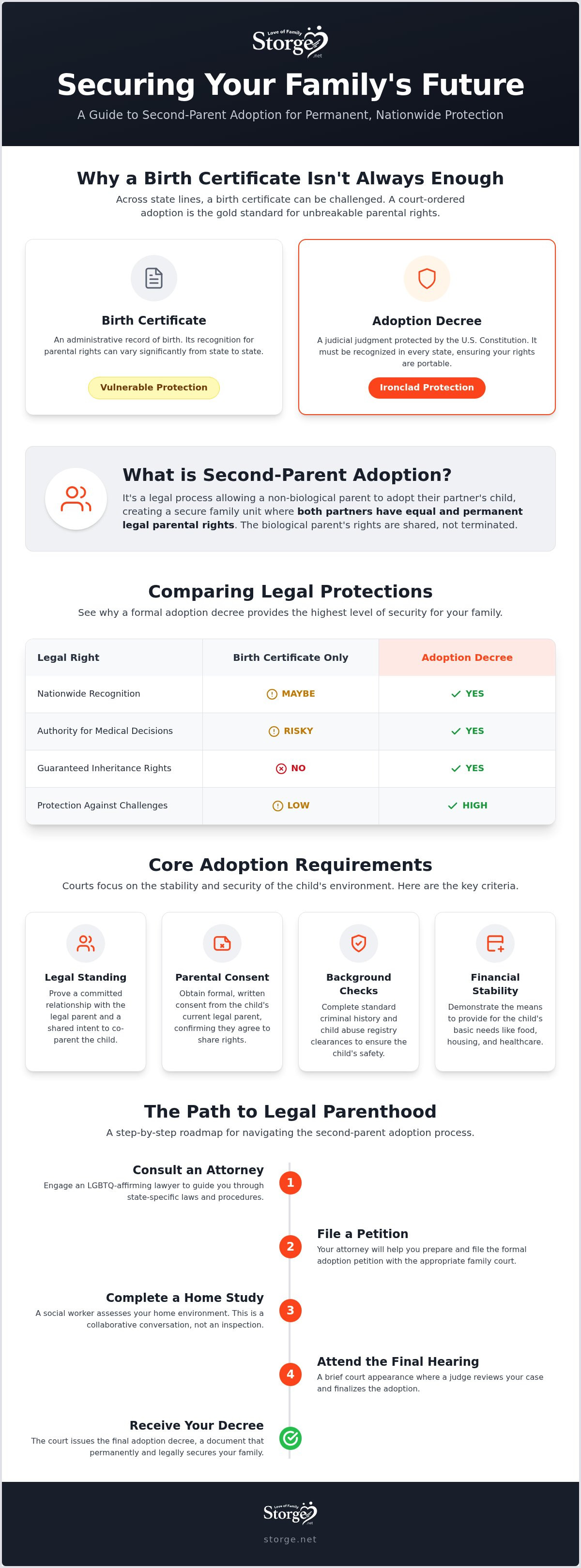
Many LGBTQ+ parents believe that being listed on a birth certificate is enough to protect their family. While it's a vital document, a birth certificate is an administrative record that can be challenged in certain jurisdictions, especially if the parents aren't married or lack a biological link. This is why meeting second parent adoption requirements is often described as a "belt and suspenders" approach. The birth certificate is the belt; the adoption decree is the suspenders. It provides a layer of security that is much harder to strip away, even if legal climates shift.
A court-ordered adoption decree is a judicial judgment. Under the Full Faith and Credit Clause of the U.S. Constitution, every state is required to recognize the judicial acts and judgments of every other state. This makes your parental rights "portable." Whether you're moving for work or just taking a family vacation, your status as a parent remains intact across every state line. Without this decree, you risk being treated as a "legal stranger" to your own child in an emergency.
Courts often distinguish between a biological connection and a legal one. While biology is a fact of nature, legal parentage is a status granted and protected by the state. Securing this status ensures you have the right to make medical decisions, access school records, and provide for your child's inheritance. It bridges the gap between being a parent in your heart and being a parent in the courtroom.
The Legal Legitimacy of Your Family
Even with progress in 2026, legal standards for same-sex families still fluctuate. A formal adoption provides the highest level of protection during unforeseen events like medical emergencies or travel. If your child needs urgent care in a state with less inclusive local policies, a decree serves as undeniable proof of your right to be by their side. Second-parent adoption is the gold standard for parental security because it permanently cements the bond between you and your child, regardless of future legislative changes.
Second Parent vs. Stepparent Adoption
While these two paths lead to the same goal, they serve different relationship structures. Stepparent adoption typically requires the parents to be legally married. Second-parent adoption is often the preferred path for unmarried partners or families built through assisted reproduction where one parent lacks a biological connection. Choosing the right path often depends on your marriage status and how your child was conceived. Understanding these second parent adoption requirements helps you select the most direct route to permanent legal safety.
Core Second Parent Adoption Requirements for 2026
Starting your legal journey requires a clear understanding of the specific criteria courts use to evaluate your petition. While every family's path is unique, the core second parent adoption requirements in 2026 focus on the stability and security of the child's environment. First, you must establish legal standing. This typically involves proving a committed relationship with the biological parent and a shared intent to co-parent. It's about showing the court that you've already been acting in a parental role and wish to formalize that bond.
Consent is the cornerstone of this process. The biological or current legal parent must provide formal, written consent for the adoption to proceed. This document confirms that they aren't losing their rights but are instead sharing them with you. Additionally, courts require standard background checks. These include criminal history clearances and child abuse registry searches to ensure the child's safety. Finally, you'll need to demonstrate financial stability. You don't need to be wealthy to pass this check. The court simply needs to see that you have the means to provide for the child's basic needs, such as food, housing, and healthcare.
The Home Study Process
The home study is often the part of the process that creates the most anxiety. It's helpful to view it as a conversation rather than an interrogation. A social worker will visit your home to ensure it's a safe, nurturing environment. They aren't looking for a perfect house; they're looking for a stable home. You'll need to gather documentation like birth certificates, marriage licenses, and recent health records. Most families find that once the visit begins, the process is far less invasive than they initially feared.
Donor and Carrier Clearances
If your child was born through assisted reproduction, the court must be certain that no other parties have a legal claim to your child. This means ensuring that all donor or gestational carrier rights have been legally terminated. Having a clear, signed donor agreement or gestational carrier contract on file is essential for meeting second parent adoption requirements. This documentation proves that the donor or gestational carrier never intended to have parental rights. Finding an LGBTQ family law attorney who is familiar with these specific contracts can simplify this stage significantly. If you're feeling overwhelmed by the paperwork, exploring a Storge PLUS membership can connect you with the right resources to keep your journey on track.
Comparing Legal Protections: Adoption vs. VAPs
As you explore ways to protect your family, you'll likely encounter the term Voluntary Acknowledgement of Parentage, or VAP. A VAP is an administrative form, often signed at the hospital shortly after birth, that allows a non-biological parent to be established as a legal parent. It's a wonderful, accessible tool available in many states that provides immediate recognition. However, while a VAP is a significant step forward, it doesn't offer the same ironclad security as a formal adoption decree. Many experienced family law attorneys still recommend that families complete the full adoption process to ensure their rights are beyond reproach.
The primary difference lies in the level of legal finality. A VAP is an administrative process, which means it's essentially a government record. In contrast, meeting second parent adoption requirements results in a judicial judgment. This distinction is critical because court judgments receive a higher level of deference under the law. If you're weighing the cost-benefit of these paths, consider that while a VAP is often free or very low-cost, the investment in an adoption decree provides a level of permanence that administrative forms simply cannot match.
The Power of a Court Judgment
A judge’s signature carries a weight that an administrative form does not. When a court issues an adoption decree, it's making a final legal determination about your family structure. A VAP is an administrative tool, while adoption is a judicial one. This difference becomes especially apparent during international travel. If you're visiting a country that doesn't recognize VAPs or has different standards for LGBTQ+ parentage, a court-ordered adoption decree is much more likely to be respected as a valid legal document. It provides a clear, universal language of parentage that protects you when you're far from home.
Determining the Right Path for Your Family
Choosing the right path involves looking at your budget, your timeline, and where you plan to live or travel. It's a personal decision that requires a clear view of your current legal standing. You can use this family protection checklist to audit your current security and identify any gaps in your plan. Additionally, connecting with the LGBTQ donor community can provide early legal clarity, helping you understand how your initial family-building choices impact your future second parent adoption requirements. Taking these steps now ensures that your family's future is built on a foundation of absolute legal certainty.
The Step-by-Step Second Parent Adoption Process
Transforming your personal commitment into a legal reality is a journey of several deliberate stages. While the legal maze can appear daunting, following a structured path helps demystify the second parent adoption requirements and keeps the focus on your child's future. The process typically begins with a consultation with an LGBTQ-affirming family law attorney who understands the nuances of modern family building. From there, you'll move through these primary milestones:
- Step 1: Consultation. Meet with a specialist to review your family structure and state-specific laws.
- Step 2: Filing the Petition. Your attorney prepares and submits the legal request to the family court.
- Step 3: Clearances. Complete the necessary background checks and the home study visit.
- Step 4: The Hearing. Attend a brief court session where a judge signs the final adoption decree.
- Step 5: Record Updates. Use your decree to update the birth certificate and social security records.
This progression is designed to be methodical and reassuring. Each step brings you closer to the absolute security of a court-ordered judgment. While the timeline can vary depending on court schedules, having a clear roadmap allows you to navigate the transition with a sense of order and calm. It's not just about paperwork; it's about building a fortress of legal protection around your child's life.
Preparing Your Petition
The petition is more than just a form; it's a narrative of your family's life. You'll gather "evidence" of your parental bond, such as photos of family milestones, school records where you're listed as an emergency contact, or letters from pediatricians. Using precise legal language in this document is vital to ensure your rights are airtight and protected against any future challenges. Many families choose to simplify this stage by working with vetted professionals through Storge PLUS, ensuring every detail is handled with care and empathy.
The Final Hearing: What to Expect
Many parents worry that the final hearing will feel like a trial. In reality, these sessions are almost always celebratory formalities. It's a moment where the court officially recognizes what you already know: you are a family. Both parents, the child, and your attorney usually attend. In many courtrooms, judges even encourage families to take photos to mark the occasion. Once the judge signs the order, you'll receive certified copies of the adoption decree. These are the precious documents that grant you permanent legal peace of mind. To begin your journey with a team that truly understands your needs, connect with a specialized family law attorney today.
Securing Your Legacy with Storge PLUS
The journey to permanent legal security is one of the most significant transitions your family will ever undertake. While the paperwork and procedural steps provide the framework, it's the support and expertise you surround yourself with that determine the quality of the experience. Storge PLUS was created to be that essential bridge, transforming a complex legal maze into a manageable and even celebratory path. By focusing on the unique needs of our community, we ensure that meeting second parent adoption requirements isn't just a hurdle to clear, but a milestone to be honored. Our platform provides more than just links; it offers a sanctuary where your family's legitimacy is never questioned.
We understand that the weight of these decisions can feel heavy. That's why we've focused on building a resource that balances professional reliability with deep empathy. By accessing vetted resources, you can focus on what truly matters: bonding with your child and preparing for your shared future. We believe that every LGBTQ+ family deserves the peace of mind that comes from a court-ordered decree, and we're here to guide you through every requirement with a steady, authoritative hand. This is about more than just a legal status; it's about the long-term safety and legacy of the family you've worked so hard to build.
Expert Referrals for Legal Peace of Mind
Many families assume a general family lawyer can handle an adoption petition. However, LGBTQ+ family building often involves specific nuances, such as donor agreements or gestational carrier contracts, that require specialized knowledge. A generalist might miss a subtle detail that could leave your parental rights vulnerable in another jurisdiction. Our vetting process is rigorous, ensuring that every professional in our network is not only legally proficient but deeply committed to inclusive practices. We help you build a "dream team" of experts who see your family for who you truly are, providing a sense of safety and belonging from the very first consultation. This level of specialized care reduces the risk of administrative delays and ensures your petition meets all second parent adoption requirements with precision.
Join the Storge PLUS Community
The legal side of adoption is only one part of the story. There is also an emotional weight to the process, particularly during the home study or while waiting for a court date. Within the Storge PLUS community, you'll find a space to connect with parents who have already navigated these transitions successfully. Whether you need advice on organizing your documents or simply a reassuring word from someone who understands the anxiety of a social worker's visit, our members offer a partnership based on shared values and understanding. You'll gain access to exclusive resources tailored for modern family building, ensuring you never have to feel like you're doing this alone. Taking the first step toward total family security in 2026 starts with finding the right companions for the road ahead. Secure your family's future with Storge PLUS today.
Building a Future of Absolute Certainty
The love you have for your child is the foundation of your home; legal protection is the fortress that keeps it safe. By understanding the specific second parent adoption requirements, you've taken a vital step toward ensuring your family's bond is recognized in every state and jurisdiction. We've explored how a judicial decree offers a level of portability and permanence that administrative forms simply can't match. From gathering your petition evidence to the final celebratory hearing, each stage of this journey brings you closer to lasting peace of mind.
You don't have to navigate this legal maze alone. With a community of over 10,000 intended parents and access to a vetted network of inclusive legal professionals, you can move forward with confidence. Our expert-led guidance ensures you meet 2026 legal standards with precision and care. It's time to turn your personal commitment into a permanent legal legacy.
Protect your family rights with Storge PLUS today and embrace the security your family deserves. Your future is bright, and we're honored to walk beside you.
Frequently Asked Questions
Do we need second parent adoption if we are both on the birth certificate?
Yes, because a birth certificate is an administrative record, while an adoption decree is a judicial judgment. In 2026, legal experts emphasize that while birth certificates provide initial recognition, they are not universally portable or immune to challenge in every jurisdiction. A court-ordered decree ensures your parental rights are protected under the Full Faith and Credit Clause, providing absolute security if you travel or move to a state with different local laws.
How much does a second parent adoption typically cost in 2026?
Total costs involve court filing fees and professional service expenses that vary by location. For example, court filing fees in 2026 can be as low as $20 in some areas or range between $65 and $210 in others. Additional costs for background checks or home study investigations also apply. Investing in specialized counsel ensures all second parent adoption requirements are met correctly the first time, providing a level of security that outweighs the initial investment.
Is a home study always required for second parent adoptions?
A home study is frequently required, but some jurisdictions offer waivers for established families or cases where parents are married. In 2026, many states have streamlined this process for confirmatory adoptions to make it less burdensome for LGBTQ+ parents. You should generally prepare for a social worker visit and background clearances as a standard part of the process. Your attorney can advise if your specific family situation qualifies for an exemption under current state regulations.
Can we complete a second parent adoption if we are not married?
Yes, second parent adoption is specifically designed for unmarried partners to secure legal rights without terminating the first parent's status. However, availability varies by state. As of August 2026, states like Alabama, Kansas, North Carolina, Ohio, Utah, and Wisconsin have laws that may prohibit or complicate adoption by unmarried partners. For married couples, the process is typically handled through stepparent adoption, which is legally available in all 50 states following national marriage equality rulings.
What happens if the biological parent does not consent to the adoption?
Consent from the current legal parent is a fundamental requirement, and the process is difficult to complete without it. If a biological parent has had no meaningful contact with the child for a year or more, some states may consider the child legally abandoned and waive the consent requirement. These situations are legally complex and require a skilled attorney to navigate the specific abandonment and termination laws of your jurisdiction to ensure the child's future is secure.
How long does the second parent adoption process usually take?
The timeline typically spans three to six months from the initial filing to the issuance of the final decree. This duration depends on the local court's schedule and how quickly background checks and home studies are completed. Some families experience a faster turnaround if their paperwork is meticulously prepared. Staying organized and working with a specialized team helps ensure that all second parent adoption requirements are addressed promptly to avoid unnecessary administrative delays during the transition.
Is second parent adoption recognized in every state?
Yes, once a court issues a final adoption decree, it must be recognized by every state in the country. This protection is guaranteed by the Full Faith and Credit Clause of the U.S. Constitution. While the specific laws to obtain an adoption vary significantly from state to state, the resulting judicial judgment is portable. This means your parental rights remain secure whether you are traveling for a family vacation or moving your home to a new state permanently.
Do I need a lawyer for a second parent adoption, or can I do it myself?
While it is technically possible to file on your own, working with an LGBTQ-affirming attorney is highly recommended to ensure your family's security. The legal language used in petitions must be precise to withstand potential future challenges in different jurisdictions. An experienced lawyer manages complex filing deadlines and coordinates background checks, providing a layer of professional reliability. This partnership allows you to focus on your child while a trusted guide handles the intricate legal details.


