

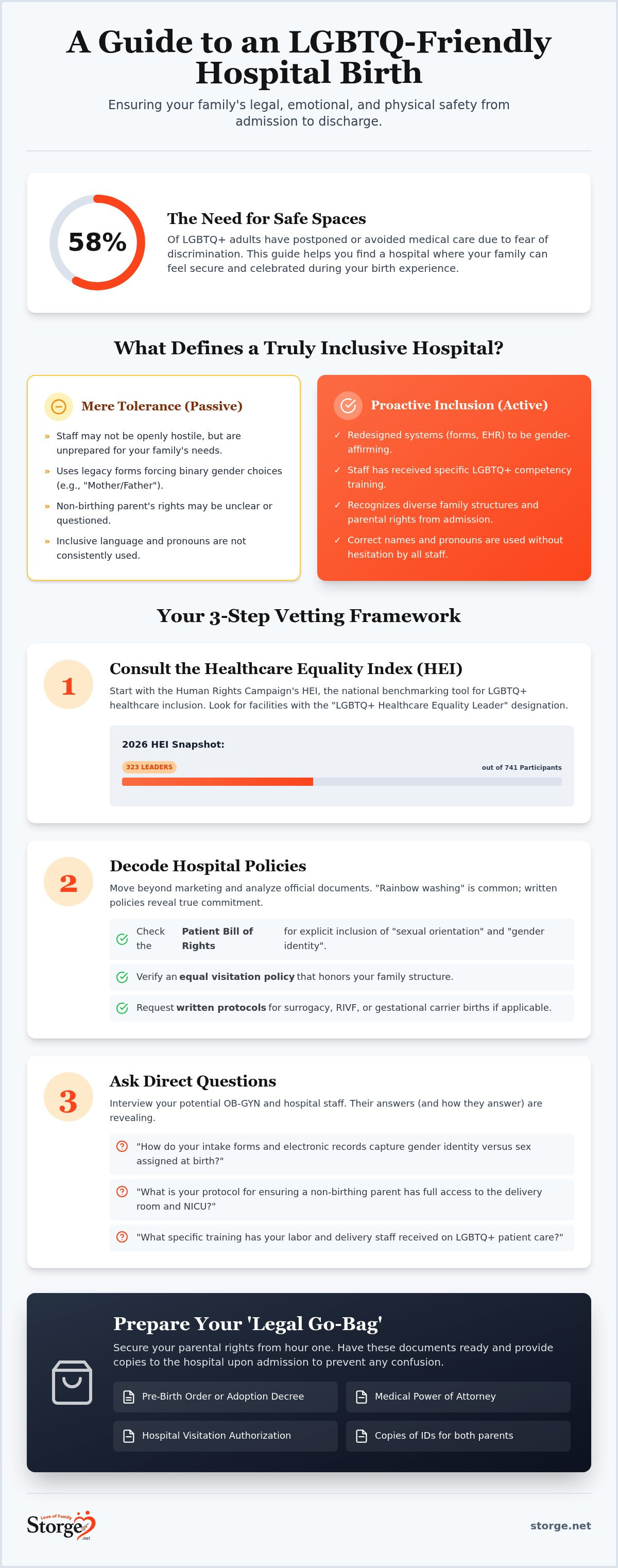
What if the hospital where you plan to welcome your baby doesn't recognize both of you as parents the moment you walk through the door? Learning how to find an LGBTQ-friendly hospital for birth is about more than just checking for a rainbow sticker on the window. It is about ensuring your family's legal and emotional safety during your most vulnerable hours. You likely worry about being misgendered by a rotating shift of nurses or fear your partner being barred from the NICU because a clinical intake form doesn't reflect your family structure. These anxieties are valid in a landscape where 58% of LGBTQ+ adults have postponed medical care due to fear of discrimination.
You deserve a birth experience defined by dignity and legal security rather than advocacy and stress. We've built this 2026 guide to provide a professional framework for vetting institutional policies, verifying staff training through the latest Healthcare Equality Index data, and building a "legal go-bag" that protects your parental rights from hour one. We will walk you through the process of identifying truly inclusive environments and community-verified providers, ensuring you can focus on your new arrival with total peace of mind.
Key Takeaways
- Learn how to find an LGBTQ-friendly hospital for birth by evaluating institutional policies and verifying staff competency through the 2026 Healthcare Equality Index.
- Discover the essential questions to ask your medical team to ensure your family structure is respected and affirmed from the delivery room to the NICU.
- Prepare a comprehensive "Legal Go-Bag" with pre-birth orders and power of attorney documents to secure your parental rights immediately.
- Differentiate between mere tolerance and proactive inclusion by identifying hospitals that prioritize gender-affirming intake forms and queer-inclusive medical training.
- Gain peace of mind by accessing a community-vetted network of inclusive healthcare providers and professionals through Storge PLUS.
What Defines an LGBTQ-Inclusive Hospital Birth in 2026?
In 2026, an inclusive birth experience is more than a polite greeting. It's a rigorous standard of care where your family structure is legally and socially affirmed from the moment you check in. When you're researching how to find an LGBTQ-friendly hospital for birth, you must look for the gap between tolerance and proactive inclusion. Tolerance is a passive state where staff might not be openly hostile, but they aren't prepared for your specific needs. Proactive inclusion means the hospital has already redesigned its systems, from intake forms to staff training, to welcome you specifically.
This distinction is critical because of the historical context of understanding LGBTQ health disparities. Modern medical environments now use Electronic Health Records (EHR) that allow for a clear distinction between gender identity and sex assigned at birth. If a facility still uses legacy software that forces you into binary boxes, your risk of being misgendered increases significantly. A safe birth environment directly impacts postpartum mental health by reducing the likelihood of birth trauma and ensuring a smoother transition into parenthood for every member of the family.
The Role of Gender-Affirming Care in Labor and Delivery
Inclusive hospitals prioritize the psychological safety of trans and non-binary birthing people. During high-stress medical moments, such as an emergency transition or an epidural placement, staff must be trained to use your correct pronouns and preferred name without hesitation. Many 2026 leaders in healthcare have moved toward gender-neutral birthing suites and recovery areas to ensure every patient feels they belong. Gender-affirming birth care is a medical necessity for 2026.
Recognizing Diverse Family Structures from Admission to Discharge
True inclusion means moving beyond "Mother" and "Father" labels on hospital wristbands and birth certificates. In an affirming environment, the non-birthing parent is recognized as a primary caregiver from hour one, with full access to the NICU and delivery room. You shouldn't have to explain your legal relationship to your child while you're exhausted from labor. Finding a facility that understands these nuances is easier when you leverage community-verified resources. Using Storge PLUS allows you to connect with providers who have been vetted by other queer families, ensuring your first days of parenthood are defined by joy rather than legal anxiety. Learning how to find an LGBTQ-friendly hospital for birth is the first step toward a safe, celebrated arrival for your child.
How to Research and Vette Hospitals for LGBTQ+ Safety
Researching a hospital is a deliberate act of protection for your growing family. It requires moving past aesthetic marketing to find institutional accountability. When you're looking at how to find an LGBTQ-friendly hospital for birth, your primary research tool should be the Human Rights Campaign's Healthcare Equality Index (HEI). In 2026, the 17th edition of the HEI saw 741 healthcare facilities actively participate in the survey, with 323 of them earning the "LGBTQ+ Healthcare Equality Leader" designation. This status confirms the hospital has achieved a perfect score in areas like patient non-discrimination, equal visitation, and staff training. You should verify that their non-discrimination policies explicitly include both "sexual orientation" and "gender identity" to ensure comprehensive protection.
Beyond the scores, investigate the hospital's history with second-parent and intended-parent access. A truly inclusive facility doesn't just allow your partner in the room; they have established protocols that recognize both parents' rights from the moment of admission. This is especially vital if you are navigating a surrogacy journey where a pre-birth order must be honored by the administrative staff. You want to ensure the facility has experience handling these legal documents so you aren't forced to educate the staff during active labor.
Decoding Hospital Mission Statements and Policies
Don't be swayed by "rainbow-washing," which occurs when a hospital uses inclusive imagery without backing it up with documented policy. Analyze the Patient Bill of Rights for specific LGBTQ+ protections. Ask for written policies regarding surrogacy and gestational carrier births. These documents reveal whether the hospital treats your family as a standard case or an exception to the rule. If you're feeling overwhelmed by the research, joining a community-driven platform like Storge PLUS can provide a shortcut to these vetted professional referrals.
Using Community Feedback and Vetted Networks
Data points tell half the story; lived experience tells the rest. Peer-to-peer reviews from other queer families offer insights into the actual attitudes of nursing staff and the quality of lactation support for non-birthing parents. Connecting with LGBTQ fertility communities allows you to crowdsource information on which hospitals follow through on their inclusive promises. These networks can tell you if the staff actually uses correct pronouns in the delivery room or if they struggle with inclusive intake forms. This real-world feedback is a cornerstone of how to find an LGBTQ-friendly hospital for birth that feels like a safe haven for your entire family.
The Interview: Questions to Ask Your OB-GYN and Hospital
Once you've narrowed your list using institutional data, the next step in how to find an LGBTQ-friendly hospital for birth is the direct interview. This conversation with your OB-GYN or hospital administrator is where policy meets practice. You aren't just looking for clinical excellence; you're looking for a team that views your family structure as a standard of care, not a special project. Ask directly about staff training on LGBTQ+ competency. It's helpful to know if the training is a mandatory, recurring requirement or just an optional module from several years ago. You need to feel confident that the person delivering your child understands your family's unique journey.
If your journey involves surrogacy for gay couples, ask how the facility handles the transition from the surrogate to the intended parents. You should also inquire about "skin-to-skin" protocols for non-birthing parents immediately following delivery. A truly inclusive hospital will have established pathways to facilitate this bonding experience for both parents, regardless of who gave birth. Assessing a provider's comfort level with your specific family-building path early on prevents stressful explanations during labor.
Direct Questions for Your Delivery Team
Don't hesitate to be specific with your questions. The way a team responds to these inquiries tells you everything you need to know about their daily culture:
- "How does your staff handle birth certificates for same-sex couples?"
- "Are there inclusive lactation consultants who support chestfeeding or induced lactation?"
- "What is the protocol if a staff member repeatedly misgenders a patient?"
The response to these questions should be clear and documented. If a provider seems confused by the term "chestfeeding" or doesn't know how the state’s birth certificate forms accommodate two fathers, it indicates a lack of preparation that could lead to friction later.
Evaluating the Response: Red Flags vs. Green Flags
Pay close attention to the tone of the answers. A significant red flag is a dismissive attitude toward legal questions or parentage issues, suggesting the staff might see these as administrative nuisances rather than essential care. Conversely, a green flag is the proactive mention of inclusive intake forms or the location of gender-neutral bathrooms before you even ask. A Green Flag provider is one who leads with education rather than correction. This proactive stance ensures that the burden of "teaching" doesn't fall on you during a vulnerable moment. When you know how to find an LGBTQ-friendly hospital for birth, you can choose a team that protects your peace of mind.
Preparing Your 'Legal Go-Bag' for the Hospital
While finding the right facility is a major milestone, your physical arrival requires a different kind of preparation. Knowing how to find an LGBTQ-friendly hospital for birth is only half the battle. You must also ensure your legal standing is unassailable once you cross the threshold. This means assembling a "Legal Go-Bag" that speaks for you when you're focused on labor or recovery. In a medical system that often defaults to heteronormative assumptions, these documents act as an essential shield for your family structure.
Non-birthing parents face unique vulnerabilities in hospital settings, especially during emergencies. You should carry a physical folder containing a Healthcare Power of Attorney and HIPAA release forms for both partners. Even in the most inclusive environments, paperwork can get lost in digital systems or be inaccessible to a weekend shift of nurses. Having a hard copy ensures you can prove your right to medical decision-making and information access immediately. An Acknowledgment of Parentage (AOP) is another critical tool, providing a streamlined way to establish legal parenthood at the hospital. It's vital to verify state-specific requirements with your LGBTQ family law attorney well before your due date.
The LGBTQ-Inclusive Birth Plan
A standard birth plan usually focuses on medical interventions, but an LGBTQ-inclusive plan prioritizes family recognition and psychological safety. You should explicitly list who is allowed in the delivery room and NICU without needing biological proof. This document is the place to define terminology for the birthing person and the baby's body parts, ensuring the staff uses language that feels affirming rather than clinical. If your journey involves surrogacy, include a copy of your surrogacy contract or pre-birth order to prevent administrative delays. Designate a spokesperson, perhaps a doula or a trusted friend, to handle any policy friction with staff so the parents can remain present with the baby.
Preparation is the bridge between anxiety and peace. When you understand how to find an LGBTQ-friendly hospital for birth, you can layer that choice with solid legal protections. If you're looking for the ultimate shortcut to a secure experience, you can find vetted legal and medical professionals who specialize in queer family building. Having your attorney on call for delivery day adds a final layer of security, allowing you to focus entirely on the joy of your new arrival.
Finding Your Safe Haven Through Storge PLUS
The journey to parenthood is meant to be a time of joyful anticipation, but for many queer families, it often comes with the weight of minority stress. This chronic anxiety stems from the constant need to scan your environment for safety, acceptance, and legal recognition. When you're trying to figure out how to find an LGBTQ-friendly hospital for birth, the volume of vetting required can quickly lead to search fatigue. Storge PLUS acts as your steady guide and protective bridge, connecting you directly to medical professionals and facilities that have already proven their commitment to our community. By providing a curated path to inclusive care, we help you reclaim the joy of your transition into parenthood.
Accessing a Vetted Network of Providers
General hospital directories often prioritize clinical specialties over cultural competency, leaving you to do the heavy lifting of verification. Storge PLUS members benefit from a community-led verification process where real families share their lived experiences. These insights help you avoid hospitals that might have the right marketing but lack the internal culture to support your family. Beyond the hospital stay, our members utilize resources like our guide on 23 essential questions to vet their broader care team. This community-verified data is far more reliable than a generic mission statement because it reflects the actual treatment you can expect from nursing staff and administrators on delivery day.
Joining the Community for Long-Term Support
Your need for affirming care doesn't end when you leave the recovery room. Finding a safe birth environment is just the beginning of a lifelong journey of protecting your family's dignity. Storge PLUS helps you transition from birth planning to active parenting by offering a network that supports every stage of your child's life. Whether you need an attorney referral to finalize a second-parent adoption or a vetted pediatrician who understands donor-conceived families, our platform removes the guesswork. We understand that your time is better spent bonding with your baby than auditing medical staff or correcting intake forms. By centralizing these high-quality resources, we provide the peace of mind you need for long-term success. We invite you to join our community today to secure your family's future and ensure your birth story is one of respect, safety, and celebration.
Your Path to a Dignified Birth Experience
Choosing the right environment for your child's arrival is one of the most significant decisions you'll make. By focusing on institutional policies, asking the right questions of your delivery team, and preparing a thorough legal go-bag, you transition from being a patient to being an empowered advocate for your family. Understanding how to find an LGBTQ-friendly hospital for birth is about ensuring that your identity and your partner's parental rights are never up for debate during your most joyful moments.
You don't have to navigate this complex healthcare system alone. A steady guide can make all the difference in achieving long-term peace of mind. You can secure your family's birth experience with a Storge PLUS Membership. Our platform provides a direct link to a vetted network of inclusive professionals and community-verified hospital resources. From expert legal referrals to trusted fertility clinic data, we offer the shortcuts you need to avoid search fatigue and discrimination. Your journey is unique, and you deserve a birth story defined by respect and celebration. We're here to walk beside you every step of the way.
Frequently Asked Questions
What is the Healthcare Equality Index (HEI) and why does it matter for birth?
The Healthcare Equality Index is a national benchmarking tool created by the Human Rights Campaign Foundation to evaluate healthcare facilities on LGBTQ+ inclusion. For birth, it matters because it verifies whether a hospital has mandatory staff training and explicit non-discrimination policies. In 2026, 323 facilities earned the "Leader" designation with perfect scores. This index helps you identify environments where your family structure is legally and socially affirmed rather than just tolerated.
Can the non-birthing parent be listed on the birth certificate at the hospital?
Yes, the non-birthing parent can often be listed on the birth certificate at the hospital, but the process depends on your state’s specific laws and your marital status. In many states, married same-sex couples benefit from a marital presumption of parentage. Unmarried partners typically need to sign an Acknowledgment of Parentage (AOP) form. We recommend consulting a specialized attorney to ensure your rights are secured before your baby arrives.
How do I handle a nurse or doctor who uses the wrong pronouns?
You should correct the staff member firmly and clearly as soon as the mistake occurs. It's helpful to have a designated spokesperson, such as a partner or doula, handle these corrections so you can focus on labor. If the misgendering continues despite your requests, you have the right to ask for a different nurse or speak with the charge nurse. Inclusive hospitals usually have a protocol for addressing these clinical competency failures immediately.
What should I do if the hospital forms only have 'Mother' and 'Father' options?
If hospital forms only offer binary options, you should cross out the labels and write in the terminology that accurately reflects your family roles. You can also ask the admissions staff for updated gender-neutral forms or an addendum. Many modern facilities in 2026 have updated their Electronic Health Records to be more inclusive. If the forms are outdated, it's a signal to double-check that your legal documents are readily available in your go-bag.
Is a birth center safer for LGBTQ+ families than a traditional hospital?
Birth centers are often perceived as safer for LGBTQ+ families because they typically follow a midwifery model that emphasizes personalized, affirming care. These facilities often have more experience with diverse family structures and gender-neutral language. However, they don't provide the same level of emergency medical intervention as a hospital, such as a NICU. Your choice should balance your desire for a supportive environment with your specific medical needs and risk factors.
Do I need a pre-birth order if we are a married same-sex couple?
You should consider obtaining a pre-birth order even if you are married, as it provides an extra layer of legal security across state lines. While marital presumption exists, a court order is a stronger legal document that a hospital cannot easily ignore. This is especially vital for non-biological parents to ensure they have immediate medical decision-making power. Professional legal referrals can help you determine the necessity of this step based on your specific location.
How can I find other LGBTQ+ families who have used a specific hospital?
You can find other LGBTQ+ families by joining community-led platforms that specialize in queer family building. Learning how to find an LGBTQ-friendly hospital for birth is much easier when you have access to peer-to-peer reviews and verified experiences. Storge PLUS members share honest feedback about their birth journeys, helping you avoid facilities with discriminatory cultures. These networks provide real-world insights into staff attitudes and the quality of lactation support for non-birthing parents.
What are my rights if I am misgendered or discriminated against during labor?
You have the right to receive medical care free from discrimination under federal laws like Section 1557 of the Affordable Care Act. If you experience discrimination or persistent misgendering, you should immediately contact the hospital’s patient advocate or ombudsman. Document every instance of mistreatment, including the names of the staff involved and the time of the incident. These reports are essential for institutional accountability and protecting your rights as a patient and a parent.


