

Finding a surrogate mother for queer couples can bring up big questions: where to begin, who will understand your family, and how to tell whether expectations align. The most important first step may not be how quickly you connect, but whether you can build trust together.
A strong connection is about more than shared hopes. It also involves honest conversations about communication, boundaries, and the relationship each of you wants throughout the journey. Medical and legal decisions matter, too, but they’re separate from the personal work of exploring compatibility.
This guide covers ways to connect with a gestational carrier, topics to discuss as you explore a potential match, and how community and professional referrals can support the process. Storge connects LGBTQ+ intended parents with a community of gestational carriers and verified family-building resources, along with referrals to fertility clinics and specialized attorneys. Use the steps below to clarify what you’re looking for and decide which support may help.
Key Takeaways
- Understand what a gestational carrier is and why this term is commonly used in family-building conversations.
- Compare community platforms, agency-led matching, and clinic referrals to see how each can support a different part of the search.
- When Finding a surrogate mother for queer couples, focus on mutual alignment around communication, privacy, boundaries, and involvement.
- Prepare for an initial conversation by agreeing on priorities, bringing thoughtful questions, and making room for the carrier’s questions too.
- Learn how Storge PLUS connects members with an LGBTQ+ family-building community, verified resources, and professional referrals.
Finding a Surrogate Mother as a Queer Couple: Begin with the Relationship
Searching for a gestational carrier can feel deeply personal and unfamiliar. You may be imagining the family you hope to build while working out what the process asks of you and another person. Finding a surrogate mother for queer couples isn’t simply about locating someone willing to carry a pregnancy. It starts with considering whether you can communicate openly, respect each other’s boundaries, and make decisions that account for everyone’s needs.
An initial conversation is an opportunity to learn about one another, not a commitment to match or begin medical treatment. You and a potential carrier should both have room to ask questions, take time, and decide whether continuing feels right. A connection can be meaningful without being the right fit.
What does finding a gestational carrier involve?
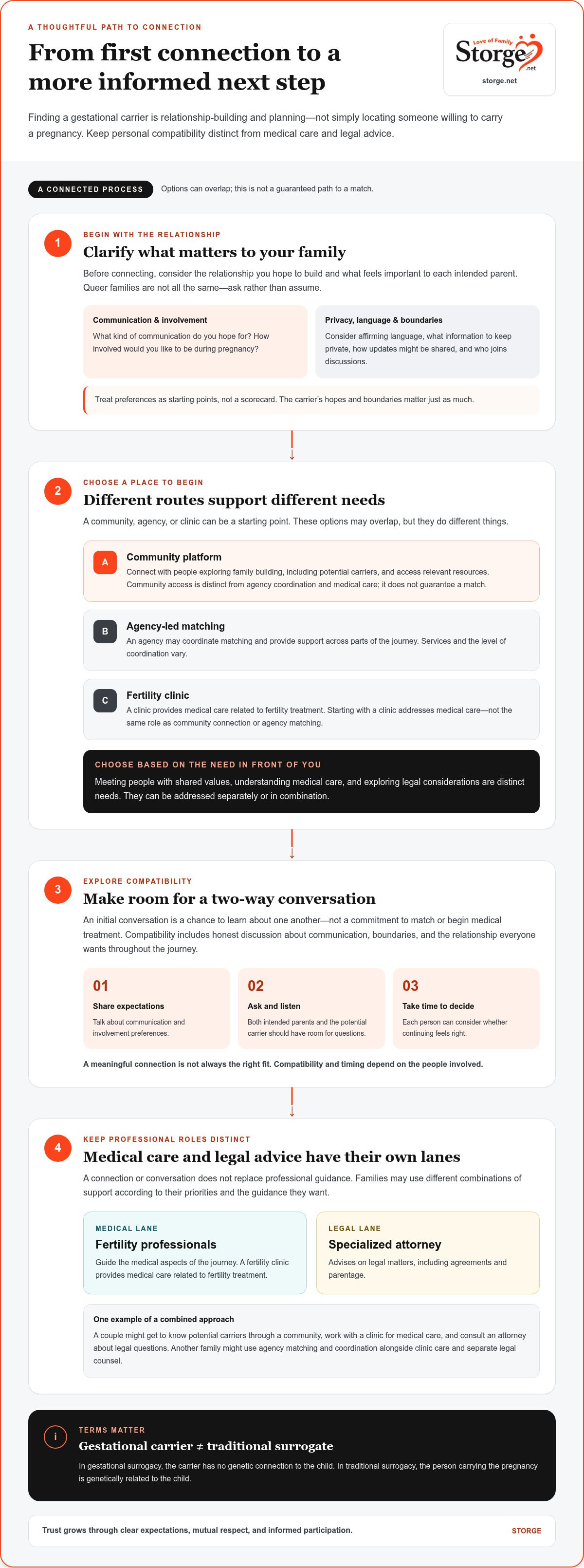
A gestational carrier carries a pregnancy for intended parents and, in gestational surrogacy, has no genetic connection to the child. The term “carrier” distinguishes this arrangement from traditional surrogacy, where the person carrying the pregnancy is genetically related to the child. The Surrogacy overview explains these terms and the different roles involved.
Finding a connection is a relationship and planning decision, not a guaranteed outcome. Intended parents and a carrier may get to know each other while considering whether their expectations and communication styles feel compatible. Fertility professionals guide the medical aspects of the journey, while specialized legal counsel advises on agreements and parentage matters. These are distinct parts of the process: a conversation or potential connection is not medical treatment, and neither replaces legal advice.
Keeping the stages distinct can make the search easier to manage. First, consider the relationship you hope to build. Medical decisions and legal agreements belong in conversations with the appropriate professionals. Informed participation from everyone involved matters at every stage.
How can queer couples approach the search inclusively?
Queer intended parents aren’t one family type. They may be couples or individuals, cisgender or transgender, with different relationships to genetics, pregnancy, and parenthood. Don’t assume a couple consists of two men, that both partners want the same role, or that their reproductive plans follow one familiar path. Ask what matters to each person instead of making assumptions.
Before connecting with a potential carrier, consider what language feels affirming, what information you want to keep private, and how involved you hope to be during the pregnancy. You may want regular communication, a particular approach to sharing updates, or clarity about who participates in discussions. Treat these preferences as starting points, not a scorecard. The carrier’s hopes and boundaries matter just as much.
Where Queer Couples Can Begin Connecting with a Surrogate Mother
There isn’t one route that suits every family. Some intended parents start by meeting people through a community; others explore agency-led matching or begin with a fertility clinic. These options can overlap, but they serve different purposes. Consider the kind of connection and coordination you want instead of assuming one pathway is right for everyone.
What role can a community platform play?
A community platform can connect intended parents with people exploring family building, including potential gestational carriers, and provide relevant resources. It can be a place to start conversations and learn about different experiences. Community access is distinct from agency coordination and medical care, and it doesn’t guarantee a match. A connection may develop, but compatibility and timing depend on the people involved.
Storge PLUS provides membership access to a trusted LGBTQ+ family-building community that includes gestational carriers, donors, and verified resources. Storge also connects members with referrals to fertility clinics and specialized attorneys. These resources support different parts of the process: the community helps members make connections, while clinics and attorneys provide medical care and legal representation. For a broader look at the family-building journey, explore this gay surrogacy guide.
How do agencies, clinics, and legal professionals differ?
An agency may coordinate matching and provide support across parts of a surrogacy journey, though services and the level of coordination vary. A fertility clinic provides medical care related to fertility treatment. An attorney advises on legal matters, including agreements and parentage. Understanding these roles helps you identify which kind of support fits each need.
For example, a couple might use a community to get to know potential carriers, work with a clinic for medical care, and consult an attorney about legal questions. Another family might choose agency matching and coordination alongside clinic care and separate legal counsel. The right combination depends on the family’s priorities, existing relationships, and the guidance they want.
As you consider where to begin finding a surrogate mother for queer couples, be specific about what support you need first. Is your priority meeting people with shared values, learning about the medical process, or understanding legal considerations? You can address these needs separately. A community connection and professional referrals can support different parts of the search. If connecting with an affirming network feels like a helpful first step, explore Storge’s LGBTQ+ family-building community.
How to Assess Compatibility Before Moving Toward a Match
Compatibility isn’t a scorecard, and no conversation can guarantee how a relationship will unfold. It’s a chance for intended parents and a potential carrier to consider whether their expectations, communication styles, and boundaries can work together respectfully. Asking for more time, raising further questions, or deciding not to continue can all be thoughtful outcomes. An early connection doesn’t need to become a commitment.
Which expectations are helpful to discuss early?
Talk about practical communication preferences as well as the hopes behind them. One person may prefer regular text check-ins, while another may want fewer updates or conversations scheduled in advance. Neither preference is automatically better. The aim is to understand whether you can agree on an approach that feels considerate to everyone.
Give privacy the same attention. Discuss what each person is comfortable sharing, with whom, and how family or friends might be included in conversations. These prompts can help:
- How often would you ideally communicate, and which channels feel comfortable?
- Are there topics you’d prefer to discuss only at a particular time or with professional support?
- What information about the journey feels private, and who may be told?
- What kind of involvement do you each hope for, and what boundaries would help you feel respected?
Invite each person to describe their hopes and concerns in their own words. Listen for what they mean, not only whether their answer matches your initial preference. Expectations can be clarified and revisited as the relationship develops.
How can the process remain affirming and balanced?
Affirmation is part of compatibility. Use each person’s stated name and pronouns, and ask what terms they prefer for the intended parents, carrier, and future child. A respectful foundation includes recognizing both parents and their family structure. Queer families aren’t interchangeable, and each may have different relationships to genetics, pregnancy, disclosure, and family involvement.
Don’t use a carrier’s identity, family structure, or stated motivation as a shortcut for judging compatibility. Focus on what each person says they want and whether expectations can be discussed openly. Give intended parents the same consideration: each partner should have room to speak, ask questions, and express their priorities.
Finding a surrogate mother for queer couples is a mutual process, not a one-sided selection. Each person should be able to take time, ask for clarification, or decline without pressure. Independent medical and legal guidance can help intended parents and carriers make informed decisions about those parts of the journey, separately from deciding whether the personal connection feels right. Compatibility includes making room for honest choices, including the choice to wait.
Prepare for the First Conversation with a Potential Gestational Carrier
A little preparation can make the first conversation feel less like an interview and more like a chance to learn about one another. You don’t need to settle every question beforehand. Come with shared priorities, a few open-ended prompts, and a willingness to listen without rushing toward a decision.
What should intended parents clarify before reaching out?
If you’re parenting as a couple, talk together first. Identify what you both want to share, where your hopes differ, and which topics you’d prefer to discuss privately before raising them with someone new. Agree on which personal details feel comfortable to share at this stage. You can be genuine without disclosing everything at once.
This simple preparation sequence can help keep the conversation focused:
- Reflect. Consider what you hope the relationship with a carrier could feel like and what you’re still unsure about.
- Agree on priorities. Decide which subjects you want to raise together, while leaving room for each partner to speak in their own words.
- Prepare questions. Choose open-ended prompts about communication, boundaries, and hopes for involvement, such as, “What helps you feel comfortable staying in touch?”
- Listen. Give the other person time to answer. Note what you’d like to understand better instead of treating the conversation as a checklist.
Make the conversation two-way. Invite the carrier to ask about your family, communication preferences, values, or hopes for the journey. You might say, “What would you like to know about us?” That makes room for her questions and recognizes that her comfort and decision matter, too.
How can the first conversation stay respectful?
Start with introductions. Use each person’s stated name, pronouns, and preferred family terms. Let people describe their own experiences instead of assuming what they want or believe. A pause is welcome, as is saying, “I’d like to think about that before I answer.” The goal is to understand each other, not reach an agreement in one sitting.
Keep early questions focused on the relationship and shared expectations. Leave private medical details for the appropriate professional process, since personal conversation and medical screening are different. Medical professionals guide clinical questions, and legal counsel advises on agreements and parentage. For more context on the legal side, see this guide to LGBTQ family law attorneys.
Finding a surrogate mother for queer couples includes making space for an unhurried first conversation, not just preparing the right questions. Either party can decide not to continue, without pressure or blame. If an affirming family-building community would help you prepare for these conversations, explore Storge’s LGBTQ+ community.
How Storge Supports Queer Couples Seeking a Gestational Carrier
Finding a surrogate mother for queer couples can involve more than looking for a potential carrier. Intended parents may also want an affirming community, relevant information, and connections to professionals who understand different parts of family building. Storge offers Storge PLUS membership, which provides access to a family-building community and resources.
What can Storge’s community access help with?
Storge PLUS gives members access to a trusted LGBTQ+ family-building community that includes gestational carriers and donors, along with verified resources. Members can learn from people connected to family building and begin making connections. A community connection doesn’t guarantee a match, compatibility, or timeline. Each person decides whether a connection feels right and whether to continue the conversation.
Different needs call for different professional support. Storge connects members with referrals to fertility clinics and specialized attorneys. Clinics provide medical care, while attorneys provide legal advice and representation. Members can use these referrals alongside community access as they explore the parts of the journey relevant to them.
Keeping each resource’s role clear can help you plan without expecting one resource to handle every part of the journey. You might use community access to explore potential connections, clinic referrals to find medical support, and attorney referrals to connect with counsel for legal questions. Consider each option as your needs become clearer.
What are the next steps for exploring membership?
If community access feels like a useful starting point, learn about Storge PLUS membership and consider whether it fits your needs. You can explore the community and resources without assuming that joining will lead to a carrier match or a specific outcome. Membership gives you access to connections and relevant information as you consider your next steps.
You don’t need every decision settled before looking for support. Some families begin by learning about the process; others are ready to connect with potential carriers or explore professional referrals. Your priorities may change as you learn more. Decide what feels helpful now and take the next step when you’re ready. Your family-building path can move at your pace.
Take Your Next Step at a Pace That Feels Right
Finding a surrogate mother for queer couples doesn’t require having every answer before you begin. A useful next step might be writing down what you hope the relationship will feel like, choosing the questions that matter most to your family, or learning more before you reach out. Give yourselves room to move thoughtfully. Readiness can look different for each person and family.
As you consider what support would help, choose a step that leaves room for your priorities and a potential carrier’s voice. You don’t need to rush into a decision to make progress. Building a family is personal, and trust grows through care, openness, and time.
If you’d like an affirming space for your family-building journey, explore the Storge PLUS community. Learn about membership and take a practical next step toward connecting with community and family-building resources.
Frequently Asked Questions
Is surrogacy legally available to queer couples in every U.S. state?
Surrogacy laws and legal protections differ by state, so there isn’t one uniform answer that applies nationwide. State rules may affect whether an arrangement is recognized and how intended parents establish legal parentage. Before committing to a plan, consult an attorney experienced in reproductive law who can explain the current rules relevant to your circumstances. A fertility clinic or community platform can’t replace state-specific legal guidance.
Can a gestational carrier be genetically related to the baby?
No. In gestational surrogacy, the carrier isn’t genetically related to the baby. This distinguishes gestational surrogacy from traditional surrogacy, where the person who carries the pregnancy is also genetically related to the child. If you’re discussing a possible arrangement, clarify which type is being considered with fertility professionals and legal counsel. The terms describe different roles and can involve different medical and legal considerations.
How long does it take to find a surrogate mother?
There’s no reliable timeline that applies to every family. Finding a surrogate mother for queer couples can take different amounts of time depending on the search pathway, individual preferences, and whether both parties feel comfortable proceeding. A promising first conversation isn’t a confirmed match, and a match doesn’t mean treatment starts immediately. Build flexibility into your plans, and avoid making major commitments based on an assumed timetable.
Can intended parents meet a gestational carrier before deciding to match?
Yes, intended parents and a potential carrier can have conversations to learn about one another before deciding whether to move forward. These meetings can help each person understand expectations, communication preferences, and whether they want to continue exploring a connection. A conversation doesn’t obligate either party to match. Take time to reflect afterward, and make sure everyone has a genuine opportunity to ask questions and decide freely.
What happens if a potential carrier match does not feel right?
You can decide not to move forward. A mismatch in expectations, communication preferences, or comfort level doesn’t mean either person did something wrong; it may simply mean the relationship isn’t the right fit. Share your decision respectfully, following any process or agreements already in place. If you’re unsure, pause and seek guidance from the relevant professionals rather than feeling pressured to continue.
Can transgender or nonbinary people pursue gestational surrogacy?
Yes. Transgender and nonbinary people can explore gestational surrogacy, and their identity alone doesn’t determine whether it’s an option. Individual medical circumstances, reproductive goals, and the laws relevant to the arrangement can shape the path. A fertility professional can discuss medical considerations, while an attorney experienced in reproductive law can explain legal questions. Use each person’s stated name, pronouns, and family terms throughout the process.
Do queer couples need an attorney for a surrogacy journey?
It’s strongly advisable to get guidance from an attorney experienced in reproductive law. Surrogacy and parentage rules vary by state, and legal questions may depend on the specific arrangement and the people involved. An attorney can explain the implications of agreements and parentage steps for your situation. Referral services can help connect you with specialized counsel, but a referral itself isn’t legal advice or representation.


