

What if the right legal support depends less on finding a general family-law attorney and more on how you plan to build your family? For LGBTQ+ intended parents, an LGBTQ friendly fertility attorney referral can be a useful starting point because donor conception, reciprocal IVF, gestational-carrier arrangements, and parentage questions can raise different legal considerations. The rules may also vary by state, so it can be difficult to know where to begin.
You deserve guidance that recognizes your family structure and the path you’re considering. This article explains what specialized fertility-law support may address, what details about your plans can help shape a referral, and why state-specific legal experience matters. Storge connects LGBTQ+ individuals and couples across the United States with referrals to specialized legal representation. The platform is a bridge to resources, not a provider of legal advice or in-house representation.
Whether your plans are still taking shape or you’re preparing for a specific next step, knowing what to share can make the process more manageable. A thoughtful referral starts with your family-building path and connects you with legal support relevant to the questions it may raise.
Key Takeaways
- An LGBTQ friendly fertility attorney referral can connect your family-building plan with relevant specialized legal representation.
- Different paths to parenthood can raise different legal questions. Describe your intended role and the steps you’re considering.
- Assess referral fit by considering relevant family-building experience, affirming communication, and familiarity with the jurisdictions involved.
- Prepare by outlining your plan, noting who may be involved, and gathering details about treatment or arrangements already decided.
- Storge connects LGBTQ+ individuals and couples across the United States with specialized legal representation referrals as part of a wider family-building resource community.
Why an LGBTQ-Friendly Fertility Attorney Referral Matters
Seeking legal guidance is a practical part of planning for a family, not a sign that something is wrong. An early conversation can help you understand which legal questions relate to your plans and where specialized support may be useful. The right starting point depends on your path to parenthood, the people involved, and the jurisdictions connected to your arrangements.
An LGBTQ friendly fertility attorney referral connects you with legal representation experienced in matters relevant to LGBTQ+ family building and assisted reproduction. It can narrow your search from general family-law support to someone whose work relates to your questions. Donor conception, IVF, and surrogacy can involve different participants and documents, so a referral is more useful when it reflects your intended path rather than assumptions about gender, biology, or relationship status.
Storge connects LGBTQ+ individuals and couples across the United States with fertility resources, including referrals to specialized legal representation. A referral can point you toward a relevant legal professional. Your attorney is the person who will learn the details of your circumstances and provide legal advice.
What does a fertility attorney referral help you find?
A referral connects you with legal representation whose experience may be relevant to your family-building plan. An affirming approach also means your family structure is treated with respect, and you can discuss your plans without having to explain or defend who your family is. A referral opens a door to legal support; it is not itself legal advice or representation. The attorney provides those services directly.
Why can family-building plans have legal questions?
Legal questions may arise at different stages, from discussing donor arrangements to reviewing assisted-reproduction documents or planning for parentage. For a general overview of options and related issues, see LGBTQ+ reproduction methods and legal considerations. The issues that matter depend on your plan and circumstances, not on one universal checklist.
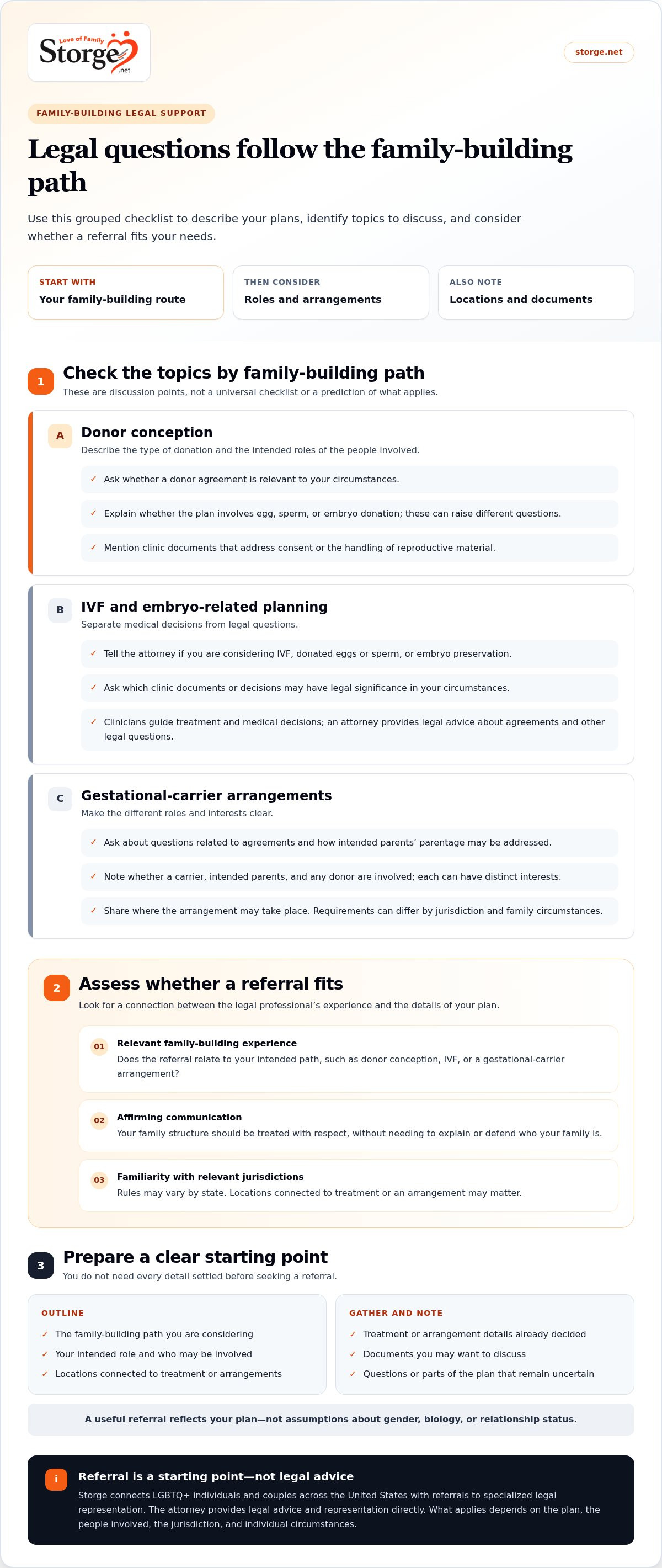
For example, people using donor conception may want to ask whether an agreement is relevant to their circumstances. IVF plans may involve clinic documents, while a gestational-carrier arrangement can raise questions about agreements and establishing parentage. These are topics to discuss with an attorney, not steps that apply to every family or guarantee a particular result. Requirements vary by jurisdiction and individual situation. The location connected to treatment or an arrangement may matter, so specialized legal guidance can help identify which questions apply to your circumstances.
You don’t need every detail settled before seeking a referral. Explain what you’re considering, who may be involved, and what remains uncertain. That gives the referral process a clear starting point and helps focus the conversation on legal support relevant to your family-building path.
Which Fertility-Law Needs Can an LGBTQ+ Attorney Referral Address?
Start with the family-building route, rather than assumptions about someone’s gender, relationship status, or biological connection to a child. A referral should reflect the role you expect to have, the people involved, and the arrangements you’re considering. Someone pursuing donor conception may have different questions from an intended parent working with a gestational carrier.
Legal questions depend on the family-building arrangement, the people involved, and the jurisdiction connected to it. An LGBTQ friendly fertility attorney referral can connect you with legal representation whose experience relates to those details. The referral doesn’t determine what applies in your situation. The attorney can assess that with you.
Donor conception, IVF, and embryo-related planning
For donor conception, a conversation with legal counsel may address whether a donor agreement is relevant and how the intended roles of the people involved are documented. Egg, sperm, and embryo donation can raise different questions, so don’t assume one approach fits all three. Clinic documents may also be worth discussing, particularly if they address consent or the handling of reproductive material.
Legal support is distinct from medical care. A fertility clinic and its clinicians guide treatment and medical decisions; an attorney provides legal advice about agreements and other legal questions. If you’re considering IVF, using donated eggs or sperm, or preserving embryos, describe your plan and ask which documents or decisions may have legal significance in your circumstances. The legal aspects of LGBTQ+ assisted reproductive rights also vary across family-building paths, as the Academy of Adoption and Assisted Reproduction Attorneys explains.
Gestational surrogacy and establishing parentage
Gestational-carrier arrangements can raise questions about agreements and how intended parents’ parentage may be addressed. The carrier, intended parents, and any donor can have distinct interests. A legal professional can help clarify which questions relate to each person’s role. This is not a single national process: applicable requirements can differ by jurisdiction and family circumstances.
When explaining a surrogacy plan, note where the arrangement may take place, who is participating, and which decisions have already been made. These details can help shape a relevant referral without assuming that one contract, court process, or outcome applies everywhere. A lawyer can explain which legal steps may be appropriate for the particular arrangement and jurisdiction.
Other routes, such as reciprocal IVF or plans involving embryos created with donated genetic material, may combine several kinds of questions. You don’t need to resolve them all before seeking a referral. Storge connects LGBTQ+ individuals and couples with specialized legal representation referrals, helping turn a family-building question into a focused starting point. Explore Storge’s fertility legal referral resources as you consider which path best reflects your plans.
How to Assess Whether an LGBTQ-Friendly Fertility Attorney Referral Fits
A referral is most useful when it reflects the plan you’re considering, not just a broad label such as “fertility law” or “family law.” Your questions may depend on whether you’re pursuing donor conception, fertility treatment, or gestational surrogacy, as well as the role you’ll have. Use the comparison below to identify what you want a referral to take into account. These are possible topics to discuss, not steps that apply to every family.
| Family-building path | Possible legal topics | Details that help clarify referral needs |
|---|---|---|
| Donor conception | Donor agreements and questions about participants’ intended roles | Whether the donor is known, and whether eggs, sperm, or embryos are involved |
| Fertility treatment, including IVF | Clinic-related documents, consent, and questions connected to reproductive material | The treatment route you’re considering and any documents already provided |
| Gestational surrogacy | Potential agreements and parentage planning | The intended parents’ roles, other participants, and jurisdictions connected to the arrangement |
Match the referral to your family-building path
Two people using the same broad route may still have different questions. An individual considering donor conception may want to understand how the donor’s role is addressed. A couple pursuing IVF may have questions about clinic forms and how each person’s intended role is recorded. Intended parents considering a gestational carrier may need to discuss different topics. Describe your actual plan, including what’s decided and what’s still open, rather than relying on a general label to explain your needs.
Recognize inclusive and relevant legal support
Relevant experience means familiarity with the type of family-building arrangement you’re considering. Affirming communication means the attorney uses respectful language, recognizes your family structure, and makes room for questions without assumptions. Jurisdictional fit matters because legal requirements can vary based on the circumstances and places connected to a plan. A referral should help account for these factors, not promise a particular attorney relationship or legal outcome.
A well-matched referral reflects your family-building path, respects your family structure, and takes jurisdiction into account. To prepare for a conversation about fit, note your planned route, the people involved, key locations, and the questions you most want answered. You can also explore this guide to finding an LGBTQ family law attorney for broader considerations when seeking legal support.
Storge connects LGBTQ+ individuals and couples with referrals to specialized legal representation. Sharing these details can make the referral conversation more specific to your needs. The attorney is responsible for assessing your circumstances and providing legal advice.
How to Prepare for an LGBTQ Fertility Attorney Referral
You don’t need a complete plan or a folder of paperwork to begin. A few clear notes can make an LGBTQ friendly fertility attorney referral more relevant to your situation and help you explain the support you’re seeking. Keep the preparation simple and share only what’s needed to understand your referral needs.
- Outline your family-building plan. Briefly name the route you’re considering, such as donor conception, IVF, or gestational surrogacy. Note your current stage, whether you’re exploring options or have started making arrangements.
- Identify the question you want help with. Is it an agreement, a clinic document, or parentage planning? If you’re unsure, write down the point that feels least clear.
- Organize the basics. List known participants, the treatment or arrangement you’re considering, and decisions already made. Note the jurisdictions connected to the plan, since legal questions can depend on the circumstances and location.
- Use the referral as a starting point. Share a concise summary, then let the attorney explain what information is useful for a legal discussion.
Summarize your plans and immediate legal questions
A short description is enough to begin: “We’re considering IVF with donated sperm and want to understand whether there are legal questions about the documents involved.” Or: “I’m exploring a gestational-carrier arrangement and have questions about parentage planning.” Then list what remains unresolved. You don’t need to provide medical records, signed agreements, or other sensitive documents in an initial referral description.
Protect your privacy as you prepare. Start with general details that explain your family-building route and question. Before sharing sensitive information, understand how the referral process works and who will receive it. Storge PLUS provides access to a community and family-building resources, including resources that can support you as you organize your next steps.
Understand what happens after a referral
A referral introduces you to specialized legal representation; it isn’t legal advice or a promise of a particular result. The referred attorney can discuss your circumstances, answer jurisdiction-specific questions, and explain whether they can represent you and what that relationship would involve. Representation begins only as defined between you and the attorney, not simply because a referral was made.
Keep questions about applicable requirements, agreements, and parentage for qualified legal counsel familiar with the relevant jurisdiction. A useful summary helps start that conversation, but it doesn’t replace an attorney’s assessment of your specific circumstances.
When you’re ready to connect your family-building question with specialized legal representation, explore Storge’s fertility attorney referral resources.
Find LGBTQ-Inclusive Fertility Attorney Referrals Through Storge
Legal questions can be one part of a much larger family-building plan. Storge is an online platform connecting LGBTQ+ individuals and couples across the United States with fertility resources, including referrals to specialized legal representation. A referral can help you move from a specific question, such as whether your donor-conception plan raises legal considerations, toward a conversation with an attorney whose work relates to family building.
A referral is one resource, not the whole journey. You may also be looking for a fertility clinic, searching for a donor, or exploring a gestational-carrier arrangement. Storge brings these family-building resources together, so you can consider a legal question alongside the path you’re planning. This can be useful whether you’re still exploring options or have begun shaping a particular arrangement.
A referral connection within a wider support community
Storge connects LGBTQ+ families with specialized legal representation referrals and fertility-related resources. Through Storge PLUS, members can access a trusted community of donors and gestational carriers, along with verified resources. This wider context supports different family-building paths without assuming that one route, family structure, or legal question fits everyone.
For example, someone exploring donor conception may be looking for donor-related resources as well as legal representation referrals. Intended parents considering a gestational carrier may have questions about legal support and the people and resources involved in their plans. Fertility clinic referrals are another part of Storge’s broader family-building support. Storge PLUS membership provides access to this vetted community and a starting point for exploring connections in one supportive setting.
Each resource has a distinct role. Storge connects you with relevant resources and specialized legal representation referrals; it doesn’t act as a law firm or provide in-house legal advice. An attorney provides legal advice and representation directly and can assess your situation, including jurisdiction-specific questions. A referral is an introduction, not a guarantee of representation or a particular outcome.
Take a clear next step with Storge
Begin with the question you have today. It may be a concern about an agreement, uncertainty about which legal topics relate to your family-building route, or a need to understand what kind of support could be relevant. You don’t need to have every decision made before exploring resources. A concise description of your plan and what feels unclear can make your next conversation more focused.
If you’re ready to explore family-building connections and resources, explore Storge PLUS resources. It’s a welcoming place to consider support that may fit your path, while an attorney remains the professional who can advise you on your legal circumstances.
Take Your Next Step With Confidence
You don’t need to have every decision settled before moving forward. A clear first question, even “What should I understand about my plan?”, can help turn uncertainty into a more focused conversation. Your needs may change as your family-building plans take shape. It’s okay to seek support at the point you’re at now.
An LGBTQ friendly fertility attorney referral can connect your plans with legal representation relevant to your needs. From there, you can explore the questions that matter to your family with an attorney and draw on resources and community connections that support your wider journey.
Explore Storge PLUS for family-building resources, including connections with donors, gestational carriers, fertility clinics, and specialized legal representation referrals. Explore Storge PLUS family-building resources and take the next step at a pace that feels right for you. Your path can begin with one question, and you deserve support that respects where it leads.
Frequently Asked Questions
What does an LGBTQ-friendly fertility attorney referral include?
It connects you with legal representation whose experience may relate to LGBTQ+ family building and your planned route to parenthood. The referral itself isn’t a legal consultation, attorney-client relationship, or promise of representation. For example, you might describe plans involving donor conception and ask for a connection relevant to that topic. The attorney can discuss your circumstances, explain their role, and provide legal advice if you establish a representation relationship.
Do LGBTQ+ parents need a fertility attorney?
Not every LGBTQ+ parent has the same legal needs, and there isn’t one answer that fits every family. You may want to discuss legal questions if your plan involves a donor, fertility treatment, a gestational carrier, or establishing parentage. For instance, if you’re unsure how a clinic document relates to your family-building plan, an attorney can help explain its legal significance in your circumstances. A qualified lawyer can advise whether you need legal support.
Can one attorney help with both fertility treatment and parentage questions?
Possibly. An attorney with relevant experience may be able to discuss more than one issue, such as treatment-related documents and parentage planning. The scope depends on the attorney’s practice, your circumstances, and the jurisdictions involved. At the start of a conversation, describe each topic you want help with, including any locations connected to the plan. The attorney can explain what they can address and whether another professional’s input may be needed.
How do I prepare for a fertility attorney referral?
Write a brief description of your family-building route, your current stage, the people involved, and the main question you want answered. You might note that you’re considering IVF with donated sperm and want to understand which documents to discuss with counsel. Keep a separate list of unresolved questions. You don’t need to send sensitive medical records or legal documents just to explain your referral needs.
Are fertility and parentage laws the same in every state?
No. Legal requirements can differ by jurisdiction, and the rules relevant to a family may depend on the arrangement and circumstances. A plan involving treatment or a gestational carrier can raise questions tied to more than one location. Don’t assume that information about one state applies elsewhere. An attorney familiar with the relevant jurisdiction can explain which rules may affect your situation and which questions need individual legal guidance.
Does Storge provide legal advice or represent clients?
No. Storge connects LGBTQ+ individuals and couples with referrals to specialized legal representation; it isn’t a law firm and doesn’t provide in-house legal advice or represent clients. The attorney you connect with is responsible for discussing your legal questions and explaining whether they can represent you. A referral is an introduction, so it doesn’t by itself establish an attorney-client relationship or determine the outcome of a legal matter.
Can a single LGBTQ+ person use a fertility attorney referral?
Yes. You don’t need to be part of a couple to explore an LGBTQ friendly fertility attorney referral. A single person considering donor conception, fertility treatment, or another family-building route may have questions about agreements, documents, or future parentage planning. Start by explaining your intended role and plans. That helps make the legal conversation specific to you, rather than based on assumptions about relationship status.


