

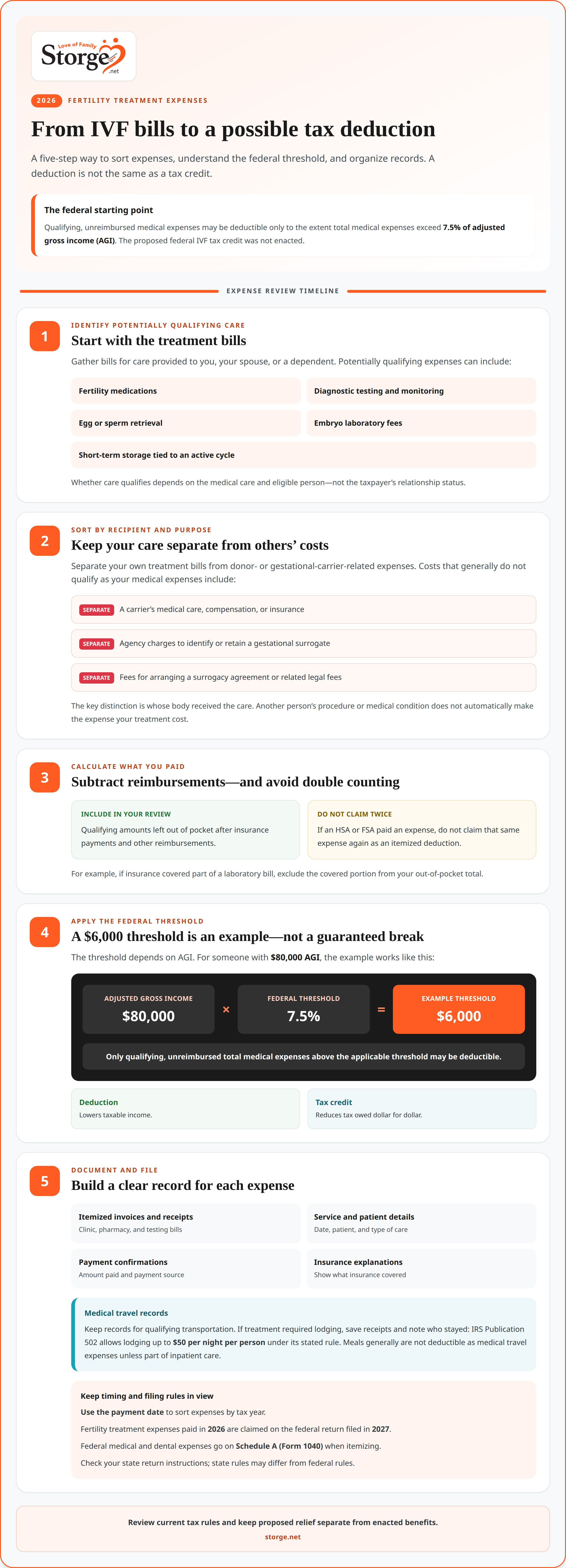
A $6,000 IVF deduction isn’t a flat tax break available to everyone. For tax credits for fertility treatments in 2026, the key federal rule is that qualifying, unreimbursed medical expenses may be deductible only to the extent they exceed 7.5% of adjusted gross income, according to the Internal Revenue Service. A proposed federal IVF tax credit wasn’t enacted, so the deduction rules are the relevant starting point for 2026.
It’s understandable to want a clear answer when treatment expenses can involve many different kinds of care. The $6,000 figure is a threshold example for someone with $80,000 in adjusted gross income, not a guaranteed deduction or tax credit. What matters is which costs qualify, how much you paid out of pocket, and whether you itemize.
This guide explains which fertility treatment expenses may count, which donor and surrogacy-related costs generally don’t, and what records can help you sort the expenses. It also clarifies the difference between a tax credit and a deduction, so you can approach your 2026 tax planning with more confidence.
Key Takeaways
- Separate eligible, unreimbursed treatment expenses from costs that may not count before estimating a deduction.
- Don’t assume surrogate or donor-related payments qualify as your own medical expenses; their tax treatment can differ from treatment performed on you.
- Keep itemized receipts and records showing what you paid, when you paid it, and whether insurance or tax-advantaged funds covered any portion.
- For 2026, distinguish current tax rules from proposed or unenacted relief, and consider whether state rules affect your filing.
Potentially deductible fertility treatment expenses
For tax credits for fertility treatments 2026, begin by separating a possible deduction from a tax credit. The person treated, the type of care, and the amount left after reimbursement all matter.
-
Identify Potentially Deductible Expenses
Gather bills for fertility medications, diagnostic testing, monitoring, egg or sperm retrieval, embryo laboratory fees, and short-term storage tied to an active cycle. According to the Internal Revenue Service, unreimbursed qualifying IVF medical expenses are deductible only to the extent total medical expenses exceed 7.5% of adjusted gross income.
Same-sex couples and single people may be able to claim qualifying expenses for care provided to themselves. Federal rules also cover care for a spouse or dependent. Eligibility depends on whether the treatment qualifies as medical care for an eligible person, not on the taxpayer’s relationship status. A deduction lowers taxable income; a credit reduces tax owed dollar for dollar.
-
Check State Credits and Deductions
For the 2026 U.S. tax year, use current tax rules because the proposed IVF tax credit was not enacted. A federal proposal doesn’t establish a state benefit, and state return rules may differ from federal rules.
Review the instructions for the state return you file, looking for fertility-specific credits or rules for medical expenses. Don’t assume a general medical deduction is a fertility tax credit. Understanding tax credits for fertility treatments 2026 also means distinguishing enacted benefits from proposals that never became law.
-
Account for Insurance and Reimbursements
Calculate what you paid after insurance payments and other reimbursements. Only unreimbursed qualifying expenses can count toward the federal medical-expense deduction threshold. For example, if insurance covered part of a laboratory bill, exclude that portion from your out-of-pocket total.
Keep health savings account and flexible spending account payments separate. Don’t claim an expense again as an itemized deduction if those funds paid it. For tax credits for fertility treatments 2026, tracking each payment source helps prevent counting the same treatment expense twice.
Surrogacy and donor expenses that generally do not qualify
- Separate your own treatment bills from payments connected to another person’s care. Determination letter 202518023 allowed deductions for IVF procedures performed on the taxpayers, but denied deductions for a gestational carrier’s medical care and compensation. The distinction is whose body received the care, not whether the expense supported a family-building plan.
Review each bill by service and recipient. Surrogate compensation, insurance, medical care for someone else, and related legal fees generally don’t qualify as your medical expenses. Care provided to a donor follows the same principle: another person’s medical condition or procedure does not automatically make the cost your treatment expense.
- Classify agency and legal charges separately from clinical procedures. Payments to identify or retain a gestational surrogate generally don’t qualify as medical expenses. Neither do fees for arranging a surrogacy agreement or compensating the carrier. Don’t combine these costs with your own IVF clinic bills in one deduction total.
IRS Publication 502 excludes payments for identifying, retaining, compensating, and providing medical care for a gestational surrogate. Under IRC §213 reasoning, the central question is whether the expense represents medical care for the taxpayer. A dependent’s qualifying care is a separate category, but another person’s role in treatment doesn’t by itself make their expenses your dependent’s medical costs.
- Create a brief summary that groups expenses by recipient and purpose. List your own IVF procedures separately from donor or carrier care, compensation, insurance, agency charges, and legal fees. Keep service descriptions and payment records with each invoice so the categories remain clear during tax preparation.
These tax distinctions don’t determine which family-building path is right for you. If donor options are part of your planning, Storge’s donor egg and sperm search offers a resource for that separate decision. Keep any search or arrangement costs distinct from medical expenses when organizing your records.
Records and receipts for tax filing
Organize receipts by treatment date, service, and payment source before preparing returns. For federal and state filing, report eligible expenses using each return’s applicable instructions; federal medical and dental expenses go on Schedule A (Form 1040).
-
Gather Records and Receipts
Gather itemized clinic invoices, pharmacy receipts, diagnostic testing bills, and payment confirmations. Keep records showing the service date, patient, and type of medical care, such as testing related to an infertility diagnosis. Save insurance explanations of benefits with each bill to identify the amount you paid.
Include records for qualifying transportation that was primarily for and essential to medical care. If treatment required lodging, keep receipts and note who stayed; IRS Publication 502 allows lodging up to $50 per night per person under its stated rule. Meals generally aren’t deductible as medical travel expenses unless they’re part of inpatient care.
-
Claim Expenses on Tax Returns
Sort records by tax year, using the date you paid each expense. Fertility treatment expenses paid in 2026 are claimed on the federal return filed in 2027. Add only eligible, unreimbursed amounts to your medical-expense analysis, and calculate whether total medical expenses exceed the applicable adjusted-gross-income threshold.
On the federal return, report deductible medical and dental expenses on Schedule A (Form 1040). For a state return, follow that state’s filing instructions and separate state-specific treatment from federal calculations. Don’t assume a state uses the same eligibility rules or reporting lines.
- Use a simple expense summary with columns for payment date, provider, patient, service, gross amount, insurance reimbursement, and final out-of-pocket amount. Match each entry to its receipt or statement. This makes it easier to trace a claimed expense to its source and catch duplicate claims.
Separate expenses paid with health savings account or flexible spending account funds. The IRS doesn’t allow you to deduct an expense again if those funds paid it. Keep supporting records with your tax documents in case you need to explain how you calculated the eligible total.
2026 State Tax Credits for Fertility Treatments
For the 2026 U.S. tax year, use current tax rules because the proposed IVF tax credit was not enacted. Review your state return separately from federal rules before counting fertility expenses.
- Start with the state where you file, then locate that state’s 2026 income tax instructions. Look for sections addressing medical expenses, fertility treatment, or tax credits. A proposed federal credit does not establish a state benefit, so don’t treat a bill or proposal as an available deduction.
Distinguish a tax credit from a deduction in your notes. A credit reduces tax owed, while a deduction reduces taxable income. If state instructions describe a medical-expense deduction, follow its eligibility and calculation rules instead of assuming IVF costs qualify for a separate credit.
- Check whether state instructions address fertility care specifically or refer broadly to medical expenses. Note the tax year, eligible taxpayer, qualifying treatment, and any stated limits. If the state form provides no fertility-specific credit, don’t create one by transferring a proposed federal benefit to the state return.
Keep the state’s wording with your return records. An instruction that covers medical expenses generally, for example, may require a different calculation from one that names a fertility credit. Classification matters because credits and deductions affect a return differently.
- Compare the state’s treatment with your federal calculation, but maintain separate totals. A cost treated one way on a federal return may be subject to different state instructions. Record the state, tax year, and relevant form section beside each calculation to avoid mixing rules.
If you moved or are filing for part of a year, organize expenses by payment date and the state return involved. Don’t assume one state’s rules apply to another. Follow the instructions for each return you must prepare, and keep supporting receipts with the corresponding calculation.
- Save a short decision note stating whether the state instructions provide a fertility-specific credit, a general medical deduction, or no applicable treatment. Include the form name and tax year. This helps explain how you classified expenses without relying on memory when filing.
For 2026, the practical next step is to follow enacted state rules, not proposed federal relief. Keep any state-specific amount separate from federal medical expenses, and claim only what the applicable return instructions allow.
Storge: Fertility Clinic Referrals
Storge offers Fertility Clinic Referrals for LGBTQ+ individuals and couples exploring fertility care. Once you’ve reviewed which expenses may qualify for tax treatment, a clinic referral can help you take the next step in considering care options.
Storge also offers Donor Egg / Sperm Search and Attorney Representation Referrals for people whose family-building plans involve these resources. They can support different parts of the journey, while your tax records and filing decisions remain separate from referral services.
If you’d like support exploring fertility clinic referrals, contact Storge.
Take Your Next Step With Clarity
Planning for fertility care involves more than a tax return. As you consider tax credits for fertility treatments in 2026, keep tax decisions distinct from the personal choices about how you hope to build your family. A clear next step can be exploring the kinds of support that fit your plans, without feeling pressured to decide everything at once.
Storge offers Fertility Clinic Referrals, Attorney Representation Referrals, and Storge PLUS Membership to connect LGBTQ+ individuals and couples with fertility resources. These options address different needs, from exploring clinic resources to finding attorney referrals.
For questions that arise as you consider how tax matters fit into your fertility plans, contact Storge about fertility tax questions. You can take things one decision at a time, with support that respects your path forward.
Frequently Asked Questions
Is there a $6,000 IVF deduction in 2026?
No. The $6,000 figure illustrates the medical-expense threshold for a taxpayer with $80,000 in adjusted gross income, not a fixed IVF deduction. The deductible amount depends on the taxpayer’s total qualifying, unreimbursed medical expenses and adjusted gross income. Only the amount above the applicable threshold may be deductible when the taxpayer itemizes.
Are there federal tax credits for fertility treatments in 2026?
No enacted federal IVF tax credit applies for the 2026 tax year. H.R. 9333, the IVF for Families Act, proposed a federal credit, but it was not enacted before the 118th Congress ended in January 2025. A proposed credit and a deduction are different: a credit reduces tax owed, while a deduction lowers taxable income.
Which fertility treatments and expenses qualify for tax deductions or credits?
Potentially eligible expenses include care that meets medical-expense rules, such as IVF procedures, fertility medications, diagnostic testing, and monitoring. The care must be for the taxpayer, their spouse, or a dependent. Tie each expense to the specific service and patient, since a general family-building expense is not automatically a deductible medical cost.
Can IVF, IUI, fertility medications, egg freezing, or sperm storage be claimed as medical expenses?
IVF costs and fertility medications may qualify when they meet medical-expense requirements and remain unreimbursed. Temporary egg or sperm storage connected to an active cycle may also qualify for the taxpayer, spouse, or dependent. IUI and egg-freezing costs depend on the specific care and circumstances, so don’t assume every procedure or storage expense is eligible.
What are the 2026 IRS rules and thresholds for deducting fertility treatment costs?
According to the Internal Revenue Service, qualifying unreimbursed medical expenses are deductible only to the extent that total medical expenses exceed 7.5% of adjusted gross income. You generally claim the eligible amount by itemizing medical and dental expenses on Schedule A (Form 1040). Expenses paid during 2026 go on the federal return filed in 2027.
What records and receipts are needed to claim fertility expenses on a 2026 tax return?
Keep itemized provider bills, pharmacy receipts, payment confirmations, and insurance statements showing reimbursements. A useful record identifies the patient, service, provider, and payment date. Separate costs covered by HSA or FSA funds from out-of-pocket spending, since the same expense can’t be deducted twice. Preserve supporting documents with your 2026 tax records.


