
What if the right LGBTQ+ parenthood resource isn’t one perfect directory, but the support that fits your family’s current stage? Navigating LGBTQ parenthood resources can mean moving between fertility information, legal guidance, healthcare, and parenting support while assessing whether each source is current and genuinely affirming.
It can be a lot to sort through. Forms and services don’t always reflect every family structure, and a resource that helped at one stage may not fit the next. Start with your immediate need, then assess each resource for relevance, inclusivity, and credibility.
This guide explains where to begin, how to compare different kinds of support, and how to organize what you find. Use it to build a manageable plan that can adapt as your family grows.
Key Takeaways
- Start with the support your family needs now, then choose a resource category that fits that stage.
- Navigating LGBTQ parenthood resources is easier when you assess each option for its audience, scope, inclusivity, and credibility.
- Track next steps, questions, relevant documents, and follow-up dates in one simple plan.
- Family-building information, fertility clinic referrals, legal representation referrals, hospital searches, and peer connections can support different needs.
- Storge PLUS connects LGBTQ+ people and couples with a community of egg donors, sperm donors, and gestational carriers.
Navigating LGBTQ Parenthood Resources Starts With the Support You Need Now
Family needs change over time, and support that’s useful at one stage may not answer the next question. Someone planning to become a parent might be exploring donor conception, adoption, or surrogacy. A parent preparing for birth, completing an adoption, or handling everyday family life may need different information and connections.
LGBTQ parenthood resources include practical information, professional referrals, and community support. Some focus on family building, such as fertility information or legal referrals. Others relate to pregnancy, birth, healthcare, education, or peer connection as children grow. These categories can overlap, but they serve different purposes. A resource explaining a family-building path, for example, isn’t automatically the right place to take a health or parenting question.
For a broad overview of family structures and paths to parenthood, the article on LGBT parenting surveys options including adoption, surrogacy, and donor insemination. Use general information to orient yourself, then focus your search on the decision or transition in front of you.
Which parenting stage are you navigating?
Name your stage before searching. Are you planning to become a parent, considering a family-building path, pregnant, preparing for birth, pursuing adoption, or looking for help with an everyday parenting need? Your family structure, identity, and path to parenthood can affect which information feels relevant and affirming.
Then choose one immediate priority. You might need to understand an unfamiliar term, find a professional connection, or locate support for a transition. Naming that priority gives your search a clear boundary and helps you judge whether a resource answers the question you actually have.
Why one resource directory rarely answers every question
A directory can provide a useful overview, but legal, clinical, community, and practical resources have different roles. A legal resource addresses different questions from a fertility clinic referral. Peer support can offer connection, but it doesn’t replace professional medical or legal guidance. Your starting point may change as your circumstances and questions change.
A stage-based approach means choosing resources for the decision in front of you, then revisiting your plan as your family’s needs evolve.
To get started, write down the question you want answered in one sentence. Then identify the kind of help that would move it forward: clear information, a professional connection, or the experience of people who understand a similar transition. If your question touches more than one area, list those needs separately instead of expecting one directory to address them all. This turns Navigating LGBTQ parenthood resources into a purposeful next step rather than an open-ended search.
A Resource Map for LGBTQ Families: From Family Building to Parenting
Organize a resource map by what each kind of support can do, not by how many names appear in a directory. Family-building information, clinical care, legal guidance, hospital searches, and peer connection each address different questions. Later, your focus may shift to a child’s health, education, emotional wellbeing, or sense of community. Identifying the category that matches your current need makes it easier to choose a useful next step.
Resource availability and legal processes can vary across the United States, so information that applies to one family or location may not fit another. Use general resources for orientation, and seek professional guidance for decisions that depend on your circumstances.
Resources for planning and welcoming a child
Family-building support can include information about fertility, donor conception, and gestational carriers, as well as connections to fertility clinics and legal representation. Each plays a distinct role: a clinic provides medical care, an attorney provides legal representation, and a donor or gestational carrier community can help people explore potential family-building connections. A hospital search can help families consider where they’d like to receive care. For more context, Storge’s gay surrogacy guide and LGBTQ donor community guide cover two parts of this process.
Storge connects LGBTQ+ individuals and couples with family-building resources, including fertility clinic and attorney representation referrals, hospital searches, and Storge PLUS access to a community of egg donors, sperm donors, and gestational carriers. Explore Storge’s family-building resource platform to find relevant connections. Clinical care and legal representation are provided by the appropriate professionals.
Resources for the everyday realities of parenting
After a child arrives, family questions may have little to do with how the child joined the family. Ongoing support can include affirming healthcare, education resources, emotional wellbeing, and connection with other families. A caregiver preparing for a school conversation may need different support from a parent looking for a healthcare professional or a sense of belonging for their child.
Choose resources based on the child’s needs and your family’s circumstances. Consider the specific concern, who the resource is designed to serve, and whether its guidance fits your situation. A family-building platform can help with connections during that journey, while ongoing healthcare, education, and parenting needs call for resources focused on those areas.
Your map can change over time. You might move from exploring donor options to preparing for birth, then later seek community or school-related guidance. Keep the categories distinct and update your map as questions change. Navigating LGBTQ parenthood resources is easier when you match support to the moment instead of expecting one directory to answer every need.
How to Tell Whether an LGBTQ Parenthood Resource Is a Good Fit
A resource can use inclusive language and still be a poor match for your question. Before relying on a directory, organization, or professional referral, check what it covers, whom it serves, and what role it plays. This quick review helps you assess relevance and trustworthiness without expecting one resource to meet every need.
Check relevance, expertise, and freshness
Start with the resource’s stated focus, not just an LGBTQ+ label. A family-building page may not answer an ongoing healthcare question. For specialized guidance, look for named expertise or a clear explanation of the organization’s role. Check publication or review dates, especially for legal, policy, and medical information, which can change.
- Match it to your question. Does the resource address your current need, such as donor information, legal guidance, or parenting support, rather than a broad topic that only partly applies?
- Identify its audience and scope. Look for a clear description of whom the resource serves, what it covers, and what it doesn’t address. This helps you assess whether it fits your situation.
- Look for relevant expertise. For specialized advice, check whether the author or organization names relevant qualifications or explains its role. A directory, community group, and professional service provide different kinds of support.
- Check freshness. Find a publication, update, or review date. If legal, policy, or medical guidance has no clear date, treat it as a starting point rather than your only source.
- Review access, privacy, and referrals. Consider whether the information is accessible to you, how personal details are handled, and whether referral relationships or sponsorships are explained clearly.
Look for signs of affirming and respectful support
Notice how a resource describes sexual orientations, gender identities, parents, and children. Forms and examples offer practical clues: do they recognize different family structures, or assume every child has one mother and one father? Consider how the organization handles personal information and whether its materials work for your needs.
Affirming language is a useful signal, but it doesn’t by itself show that a resource fits every family. Read beyond a welcome statement and check whether the examples, processes, and stated role align with your question.
Keep a brief note for each resource: what it helps with, when it was updated, and what you still need to learn. This makes it easier to compare options and return to useful sources without starting over. Navigating LGBTQ parenthood resources becomes more manageable when you assess each option on its own merits and let your needs guide the choice.
Build a Manageable LGBTQ Parenthood Resource Plan
Your resource plan doesn’t need to cover every future question. Keep a short, flexible record of what you need now, where you’re looking, and what you’ll do next. This can make the search feel more manageable and give you a place to return when your family’s circumstances change.
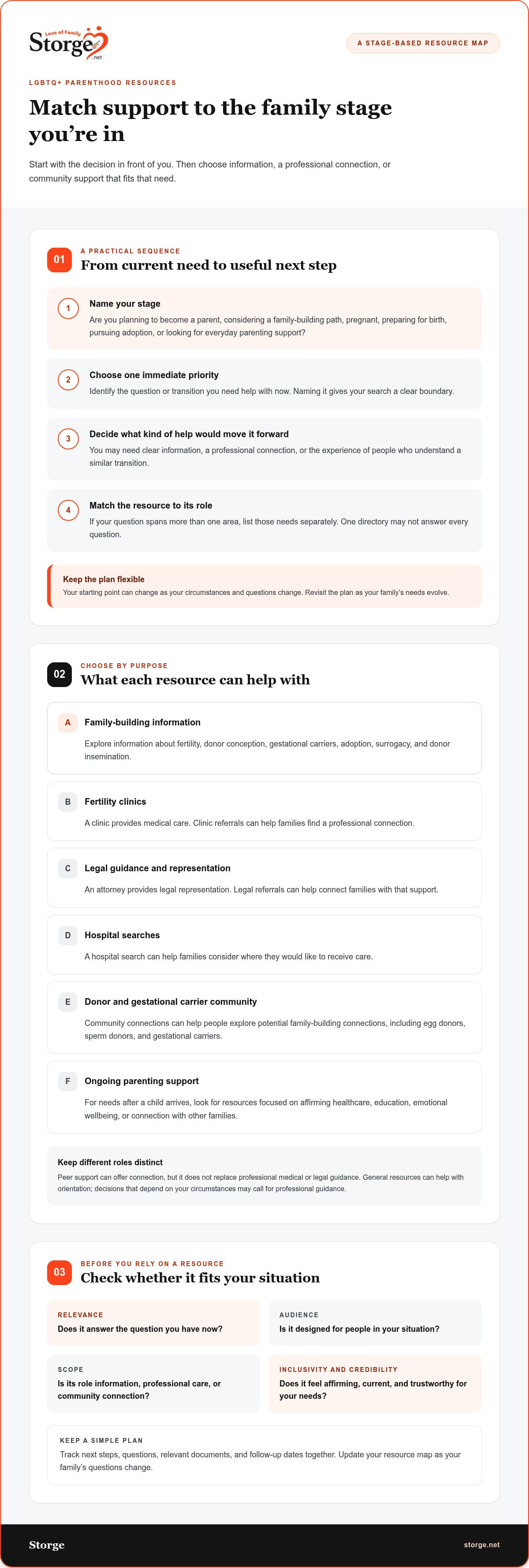
Try this simple sequence:
- Name the need. Turn a broad concern into one question, such as “Where can I learn about legal representation?” or “How can I connect with other families?”
- Choose a resource category. Focus on one kind of support at a time, such as legal referrals, clinical care, hospital information, or peer connection.
- Assess the fit. Check whether the resource addresses your question, explains its role, and provides current, respectful information.
- Record a next step. Note what you’ll do, what information you need, and when you’d like to revisit the question.
For legal or medical questions, use qualified support suited to your circumstances. General information can help you prepare, but it shouldn’t replace guidance from an appropriate professional.
Turn a broad concern into a focused search
A thought like “I need to understand my family’s options” can lead in many directions. Narrow it to the next decision: perhaps you want to explore family-building information, understand legal representation, or find a community with relevant lived experience. Start with one category, then expand only if a new question comes up. If legal representation is your next need, Storge’s LGBTQ family law attorney guide can help you focus your search.
Keep useful information organized as needs evolve
Use a private note or simple table to track each resource’s name, purpose, date checked, and follow-up action. Keep a separate list of questions and relevant documents so you can prepare for a conversation without searching through scattered notes. Share personal details only when needed, and be thoughtful about what you post in directories or community spaces. If you’re planning birth-related care, the inclusive hospital guide can help you explore that resource category.
Revisit your plan when a new stage, decision, or concern comes up. An older resource may still be useful, but its information may need review, and your next priority may have changed. Navigating LGBTQ parenthood resources is easier when your notes support the process without becoming another obligation. For family-building connections, explore Storge’s family-building resources.
How Storge Connects LGBTQ Families With Family-Building Resources
Once you know what kind of support you need, a focused connection point can make the next step easier to identify. Storge is an online platform connecting LGBTQ+ individuals and couples with family-building resources. Through Storge PLUS, members can access a trusted community of egg donors, sperm donors, and gestational carriers. Storge also provides referrals to fertility clinics and attorney representation, along with hospital searches.
Each connection has a specific role. Storge helps families discover relevant resources, while medical care and legal representation come from the appropriate professionals. This distinction helps you understand what kind of support you’re exploring and who provides specialized services.
When a family-building connection may be useful
If you’re exploring donor conception or a gestational carrier, Storge PLUS provides access to a community relevant to those family-building paths. Fertility clinic referrals connect members with fertility care, while attorney representation referrals help them find legal support. Professionals provide their own services. For more detail about the community, explore the Storge PLUS membership overview.
A hospital search can also help as you consider where to receive care. These resources address different needs, so you can focus on one connection at a time rather than treating them as a single package. For instance, someone starting with donor questions may first explore the donor community, while someone preparing to discuss fertility care may begin with a clinic referral. Let your family’s priorities guide the next step.
Choose a next step that feels right for your family
You don’t have to pursue every resource at once. Begin with the category that matches your current priority, whether you’re exploring donor or gestational carrier connections, looking for a clinic referral, considering legal representation, or searching for a hospital. Storge PLUS supports resource discovery for people seeking family-building connections, while professional care is provided by the relevant specialists.
As you compare options, keep your immediate question in view. A resource is most useful when its purpose aligns with what you’re trying to understand or explore. Your needs may change as your plans develop, so revisit your options at each stage. Navigating LGBTQ parenthood resources can feel more grounded when you choose one relevant connection, understand its role, and decide whether it fits your family’s next step.
If Storge’s family-building resources align with what you’re looking for, explore Storge and its family-building resources at a pace that feels comfortable for your family.
Take the Next Step at Your Own Pace
Your next step doesn’t need to settle every question about the future. Choose one connection that supports the decision in front of you, then reassess as your plans develop. Navigating LGBTQ parenthood resources is an ongoing process, and your priorities can change as your family grows.
If you’re looking for family-building support, Storge offers a place to explore relevant connections. Storge PLUS gives members access to a trusted community of donors and gestational carriers. Storge also provides fertility clinic and attorney representation referrals, along with hospital searches. These connections can help you identify resources aligned with your needs, while relevant professionals provide medical care and legal representation.
There’s no single timeline or path that every family has to follow. Start where you are, take a meaningful next step, and let your resource plan evolve with you. Explore Storge’s family-building resources to find connections that may fit your family’s next step.
Frequently Asked Questions
What resources are available for LGBTQ parents?
Resources can support both the path to parenthood and the years that follow. Depending on your needs, you might look for donor or gestational carrier information, fertility care, legal guidance, hospital searches, affirming healthcare, school-related support, or connection with other families. Someone preparing for a school meeting, for example, may need different information from someone exploring family-building options. Start with the decision or concern that feels most immediate.
How can I find LGBTQ-inclusive parenting support?
Begin with the kind of support you want, such as a parent group, healthcare guidance, or help with a child’s school experience. Search using specific terms that reflect your family’s situation, then review the group’s audience, activities, and community guidelines. If the description is broad, look for examples of the families it serves. A trusted personal or professional network can also help you find relevant community connections.
Are LGBTQ parenthood resources available across the United States?
Yes, LGBTQ families can find resources across the United States, though options and processes may vary by state and by need. This is especially important for legal questions, where location can affect which information applies. Start with resources that serve families nationally, then narrow your search to the location relevant to your circumstances. Storge connects LGBTQ+ people and couples with family-building resources nationwide.
Can LGBTQ families use the same parenting resources as other families?
Often, yes. General resources about child development, education, and everyday caregiving can be useful to LGBTQ families too. Still, check the details: a form that assumes a child has a mother and a father, for example, may not reflect your family. Look for resources that address your question and use language and examples that recognize different identities, caregivers, and family structures.
How do I know whether an LGBTQ family resource is trustworthy?
Check who created the resource, what expertise or organizational role they describe, and when the information was published or reviewed. For advice that could affect health or legal decisions, look for relevant professional qualifications and current guidance. Notice how the resource handles personal information and whether it explains referral relationships. If a claim matters to your decision, compare it with another reliable source instead of relying on a single page.
What should I do if I cannot find a resource that fits my family?
Describe your need more specifically, then search one category at a time. A concern about “support” might mean peer connection, school guidance, healthcare, or help with a family-building decision. If results still feel mismatched, write down what’s missing, such as inclusive forms or guidance for your family structure. That can help you refine your search or explain your needs when seeking a referral.
Does Storge provide medical care or legal services?
Storge is a resource platform that offers fertility clinic and attorney representation referrals, hospital searches, and Storge PLUS access to a trusted community of egg donors, sperm donors, and gestational carriers. Medical care and legal representation are provided by the relevant professionals.


