

Your family’s legal planning should reflect how your family is formed, not follow a one-size-fits-all approach. Knowing how to choose an LGBTQ family planning attorney means finding someone whose experience matches your needs, whether you’re planning for a child through assisted reproduction or adoption, or seeking clarity about parental rights, custody, or support. The attorney should also understand how the laws where you live may affect your plans.
It’s understandable to want legal guidance that recognizes both the personal importance and practical details of these decisions. This article explains how an attorney can help with relationship recognition, parental rights, custody, support, and family formation, and what to consider when choosing the right fit. You’ll also learn how legal guidance can connect with fertility resources as you plan your next steps.
Key Takeaways
- Look for legal guidance that fits your family structure, location, and plans for establishing parental rights.
- Understand how parentage, custody, and support questions may affect both biological and nonbiological parents.
- Consider how the legal details of insemination, surrogacy, or adoption can shape your family-building plans.
- Learn which case details can affect attorney fees, and how Storge’s Attorney Representation Referrals can help connect you with legal support.
Parental rights and birth certificates
State laws shape how LGBTQ parents establish legal parentage, pursue adoption, and protect parental rights. An LGBTQ family lawyer can assess your family’s structure, relationship status, and plans, then explain which legal steps may apply in your state.
Adoption and Second-Parent Adoption
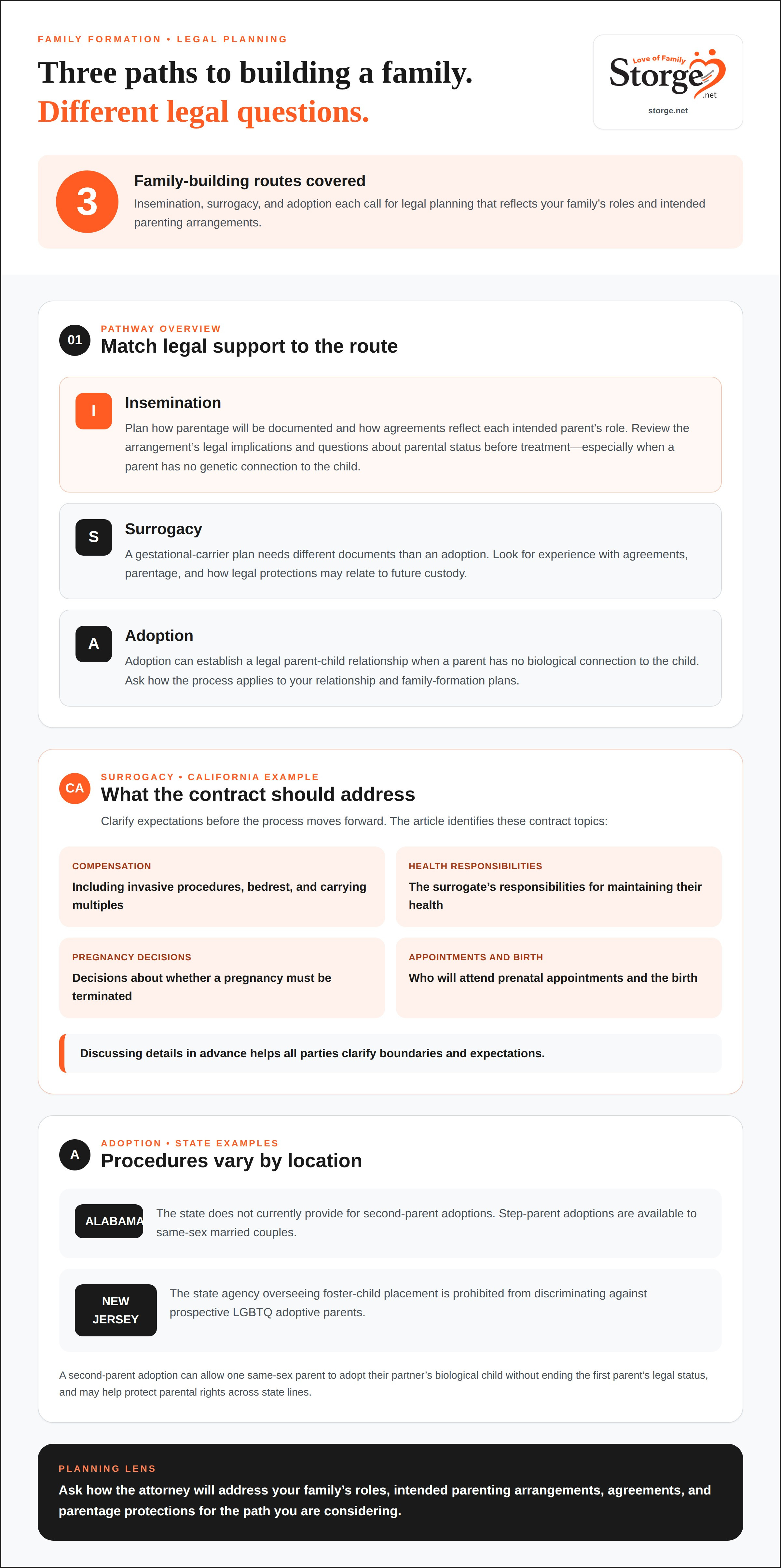
Adoption can establish a legal parent-child relationship when a parent has no biological connection to the child. In a second-parent adoption, one same-sex parent adopts their partner’s biological child without ending the first parent’s legal status. This can also help protect parental rights across state lines. Alabama law does not currently provide for second-parent adoptions, but step-parent adoptions are available to same-sex married couples. Ask how the state’s process applies to your relationship and family-formation plans.
Rights of Non-Biological Parents
A birth certificate or marriage record may not answer every question about a nonbiological parent’s legal protections. In New Jersey, a married or civil-union partner of the person who gives birth is presumed to be the child’s second parent, even without a biological connection. An attorney can assess whether that presumption applies to your circumstances and whether adoption could add protection. This can matter if your family relocates or your relationship ends.
Parentage status can affect custody, parenting time, and support if a relationship ends. In Oregon, registered domestic partners may have custodial and parenting-time rights after dissolution. California offers a distinct example: a transgender man who gives birth may need to establish his legal status as the child’s father, since a hospital may presume he is the mother. California also bars using a transgender parent’s identity against them in custody or parenting-time decisions, regardless of transition status.
The 2015 Obergefell decision addressed equal treatment for families of same-sex couples. Still, birth certificates, adoption, and custody questions can involve state-specific procedures. When assessing how to choose an LGBTQ family planning attorney, consider experience with parentage, sexual orientation and gender identity issues, and the legal steps that support your family’s rights.
Custody and support of biological and nonbiological children
When a relationship ends, custody and support questions may differ for biological and nonbiological parents. A dedicated family-law attorney can map each child’s parentage, caregiving roles, and existing agreements before discussing parenting schedules. That review separates parental rights from financial issues, including child support, spousal support, and property division. For example, a parenting plan for siblings may need to account for different routines, school commitments, or caregiving arrangements.
Relationship status can shape which financial issues arise during a dissolution. In New Jersey, ending a domestic partnership does not confer rights to alimony or support, equitable distribution of assets, or pension benefits. Marriage, civil unions, and domestic partnerships can have different legal implications when a relationship ends in California. An attorney can identify which status applies and explain how it relates to support, property, and children’s care.
Custody planning should address the children’s daily lives, not just the adults’ legal relationship. Parents may need to decide where children live, how parenting time works, and how decisions are shared. For a nonbiological parent, established parentage can be central to seeking custody or parenting time. A lawyer can review family records and agreements, then explain how legal parentage and caregiving history affect the issues in dispute.
California family-law dissolutions involving LGBTQ+ couples may also involve surrogacy arrangements or frozen eggs or sperm. These details can connect parenting questions with financial and family-formation matters. An attorney can consider them alongside custody and support issues. In states that have not extended marriage-related rights, same-sex couples may face more difficult questions about divorce, child custody, property division, spousal maintenance, and healthcare. Discussing these issues together helps clarify what needs resolution, from a child’s schedule to support and asset division.
Family formation through insemination, surrogacy, and adoption
Family formation can involve insemination, surrogacy, or adoption, and each path raises distinct legal questions. Look for an attorney whose experience matches the route you’re considering, including agreements, parentage, and how legal protections may relate to future custody. A plan involving a gestational carrier, for example, calls for different documents than an adoption. Ask how the attorney will address your family’s roles and intended parenting arrangements.
For surrogacy in California, the contract should clarify important expectations before the process moves forward. It should address compensation, including compensation related to invasive procedures, bedrest, and carrying multiples. It should also cover the surrogate’s responsibilities for maintaining their health, decisions about whether a pregnancy must be terminated, and who will attend prenatal appointments and the birth. Discussing these details in advance helps all parties clarify boundaries and expectations.
Insemination also involves decisions about how parentage will be documented and how agreements reflect each intended parent’s role. Relevant considerations vary with the people involved and the family’s plans. A lawyer can review the proposed arrangement, explain its legal implications, and identify questions about parental status before treatment. This is particularly relevant when one parent has no genetic connection to the child.
Adoption offers another route to building a family. In New Jersey, the state agency overseeing foster-child placement is prohibited from discriminating against prospective LGBTQ adoptive parents. An attorney can explain the adoption process and how legal parentage relates to existing family relationships. Consider whether the attorney can address both the adoption itself and steps that may affect parental rights later.
Look for an attorney who understands how family-formation documents connect with legal parentage, rather than treating each form as a standalone task. Ask how they approach agreements, explain each parent’s status, and account for possible relationship changes, including divorce. A clear plan can help intended parents understand what the documents cover and what questions still need answers before welcoming a child.
How much do LGBTQ family planning attorneys charge, and what payment options are available?
The cost depends on the case and is provided after a quote request. Factors include the legal work, case complexity, and whether court proceedings are involved. Reviewing an adoption matter may require different work from preparing a surrogacy agreement or handling a contested custody case. Scope matters, too: document preparation, negotiations, and court representation are distinct tasks. Before agreeing to representation, ask for a written explanation of the work covered.
Payment structures and arrangements vary by attorney. Some may bill by the hour, while others may quote a flat fee for a defined task. A retainer may also be part of the arrangement. Ask how the attorney bills, what the initial amount covers, and how additional work is charged. These details help you understand the commitment without assuming every lawyer works the same way.
Discuss payment timing before work begins. Ask whether installments or another payment schedule are available, and whether payment is due before each stage or as work progresses. Clarify how the attorney handles expenses such as filing costs or other case-related charges. A clear written agreement should explain the billing method, included work, payment dates, and how changes to the case affect fees.
Compare proposals by scope, not just by the quoted total. One agreement, for example, may cover document drafting, while another may include negotiation or court appearances. Ask what happens if your matter changes, such as an adoption becoming contested or a custody dispute requiring additional work. Understanding what’s included helps you plan and assess whether the proposed representation fits your needs.
If you’re seeking legal guidance for family planning, explore attorney representation options and consider which legal tasks you need help addressing.
Storge: Attorney Representation Referrals
Storge connects LGBTQ+ individuals and couples with attorney representation referrals for family-planning legal needs. If you’re considering parentage documents, adoption, or legal agreements related to family formation, an attorney referral can be a practical next step after you identify the questions you want answered.
Legal needs may arise alongside fertility planning. Storge also offers fertility clinic referrals and donor egg or sperm search for people considering assisted reproduction. These resources address different parts of the journey: attorney referrals help you find legal representation, while fertility resources relate to family-building options.
When you’re ready to explore legal support suited to your family-planning circumstances, contact Storge to discuss attorney representation referrals.
Move Forward With Support That Fits Your Family
Your next step can be a conversation about the decision directly in front of you. Choosing an LGBTQ family planning attorney starts with matching legal guidance to that decision, rather than trying to resolve every future question at once. Before reaching out, identify what feels most immediate and what you hope to protect. That gives the conversation a clear starting point and helps you explain what matters to your family.
As plans evolve, your needs may shift from legal questions to fertility resources or broader support. Storge PLUS Membership is another option to consider as you continue planning. A thoughtful next step can be simple: share where you are in the process and what kind of guidance would help you move forward. You can bring questions about timing, whose legal status matters, and how your family-building choices shape the support you need.
When you’re ready, contact Storge to discuss your family. You deserve to approach the next decision with support and a clearer sense of direction.
Frequently Asked Questions
What does an LGBTQ family planning attorney do?
An LGBTQ family planning attorney helps address legal questions connected to forming or caring for a family. Depending on your plans, this can include reviewing agreements, explaining parentage options, and advising on adoption or donor and carrier arrangements. Intended parents using donated sperm, for example, may need guidance on documents that reflect each person’s role. The attorney’s scope depends on your legal needs and jurisdiction.
What experience and credentials should an LGBTQ family planning attorney have?
Look for an attorney whose practice includes family formation and LGBTQ family-law matters relevant to your plans. Ask about experience with situations like yours, such as donor conception, adoption, or parentage questions involving a nonbiological parent. You can also ask where the attorney is authorized to practice, who will handle your matter, and how they explain options in clear, respectful language.
How can an attorney referral service help me find LGBTQ-affirming family law attorneys near me?
An attorney referral can connect you with legal representation suited to LGBTQ family-planning needs. Storge offers attorney representation referrals, providing a starting point for finding specialized legal support. When speaking with an attorney, describe your state, family structure, and main concern, such as adoption or donor conception. This context can help clarify whether the attorney’s experience fits the legal questions you need addressed.
What questions should I ask when interviewing a family planning attorney?
Ask how the attorney has handled family-building matters like yours and what work they would personally complete. Clarify the proposed scope, billing approach, expected communication, and documents they’ll need to understand your situation. If you’re using a donor or carrier, ask how the attorney approaches agreements and parentage planning. Clear answers can help you assess both the practical fit and how comfortable you feel discussing personal decisions.
What legal steps establish parentage for same-sex couples using assisted reproduction?
The steps depend on your state and family-building arrangement. An attorney can review the proposed treatment, identify documents relevant to a donor or carrier arrangement, and explain ways to establish each intended parent’s legal relationship with the child. They can also address how parentage should be documented and whether additional legal proceedings may be relevant. Discuss your plans before treatment so legal questions are considered alongside your family’s arrangements.
What legal issues should LGBTQ parents consider when using a surrogate or donor?
Consider how written agreements describe each person’s role, expectations, and responsibilities, and how they address sensitive decisions if plans change. With a donor, discuss the intended parents’ roles and what information or records your family hopes to preserve. With a gestational carrier, clarify expectations around communication and participation during the process. An attorney can help identify the legal questions these arrangements raise without assuming one document fits every family.


