

What if the most vital connection in your journey to fatherhood didn't have to start with a $50,000 agency fee? For many, the search for a gestational carrier for a gay couple feels like a choice between financial exhaustion and legal uncertainty. You've likely spent hours worrying about whether you can successfully manage shifting state laws or find someone who truly understands your vision for a family. It's natural to feel overwhelmed by the clinical nature of the industry when what you're really looking for is a partnership built on mutual respect and shared values.
This guide provides the clarity you need to move forward with confidence. We'll explore a roadmap to matching that prioritizes community connection over high-overhead fees, ensuring you're supported every step of the way. You'll learn how to leverage new 2026 legal protections in states like Hawaii and Michigan, secure professional legal vetting, and ultimately connect with a vetted carrier who is as committed to this journey as you are. By the end, you'll have a practical strategy to bridge the gap between your dream and the reality of holding your child.
Key Takeaways
- Understand the vital distinction between gestational and traditional surrogacy to ensure your rights as intended parents are legally protected from the start.
- Discover how a community-based search for a gestational carrier for a gay couple can bypass high agency fees while often shortening the timeline to a successful match.
- Learn the essential medical, legal, and emotional vetting criteria necessary to build a secure and healthy partnership with your carrier.
- Master the process of creating an authentic intended parent profile that connects with vetted community members on a deeper, more personal level.
- Identify how specialized legal and clinic referrals provide a safety net, ensuring your journey complies with the latest 2026 state-specific parentage laws.
Defining the Role: What is a Gestational Carrier for Gay Couples?
Starting a family as a gay couple often involves a beautiful, collaborative process that differs from the traditional narrative. When searching for a gestational carrier for a gay couple, you're looking for a partner who will help bring your child into the world. In this context, a gestational carrier is someone who carries a pregnancy created through IVF, using an egg from a donor and sperm from one or both intended fathers. This biological setup is unique to the queer experience, as it requires a "third-party" team to achieve the dream of fatherhood. By separating the genetic contribution from the physical pregnancy, you create a clear and protected path to parenthood.
Gestational vs. Traditional Surrogacy
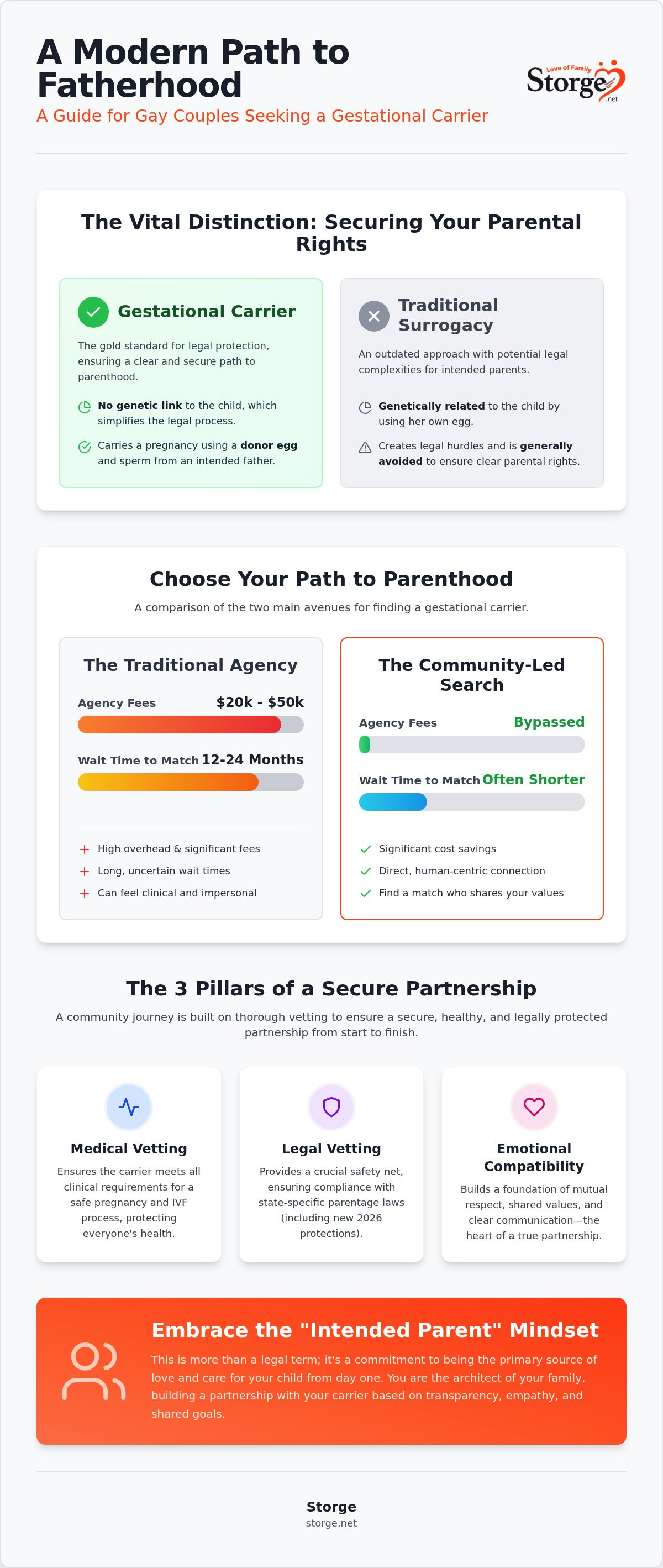
In your research, you might ask, What is a Gestational Carrier? and how does it differ from a traditional surrogate? Unlike traditional surrogacy, where the carrier uses her own eggs and is genetically related to the baby, a gestational carrier has no genetic link to the child. This is why it's the gold standard for legal protection. Because there's no biological connection between the carrier and the child, the legal process of establishing parentage is much more straightforward. This clarity often simplifies the second parent adoption requirements in states where pre-birth orders aren't as easily accessible, giving both fathers peace of mind from day one.
We intentionally use the term "gestational carrier" rather than "surrogate mother." This language respects the professional and altruistic nature of the role. It acknowledges that while she is providing a life-giving service, the maternal role belongs to the intended parents or the egg donor. It's about honoring the boundaries of the relationship while celebrating the incredible gift she provides. Most carriers prefer this distinction too, as it aligns with their own understanding of their role in your family's story.
The "Intended Parent" Mindset
Stepping into the role of an Intended Parent (IP) is a profound transition. It's more than just a legal designation; it's a commitment to being the primary source of love and care for your child from the very beginning. The intended parent is the legal and emotional architect of the family. This mindset involves building a relationship with your carrier based on transparency and shared goals. You aren't just "hiring" someone; you're entering into a partnership that requires deep empathy and clear communication. By establishing this foundation early, you ensure that the journey is as fulfilling for the carrier as it is for you, turning a complex medical process into a shared human experience.
Agency vs. Independent Search: Choosing Your Path to Parenthood
Deciding how to find a gestational carrier for a gay couple is one of the most significant choices you'll make on your journey to fatherhood. It's a decision that balances professional oversight with personal connection. When Choosing Your Path to Parenthood, you'll likely encounter two main avenues: the traditional agency model and the independent, community-led search. Each path offers distinct advantages depending on your budget, timeline, and desired level of involvement in the process.
The Traditional Agency Model
Agencies act as full-service coordinators, handling everything from matching to logistics. For many, this offers a sense of security and a "one-stop-shop" experience. However, this convenience comes with high overhead. Agency fees often range from $20,000 to $50,000, which is a substantial addition to the already significant costs of surrogacy. Additionally, wait times can be extensive, often stretching between 12 and 24 months before a match is even made. While an agency might be the right choice for a high-net-worth couple who prefers a hands-off approach, the clinical nature of these databases can sometimes feel detached from the personal reality of building a family.
The Community-Led Search
A community-led search offers a more human-centric and affordable alternative. By connecting directly with potential carriers, you can find someone who truly shares your LGBTQ+ values and vision for the future. This path significantly reduces costs because you aren't paying for an agency's marketing or administrative staff. Instead, you're investing directly in your own family's needs. While this requires more active involvement, many intended parents find that community-based searches move faster because they aren't restricted by an agency's internal queue. You can bridge the gap between going it alone and using a full-service agency with a Storge PLUS Membership, which provides a vetted network without the agency-level price tag.
Trust shouldn't be a luxury reserved for those with the largest budgets. Even in a community search, you can achieve a high standard of security through specialized legal and medical referrals. Platforms like Storge PLUS replicate the trust of an agency by offering a vetted community of carriers and donors. This middle ground allows you to maintain control over your search for a gestational carrier for a gay couple while having a safety net of experts to guide you. It's about empowering you to lead your own journey with the confidence of a trusted companion in surrogacy by your side.
Essential Vetting: Medical, Legal, and Emotional Compatibility
Vetting a gestational carrier for a gay couple involves three essential pillars: medical health, legal security, and emotional alignment. While the medical screening ensures a safe pregnancy, the legal and emotional components protect your family's future and your peace of mind. A carrier should typically be between 21 and 45 years old with at least one previous uncomplicated birth to demonstrate her body can safely handle the process. Psychological screening then confirms she is emotionally prepared for the unique experience of third-party reproduction, ensuring she has the support system needed for this commitment.
Navigating Surrogacy-Friendly States
The carrier's location is the most critical legal factor because the laws of the state where she gives birth will govern your parental rights. You should prioritize matching with a carrier in a "surrogacy-friendly" state that allows for Pre-Birth Orders (PBOs). These court orders ensure that both dads' names go directly on the birth certificate, avoiding the need for post-birth adoption. Recent 2026 legal updates in Hawaii and Michigan have expanded these protections, making them excellent options for intended parents. A specialized surrogacy for gay couples attorney can help you review these specific state statutes to ensure your rights are airtight before the first medical procedure begins.
The Emotional Connection
Beyond medical and legal checks, you need to find a gestational carrier for a gay couple whose values align with your own. For gay dads, this means ensuring the carrier is genuinely supportive of LGBTQ+ families and enthusiastic about your specific path to parenthood. Discussing LGBTQ+ Family Building Options can help you gauge her comfort level and expectations for the journey. You should also talk about hospital plans and delivery room expectations early in the matching process. Do you want to be present for the birth? Does she prefer a certain level of post-birth contact? Emotional compatibility is the foundation of a stress-free journey. By vetting for these shared values, you transform a clinical arrangement into a partnership built on mutual respect and a shared goal of bringing your child safely into the world.
Step-by-Step: Matching with a Gestational Carrier Through Community
Matching with a gestational carrier for a gay couple is a deeply personal phase of the journey that transitions you from planning to partnership. Unlike the clinical matching processes often found in traditional agencies, a community-led approach allows you to lead with your heart and your values. This phase is about finding a person who doesn't just meet medical criteria, but someone who resonates with your vision of family. By following a methodical, step-by-step approach, you can navigate these first interactions with clarity and purpose.
Crafting Your Story
Your "Intended Parent" profile is your first introduction to the community, and it's where your journey truly begins to take shape. Carriers are often looking for a genuine connection to your specific story and the love you have to offer as future fathers. Instead of aiming for a perfectly curated image, focus on sharing your genuine hopes and the support system you have in place. Our starting a family as a gay man guide provides deeper insights into how to articulate your story in a way that attracts a carrier who shares your outlook on life.
The First Conversation
Once you identify a potential match on Storge PLUS, the first conversation is your opportunity to build rapport and see if your personalities align. While it's important to keep things light initially to build comfort, you eventually need to address specific logistical points to ensure long-term compatibility. These discussions prevent misunderstandings later in the pregnancy and ensure everyone is on the same page from day one.
During these early meetings, you should prioritize discussing the following topics:
- Agreement on the number of embryos to transfer, usually focusing on single embryo transfers for safety.
- Shared views on selective reduction or termination in the event of severe medical complications.
- Expectations for communication frequency during the pregnancy and the level of contact after birth.
Watch for how naturally the conversation flows and how comfortably she answers your questions. A strong partnership is built on transparency and mutual respect rather than just a signed contract. After you feel a genuine connection, the final steps involve formalizing the match through your fertility clinic's medical screening and your attorney's contract review. This professional oversight ensures that your emotional bond is backed by a secure legal and medical framework. To start connecting with women who are specifically looking to help LGBTQ+ families, you can join the Storge PLUS community today and begin your search with confidence.
Securing Your Future: Why Storge PLUS is the Modern Solution
Finding a gestational carrier for a gay couple doesn't have to be a journey defined by isolation or exorbitant agency fees. Storge PLUS offers a modern solution by combining the safety of a vetted network with the warmth of a community-focused platform. It's designed to be your trusted companion, providing direct access to carriers, donors, and specialized professionals who share your values. By shifting the focus from corporate overhead to human connection, you gain a clear, manageable roadmap to fatherhood. This approach empowers you to lead your own search while maintaining the professional security necessary for such a significant life transition.
The Vetted Path to Parenthood
Safety is paramount when building your family. Storge PLUS screens community members to ensure legitimacy, creating a space where you can connect with confidence. A key part of this security is our network of attorney representation referrals. These specialized legal experts ensure your parental rights are established correctly from the start, navigating the nuances of 2026 parentage laws in surrogacy-friendly states. Beyond the logistics, you're joining a support system of other LGBTQ+ families who have walked this path, offering a sense of belonging that traditional agencies often lack. You aren't just a client; you're a member of a community that understands the unique emotional weight of your journey.
Gaining a deep understanding of the surrogacy process for gay men is much easier when you're surrounded by people who speak your language. Membership allows you to reduce the financial burden of family building by avoiding the $20,000 to $50,000 fees typical of full-service agencies. Instead, you invest in the resources that matter most: high-quality fertility clinic referrals and a vetted pool of carriers who are eager to help you start your family. This model prioritizes your peace of mind and long-term success over agency profit margins.
Your Next Steps
Transitioning from research to action is often the hardest part of the journey. Storge PLUS is here to help you move forward with a steady, methodical pace. You can begin by creating your profile and exploring the community, knowing that you have a dedicated partner to guide you through every legal and medical milestone. The dream of holding your child is within reach. We invite you to join Storge PLUS and find your gestational carrier today to begin this transformative chapter with the support and connection you deserve.
Your Journey to Fatherhood Awaits
The path to finding a gestational carrier for a gay couple is paved with significant decisions, but you don't have to navigate them alone. By prioritizing legal security in surrogacy-friendly states and seeking out carriers who share your vision for a family, you're building a foundation of trust. We've explored how a community-based approach allows you to bypass high agency overhead while still ensuring the highest standards of medical and legal vetting. This modern model puts you in the driver's seat of your own story, turning a complex process into a manageable and hopeful experience.
Storge PLUS is here to be your steady guide, offering verified LGBTQ-inclusive legal and medical referrals and a dedicated community for gay men and same-sex couples. Our membership-based model saves thousands in agency fees, redirecting those resources where they matter most: your future child. You have the tools and the roadmap; now it's time to take the next step toward the family you've always imagined. Access our vetted community of gestational carriers with Storge PLUS and begin your search with confidence. Your dream of fatherhood is closer than it feels.
Frequently Asked Questions
How much does a gestational carrier cost for a gay couple in 2026?
The total cost for gestational surrogacy in the U.S. typically ranges from $140,000 to $180,000 as of August 2026. In states like California, these figures can exceed $200,000 due to higher compensation rates. This total includes surrogate compensation, which often falls between $50,000 and $65,000, along with IVF procedures and egg donor fees. Choosing a community-based search can help lower these expenses by reducing the heavy administrative fees associated with traditional agencies.
Is it legal for gay couples to use a gestational carrier in all US states?
No, surrogacy laws vary significantly by state as there's no federal law governing the process. While many states like California, Nevada, and Illinois are highly supportive, others like Louisiana and Nebraska have restrictive laws that can make contracts unenforceable. Recent 2026 legislation in Hawaii and 2025 laws in Michigan and Massachusetts have expanded protections for LGBTQ+ families. It's vital to work with a specialized attorney to ensure your agreement complies with local statutes.
What is the difference between an egg donor and a gestational carrier?
An egg donor provides the genetic material, while a gestational carrier for a gay couple carries the pregnancy but has no biological link to the child. For gay male couples, both roles are essential. The egg donor's contribution is combined with sperm via IVF to create an embryo, which is then transferred to the carrier. This clear biological separation is a key reason why gestational surrogacy offers stronger legal protections for intended parents than traditional surrogacy.
How do we ensure both gay dads are on the birth certificate?
You can ensure both fathers are recognized through a Pre-Birth Order (PBO), which is a court-issued document obtained before the baby arrives. In surrogacy-friendly states, this legal tool allows both intended parents' names to be placed directly on the birth certificate at the time of delivery. If a PBO isn't available in the carrier's state, you may need to complete a post-birth second-parent adoption. Always verify the specific parentage laws of the state where the birth occurs.
Can we find a gestational carrier without using an expensive agency?
Yes, you can successfully find a carrier through community-based platforms that connect intended parents directly with vetted carriers. This independent path allows you to avoid agency fees that often range from $20,000 to $50,000. By using a membership-based network, you maintain control over the matching process while still accessing professional referrals for legal and medical vetting. This approach prioritizes authentic connection and shared values while significantly reducing the overall financial burden of building your family.
What medical tests does a gestational carrier need to pass?
A carrier must undergo a comprehensive medical screening to ensure she can safely carry a pregnancy to term. This includes blood work to check for infectious diseases, a physical exam, and a detailed review of her reproductive history. Clinics also perform a saline sonogram or hysteroscopy to evaluate the health of the uterine lining. These tests are vital for the safety of both the carrier and the baby, providing the medical foundation for a successful journey.
How long does the matching process usually take for gay couples?
The entire surrogacy journey typically takes between 12 and 24 months from the initial search to the birth of the child. Finding a gestational carrier for a gay couple can vary in length based on your specific criteria and search method. While traditional agency waitlists can be long, community-based searches often move more quickly because you're engaging directly with potential carriers. Staying organized and having your profile ready can help streamline this vital stage of the process.
What happens if the gestational carrier lives in a different state?
If your carrier lives in a different state, the laws of the state where she delivers will dictate the legal process. This is why it's critical to match with a carrier residing in a surrogacy-friendly state, regardless of where you live. You'll need to coordinate travel for the embryo transfer and the birth, and your legal team must handle interstate requirements. Working with an attorney who understands the nuances of cross-border parentage is essential for a secure outcome.


