

An egg donor profile is not a retail catalog; it is the living blueprint of your future family. Yet when you open a donor registry for the first time, it's completely normal to feel overwhelmed by genetic carrier screenings, clinical fertility metrics, and the emotional weight of deciding between an anonymous or open-identity donor. Understanding egg donor profiles for LGBTQ families requires looking past the clinical jargon to focus on what truly matters: your child's health, heritage, and future sense of self. You shouldn't have to worry whether a donor respects queer family structures or whether you're missing a critical piece of medical history hidden behind agency shorthand.
In this guide, you'll learn how to confidently interpret medical, genetic, and personal details in egg donor profiles to build your family with peace of mind. We will explore how to analyze clinical carrier reports, balance physical traits with authentic personal connection, and use a structured evaluation framework that puts your future child first.
Key Takeaways
- Learn the crucial differences between initial public registries and unlocked candidate files so you know where essential background details hide.
- Demystify complex clinical data by discovering which ovarian reserve metrics and genetic carrier screens truly impact your future child's health.
- Understand the full spectrum of contact options and how donor-conceived perspectives are transforming choices between anonymous and open-identity agreements.
- Master a step-by-step decision framework that separates non-negotiable health criteria from aesthetic preferences to avoid emotional burnout.
- Discover how understanding egg donor profiles for LGBTQ families empowers you to find community-vetted, affirming matches with total transparency.
Anatomy of an Egg Donor Profile: What Intended Parents See
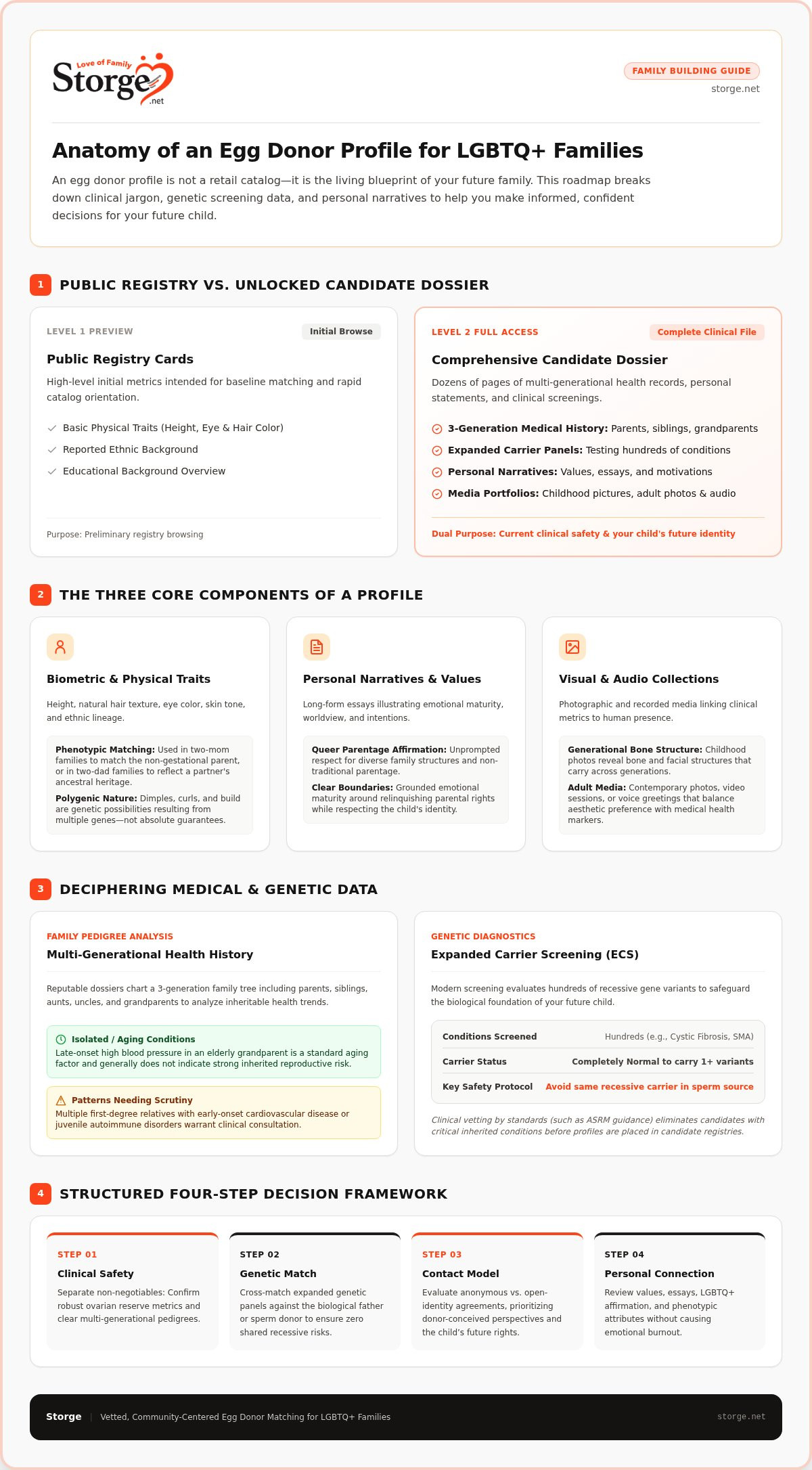
Opening an egg donor profile can feel surreal. What begins as an administrative search quickly transforms into an intimate window into another person's genetic and personal history. Understanding egg donor profiles for LGBTQ families means recognizing that these documents are not transactional resumes; they are comprehensive clinical, genetic, and autobiographical portfolios. In public registry previews, you usually see high-level summaries such as height, eye color, and educational background. Unlocking a full candidate dossier, however, reveals dozens of pages spanning multi-generational health records, personal essays, and clinical screening results.
These detailed records serve two distinct purposes. Right now, they help your medical team assess clinical viability and biological safety during the egg donation process. Decades from now, that same dossier will help your child understand their biological roots, ancestral history, and genetic identity. Transitioning from casually browsing cards to critically evaluating full dossiers requires looking at three core components.
Physical Attributes and Biometric Information
Donor profiles detail height, natural hair color and texture, eye color, skin tone, and ethnic ancestry. For same-sex male couples or single intended fathers, phenotypic matching often helps mirror a partner's family heritage or celebrate a shared ethnic background. In two-mom families, intended parents might choose a donor whose features echo the non-gestational parent's lineage. Physical traits are polygenic; they stem from complex combinations of multiple genes. A donor's dimples, curly hair, or athletic build are genetic possibilities, not absolute guarantees for your child.
Personal Narratives, Values, and Creative Essays
Long-form questionnaire responses reveal a donor's emotional maturity and motivations. When understanding egg donor profiles for LGBTQ families, pay special attention to why the candidate chose to participate in assisted reproduction. Thoughtful essays show whether the donor genuinely values family diversity and supports queer parentage. Look for answers that demonstrate:
- A mature, grounded perspective on relinquishing parental rights while respecting the child's identity.
- Genuine empathy and respect for intended parents from diverse family structures.
- Unprompted reflections on personal values, artistic talents, and academic pursuits.
Childhood and Adult Photograph Collections
Photographs bridge clinical data and human connection. Childhood pictures show baby facial structures, authentic expressions, and bone structures that persist across generations. Many modern agencies and programs now provide adult photos, video interviews, or audio greetings. Visual affinity brings comfort, but balance physical attraction with non-negotiable medical health markers, genetic carrier results, and shared values regarding future communication.
Deciphering Clinical and Genetic Information in Donor Records
Clinical data in a donor record can feel intimidating at first glance. Pages filled with laboratory acronyms, genetic panels, and reproductive hormone numbers look like medical charts because that is precisely what they are. Understanding egg donor profiles for LGBTQ families involves recognizing that reputable clinical vetting eliminates candidates with serious inherited risks long before their profiles reach you. For a comprehensive overview of safety protocols, the ASRM guide to third-party reproduction outlines how clinical screening standards safeguard everyone involved. When reviewing these medical files, three distinct clinical sections deserve your focused attention.
Navigating Multi-Generational Family Medical Pedigrees
Dossiers include a three-generation family tree detailing the biological health of parents, siblings, aunts, uncles, and grandparents. Look for patterns rather than isolated health incidents. An elderly grandparent who developed high blood pressure late in life represents a common aging factor. Conversely, multiple first-degree relatives diagnosed with early cardiovascular disease or juvenile autoimmune disorders warrant closer scrutiny. Your fertility team will assess whether noted conditions stem from complex polygenic traits or shared environment.
Understanding Expanded Genetic Carrier Screening Results
Modern fertility clinics use expanded carrier panels testing for hundreds of recessive genetic conditions, including cystic fibrosis and spinal muscular atrophy. Seeing that a donor tested positive as a carrier is completely normal. Almost everyone carries a handful of non-working recessive genes. Carrier status only poses a health risk to offspring if the sperm provider carries a mutation in the exact same gene. If you are comparing candidate genetics against your own, exploring vetted donor profiles on storge.net connects you directly with affirming clinical partners who coordinate seamless genetic cross-matching.
Ovarian Reserve Metrics and Clinical History
A candidate's biological suitability depends heavily on ovarian reserve markers. When evaluating reproductive metrics, focus on two key numbers:
- Anti-Müllerian Hormone (AMH): A blood test indicating the size of the remaining egg pool, with typical donor values reflecting robust biological reserves.
- Antral Follicle Count (AFC): An ultrasound measure counting resting follicles visible across both ovaries before cycle stimulation begins.
If the donor completed previous donation cycles, review the number of mature oocytes retrieved and blastocysts formed. Remember that retrieval yields vary significantly based on stimulation medication protocols, clinic laboratory techniques, and sperm parameters. Master the numbers, but trust certified reproductive specialists to confirm biological viability.
Evaluating Contact Levels: Anonymous, Open-ID, and Known Donors
Choosing a contact level is one of the most defining choices in your parenting journey. In the past, traditional programs defaulted to closed, anonymous arrangements. Today, the conversation has shifted dramatically. Direct-to-consumer genetic testing and commercial databases have made lifelong donor anonymity functionally obsolete. More importantly, adult donor-conceived individuals have voiced clear insights about their emotional well-being, emphasizing that having access to biological origins fosters healthier self-identity. When exploring comprehensive LGBTQ+ family-building options, intended parents increasingly view contact disclosure as an act of transparency that supports their child's future peace of mind.
Comparing Donor Disclosure Frameworks
Programs classify donor relationships across three main contact tiers:
- Open-Identity (Open-ID): The donor agrees to allow the program or registry to release their identifying details directly to the donor-conceived child once they reach legal adulthood, typically age eighteen.
- Known Donor: Intended parents and the donor establish contact from the beginning, building a transparent relationship governed by detailed legal agreements outlining social roles and clear boundaries.
- Semi-Open or Mediated Contact: Communication takes place through secure platforms or intermediaries during the child's upbringing without immediately disclosing full legal identities or home addresses.
Each tier demands distinct legal documentation to ensure parental rights remain completely protected from birth.
Assessing Donor Values and LGBTQ+ Inclusivity
Understanding egg donor profiles for LGBTQ families requires confirming that your candidate genuinely celebrates queer parentage. Reading candidate questionnaires helps ensure their motivations stem from compassion rather than mere convenience. Look for explicit affirmations of two-dad, two-mom, non-binary, or solo-queer homes. For more on finding partners who align with your goals, our guide on Understanding the LGBTQ Donor Community offers additional perspective on shared values and family design.
Psychological Screening and Emotional Readiness
A reputable donor file includes clearance from a qualified reproductive psychologist. This standardized mental health assessment confirms that the candidate thoroughly understands the long-term realities of donating eggs. It verifies that they have healthy personal boundaries, an absence of unresolved emotional trauma, and a mature comprehension that they are donating genetic material rather than becoming a parent. Understanding egg donor profiles for LGBTQ families means trusting these psychological clearances to ensure your match enters the arrangement with clarity, emotional stability, and mutual respect.
A Four-Step Framework for Choosing the Right Donor Profile
Endless scrolling through donor registries quickly leads to decision fatigue. You can look at dozens of candidate files before realizing they all begin to blur together. Understanding egg donor profiles for LGBTQ families requires a structured, intentional approach that protects your peace of mind. Instead of letting agency sales pressure rush your journey, take control by breaking your evaluation into four distinct, orderly phases.
Step 1: Aligning Core Values and Non-Negotiables
Sit down with your partner or personal support circle before opening a single database. Define your shared priorities. Clarify non-negotiable requirements versus flexible preferences:
- Non-Negotiables: Genetic carrier compatibility, verified family health history, clean infectious disease screening, and mutual agreement on contact disclosure levels.
- Flexible Preferences: Height, eye color, musical talent, athletic background, or specific collegiate degrees.
When partners disagree on visual resemblance versus personality, focus on values that will support your child's well-being. Narrow your initial selections down to a focused shortlist of three to five candidates.
Step 2: Medical Review and Genetic Cross-Matching
Never lock in an egg donor without clinical clearance. Send the complete candidate dossier to your reproductive endocrinologist for thorough evaluation. Your physician will review hormonal markers, antral follicle counts, and prior cycle outcomes. Simultaneously, clinical teams cross-match the donor's expanded carrier panel against the biological sperm provider to verify zero overlapping recessive mutations. When establishing care, explore our guide covering 23 Essential Questions to Ask an LGBTQ-Friendly Fertility Clinic in 2026.
Step 3: Legal Review and Direct Donor Agreement
Parentage laws vary significantly across states, making tailored legal representation essential before cycle stimulation begins. Retain an independent reproductive attorney specializing in LGBTQ+ family building to represent your interests, while ensuring the donor has separate legal counsel. Your attorney drafts a legal agreement explicitly establishing your parental rights from birth, defining contact parameters, and extinguishing any parental claims by the donor. Review key legal safeguards in our guide on How to Find an LGBTQ Family Law Attorney.
Step 4: Final Match Confirmation and Next Steps
Once clinical approvals, genetic clearance, and legal contracts are securely executed, you can confidently move forward to cycle scheduling or frozen cohort shipment. If you want a supportive space to connect with vetted candidates and expert partners, you can begin your search with Storge to build your family on your own terms.
Building Your Family with Storge: Vetted, Community-Centered Matches
Family building should feel collaborative and hopeful, not transactional or exhausting. Traditional agency pipelines often present fragmented steps, steep broker markups, and lingering uncertainty about whether a candidate genuinely supports queer parenthood. Storge reimagines this process by offering an affirming, centralized community platform built specifically for LGBTQ+ intended parents. Instead of facing rigid sales quotas or opaque matching criteria, you gain clear tools to evaluate candidates at your own pace with full clarity.
Vetted LGBTQ-Affirming Donor Connections
Understanding egg donor profiles for LGBTQ families becomes far more straightforward when you know every prospective donor intentionally chose to support queer family creation. Candidates in the Storge network are pre-screened to ensure clear communication, verified health details, and authentic enthusiasm for diverse family structures. By engaging with candidates who actively celebrate two-dad, two-mom, trans, non-binary, and solo-parent households, you eliminate the emotional anxiety of wondering whether a donor will accept your match. Intended parents can also draw on community perspectives from peers who have walked the same path, turning what once felt isolating into an experience of shared community wisdom.
Connecting Donors, Carriers, and Legal Allies
Building your family rarely stops at selecting an egg donor. Many intended parents need to coordinate multiple puzzle pieces simultaneously, from finding an affirming gestational carrier to securing trusted reproductive endocrinologists and legal counsel. Storge connects all of these essential searches into one cohesive ecosystem:
- Explore vetted egg and sperm donor searches alongside independent gestational carrier searches.
- Obtain dedicated referrals to LGBTQ-specialized reproductive attorneys who understand state-specific parentage laws and non-biological parent protections.
- Connect with top fertility clinic referrals that maintain high clinical standards and affirming patient care.
Joining the Storge PLUS Membership unlocks continuous access to community-vetted profiles, reliable professional partner referrals, and a safe network designed to protect your peace of mind. By pairing verified clinical data with transparent, human-centered connections, understanding egg donor profiles for LGBTQ families transforms from a confusing medical chore into an empowering first step toward holding your child.
Taking Your Next Steps Toward Confident Parenthood
Choosing an egg donor is an act of profound love and intention. Understanding egg donor profiles for LGBTQ families allows you to look past clinical shorthand, evaluate carrier screenings objectively, and honor your future child's identity through transparent contact choices. When you anchor your search in medical safety, clear legal protections, and shared values, what once felt overwhelming becomes a grounded, joyful milestone.
You don't have to walk this path alone or navigate impersonal agency barriers. Storge provides a safe, affirming space featuring a community network of vetted egg donors, sperm donors, and gestational carriers. You'll also gain direct referrals to dedicated LGBTQ-specialized reproductive attorneys and inclusive fertility clinics ready to protect your growing family. When you're ready to find an affirming match with complete peace of mind, join Storge PLUS to connect with vetted egg donors and family-building resources. Your family's story is ready to begin.
Frequently Asked Questions
What should LGBTQ intended parents prioritize first when reading an egg donor profile?
Prioritize genetic compatibility and multi-generational health history over physical appearance or academic degrees. Understanding egg donor profiles for LGBTQ families begins with foundational safety. Ensure the donor's family pedigree shows no severe hereditary patterns, and check their willingness to participate in your desired contact structure. Once biological safety and contact boundaries align with your values, you can comfortably explore physical resemblance, shared creative hobbies, and personal connection.
Can a donor be accepted if they carry a recessive genetic condition?
Yes, a donor carrying a recessive genetic condition can usually be accepted as long as the sperm provider tests negative for mutations on that same gene. Every human carries several recessive traits. Risk to a child only occurs when both biological contributors carry variations in the identical gene. Your reproductive endocrinologist and a certified genetic counselor will cross-reference both reports before approving the donor for cycle stimulation.
How do open-identity egg donor arrangements work as the child grows up?
Open-identity programs maintain confidential contact details until the child turns eighteen, at which point the registry facilitates direct contact upon the young adult's request. During childhood, parents often speak openly about their donor using non-identifying photos and health updates. Some modern programs also allow mediated communication or annual photo exchanges through secure registries, letting the child grow up with an evolving, healthy understanding of their biological origin.
Why is Anti-Müllerian Hormone (AMH) important when evaluating an egg donor?
Anti-Müllerian Hormone (AMH) serves as a primary biological indicator of a donor's ovarian reserve and response to fertility medications. Higher AMH levels generally predict that a donor will yield a robust number of mature eggs during retrieval, which is essential for creating multiple viable embryos. Your fertility clinic evaluates AMH alongside antral follicle count to confirm the candidate is primed for an effective, medically safe donation cycle.
What is the difference between known, open, and anonymous egg donor profiles?
The key differences center on contact timing and personal disclosure. Known donors share full identities and communicate directly with intended parents from the start. Open-identity donors remain anonymous until the child turns eighteen, when contact details are released upon request. Anonymous profiles restrict identifying contact entirely, though commercial DNA testing makes true lifelong anonymity unrealistic. Intended parents increasingly favor open or known models to support their child's future curiosity.
Do egg donor profiles provide information on how the donor views LGBTQ+ families?
Yes, comprehensive profiles include autobiographical essays where donors discuss why they chose to donate and their feelings about diverse family types. Understanding egg donor profiles for LGBTQ families means reviewing these personal statements to confirm authentic affirmation of queer parentage. Many modern registries specifically ask candidates whether they support two-dad, two-mom, or transgender parents, ensuring you match with someone who genuinely respects your family structure.
How do we ensure the egg donor has no parental rights over our child?
You ensure legal protection by executing a direct, enforceable egg donation contract drafted by independent reproductive attorneys before any medical procedures occur. Both the intended parents and the donor must have separate legal counsel. The agreement explicitly waives the donor's parental rights, confirms your permanent parentage, and outlines expectations regarding future communication. Partnering with experienced LGBTQ+ family law attorneys ensures full compliance with relevant state parentage statutes.


