
Building your family should never feel like scrolling through a cold, impersonal catalog where your future child is reduced to an inventory number. For many queer intended parents, conventional gamete databases feel profoundly transactional. Seeking donor matching services for LGBTQ parents should foster authentic connection and safety, yet it often brings sharp anxieties about genetic screenings, complex clinic coordination, and securing parental rights across state lines.
You already know that building a queer family requires deliberate care, deep love, and emotional resilience. You deserve a pathway that feels affirming rather than purely clinical, supported by professionals who respect your identity and protect your parenthood from day one. In this guide, you will discover how to navigate donor matching safely, combining vetted health screenings, essential legal security, and affirming community support. We'll examine key criteria for evaluating potential donors, outline how to protect your parental bonds, and show you how to coordinate reproductive attorneys and fertility clinics with calm confidence.
Key Takeaways
- Explore how tailored donor matching services for LGBTQ parents provide affirming, personalized pathways for reciprocal IVF, surrogacy, and diverse family structures.
- Discover the critical differences between commercial cryobanks and vetted community networks that honor shared values, identity, and personal connection.
- Learn the essential medical vetting benchmarks, including FDA infectious disease testing and expanded genetic carrier screenings, needed to safeguard your family's health.
- Understand why marriage alone does not guarantee legal parentage and how specialized reproductive attorneys secure your parental rights from day one.
- See how connecting through an inclusive membership network simplifies your journey by bridging donor searches with trusted clinical and legal referrals nationwide.
Understanding Donor Matching Services for LGBTQ Parents
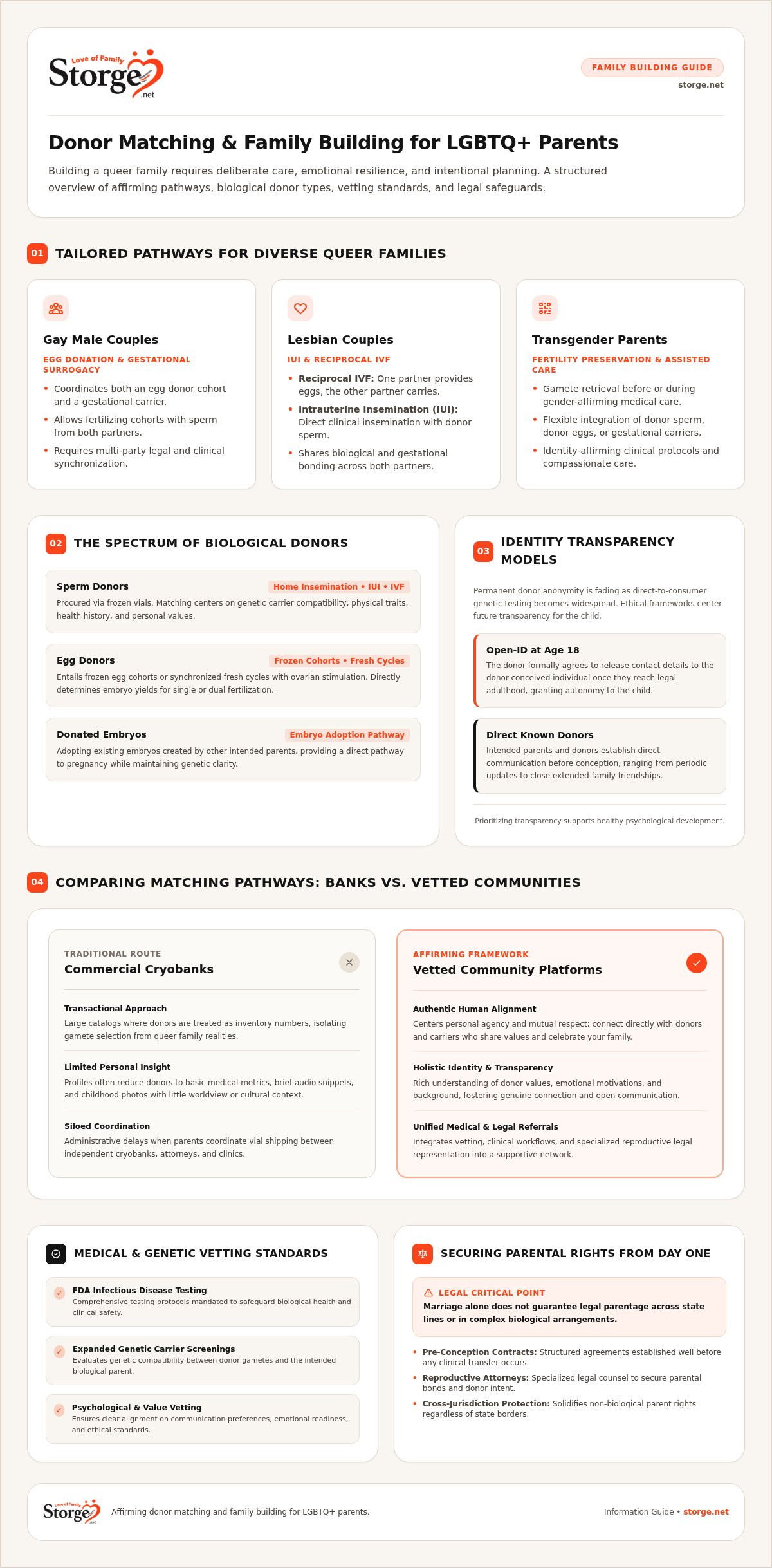
Traditional fertility banks often treat family creation as an inventory query, isolating gamete selection from the realities of queer parenthood. In contrast, modern donor matching services for LGBTQ parents embrace a holistic framework. Rather than forcing your story into a clinical box, these services unite medical screening, legal security, and human alignment across varied family structures.
Every queer journey demands a distinct approach. Gay male couples coordinate both egg donation and gestational surrogacy, sometimes fertilizing cohorts with sperm from both partners. Lesbian couples often choose intrauterine insemination or reciprocal IVF, where one partner provides the eggs and the other carries the pregnancy. Transgender intended parents may navigate gamete retrieval before or during gender-affirming care, utilizing donor sperm, donor eggs, or gestational carriers. Understanding Assisted Reproductive Technology for LGBTQ People reveals that true success requires coordinating these complex biological steps simultaneously rather than in clinical silos. Engaging with an authentic LGBTQ donor community transforms this phase from an overwhelming logistical chore into an affirming, shared milestone.
The Spectrum of Biological Donors: Eggs, Sperm, and Embryos
Choosing the right biological donor involves distinct procedural paths:
- Sperm Donors: Procured via frozen vials for home insemination, clinic IUI, or IVF. Matching centers on genetic carrier compatibility, physical traits, and personal values.
- Egg Donors: Entails either frozen egg cohorts or synchronized fresh cycles requiring ovarian stimulation. This path directly influences embryo yields for single-parent or dual-partner fertilizations.
- Donated Embryos: Involves adopting existing embryos created by other intended parents, offering another pathway to parenthood while preserving genetic clarity.
Open-ID, Known, and Identity-Release Matching Models
How your child connects with their genetic origins matters. Anonymous donation is rapidly fading as direct-to-consumer genetic testing makes permanent anonymity obsolete. Today's intended parents primarily choose between two affirming options:
- Open-ID at Age 18: The donor agrees to allow the donor-conceived child to obtain contact information once they reach legal adulthood, granting autonomy to the child.
- Direct Known Donors: Intended parents and donors establish communication before conception, ranging from periodic holiday updates to close family friendships.
Prioritizing early identity transparency supports healthy psychological development for donor-conceived children. Quality donor matching services for LGBTQ parents protect these future communication pathways through structured, ethical agreements established well before any clinical transfer occurs.
Comparing Matching Pathways: Traditional Banks vs. Vetted Communities
Choosing how to build your family often begins with deciding where to look. Prospective parents typically weigh two distinct avenues: traditional commercial gamete banks and vetted community platforms. While both models offer donor matching services for LGBTQ parents, their philosophies create vastly different experiences for queer intended families.
Commercial Cryobanks: Scale, Protocols, and Constraints
Commercial cryobanks provide extensive catalogs of frozen specimens backed by established laboratory storage systems. However, this transactional scale often brings distinct limitations. Donor profiles frequently reduce human beings to basic medical metrics, brief audio clips, and childhood photographs. You rarely gain insight into their genuine worldview, emotional motivations, or cultural heritage. Intended parents often experience administrative delays when attempting to coordinate vial shipments between large cryobanks, independent attorneys, and fertility clinics.
Vetted Community Platforms: Autonomy and Human Connection
Vetted community platforms take a different path by centering personal agency and mutual respect. Rather than browsing an impersonal inventory, you connect directly with egg donors, sperm donors, and gestational carriers who share your values and actively celebrate queer parenthood. Reliable platforms ensure that candidates respect professional benchmarks, including the ASRM donor screening guidelines for comprehensive psychological and medical vetting. This framework allows for intentional communication and smoother alignment from the very start. If you want a more collaborative path to finding a match, exploring affirming family-building networks can offer that essential peace of mind.
The operational differences between these models affect every phase of your journey:
| Feature | Commercial Cryobanks | Vetted Community Platforms |
|---|---|---|
| Core Focus | Specimen sales and laboratory inventory management | Human connection, mutual fit, and shared values |
| Contact Flexibility | Strictly restricted or limited to Open-ID at 18 | Customizable contact agreements, from open updates to direct connection |
| Cultural Alignment | Minimal context regarding donor values or identity | Deep insight into cultural background, ethics, and motivations |
| Journey Integration | Siloed gamete purchase requiring self-managed coordination | Holistic bridging between donors, reproductive attorneys, and fertility clinics |
Essential Screening Standards: Medical, Genetic, and Psychological Vetting
Rigorous vetting is the cornerstone of responsible family building. Beyond physical traits and personal backgrounds, prospective parents need absolute certainty regarding the health and stability of their match. High-integrity donor matching services for LGBTQ parents rely on a structured, three-pillar evaluation framework that examines infectious diseases, genetic carrier risks, and psychological readiness.
Infectious Disease Testing and FDA Regulatory Compliance
Federal regulations under 21 CFR Parts 1270 and 1271 mandate extensive communicable disease testing for all non-intimate gamete donations. Donors must test negative for HIV-1, HIV-2, hepatitis B, hepatitis C, and syphilis, alongside chlamydia and gonorrhea panels. For donor sperm, specimens undergo a mandatory six-month quarantine period followed by repeat serological testing before release. Clinics ensure that outside donor tissue meets these FDA standards before initiating any preparation cycle.
Genetic Compatibility and Multi-Generation Pedigree Review
Modern screening looks deeply into heritable patterns through clinical multi-generation pedigree reviews spanning at least three generations. In addition, donors and gamete-contributing intended parents undergo expanded carrier screening panels that evaluate hundreds of autosomal recessive conditions. Almost everyone carries a few recessive mutations. The objective is not discovering a donor with zero genetic variants; it is ensuring that both gamete contributors do not carry mutations on the same gene. Partnering with an LGBTQ friendly fertility clinic ensures that certified genetic counselors review these overlapping profiles before fertilizing eggs or freezing embryos.
Psychological Consultations and Long-Term Implications
Ethical guidelines strongly advise psychoeducational assessments for donors and prospective parents before any medical procedures begin. Conducted by licensed mental health professionals specializing in third-party reproduction, these sessions evaluate emotional stability, personal motives, and boundaries around future contact. They also equip intended parents to navigate open-identity agreements confidently, establishing positive narratives around donor conception long before their child asks their first question.
Approaching screening through this comprehensive lens eliminates guesswork. By verifying medical compliance, genetic compatibility, and emotional readiness together, donor matching services for LGBTQ parents transform clinical requirements into lasting peace of mind.
Securing Parental Rights: Legal Frameworks and Representation
Commercial gamete banks often step away the moment a vial or cohort ships, leaving families to decipher legal parentage alone. Biology does not automatically determine legal parentage, nor does marriage equality offer complete protection across state borders. Thoughtful donor matching services for LGBTQ parents prioritize legal security from the start, ensuring both intended parents hold indisputable parental rights.
Drafting Comprehensive Known Donor and Gamete Agreements
Informal handshakes and downloaded templates offer zero enforceable protection in family court. Clear, legally sound parentage begins with a tailored gamete agreement drafted prior to conception. These contracts establish vital guardrails:
- Parental Intent and Custody Relinquishment: Explicitly states that the donor has no parental rights, responsibilities, custody claims, or child support duties.
- Future Boundaries and Communication: Clarifies expectations regarding updates, identity release, or in-person interactions as the child grows.
- Independent Counsel: Requires separate legal representation for both the donor and intended parents. Family courts routinely invalidate agreements when all parties share the same attorney.
Understanding how to find an LGBTQ family law attorney ensures your contract complies with current reproductive statutes in your jurisdiction.
Second-Parent Adoption and Parentage Orders Post-Birth
Many intended parents believe that having both names on a birth certificate settles everything. However, a birth certificate is merely an administrative record, not a binding judicial decree. If you move or travel through states with restrictive reproductive laws, a non-biological or non-gestational parent without a court judgment remains legally vulnerable.
To establish permanent protection under the Full Faith and Credit Clause of the U.S. Constitution, queer parents must secure a court-ordered judgment. This is achieved through second-parent adoption, confirmatory adoption, or a pre-birth parentage order. While 15 states and Washington D.C. allow same-sex couples to establish rights through Voluntary Acknowledgment of Parentage (VAP) forms, an adoption decree provides portable, unassailable security nationwide.
Never leave your family's legal safety to chance. To secure specialized reproductive counsel who understand the unique dynamics of queer family building, request an attorney referral through Storge and establish rock-solid protection from day one.
Finding Your Match Through Storge PLUS and Inclusive Networks
Searching for a donor shouldn't mean wandering through isolated message boards or settling for detached commercial transactions. Choosing modern donor matching services for LGBTQ parents works best within an intentional, supportive environment built specifically around queer family journeys. Rather than wrestling with fragmented steps alone, prospective parents thrive when they have a unified space that blends authentic human connection with verified standards.
A Vetted Community for Intentional Family Building
Unregulated online groups often leave intended parents vulnerable to unvetted profiles, broken boundaries, and emotional fatigue. Through a Storge PLUS Membership, families enter a secure, identity-verified network. Intended parents can conduct dedicated egg and sperm donor searches or gestational carrier searches among individuals who actively share their values and celebrate queer parenthood.
Within this private space, members connect not only with prospective donors but also with peers walking parallel paths. Whether you're planning reciprocal IVF, independent donor insemination, or gestational surrogacy, engaging with fellow queer parents provides invaluable clarity, shared insights, and mutual encouragement.
Connecting with Verified Clinics and Legal Specialists
Finding an ideal match is only one part of the equation. Turning that match into a healthy pregnancy and a legally protected family requires close coordination between reproductive endocrinologists and legal professionals. Storge bridges this gap nationwide, simplifying complex logistics by connecting members directly to an affirming professional network:
- Fertility Clinic Referrals: Connect with reproductive medical teams celebrated for culturally competent, LGBTQ-affirming clinical care.
- Attorney Representation Referrals: Partner with specialized assisted reproductive technology attorneys who draft enforceable gamete agreements and secure binding court parentage judgments.
- Hospital Search: Identify delivery hospitals experienced in honoring diverse family structures and non-gestational parents during birth.
By uniting community matching, clinical referrals, and legal protection under one roof, donor matching services for LGBTQ parents become an empowering, well-guided experience. You can step forward knowing every layer of your parenthood is honored and protected.
Moving Forward on Your Family-Building Journey
Every queer family begins with intention, deep love, and courage. By pairing rigorous clinical screenings with proactive legal protections, you create an enduring foundation where your future child can flourish. Choosing the right donor matching services for LGBTQ parents isn't just about finding compatible gametes; it's about honoring your personal values, maintaining emotional clarity, and ensuring your parental rights remain unassailable from day one.
You don't have to navigate these complex decisions in isolation. Through Storge, you gain access to a safe, nationwide network of vetted egg donors, sperm donors, and gestational carriers, alongside trusted referrals to LGBTQ-inclusive reproductive attorneys and fertility clinics. When you're ready to take the next step on your own terms, join the Storge PLUS community to find vetted donors and affirming resources. Your dream of parenthood is entirely within reach, and you have an affirming community ready to walk beside you.
Frequently Asked Questions
How do donor matching services protect parental rights for LGBTQ couples?
High-quality donor matching services for LGBTQ parents ensure that legal parentage isn't treated as an afterthought. They coordinate the matching process with referrals to independent reproductive attorneys who draft explicit gamete donor contracts prior to insemination or retrieval. These agreements clearly relinquish the donor's parental claims and affirm intended parents' legal status, setting up the required foundation for post-birth confirmatory adoptions or parentage judgments.
What is the difference between an open-ID donor and an anonymous donor?
An open-ID donor agrees to allow the donor-conceived person to request identifying contact information once they turn eighteen. In contrast, anonymous donation historically barred any contact, though modern home DNA kits have rendered true permanent anonymity virtually impossible. Choosing an open-ID arrangement respects your child's future curiosity and identity development while maintaining clear parental boundaries throughout their childhood years.
Can lesbian or gay couples use known donors safely without future custody disputes?
Yes, known donors can be utilized safely, provided both parties establish formal legal boundaries before conception occurs. Simply trusting a verbal agreement or downloading an online template leaves families vulnerable in court. Safe collaboration requires working with specialized reproductive attorneys so the donor and intended parents have independent legal representation. This ensures the contract explicitly waives donor custody, parenting time, and support obligations under state laws.
What medical and genetic screening should we expect a qualified donor to complete?
Qualified donors undergo thorough evaluations before gametes are cleared for use. Expect complete infectious disease testing complying with FDA regulations, covering HIV, hepatitis B and C, syphilis, and gonorrhea. In addition, donors should complete expanded genetic carrier screening panels assessing hundreds of recessive conditions, alongside a detailed three-generation health history review and a psychoeducational evaluation conducted by a qualified reproductive mental health professional.
How does community matching differ from ordering through a traditional cryobank?
Traditional cryobanks operate as transactional gamete warehouses, offering limited donor profiles and rigid customer portals. Community matching platforms like Storge emphasize transparent, human-centered alignment. Intended parents connect directly with vetted donors and gestational carriers who share their values and celebrate queer family creation. These networks streamline the process by pairing donor searches with trusted referrals to LGBTQ-inclusive reproductive attorneys and clinics nationwide.
What steps should transgender parents take when planning for donor conception?
Transgender parents should consult with affirming reproductive endocrinologists to discuss fertility preservation, gamete viability, and any necessary pauses in hormone replacement therapy. Choosing donor matching services for LGBTQ parents allows trans individuals and couples to find compatible donors while working with culturally competent clinics. Securing independent legal counsel is equally vital to ensure that legal gender markers on identification documents do not complicate parental rights.
Why do LGBTQ parents need confirmatory adoption if both are on the birth certificate?
A birth certificate is an administrative document, not a judicial court decree. While the marital presumption or state laws may place both parents on the certificate at birth, other jurisdictions are not legally obligated to honor administrative records alone. A confirmatory or second-parent adoption creates an unassailable court judgment protected across all fifty states by the Full Faith and Credit Clause of the U.S. Constitution.


