

Single women now represent upwards of 40% of all donor sperm recipients at major fertility clinics, yet opening an online commercial cryobank catalog often feels sterile, transactional, and overwhelming. If you are scrolling through donor numbers late at night and wondering how to protect your parental rights without a partner, your hesitation is completely valid. Sperm donor selection for single LGBTQ women should be an empowering, joyful milestone; instead, it frequently stirs up anxiety over anonymous versus open-identity options, complex genetic screenings, and the long-term well-being of your future child.
You deserve a path that honors your values rather than reducing solo queer family building to a cold, confusing checklist. We are here to offer clear guidance on evaluating donor types, understanding essential genetic carrier screenings, establishing legal non-parentage protections, and connecting with vetted community networks. Ahead, explore a comprehensive 2026 roadmap built to help you move past clinical overwhelm and step into parenthood with confidence, security, and peace of mind.
Key Takeaways
- Explore a structured framework for sperm donor selection for single LGBTQ women that aligns your personal values, ancestry, and future identity preferences.
- Compare open-identity, anonymous, and known donors across health screenings, family sibling limits, and long-term child welfare considerations.
- Understand vital clinical preparation steps, from baseline fertility assessments and carrier screening matches to choosing between ICI, IUI, and IVF.
- Protect your family unit before conception with established legal safeguards, non-parentage contracts, and reproductive attorney representation referrals.
- Replace isolating commercial catalogs with an affirming, vetted community ecosystem designed to support solo parents by choice at every milestone.
Understanding Your Options: Sperm Donor Types for Single LGBTQ Women
Single queer women build families on their own terms. Unlike traditional clinical paths designed around heterosexual infertility, your decision is rooted in self-determination, autonomy, and clear intention. Approaching this process means looking past cold catalog listings to center your future child's identity and emotional welfare. Selecting the right gamete provider is not just a logistics checkbox; it is the foundation of your family structure.
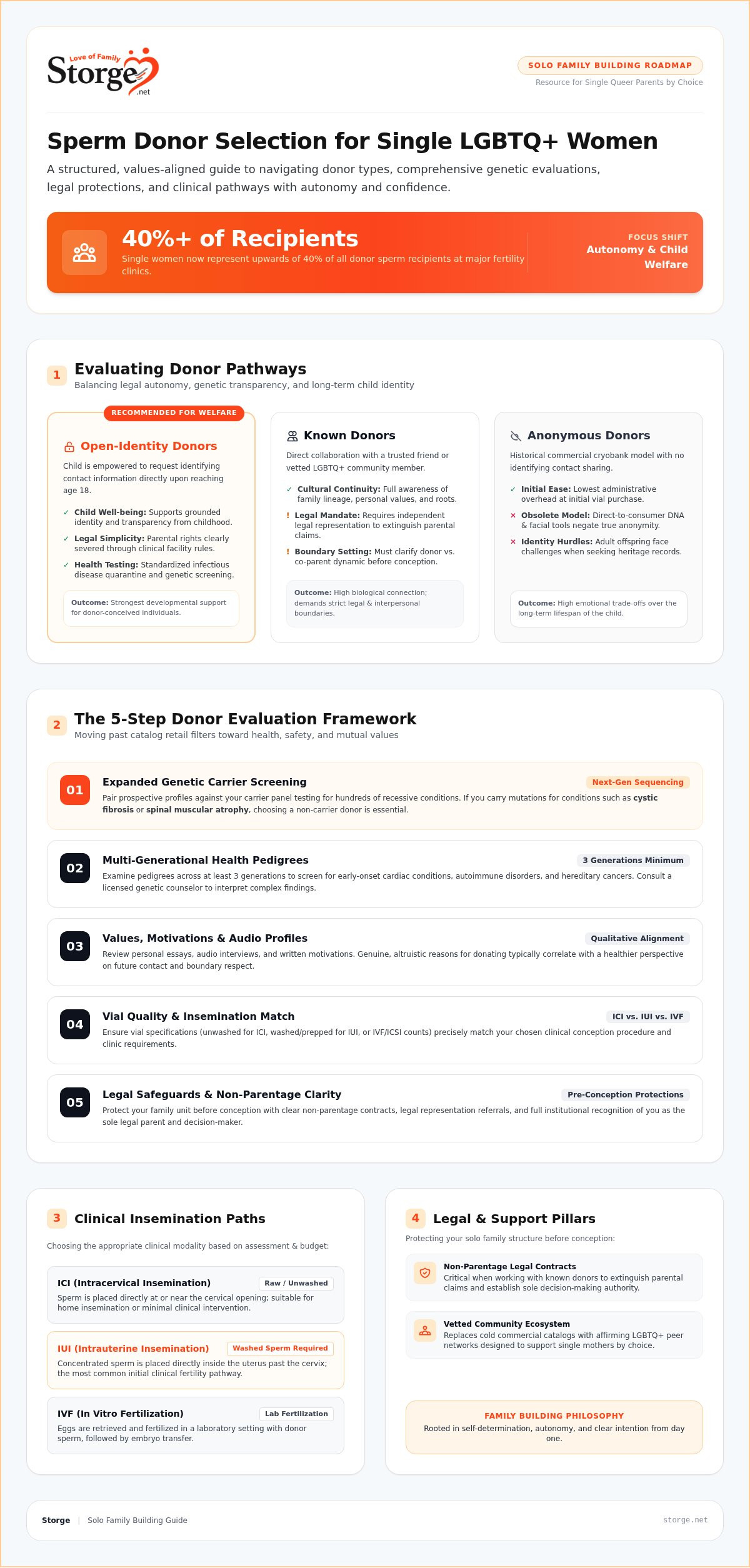
Modern reproductive awareness has shifted how prospective parents view genetic origins. Familiarizing yourself with foundational sperm donation options and donor types helps you weigh biological openness against practical autonomy. When navigating sperm donor selection for single LGBTQ women, you will generally weigh three pathways: open-identity, anonymous, and known donors.
Open-Identity vs. Anonymous Donors
Historically, commercial banks favored total anonymity, but direct-to-consumer genetic databases and facial matching have made true anonymity obsolete. Open-identity arrangements allow your child, upon reaching age 18, to request identifying contact information directly from the cryobank. Developmental research consistently shows that donor-conceived individuals experience better psychological outcomes when their origins are transparent from childhood. Knowing they have access to their genetic background fosters grounded self-understanding.
Known and Community Donors: Balancing Connection and Autonomy
Collaborating with a friend or community member offers an organic alternative to commercial cryobanks. It provides immediate health transparency, cultural continuity, and personal connection. However, solo mothers must establish clear interpersonal boundaries early. A known donor must understand they are providing biological material, not entering a co-parenting dynamic. Finding a trusted partner through an LGBTQ donor community enables single women to build transparent connections while safeguarding their role as the sole decision-maker.
Donor Type Comparison for Solo Queer Parents
Choosing a path requires balancing parental autonomy, legal requirements, and future relationship dynamics. Consider how each option functions in practice:
- Open-Identity Bank Donors: Offer clear parental rights severance through clinical facilities, standard infectious disease quarantines, and child-initiated contact at adulthood.
- Known Donors (Direct Collaboration): Provide full knowledge of family lineage, personal alignment, and early genetic awareness, but require formal legal representation to extinguish parental claims.
- Anonymous Donors: Present the lowest administrative overhead at initial purchase, yet carry significant emotional trade-offs and future identification challenges as adult offspring seek heritage records.
Thoughtful sperm donor selection for single LGBTQ women honors both your immediate peace of mind and your future child's lifelong identity narrative.
The 5-Step Evaluation Framework: How to Choose Your Donor
Filtering hundreds of profiles based solely on eye color or height reduces a deeply personal milestone to a retail transaction. A structured framework brings clarity to this process, shifting your attention toward generational wellness, mutual values, and biological safety. Methodical sperm donor selection for single LGBTQ women ensures that every decision aligns with your long-term parenting vision.
Step 1 & 2: Genetic Screening and Health Pedigrees
Begin by comparing your expanded carrier screening panel against prospective profiles. Most fertility clinics run Next-Generation Sequencing testing for several hundred recessive conditions. If you carry a mutation for cystic fibrosis or spinal muscular atrophy, pairing with a non-carrier donor is essential. Beyond single-gene testing, examine multi-generational family pedigrees spanning at least three generations to identify patterns of early-onset cardiac conditions, autoimmune disorders, or hereditary cancers. A licensed genetic counselor can help interpret complex or ambiguous findings.
Step 3 & 4: Assessing Values, Motivation, and Vial Quality
Delve into the donor's personal essays and audio interviews. Listen for why they chose to donate; authentic, altruistic motivations often reflect a healthier perspective on future contact than purely transactional participation. Next, align the technical specifications with your fertility protocol:
- IUI Vials (Pre-Washed): Prepared to eliminate seminal plasma and bacteria, allowing direct insertion into the uterus.
- ICI Vials (Unwashed): Preserved in raw fluid for cervical placement; they require laboratory washing before any intrauterine procedure.
- Motility Standards: Ensure each vial meets the minimum total motile sperm count required by your treating physician.
Every sample must adhere strictly to FDA reproductive tissue donor testing requirements, which mandate six-month infectious disease quarantines for anonymous donations to protect maternal and fetal health.
Step 5: Family Limits and Birth Caps
Investigate how the bank or organization regulates family limits. While commercial outfits may permit dozens of families per donor, responsible networks maintain strict boundaries. Capping donor-conceived sibling cohorts to smaller numbers protects your child from unexpected genealogical complications and supports healthy community connections later in life.
Applying this five-step strategy transforms sperm donor selection for single LGBTQ women from an intimidating chore into a grounded, intentional process. If you want a more transparent journey, explore how Storge connects you with vetted resources designed specifically for queer family building.
Clinical Protocols: Preparing for Insemination and Conception
Once you narrow down your donor preferences, translating those choices into a medical plan requires practical coordination. Clinical preparation turns biological selection into an actionable timeline. Medical baselines, shipping logistics, and treatment methods must align so that every purchased vial delivers its highest reproductive potential. Understanding clinical pathways ensures your journey stays organized and predictable.
Comparing IUI, IVF, and At-Home Insemination
Conception methods vary based on your anatomy, timeline, and personal preferences. Intracervical insemination (ICI) allows for quiet, home-based attempts using unwashed or washed donor samples, though precise ovulation timing remains critical. Intrauterine insemination (IUI) places washed sperm directly past the cervix into the uterus during a natural or medicated cycle, yielding clinical success rates of 10% to 15% per attempt for individuals under 35 with uncompromised fertility. When timing requires greater control or when maximizing frozen vials is a priority, exploring advanced pathways outlined in the CDC assisted reproductive technology definitions, such as in vitro fertilization (IVF), provides cumulative delivery rates between 30% and 50% per retrieval cycle.
Working with an LGBTQ-Affirming Reproductive Endocrinologist
Navigating clinic evaluations as a solo queer parent requires medical professionals who understand social rather than purely pathological infertility. Baseline assessments evaluate ovarian reserve through anti-Müllerian hormone (AMH) blood panels and antral follicle counts, alongside uterine cavity imaging. Preparing targeted questions to ask an LGBTQ-friendly fertility clinic helps you identify practices that respect solo family builders instead of treating you through a deficit-based lens.
Safe logistics safeguard your investment throughout this phase. Consider these essential technical protocols:
- Liquid Nitrogen Vapor Tanks: Frozen specimens travel in specialized dry shippers maintaining cryogenic temperatures for up to seven days during transit.
- Specimen Chain of Custody: Clinics must log strict intake verification, ensuring donor identifiers, wash types, and quarantine release documents match prior to thawing.
- CMV Antibody Alignment: If your baseline bloodwork shows you are cytomegalovirus (CMV) negative, physicians counsel choosing a CMV-negative donor to prevent congenital infection risks.
Approaching sperm donor selection for single LGBTQ women with clear clinical knowledge protects your health, streamlines clinic communication, and establishes a secure framework for conception.
Essential Legal Safeguards for Single Queer Mothers by Choice
Conceiving without a partner requires deliberate legal architecture. While a couple might lean on marital presumptions or joint adoption decrees, a single woman must establish indisputable legal recognition before conception takes place. Standard commercial bank purchase agreements provide immediate parental rights severance through clinical release protocols, but they do not replace state-level parentage protections. Unchecked assumptions leave room for judicial ambiguity.
Known Donor Agreements vs. Commercial Waivers
Informal handshakes, verbal understandings, or boilerplate online templates do not hold up in family court. Under statutory models like the Uniform Parentage Act (UPA 2017) adopted across multiple states, assisted reproduction statutes protect intended parents; however, at-home insemination using known donors without physician involvement can leave solo mothers vulnerable to unexpected paternity claims. An enforceable agreement must be executed prior to any insemination attempts. It must explicitly disclaim paternal intent, surrender child custody or visitation rights, and waive financial support obligations. Both parties must retain independent legal counsel to ensure the agreement cannot be challenged later as coercive or uninformed.
Securing Sole Parentage and Estate Protection
Signing a donor contract is only the first layer of defense. A complete legal framework should include several proactive measures:
- Pre-Birth or Post-Birth Parentage Judgments: Court orders formally declaring you as the child's sole legal parent, preempting future claims across jurisdictional lines.
- Confirmatory Adoption Decrees: An extra layer of cross-border protection that secures your parental rights even when traveling to jurisdictions with less protective family codes.
- Standby Guardianship Designations: Documentation naming trusted individuals to step in immediately should an emergency arise.
- Comprehensive Estate Directives: Clear healthcare proxies and wills confirming custody wishes and preserving your child's inheritance.
Working with an attorney who understands queer family structures is crucial. Learn how to find an LGBTQ family law attorney who can draft binding documents tailored to your jurisdiction.
Legal foresight is an integral part of sperm donor selection for single LGBTQ women. To connect directly with reproductive legal professionals who specialize in solo parentage, join Storge today and secure experienced attorney representation referrals for your family journey.
Building Your Support Ecosystem: The Power of Community Networks
Sperm donor selection for single LGBTQ women does not have to take place behind a screen in isolation. While the solo path offers complete autonomy, bearing every logistical and emotional choice on your own can feel taxing. Unregulated social media donor groups often present significant legal and health risks, while traditional commercial banks can feel cold and detached. Building a dedicated support ecosystem bridges the gap between solitary decision-making and genuine community connection.
The Emotional Reality of Solo Queer Family Planning
Solo queer family building carries a distinct mental load. Without a romantic partner to debrief after appointments or review screening panels, second-guessing yourself is common. Cultivating a chosen village helps anchor you. Surrounding yourself with fellow single parents by choice, trusted friends, and affirming mentors normalizes the experience and replaces self-doubt with reassurance. Longitudinal child development studies consistently demonstrate that children raised by single mothers thrive just as well as their peers in two-parent households when raised within a secure, communicative environment. Sharing your path with pride gives your future child a grounded sense of origin from day one.
How Storge Simplifies the Donor and Resource Search
Finding values-aligned support should feel inspiring rather than transactional. Storge creates a safe alternative to cold commercial catalogs and risky DIY networks by connecting prospective solo mothers with verified donor networks, inclusive medical clinics, and knowledgeable family law attorneys under one unified umbrella.
When you seek transparent connections, accessing the right tools makes all the difference:
- Vetted Donor Matches: Engage with trusted gamete donors who share your values regarding identity transparency and family limits.
- Curated Professional Referrals: Connect with LGBTQ-affirming fertility clinics and specialized reproductive attorneys who understand solo parentage.
- Peer Solidarity: Learn alongside other single women navigating identical emotional, medical, and legal milestones.
You don't have to assemble this intricate puzzle on your own. Gaining access through Storge PLUS Membership provides the curated guidance and professional network required to move forward safely. Approached within an affirming collective space, sperm donor selection for single LGBTQ women transforms into an empowering celebration of self-determination.
Step Confidently Into Your Solo Motherhood Journey
Building your family on your own terms is an act of deep courage and profound love. When you ground your path in comprehensive genetic screening, clear legal safeguards, and identity transparency, you create a foundation where your future child can truly thrive. Thoughtful sperm donor selection for single LGBTQ women honors both your immediate peace of mind and the lifelong emotional well-being of the family you are creating.
You don't have to carry the weight of these choices in isolation. Through a community-first approach that prioritizes child-centered ethics and donor transparency, Storge provides a comprehensive family-building platform tailored to your goals. Access a curated nationwide network of LGBTQ-affirming reproductive specialists, fertility clinics, and parentage attorneys who respect your autonomy. When you are ready to take your next step, join the Storge PLUS community to connect with vetted donors, attorneys, and clinics. Your journey to parenthood is already unfolding, and an affirming village is ready to walk alongside you.
Frequently Asked Questions
Can a single LGBTQ woman use a known sperm donor without giving up parental rights?
Yes, but it requires strict legal and medical safeguards before insemination occurs. State courts often default to classifying known donors as legal fathers if conception takes place through at-home insemination without formal legal contracts. To protect your sole custody, execute a pre-conception donor agreement through independent legal counsel and perform the insemination under clinical oversight to automatically sever donor parental rights.
How does open-identity donation differ from anonymous donation in 2026?
Open-identity donation grants your child the option to request identifying contact information from the bank when they reach age 18. Anonymous donation was designed to conceal that contact entirely. Direct-to-consumer genetic registries have rendered true anonymity obsolete; most major banks now focus on open-identity models that honor the child's future curiosity and right to genetic heritage.
What medical and genetic screenings should a prospective sperm donor undergo?
Reproductive tissue donors must undergo rigorous infectious disease screening mandated by federal health guidelines, including tests for HIV, hepatitis B and C, syphilis, chlamydia, and gonorrhea. Reputable banks also conduct multi-generational health pedigrees and Next-Generation Sequencing expanded carrier panels to identify recessive conditions like cystic fibrosis, ensuring safe genetic matching before you finalize your selection.
Is at-home insemination legally safe for a single queer mother by choice?
At-home insemination carries notable legal vulnerabilities when using a known donor without prior clinical or legal coordination. Several states only extinguish a donor's parental rights if the sample is handled by a licensed physician. If you pursue at-home insemination, consult an experienced reproductive attorney beforehand to establish parentage protections and confirm your jurisdiction's assisted reproduction statutes.
How many vials of donor sperm should I purchase for IUI or IVF?
Most reproductive specialists suggest securing three to four vials per planned child when attempting intrauterine insemination (IUI). Because clinical success averages 10% to 15% per cycle for individuals under 35, multiple attempts are often necessary. If you are pursuing IVF, one to two vials are typically sufficient because an embryology lab can fertilize multiple retrieved eggs from a single sample.
Do single women encounter institutional discrimination at conventional fertility clinics?
Some single queer women encounter subtle friction, such as clinic intake paperwork structured around heterosexual couples or diagnostic billing requiring heterosexual intercourse to prove infertility. Seeking fertility clinic referrals through dedicated platforms like Storge ensures you partner with vetted practices that understand social infertility, celebrate solo family building, and provide affirming care from your first appointment.
What legal steps must a solo mother take to secure sole custody from birth?
Effective sperm donor selection for single LGBTQ women involves securing pre-birth or post-birth parentage judgments that legally establish you as the sole guardian. You should also draft healthcare proxies, standby guardianship documents, and a comprehensive will. Securing attorney representation referrals through Storge PLUS Membership connects you with family law professionals who can tailor these critical documents to your state's specific requirements.


