
What if the journey to parenthood didn't require you to check your identity at the clinic door? For many in our community, the search for donor conception resources for non-binary individuals is often clouded by the fear of being misgendered or the frustration of navigating systems built solely for the gender binary. You deserve a process that celebrates your identity rather than asking you to fit into a box that was never meant for you.
We understand that finding a donor who respects your journey and a legal framework that secures your family's future can feel like an uphill battle. This 2026 guide is designed to change that narrative by providing a comprehensive roadmap tailored specifically to your needs. You'll discover how to access inclusive donor networks, find medical professionals who lead with empathy, and secure the legal protections necessary for your peace of mind. We've gathered the essential tools to help you move forward with confidence, ensuring your path to a growing family is as affirming as it is successful. From vetting donors to navigating gender-neutral birth certificates, we're here to guide you through every step of this beautiful transition.
Key Takeaways
- Understand the unique challenges of the traditional fertility landscape and how to find paths that honor your gender identity.
- Identify donor banks that offer gender-affirming donor conception resources for non-binary individuals, ensuring your search starts with respect.
- Learn to vet clinics by looking beyond the surface for inclusive intake forms and gender-neutral environments.
- Gain clarity on protecting your parental rights through second-parent adoption and navigating the latest trends in gender-neutral documentation.
- Explore how a vetted network of professionals and donors can provide a safe haven for your transition into parenthood.
Navigating Donor Conception as a Non-Binary Individual in 2026
For many, the path to parenthood begins with a vision of a future that reflects their most authentic self. In 2026, donor conception is no longer just a clinical procedure; it's a personalized journey where non-binary and gender-expansive individuals exercise their right to build families on their own terms. Donor conception for non-binary individuals is a self-directed path to parenthood that prioritizes your bodily autonomy and the freedom to define your family structure outside of traditional gender norms.
Most legacy fertility centers were built on a foundation of heteronormative assumptions. They often rely on binary checkboxes that don't account for the diversity of our community, which can lead to a feeling that you're an afterthought in your own care. Finding donor conception resources for non-binary individuals means seeking out spaces where your identity is a core value rather than a hurdle to be cleared. Identity-first family planning ensures that every decision, from choosing a donor to signing legal documents, starts with respect for your gender journey.
The Evolution of Gender-Affirming Fertility Care
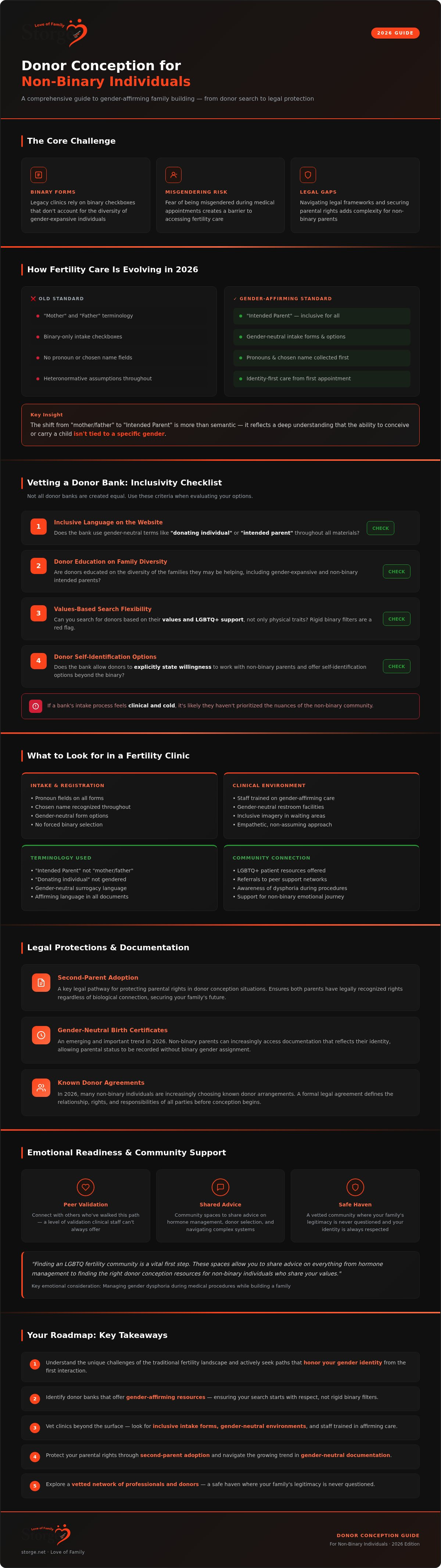
Clinical environments are finally catching up. We've seen a significant shift toward gender-neutral terminology that honors all parents. Leading clinics have replaced "mother" and "father" with the more accurate and inclusive "Intended Parent" in both surrogacy and donation contexts. This change is more than semantic; it reflects a deep understanding that the ability to conceive or carry a child isn't tied to a specific gender. Modern intake forms now prioritize your pronouns and chosen name, ensuring that every medical interaction affirms who you are from the very first appointment.
Emotional Readiness and Community Support
Building a family as a non-binary person involves a unique set of emotional considerations. You might be managing gender dysphoria during medical procedures or explaining your family structure to those who only understand the binary. This is why finding an LGBTQ fertility community is such a vital first step. Connecting with peers who've walked this path provides a level of validation that clinical staff can't always offer. These spaces allow you to share advice on everything from hormone management to finding the right donor conception resources for non-binary individuals who share your values. Within a vetted community like Storge PLUS, you can find a safe haven where your family's legitimacy is never questioned.
Key Resources for Sperm and Egg Donation: A Gender-Affirming Approach
Finding the right biological material is more than a medical transaction; it's the first tangible step toward the family you've envisioned. For non-binary intended parents, this phase requires a specialized focus on donor conception resources for non-binary individuals to ensure the process remains affirming from the very first search. Utilizing a trusted sperm donor community offers a level of safety and shared values that unregulated social media forums simply cannot provide. This vetted approach protects your peace of mind while connecting you with donors who truly understand and support gender-expansive family structures.
Vetting Sperm and Egg Donor Banks
Not all donor banks are created equal. Many still rely on rigid, binary search filters that can make the experience feel alienating. When evaluating a bank, look beyond their basic statistics and examine their culture of inclusivity. A truly gender-affirming bank will offer self-identification options for donors and allow you to filter for those who have explicitly stated their willingness to work with non-binary parents. Use this checklist during your initial research:
- Inclusive Language: Does the website use gender-neutral terms like "donating individual" or "intended parent"?
- Donor Education: Are donors educated on the diversity of the families they may be helping?
- Search Flexibility: Can you search for donors based on their values and support for the LGBTQ+ community rather than just physical traits?
If a bank's intake process feels clinical and cold, it's likely they haven't prioritized the nuances of our community. You can find more supportive options through our vetted donor search tools, which prioritize banks and individuals who lead with empathy.
The Rise of Known Donor Agreements
In 2026, many non-binary individuals are moving away from anonymous donation in favor of known donor agreements. This shift is often driven by a desire for transparency and a need to ensure the donor fully respects the gender-affirming nature of the household. A known donor allows for open dialogue about how you'll discuss the child's origins and ensures that the donor's values align with your own. This path requires clear communication and a shared understanding of boundaries, but it often results in a more cohesive support system for the future. By using community-vetted databases, you can find donor conception resources for non-binary individuals that emphasize these personal connections, ensuring that everyone involved is committed to a family structure built on mutual respect and authenticity.
Vetting Fertility Clinics for Non-Binary Inclusivity
Choosing a medical partner is one of the most vulnerable parts of your family-building journey. It's about more than clinical success rates; it's about finding a team that respects your identity as much as your dreams. A clinic's digital presence is often the first handshake. If their website only features binary imagery or "mother and father" language, it's a sign they might not have prioritized donor conception resources for non-binary individuals. Look for inclusive language and diverse representation as a baseline before you even book a consultation.
Physical markers in the office also tell a story. Gender-neutral restrooms and intake forms that include space for pronouns and chosen names are small but powerful indicators of a safe environment. During your first meeting, pay close attention to how the doctor responds to your identity. Do they use your correct pronouns effortlessly, or is there a visible struggle? To help you navigate these initial conversations, we've compiled 23 Essential Questions to Ask an LGBTQ-Friendly Fertility Clinic in 2026 to ensure no detail is overlooked.
The Clinical Experience: Red Flags vs. Green Flags
A major red flag is persistent misgendering, especially after you've corrected the staff. It's not just about politeness; it's about the safety and accuracy of your medical care. Conversely, a green flag is a clinic that proudly displays training certifications from organizations like WPATH or GLMA. These credentials show a proactive commitment to understanding the specific health needs of our community. Don't forget to assess the bedside manner of everyone you interact with, including the nursing staff and embryologists, as they'll be your primary points of contact throughout the process.
Technological Inclusivity in Fertility Labs
The lab is the heart of your journey, and its protocols should reflect your identity. For those on HRT, it's crucial to find a lab experienced in handling gametes while considering the effects of hormone therapy. Inclusivity also extends to administrative accuracy. Your chosen name should be used on all laboratory labeling and tracking systems to prevent the dysphoria of seeing a deadname during such a significant life event. The embryologist plays a vital role here, acting as a silent partner who must respect your identity while managing the technical aspects of your future family's genetic material. Finding a clinic that integrates these donor conception resources for non-binary individuals into their lab workflow ensures a seamless, affirming experience.
Legal Protections and Documentation for Non-Binary Parents
Legal security is the foundation upon which you build your family's future. For non-binary parents, the legal landscape in 2026 offers more recognition than ever before, yet it still requires a proactive and meticulous approach. While marriage equality provides some protections, it doesn't automatically secure parental rights in every scenario, especially when using donor conception. Accessing specialized donor conception resources for non-binary individuals is critical to ensure your legal standing is ironclad. One of the most important steps you can take is securing a specialized LGBTQ family law attorney to draft your donor contracts and navigate the court system.
As of 2026, federal documents like U.S. passports continue to offer "X" gender markers and "Parent" designations, providing a necessary level of consistency for non-binary families at the national level. However, state-level birth certificates still vary significantly. Many parents now advocate for "Parent/Parent" designations to avoid binary labels that don't reflect their identity. Navigating these administrative hurdles requires a steady guide who understands the nuances of gender-expansive parentage markers.
Securing Legal Parentage
Protecting your family begins long before the birth. First, you must draft a comprehensive donor agreement that clearly waives the donor's parental rights and establishes your intent to parent. Second, you should pursue a court order of parentage. This is a vital step regardless of your marital status, as it provides a judicial decree that is much harder to challenge than an administrative form. Finally, ensure your own identity documents are updated. Having consistent gender markers across your ID and your child's documentation prevents confusion and reinforces your legal identity in medical and educational settings.
Second-Parent Adoption vs. Voluntary Acknowledgement
While many states offer a Voluntary Acknowledgement of Parentage (VAP), second-parent adoption remains the gold standard for non-binary parental security. A VAP is an administrative form, but an adoption is a court judgment. Under the Full Faith and Credit Clause of the U.S. Constitution, other states are generally required to recognize a court-ordered adoption, which is essential for interstate travel or relocation. The traditional "stepparent" adoption framework can be clunky for non-binary individuals, so working with an expert is necessary to adapt these processes to your specific needs. To start building your legal safeguard, you can access our attorney representation referrals to connect with professionals who specialize in non-binary family law.
Building Your Family Through the Storge PLUS Community
Dreaming of a family is a deeply personal act that deserves a supportive foundation. While the previous sections of this guide have detailed the clinical and legal hurdles you might face, you don't have to carry the weight of those complexities alone. For those seeking donor conception resources for non-binary individuals, the search often feels fragmented and isolating. Storge PLUS was created to bridge the gap between your personal dream and the practical reality of parenthood, offering a centralized safe haven where your identity is the starting point, not an obstacle. It's a space where shared values and mutual respect form the basis of every connection.
By joining this community, you're gaining more than just a list of services; you're entering a partnership with a team that understands the nuances of gender-expansive family building. We've done the heavy lifting of vetting professionals so you can focus on the joy of your transition into parenthood. Whether you're just beginning to explore your options or you're ready to secure your family's legal future, our Storge PLUS Membership: Your Vetted Path to LGBTQ+ Family Building provides the roadmap you need.
What to Expect from a Storge PLUS Membership
Membership offers direct access to a directory of verified LGBTQ-inclusive family-building professionals who have been carefully screened for their commitment to gender-affirming care. Unlike traditional clinic-run databases that limit your choices to a single pool, Storge PLUS provides a broader, community-vetted ecosystem. You'll find donor egg and sperm search tools alongside referrals for specialized legal representation and fertility clinics that lead with empathy. This community-funded model ensures that our primary loyalty is to you and your future family. Having access to a network of donors and carriers who are explicitly non-binary affirming provides a level of safety that is rare in the traditional fertility industry.
Taking the First Step Toward Parenthood
Starting your journey within the Storge ecosystem means prioritizing your peace of mind. You can begin your donor search with the confidence that every individual in our network understands the importance of respecting your pronouns and your family structure. We believe that your non-binary identity is a profound strength in your parenting journey, offering your future child a unique perspective on authenticity and self-definition. As you take these first steps, remember that your path is valid, your dreams are achievable, and your community is standing with you. By utilizing specialized donor conception resources for non-binary individuals, you're not just building a family; you're helping to create a more inclusive world for the next generation.
Empowering Your Path to Parenthood
Your journey to building a family is a profound act of hope and self-definition. By prioritizing clinical inclusivity and securing your legal rights through specialized attorney referrals, you're creating a stable foundation for your future. Navigating these steps requires more than just clinical data; it requires a vetted network that recognizes your identity as a strength. You deserve a process that respects your autonomy and provides the legal security your family needs to thrive in every aspect of life.
Accessing specialized donor conception resources for non-binary individuals ensures that every person involved in your journey shares your commitment to authenticity. Community-driven family building is about more than just a medical procedure; it's about finding a safe haven where your family's legitimacy is never questioned. Through our vetted network of LGBTQ+ donors and professionals, we provide the steady guidance needed to bridge the gap between your dream and reality.
Join Storge PLUS to access our vetted community of non-binary inclusive donors and professionals.
We're honored to walk beside you as a trusted companion, helping you turn your vision of parenthood into a beautiful and secure reality. Your future family is a celebration of living truthfully.
Frequently Asked Questions
How do I find a sperm donor if I am non-binary?
Use a platform like Storge PLUS to access donor conception resources for non-binary individuals. This vetted network connects you with donors who have explicitly confirmed their support for gender-expansive families. You can filter for individuals who prioritize shared values, ensuring your search begins with a foundation of mutual respect. Starting within a community-focused ecosystem helps you avoid the risks of unregulated forums and find donors who truly understand your journey.
Can non-binary individuals be listed as "Parent" on a birth certificate?
In 2026, several states allow for gender-neutral "Parent" designations on birth certificates rather than the traditional binary labels. This trend toward administrative inclusivity is growing, but the specific requirements vary significantly by jurisdiction. You should consult a specialized family law attorney to ensure your documentation accurately reflects your identity. Securing a court order of parentage remains a vital step to protect your rights regardless of how the birth certificate is labeled.
Are there specific fertility clinics for non-binary people?
While few clinics exclusively serve non-binary individuals, many have transformed their practices to be deeply inclusive and affirming. Look for clinics that hold certifications from organizations like GLMA or WPATH and use gender-neutral language in their intake paperwork. Storge provides referrals to fertility clinics that have been vetted for their bedside manner and technological inclusivity. These providers understand the nuances of gender-affirming care and prioritize your comfort throughout every medical procedure.
What legal documents do non-binary parents need after donor conception?
You'll need a comprehensive donor agreement drafted by an attorney to clearly establish parental intent and waive the donor's rights. After birth, pursuing a second-parent adoption or a court order of parentage is the gold standard for legal security. These documents ensure your parental rights are recognized nationally, even if you travel to states with different laws. Consistent gender markers on your federal identity documents also help prevent administrative hurdles in medical or educational settings.
How does HRT affect donor conception for non-binary intended parents?
Hormone Replacement Therapy can impact gamete production, so it's essential to work with a clinic experienced in gender-affirming care. Some individuals choose to pause HRT or utilize gametes frozen prior to starting hormones. Every person's biological response is unique, so your medical team will create a personalized plan that respects your transition and your family-building goals. Accessing donor conception resources for non-binary individuals can help you find specialists who understand these specific endocrine considerations.
Is it better to use a known or anonymous donor as a non-binary person?
Choosing between a known or anonymous donor depends on your desire for transparency and long-term connection. Many non-binary parents prefer known donors to ensure the individual fully respects their identity and family structure. Anonymous donation through an inclusive bank offers privacy but requires careful vetting of the bank's culture. Both paths are valid, and a community platform like Storge PLUS can help you explore both options within a safe, supportive environment that prioritizes your needs.
What is the cost of non-binary donor conception in 2026?
The financial investment for donor conception varies based on the type of donor, clinic fees, and legal requirements. Costs typically include donor compensation, medical procedures like IUI or IVF, and specialized attorney fees for drafting contracts. While we don't quote specific prices, it's important to factor in the cost of second-parent adoption for long-term security. Joining a community platform can help you find vetted professionals who offer transparent information about their service fees and requirements.
How can I find a non-binary friendly fertility support group?
Finding a support group starts with connecting to communities that center the LGBTQ+ experience. The Storge PLUS community is a dedicated space where you can share advice and find emotional support from peers who understand your specific challenges. You can also look for groups through national LGBTQ+ advocacy organizations or inclusive fertility clinics. Surrounding yourself with people who validate your non-binary identity makes the complex process of family building feel much more manageable and less isolating.


