

What if the most daunting part of your parenthood journey wasn't the complex logistics, but simply finding a partner who truly honors your family's unique story? You've likely felt the weight of searching for a match while worrying about discriminatory agencies or the shifting landscape of parental rights across different states. It's a heavy burden to carry when your only goal is to bring your child home to a world that celebrates them. Finding a gestational carrier for LGBTQ individuals should feel like a warm homecoming, not a legal battle or a cold, impersonal transaction.
You deserve a path that prioritizes your peace of mind and connects you with a community that shares your values. This guide will show you how to move forward with total confidence by securing specialized legal referrals, accessing a vetted network of carriers, and finding your place in a supportive environment designed specifically for your family. We'll break down the medical and legal roadmap for 2026, ensuring you have the tools to turn your dream of parenthood into a secure, joyful reality.
Key Takeaways
- Learn why gestational surrogacy offers a more secure legal foundation for LGBTQ+ parents by simplifying the process of establishing parental rights.
- Compare the benefits of full-service agencies against community-driven platforms to find a search method that balances your financial goals with your need for support.
- Understand the essential medical and psychological vetting steps required to ensure your carrier is physically and emotionally prepared for the journey.
- Discover how to prioritize surrogacy-friendly jurisdictions and secure specialized legal referrals to protect your family's future before the process begins.
- See how finding a gestational carrier for LGBTQ individuals becomes a more personal and vetted experience through community-based platforms like Storge PLUS.
Why Gestational Surrogacy is a Preferred Path for LGBTQ+ Parents
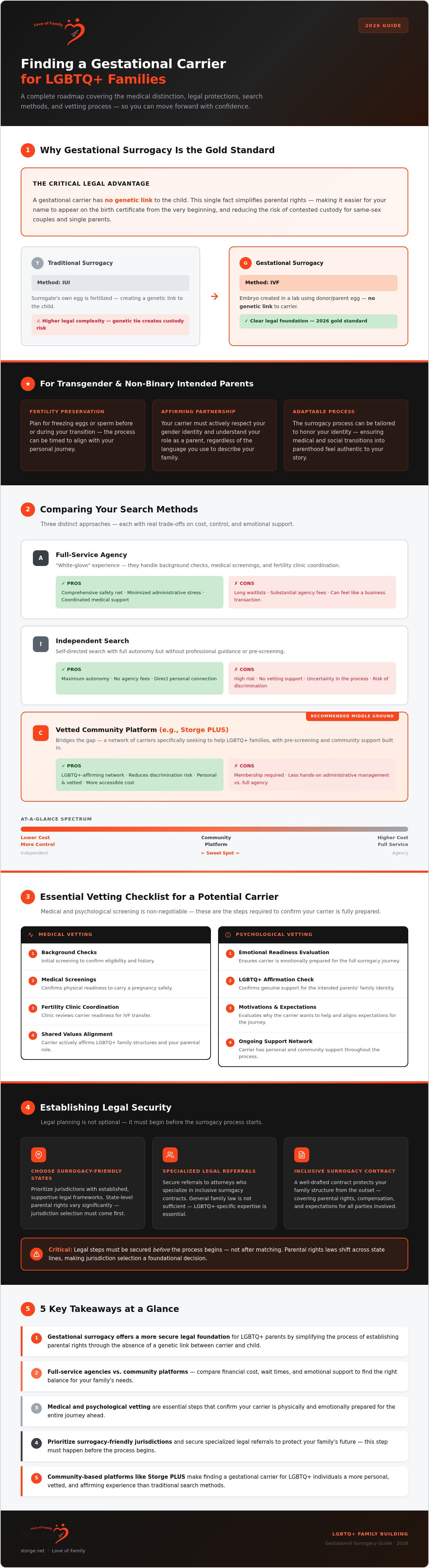
Choosing a path to parenthood is a profound decision that balances hope with practical reality. For many in our community, the dream of raising a child is deeply tied to the desire for a biological connection. Gestational surrogacy provides a path to achieve this while maintaining a high level of legal and emotional safety. Unlike older methods, modern gestational surrogacy separates the roles of the egg donor and the carrier. This separation is vital. It simplifies the legal process of establishing parental rights because the carrier has no genetic tie to the baby. For same-sex couples and single parents, this clarity reduces the fear of contested custody. It helps ensure that your name is on the birth certificate from the very beginning. This shift away from traditional surrogacy has happened because modern legal frameworks prioritize the clear-cut definitions that the gestational model provides.
Gestational Carrier vs. Traditional Surrogate: Knowing the Difference
The medical distinction between these paths is fundamental. Traditional surrogacy typically involves Intrauterine Insemination (IUI), where the surrogate's own egg is fertilized. In contrast, the gestational model relies on In Vitro Fertilization (IVF). This means the embryo is created in a lab using an egg donor or an intended parent's egg before being transferred to the carrier. A gestational carrier is a woman who carries a pregnancy with no genetic link to the child. This lack of a genetic connection is exactly why finding a gestational carrier for LGBTQ individuals has become the gold standard in 2026. It creates a clear boundary that courts and legal systems find easier to navigate. This protects your family structure and provides a sense of security that traditional surrogacy often lacks.
Considerations for Transgender and Non-Binary Intended Parents
Building a family as a transgender or non-binary individual often involves unique layers of planning. You might be navigating fertility preservation, such as freezing eggs or sperm, before or during your transition. It's a deeply personal process that requires both medical expertise and emotional sensitivity. When you begin finding a gestational carrier for LGBTQ individuals, it's essential to partner with someone who is actively affirming of your gender identity. Your carrier should understand and respect your role as a parent, regardless of the language you use to describe your family. The surrogacy process is remarkably adaptable. It can be tailored to honor your identity, ensuring that the medical and social transition into parenthood feels authentic. By choosing a carrier who shares your values, you create a supportive environment where your child is welcomed into a family built on mutual respect and visibility.
Comparing Search Methods: Agencies, Independent, and Community Platforms
Finding a gestational carrier for LGBTQ individuals often feels like choosing between two extremes: the high cost of a full-service agency or the high risk of an unguided independent search. In 2026, many parents are seeking a middle ground that offers professional security without the impersonal nature of a massive corporation. Your timeline, budget, and need for emotional support will dictate which path feels most like home. Each method offers a different level of involvement, and understanding these nuances is the first step toward a confident match.
Pros and Cons of the Traditional Agency Model
Agencies provide a comprehensive safety net that many intended parents find reassuring. They handle the heavy lifting, from initial background checks and medical screenings to coordinating with fertility clinics. This "white-glove" service is designed to minimize your stress, but it comes with a trade-off. Long waitlists are common, and the substantial agency fees can be a significant barrier for many families. While an agency might be the right choice for those who prefer a hands-off administrative process, the experience can sometimes feel more like a business transaction than a personal partnership.
The Rise of Vetted Community Platforms
Community-led searches are transforming how our community builds families. Platforms like Storge PLUS bridge the gap between expensive agencies and the uncertainty of independent searches. By joining a supportive community membership, you gain access to a network of carriers who are specifically looking to help LGBTQ+ families. This approach significantly reduces the fear of discrimination because the environment is built on shared values and mutual respect. You aren't just a file in a cabinet; you're a member of a trusted circle.
Independent searches, often called "indie" journeys, involve finding a carrier through social media or personal connections. While this path lowers upfront costs, it places the entire burden of vetting and legal coordination on your shoulders. In an independent search, you're responsible for verifying medical records and ensuring the carrier's insurance is surrogacy-friendly. It's a high-stakes environment where a single administrative oversight can lead to significant delays. Community platforms offer a safer alternative by providing verified resources and professional referrals without the overwhelming overhead of a traditional agency model. This allows you to maintain control over your journey while still having a seasoned guide by your side.
The Essential Vetting Checklist for a Potential Gestational Carrier
Vetting is the cornerstone of a successful surrogacy journey. It's the process where clinical safety meets personal compatibility. While medical clearances are non-negotiable, the emotional and ethical alignment between you and your carrier is what truly defines the experience. Finding a gestational carrier for LGBTQ individuals requires a checklist that looks beyond the surface to ensure your family is entering a partnership built on mutual respect and shared expectations. This isn't just about finding a healthy candidate; it's about finding the right person to help write your family's first chapter.
Medical and Lifestyle Vetting Standards
The American Society for Reproductive Medicine (ASRM) and the American College of Obstetricians and Gynecologists (ACOG) provide the gold standard for medical vetting. These guidelines ensure the safety of both the carrier and the baby. Typically, gestational carriers are between the ages of 21 and 45. They should have a history of at least one uncomplicated pregnancy and be currently raising their own child. This demonstrates their physical capability and their understanding of the emotional weight of pregnancy. Reviewing health records and pregnancy history helps mitigate risks from the very start.
A carrier's lifestyle and home environment are just as critical as her medical records. You'll want to understand her support system. Does she have a partner or family members who are supportive of her decision to help an LGBTQ+ family? A stable, positive environment at home directly impacts the carrier's well-being throughout the 40-week journey. Understanding how she manages her daily life and stress provides insight into how she'll handle the unique demands of a surrogacy pregnancy.
Ensuring Values Alignment and Mutual Respect
Finding a gestational carrier for LGBTQ individuals often hinges on finding someone who is not just accepting of your family structure, but actively celebratory of it. This is where many traditional checklists fall short. You need to have honest, sometimes difficult conversations early on. Ask about her previous experiences with the LGBTQ+ community. Discuss your views on pregnancy termination and selective reduction to ensure you are on the exact same page. These are heavy topics, but total alignment here prevents devastating conflicts later. A "values-first" match leads to a much more harmonious journey for everyone involved.
Relationship expectations are another vital piece of the puzzle. Some intended parents desire a "friendship-style" relationship with frequent updates and post-birth contact. Others prefer a more professional, clinical boundary. Neither approach is wrong, but a mismatch can lead to heartache. Establishing a clear birth plan and discussing how much involvement you'll have during prenatal appointments sets a steady rhythm for the months ahead. Finally, achieve total financial transparency before signing any contracts. While you won't be handling payments directly if you use professional referrals for attorneys, you must understand the structure of reimbursements and expenses. This clarity protects the relationship from being strained by administrative confusion, allowing you to focus on the joy of your child's upcoming arrival.
Establishing Legal Security and Inclusive Surrogacy Contracts
Legal security isn't just about paperwork; it's about the fundamental protection of your future family. While finding a gestational carrier for LGBTQ individuals is a milestone of joy, the legal framework you build around that relationship is what ensures your peace of mind. In 2026, the legal landscape remains a patchwork of state-level regulations. Navigating this successfully requires a proactive approach that prioritizes clear, inclusive contracts and specialized representation. This foundation allows you to focus on the emotional journey of becoming a parent without the shadow of legal uncertainty.
Navigating Surrogacy-Friendly States
A state is considered surrogacy-friendly when its laws or court rulings clearly allow for intended parents to be recognized as the legal parents from birth. For our community, this often means the state allows for both parents to be listed on the birth certificate without a genetic link requirement. Restrictive states may require lengthy court battles or refuse to recognize certain family structures, creating unnecessary risk. This is why understanding how to find an LGBTQ family law attorney is one of the most critical steps you can take before matching with a carrier. Pursuing a journey in a jurisdiction with unclear laws can lead to complications regarding medical decision-making or insurance coverage, making state selection a primary factor in your search.
Securing Your Parental Rights
Establishing parental rights often begins long before the baby arrives. A Pre-Birth Order (PBO) is a court order issued during the second or third trimester that directs the hospital to place the intended parents' names on the birth certificate. This process is seamless in many jurisdictions, but it requires precise legal timing. Even with a PBO, some families may still choose to pursue a second-parent or confirmatory adoption after birth. This provides an extra layer of protection that is recognized across the country, ensuring your parental rights remain unchallenged if you travel or move. It's a vital step for the non-biological parent to ensure their legal standing is as robust as possible.
Your surrogacy agreement should be a living document that reflects your specific family structure. It covers everything from medical decisions and financial reimbursements to the level of contact you'll maintain with the carrier. An inclusive contract uses gender-affirming language and explicitly outlines the intentions of all parties. Because these laws are complex and vary by state, having specialized representation is the only way to guarantee your rights are fully protected. You can secure specialized legal referrals through our vetted network to ensure your journey starts on the most secure foundation possible. This specialized guidance ensures that every clause in your contract is designed to support and protect your unique path to parenthood.
How Storge PLUS Simplifies Your Gestational Carrier Search
Finding a gestational carrier for LGBTQ individuals shouldn't feel like a solitary trek through a wilderness of unverified data. It's about finding your people. Storge PLUS turns the overwhelming search into a focused, community-driven experience. Instead of cold transactions, you're entering a space where every connection is rooted in shared values and mutual respect. This platform empowers you to take the lead in your journey, backed by the security of a vetted network.
The Storge PLUS Community Advantage
The internet is full of noise, and for intended parents, that noise can be exhausting. Traditional social media groups often lack the vetting necessary to ensure safety and alignment. By choosing a membership model, you're entering a curated environment where carriers and donors are already aligned with your goals. These are individuals who aren't just open to helping LGBTQ+ families; they're proactively seeking to do so. This proactive stance changes the dynamic of your search from one of "convincing" to one of "connecting."
A membership provides a layer of protection that open forums simply cannot offer. It filters out the uncertainty, allowing you to focus your energy on building genuine relationships. When you explore the Storge PLUS Membership: Your Vetted Path to LGBTQ+ Family Building, you'll see how this community-first approach prioritizes your peace of mind. It's about quality over quantity, ensuring that every interaction moves you closer to a successful match.
Your Next Steps Toward Parenthood
Building a family requires a village of experts. While finding a gestational carrier for LGBTQ individuals is a massive step, you also need specialized attorneys, inclusive fertility clinics, and supportive hospitals. Storge PLUS simplifies this by providing professional referrals to a network of vetted partners. These aren't just names on a list; they're professionals who understand the nuances of queer family building. Having access to these resources means you don't have to spend hours researching whether a clinic is truly affirming or if an attorney understands the latest surrogacy laws.
This community-based approach offers a sense of shared understanding that is rare in the fertility industry. You're surrounded by people who "get it." Whether you're managing the complexities of a donor search or preparing for the birth of your child, you have a steady guide by your side. This support allows you to move from the stress of searching to the joy of matching. It turns a logistical challenge into a deeply personal and rewarding experience. If you're ready to find a partner who honors your story, Join Storge PLUS to begin your gestational carrier search today. Your path to parenthood is ready for you, and we're here to walk it with you.
Your Family's Future Starts with a Trusted Partnership
The journey to parenthood is as much about the community you build as it is about the destination. By prioritizing values-alignment and securing specialized legal referrals, you're not just filling out forms; you're creating a safe harbor for your child's arrival. Finding a gestational carrier for LGBTQ individuals doesn't have to be a clinical or high-stress transaction. Instead, it can be a collaborative experience built on mutual respect and shared dreams. You've seen how a vetted network and expert guidance can turn complex medical and legal roadmaps into manageable steps.
Storge was founded on the principles of safety, legitimacy, and mutual support. Our platform connects you with a vetted network of LGBTQ-inclusive donors and carriers while providing the expert referrals you need to protect your parental rights. You deserve a path that honors your identity and celebrates your future family every step of the way. Your village is waiting to welcome you home.
Join the Storge PLUS community to find your gestational carrier and take the first certain step toward the family you've always imagined.
Frequently Asked Questions
Is it harder for LGBTQ individuals to find a gestational carrier?
It isn't necessarily harder, but it requires a more intentional search. While some carriers may have personal preferences, a vast community of carriers specifically seeks to help LGBTQ+ families. Using a platform that vets for inclusivity from the start removes the barrier of potential discrimination. This ensures your journey begins with a partner who is already celebratory of your family structure and understands the unique beauty of your path.
What is the average time it takes to find a gestational carrier?
The timeline varies significantly based on your chosen search method. Finding a gestational carrier for LGBTQ individuals through a full-service agency can take 12 to 24 months due to long waitlists. However, community-driven platforms often shorten this window to 6 to 12 months. Your specific requirements for a match and your readiness to move through the vetting process will also influence how quickly you connect with the right person.
Do I need a different attorney than my gestational carrier?
Yes, you must have independent legal representation to avoid any conflict of interest. Your attorney protects your parental rights, while your carrier's attorney ensures her interests and health are prioritized. This dual-representation model is the industry standard for ethical surrogacy. Storge provides referrals to specialized attorneys who understand the specific needs of queer families, ensuring your contract is both legally robust and inclusive of your family's identity.
Can a single gay man use a gestational carrier?
Absolutely, single gay men successfully build families through gestational surrogacy every day. The process is very similar to that for couples, though you'll need to decide on an egg donor separately. Many carriers find deep fulfillment in helping single parents achieve their dream of fatherhood. Ensuring your legal contracts specifically address single-parent rights is a crucial step that a specialized family law attorney will handle for you during the drafting phase.
How do I know if a gestational carrier is truly LGBTQ-friendly?
True friendliness is found in values alignment and proactive affirmation. Look for carriers who explicitly state their desire to work with the LGBTQ+ community in their profiles or during initial interviews. Ask open-ended questions about their views on diverse family structures and their comfort with your specific path. A vetted community platform like Storge PLUS helps by screening for these values before you even begin the conversation, saving you time and emotional energy.
What are the main costs associated with finding a carrier independently?
While you avoid agency fees, independent searches involve several direct costs. You'll be responsible for the carrier's medical screening, psychological evaluation, and background checks. Legal fees for both parties are another significant expense. You also need to account for insurance premiums and potential travel costs for the carrier to visit your clinic. Many parents find that joining a community platform provides a more cost-effective middle ground by offering verified resources without the high agency overhead.
Does insurance cover any part of the gestational carrier search or process?
Insurance coverage for the search itself is rare, but medical coverage for the pregnancy varies. Most intended parents must purchase a specific surrogacy-friendly insurance policy for their carrier if her personal plan has an exclusion. Some employer-provided fertility benefits now include stipends for surrogacy expenses. It's essential to have a professional insurance review early in the process to understand your financial responsibilities and avoid unexpected out-of-pocket medical bills during the pregnancy.
What happens if the gestational carrier lives in a different state?
Cross-state surrogacy is very common and perfectly manageable with the right legal team. The laws of the state where the carrier will give birth generally govern the process of establishing parental rights. You'll need to work with an attorney licensed in that specific state to secure your Pre-Birth Order. Finding a gestational carrier for LGBTQ individuals often involves looking nationally to find the best values-based match, regardless of where you or the carrier reside.


