

What if choosing someone you already know brings as many questions as reassurance? A Directed egg donor search for same-sex couples may begin with a trusted friend or family member, but a personal connection doesn’t replace thoughtful medical, emotional, and legal planning.
If you’re unsure what “directed donation” means in practice or how it compares with choosing eggs through a donor bank, you’re not alone. Both paths involve important decisions. Knowing what to discuss can help you move forward with greater clarity while caring for the relationships involved.
This guide explains the differences between directed and bank-donor searches, outlines conversations to have with a potential donor, fertility clinic, and legal professional, and highlights support that can help you make informed choices. You’ll also learn how LGBTQ+-focused community resources can complement professional guidance. Storge connects LGBTQ+ individuals and couples with a community of donors and verified resources, alongside referrals to fertility clinics and attorneys. Your path is personal, and you deserve information and support that recognize the family you’re building.
Key Takeaways
- A directed donation is one possible family-building path: it involves eggs from a donor identified by the intended parents.
- Plan the Directed egg donor search for same-sex couples step by step, from clarifying shared goals to clinic and legal conversations.
- Compare a personal donor connection with an egg bank’s available profiles to see which approach better fits your priorities around relationships, coordination, and privacy.
- Write down questions about medical care, expectations, privacy, and legal planning before speaking with a donor or clinic.
- Explore how Storge PLUS connects LGBTQ+ families with a community of donors, carriers, and verified resources, alongside fertility clinic and attorney referrals.
What Does a Directed Egg Donor Search Mean for Same-Sex Couples?
There isn’t one way to build a family. Some same-sex couples explore a directed donor search, while others consider an egg bank or another path that fits their circumstances. A directed search starts with a donor the intended parents have identified, perhaps someone already in their lives or a person they’ve connected with through a community. The relationship may feel familiar, but the practical decisions still deserve careful attention.
“Directed egg donation means pursuing eggs from a donor identified by the intended parents; an egg-bank search starts with profiles made available through a bank.” That distinction describes how the search begins, not which medical or legal steps will follow. Clinic protocols, donor screening, treatment planning, and legal considerations can depend on the people involved and their circumstances. A general overview of Egg donation can provide background. A fertility clinic and qualified legal professional can explain considerations specific to your plans.
How directed donation differs from an egg-bank search
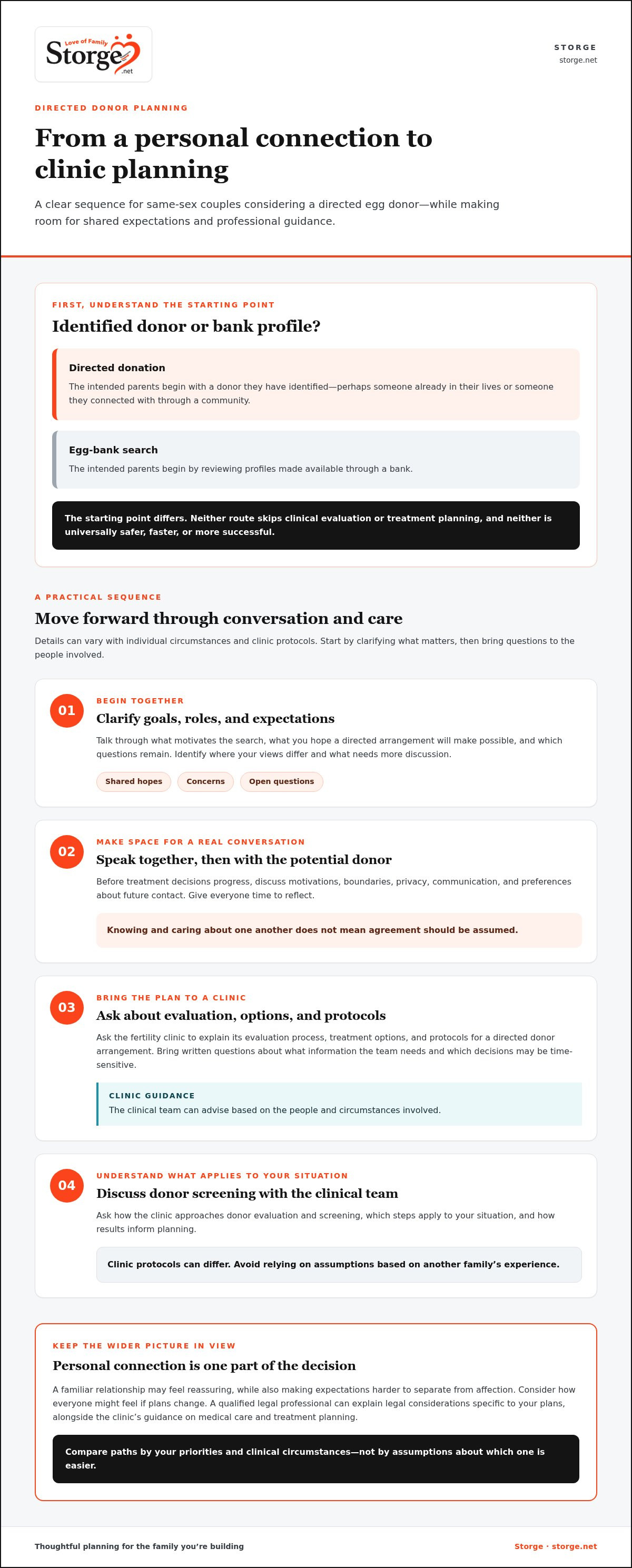
With directed donation, intended parents begin with an identified person and explore whether donation may be possible. With an egg-bank search, they review profiles available through the bank and consider a potential donor from that group. The starting point differs: an existing connection in one case, a profile search in the other.
Neither route skips clinical evaluation or treatment planning. A clinic can explain its protocols and the screening relevant to a particular donor and treatment plan. The paths aren’t automatically equivalent in timing, suitability, or emotional experience, and one isn’t universally safer, faster, or more successful. Compare them based on your priorities and clinical circumstances rather than assumptions about which route is easier.
Why same-sex couples may consider a directed donor
Family-building plans differ from couple to couple and person to person. A directed donor may appeal to intended parents who already have someone in mind, value a personal connection, or want to begin by discussing donation with a specific person. For others, starting with a bank’s available profiles may feel more appropriate. Neither choice defines how connected either parent will be to their future child.
Roles and treatment plans are personal, too. Depending on individual circumstances and clinical guidance, intended parents may have different roles in the process. A clinic can discuss which treatment approaches may be relevant; there’s no single reproductive pathway that applies to every same-sex couple. Before inviting a potential donor into the conversation, talk together about hopes, boundaries, and uncertainties.
A familiar relationship can bring warmth, but it can also make expectations harder to separate from affection. Consider how everyone might feel at different stages, including if plans change. You don’t need to settle every detail in one conversation. Naming questions early gives you a starting point for clinic and legal discussions, where professional guidance can clarify what applies to your situation.
How a Directed Egg Donor Search Moves from Conversation to Clinic Planning
A directed search is easier to approach when personal conversations and professional guidance inform each other. You don’t need to settle every detail at the outset. Start by clarifying what matters, writing down questions, and discussing expectations before making treatment decisions.
A directed search brings personal expectations together with clinic-led medical steps. The sequence below offers a practical structure, though details may vary with individual circumstances and clinic protocols.
Start with goals, roles, and shared expectations
Before approaching a potential donor, intended parents can talk through their hopes and concerns together. Consider what motivates the search, how you’d like to communicate, what privacy means to each person, and whether you have preferences about future contact. If you don’t agree on everything, note where your views differ and what needs more discussion or professional support.
- Clarify your goals. Discuss what you hope a directed arrangement will make possible and which questions remain. Identify what matters most to you, while leaving medical suitability and treatment decisions for discussion with a clinic.
- Speak together, then with the donor. Compare expectations as intended parents, then invite the potential donor into a conversation before treatment decisions progress. Discuss motivations, boundaries, privacy, communication, and future contact. Give everyone time to reflect. Agreement shouldn’t be assumed simply because people know and care about one another.
- Consult a fertility clinic. Ask the clinic to explain its evaluation process, treatment options, and protocols for a directed donor arrangement. Bring a written list of questions, including what information the team needs and which decisions may be time-sensitive. The clinical team can advise based on the people and circumstances involved.
- Discuss screening with the clinical team. Ask how the clinic approaches donor evaluation and screening, which steps apply to your situation, and how results inform planning. Protocols can differ, so don’t rely on assumptions from another family’s experience. Follow your clinical team’s guidance rather than treating general information as individual medical advice.
- Seek qualified legal guidance. Donor arrangements and parentage questions can involve legal considerations that depend on the circumstances and applicable laws. A qualified attorney can explain which agreements and steps may be relevant before treatment moves forward. Legal guidance can also help everyone understand expectations and raise questions that may affect the relationship.
Coordinate clinic evaluation and professional guidance
These conversations work best as a coordinated process, rather than as promises made before the details are clear. The donor and intended parents can talk through expectations while the clinic explains medical evaluation and treatment planning. Qualified legal guidance can address the arrangement and parentage questions. Screening protocols and legal rules vary, so no general checklist replaces advice tailored to your situation.
For LGBTQ+ individuals and couples seeking community alongside professional guidance, Storge’s LGBTQ+ family-building resources connect members with a trusted community and relevant fertility and legal referrals. Community support can complement the guidance medical and legal professionals provide.
Directed Donor or Egg Bank: Which Search Path Fits Your Priorities?
Both paths can lead to a donor search, but they begin in different places. A directed search starts with someone the intended parents have identified. An egg-bank search starts with profiles the bank makes available. To compare the options, consider whether a personal connection, a structured profile search, or particular privacy preferences matter most to your family.
| Consideration | Directed donor | Egg-bank search |
|---|---|---|
| Donor relationship | The intended parents have identified a potential donor, who may already be known to them. | The search begins with donors represented in the bank’s available profiles. |
| Profile availability | The process centers on the identified person rather than choosing from a bank’s profile selection. | Available profiles and the information they include depend on the bank. |
| Coordination | The intended parents, donor, clinic, and legal professionals may need to coordinate around the arrangement. | The bank and clinic may each have processes and policies that shape coordination. |
| Privacy considerations | Because the donor is identified, everyone can discuss expectations for privacy, communication, and future contact directly. | Identity and disclosure options vary; the bank’s policies and the intended parents’ preferences matter. |
This comparison describes how each search begins, not a promise about what follows. A bank’s descriptions of its profiles or services apply to that bank and shouldn’t be treated as general facts about egg donation or as features of a directed arrangement. A directed search doesn’t automatically involve the same coordination model as a bank search. In either path, the fertility clinic guides the relevant clinical evaluation and treatment planning.
When an existing donor relationship may matter
An existing connection gives intended parents and a potential donor a shared starting point for discussing values, communication, and future contact. Familiarity may make some questions easier to raise while making others more emotionally complex. Talk about expectations instead of assuming closeness means everyone understands the arrangement in the same way. Independent clinical and legal guidance remains important; knowing someone doesn’t replace either. A known donor isn’t automatically a better or worse fit.
When a donor-bank search may feel more suitable
Some intended parents may prefer reviewing profiles as a structured way to begin, particularly if they don’t have a specific donor in mind. Profile formats and available information differ among banks, as do bank and clinic processes. Consider what information matters to you, how you feel about privacy and identity disclosure, and which questions you want answered before making decisions. A profile can inform a search, but it can’t guarantee compatibility or a particular outcome.
For a Directed egg donor search for same-sex couples, the most useful comparison is the one grounded in your priorities and circumstances. Neither route guarantees a medical, legal, or family-building outcome. Whichever path you explore, discuss the arrangement with your clinic and seek qualified legal guidance for questions specific to your situation.
Questions Same-Sex Couples Can Prepare Before Moving Forward
A written question list can make conversations with a potential donor, clinic, and attorney feel more manageable. For a Directed egg donor search for same-sex couples, preparation also means making space for each intended parent’s perspective. You don’t need every answer before you begin. The goal is to identify what you want to understand and which decisions need professional guidance.
Before meeting, each partner can note their hopes, uncertainties, and non-negotiables separately. Comparing notes may reveal shared priorities as well as topics that need more discussion.
Questions to discuss with the donor and each other
Talk about how you’d like to communicate, what information should remain private, and what contact might look like over time. Discuss how each person understands their role without assuming everyone wants the same relationship in the future. If a subject feels difficult to raise, pause rather than treating silence as agreement.
- Expectations: What does each person hope for, and what boundaries would help everyone feel respected?
- Communication: How would you prefer to share updates or handle questions as plans develop?
- Privacy: Who may know about the donation, and how might you talk about it with family or a future child?
- Changing circumstances: How would you approach a change in plans or a difference in expectations?
Questions for clinical and legal conversations
Clinical details depend on individual circumstances, so bring questions to the fertility team rather than treating general information as personal medical advice. An LGBTQ-friendly clinic can explain its directed-donor evaluation and treatment protocols. Use questions to ask an LGBTQ-friendly fertility clinic to help prepare for that discussion.
- Evaluation and treatment: What evaluation and screening steps apply to this directed arrangement, and how will the clinic guide treatment planning?
- Family-building plan: How might embryo creation fit our circumstances? What sperm source may be part of the plan, and might a gestational carrier be involved?
- Legal planning: What agreements or parentage questions should we discuss with qualified legal counsel, including any state-specific considerations relevant to our family?
Legal processes vary, and general educational information can’t determine what applies to your family. A qualified attorney can address your specific arrangement and parentage questions. This guidance on finding an LGBTQ family law attorney can help you prepare for that conversation.
Take the questions that matter most into your next conversation, and add new ones as they arise. If community support would help alongside professional guidance, explore Storge’s LGBTQ+ family-building community.
How Storge Supports an LGBTQ+ Directed Egg Donor Search
A directed egg donor search can raise questions beyond profiles and clinic appointments. You may be thinking about how to find community, where to turn for reliable resources, and how to keep professional guidance part of the process. Storge is an LGBTQ+ family-building platform that connects individuals and couples with a trusted community and relevant resources.
Through Storge PLUS, members can access a community that includes egg donors, sperm donors, and gestational carriers. That connection can help you explore family-building paths and feel less alone as you consider what feels right. Storge also offers referrals to fertility clinics and legal professionals, bringing community access together with connections to specialized guidance.
Community connection alongside professional guidance
Community can offer a place to learn from others’ experiences and feel seen in a process that may not always be represented in general fertility resources. Storge’s LGBTQ+ donor community guide offers further context on donor-supported family building. Every person’s circumstances are different, so another family’s experience can offer perspective without determining what will work for yours.
Storge connects members with relevant referrals so they can seek professional guidance as part of the family-building process. A qualified fertility clinician should guide medical decisions, including evaluation and treatment planning. For legal advice about a donor arrangement or parentage, speak with an attorney qualified to address your circumstances. Referrals can help connect you with professionals, and those professionals provide the care or advice relevant to their expertise.
Keep expectations grounded, too. Joining a community or exploring resources doesn’t ensure a donor match, a particular treatment outcome, or a legal result. Those outcomes depend on individual circumstances and the relevant professional processes. Use community support to inform your questions while relying on clinicians and attorneys for decisions within their expertise.
A gentle next step for couples exploring a donor
If you’re considering a Directed egg donor search for same-sex couples, you can explore community support at your own pace. Storge PLUS provides access to a community of donors, carriers, and resources, while fertility clinic and attorney referrals can complement conversations with qualified professionals. You don’t need every decision settled before learning about the support available.
Family building is personal, and the next step might be a conversation, a question, or simply time to reflect together. If access to an LGBTQ+-focused community feels useful, learn about Storge PLUS membership. Move forward when you feel ready, with support that recognizes your family and the path you’re creating.
Take Your Next Step at Your Own Pace
A family-building decision doesn’t need to be made all at once. You can begin with one honest conversation, a question you want answered, or time to consider what support would feel right. A Directed egg donor search for same-sex couples is deeply personal, and your next step can reflect your priorities rather than anyone else’s timeline.
If connecting with an LGBTQ+-focused community would help, Storge offers a place to explore family-building resources. Storge PLUS provides access to a community that includes donors and gestational carriers, as well as verified resources. Referrals to fertility clinics and legal professionals can complement guidance from the qualified experts supporting your decisions.
Explore Storge PLUS and find supportive LGBTQ+ family-building resources when you feel ready. There’s no need to have every answer before you begin. Take this journey one thoughtful step at a time, knowing your family deserves care and support along the way.
Frequently Asked Questions
Is a directed egg donor the same as a known egg donor?
The terms often describe overlapping situations, but they emphasize different details. “Directed” usually means intended parents have identified a specific person to consider as their donor. “Known” generally describes whether the donor’s identity is known, which may also apply in arrangements that didn’t begin with a personal relationship. Because clinics and professionals may use these terms differently, ask how they define them in the context of your plans.
Can a friend or relative be a directed egg donor?
A friend or relative may be considered, but a personal connection doesn’t establish whether donation is clinically appropriate or feasible. The fertility clinic can explain its evaluation process and whether the person’s circumstances fit its protocols. Each person should have room to make an informed, unpressured decision. For example, a relative who feels uncertain should be able to pause or decline without the intended parents treating that choice as a promise broken.
Is a directed egg donor search only an option for gay male couples?
No. A Directed egg donor search for same-sex couples isn’t limited to gay male couples. People with different identities and family-building plans may consider a directed donor, depending on their circumstances and clinical guidance. For example, a couple might explore an identified donor while considering who may provide sperm or carry a pregnancy. A fertility clinic can discuss which treatment approaches are relevant to your situation rather than assuming one pathway fits every couple.
How long does it take to find a directed egg donor?
There’s no universal timeline for identifying and moving forward with a directed donor. If you already have someone in mind, the search itself may begin with a conversation, but planning can still depend on clinic protocols, evaluation, scheduling, and legal discussions. The potential donor may also need time to consider. Rather than relying on another family’s timeline, ask the clinic which steps apply and how they may affect your circumstances.
Does using a directed egg donor guarantee legal parenthood for both partners?
No. A directed donor arrangement alone can’t guarantee how parentage will be established or recognized for both intended parents. The relevant legal steps depend on the family’s circumstances and applicable law, so don’t rely on a general explanation or another family’s experience. Before treatment decisions progress, discuss your specific plans with a qualified attorney familiar with LGBTQ+ family building and the laws that may apply to your family.
What happens if intended parents and a donor disagree about future contact?
If expectations about future contact differ, pause and address the disagreement before moving further. A donor may imagine occasional updates, while intended parents may prefer a different boundary; neither assumption should stand in for an honest conversation. Clarify what each person hopes for, what feels comfortable, and what remains uncertain. If the discussion feels difficult, a qualified counselor or attorney may help everyone understand the issues without promising a particular relationship outcome.


