
What if an independent gestational carrier search for LGBTQ+ intended parents gives you more room to build the right connection, but also asks you to create your own support system? Searching through trusted networks and community can help you take an active role, while medical and legal guidance should come from qualified professionals.
If you’re unsure where to meet potential carriers or how to tell whether a connection feels right, that uncertainty makes sense. Searching independently doesn’t mean you have to figure out every step alone, but it also doesn’t automatically include the screening, coordination, or professional guidance an agency may provide. Community connections and professional support can play different, complementary roles.
This guide explains what an independent search involves, what it doesn’t cover, and what to discuss before moving toward a match. You’ll find practical ways to consider compatibility, medical and legal questions, and emotional readiness, along with affirming community and referral resources for LGBTQ+ intended parents. The goal is a clearer path forward at a pace that feels right for your family.
Key Takeaways
- An independent gestational carrier search for LGBTQ+ intended parents means taking an active role in finding a potential match, not replacing professional guidance.
- Before making connections, clarify your goals, support needs, communication preferences, boundaries, and how you’ll make decisions.
- Compare independent searching and agency support by who leads the search, coordinates next steps, and provides ongoing assistance.
- Use early conversations to explore compatibility, privacy, values, and expectations without treating an introduction as a commitment.
- Community can help you find connections and referrals. Resources such as Storge PLUS may complement, but don’t replace, legal and medical professionals.
What an Independent Gestational Carrier Search for LGBTQ+ Parents Means
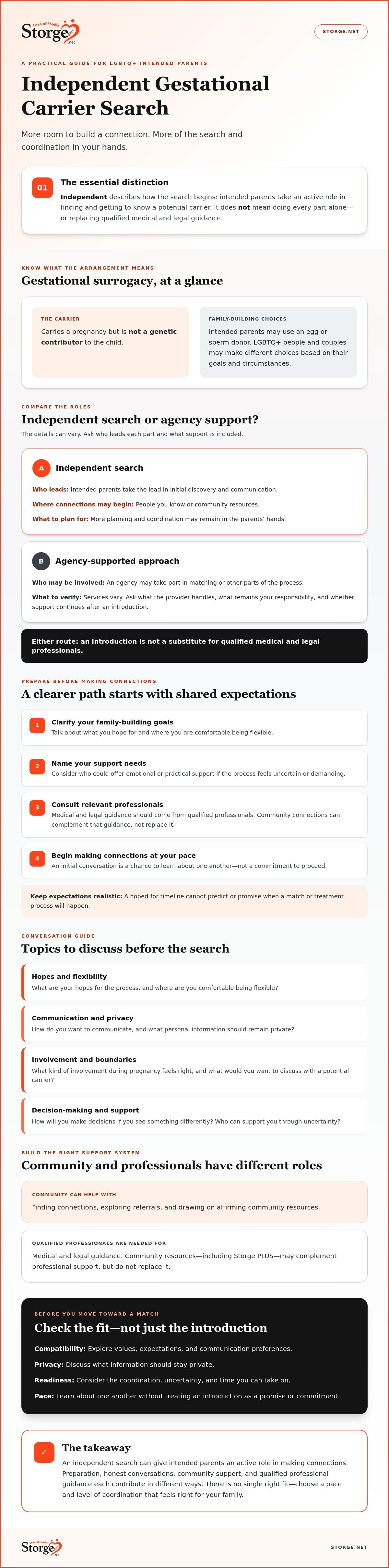
An independent gestational carrier search for LGBTQ+ intended parents means taking an active role in finding and getting to know someone who may carry a pregnancy for their family. “Independent” describes how the search begins. It doesn’t mean you must manage every part of the process without support, and finding a potential match doesn’t replace medical or legal guidance.
In gestational surrogacy, the carrier carries a pregnancy but isn’t a genetic contributor to the child. Intended parents may use an egg or sperm donor as part of their family-building arrangement. LGBTQ+ people and couples may approach these choices in different ways, depending on their family goals and circumstances. For a broader overview of what surrogacy involves and its different arrangements, see this general reference.
How independent searching differs from agency-supported matching
With an independent search, intended parents take the lead in initial discovery and communication. They may make connections through people they know or community resources, then decide what professional support to seek as the process develops. Direct involvement can feel meaningful, but it may also leave more planning and coordination in the parents’ hands.
An agency-supported approach may involve an agency in matching or other parts of the process, but services vary. Ask any provider what it handles, what remains your responsibility, and whether support continues after an introduction. Whichever route you consider, independent matching doesn’t remove the need for qualified medical and legal professionals. Community connections can complement their guidance, not replace it.
Who may consider an independent carrier search
This approach may appeal if you want to take an active role in making initial connections and feel comfortable having early conversations directly. It may also suit intended parents who have community connections they’d like to explore. There’s no single right fit. People differ in how much coordination, uncertainty, and time they can take on, so weigh those demands before choosing a path.
As you consider your preferences, talk together about how you want to share responsibilities, what support you’ll need, and what would help you feel ready to move forward. An initial connection is an opportunity to learn about one another, not a commitment to proceed. For more context on family-building pathways, read this gay surrogacy guide.
Prepare for an Independent Gestational Carrier Search Before Making Connections
Before reaching out to potential carriers, take time to make a few decisions together. An independent gestational carrier search for LGBTQ+ intended parents is easier to approach when you share an understanding of what you’re hoping for and where you’ll need support. A useful starting sequence is to clarify your family-building goals, identify emotional and practical support needs, consult relevant professionals, and then begin making connections.
Preparation doesn’t require having every answer. It can help to discuss expectations, communication preferences, boundaries, and how you’ll make decisions if you and a potential carrier see something differently. Talk about the timeline you hope for while recognizing that a match and treatment process can’t be predicted or promised. Consider how much contact you’d like during pregnancy, what information you want kept private, and who you’d turn to for support. That might be a trusted friend, family member, or counselor familiar with fertility journeys.
Questions to discuss before beginning the search
- What are our hopes for the process, and where are we comfortable being flexible?
- How do we want to communicate, and what personal information should remain private?
- What kind of involvement during pregnancy feels right to us, and what might we want to discuss with a potential carrier?
- Who can provide emotional or practical support if the process feels uncertain or demanding?
These conversations aren’t a script for a first meeting. They help you understand your own priorities before asking someone else to share theirs.
Which professionals can help clarify the process
Your chosen fertility clinic is the source for individualized medical and treatment information, including its own processes and requirements. Confirm those details with the clinic directly rather than assuming they’re the same everywhere. For clinic-vetting ideas, see these questions for an LGBTQ+-friendly fertility clinic. The gestational surrogacy fact sheet offers additional background on the arrangement.
Legal questions deserve guidance from an attorney experienced in assisted reproduction and LGBTQ+ family building. Intended parents and a potential carrier should each seek appropriate independent legal advice so everyone can understand their own rights, responsibilities, and options before making decisions. A community platform can help you explore connections and referrals, but it doesn’t replace clinic or attorney guidance. If community access would be helpful as you prepare, you can explore Storge’s community and fertility resources.
Independent Search or Agency: Compare the Support Before Choosing
Choosing between an independent search and agency-supported matching is less about finding one universally better path and more about understanding who will do what. An independent approach can give intended parents direct involvement in early connections, but it may also mean taking on more communication and coordination. Agency services differ, so ask providers to describe their actual scope rather than relying on the label alone.
| Area to compare | Independent search | Agency-supported matching | Questions to verify |
|---|---|---|---|
| Search leadership | Intended parents lead discovery and initial outreach. | An agency may lead or support the search, depending on its services. | Who identifies potential matches and makes introductions? |
| Coordination | Parents may organize conversations, keep track of questions, and identify next steps. | Coordination may be included, but the scope varies by provider. | Who coordinates communication, and what tasks remain ours? |
| Support | Parents arrange professional guidance and other support as needed. | An agency may provide certain forms of support or referrals. | What’s included, what’s excluded, and who provides each service? |
What independent searching may ask intended parents to coordinate
Alongside making introductions, you may need to organize conversations, clarify expectations, and keep a shared record of open questions. A simple list can help you track what you still need to ask a potential carrier, clinic, or attorney. Agree in advance who will follow up and how you’ll handle decisions. Medical screening and treatment decisions belong with qualified fertility professionals, not the search process itself.
How to assess the support available in either path
Ask any agency or resource provider to explain its services, exclusions, and referral relationships. Find out how LGBTQ+ inclusion shows up in its communication and processes, such as how it discusses intended parents’ family structures and preferred language. An independent gestational carrier search for LGBTQ+ families, like an agency-supported path, can’t guarantee a match, medical outcome, or legal result. Storge PLUS is a community-resource option, not an agency service. Learn more about Storge PLUS membership as one way to explore community and resources.
Before you decide, compare the support you can rely on with the work you’re prepared to coordinate. A clear division of responsibilities can help you choose a manageable path without assuming any single approach removes uncertainty.
Evaluate Compatibility and Support Without Rushing a Potential Match
An early conversation is a chance for intended parents and a potential carrier to learn about one another. It isn’t an interview with a pass-or-fail score, and it doesn’t promise that either side will choose to continue. In an independent gestational carrier search for LGBTQ+ families, a thoughtful pace leaves room to ask honest questions, reflect afterward, and decide freely whether another conversation feels right.
Compatibility is about more than shared values. It can include how each person prefers to communicate, what privacy means to them, and what kind of involvement during pregnancy feels comfortable. Independent searching can also involve coordinating introductions and keeping track of questions, so talk early about what support each person may need. This can surface practical concerns without making either person responsible for meeting needs they haven’t agreed to.
Conversation topics for an early introduction
Rather than trying to resolve every detail at once, use early discussions to understand each other’s preferences. You might ask:
- How do you prefer to communicate, especially about sensitive topics?
- What boundaries around personal information, privacy, or sharing updates feel important?
- Would you want support people involved in conversations, and if so, how?
- What expectations do you have about contact and involvement during pregnancy?
It’s fine to leave some questions open. Make a note of unresolved differences and return to them later, with appropriate professional input where needed. A pause to reflect can be more useful than reaching quick agreement just to keep a conversation moving.
When to pause and seek professional guidance
Slow down if anyone feels pressured to agree, if consent is unclear, or if communication feels uncomfortable or difficult to understand. A pause isn’t a failure. It can give everyone time to clarify what they want and whether they feel safe continuing. If expectations about coordination or support don’t match, discuss what each person can realistically manage before taking another step.
Keep personal compatibility conversations separate from professional review. Direct medical questions, including questions about clinical screening or treatment, to the fertility clinic. Bring legal questions to qualified attorneys with relevant assisted-reproduction experience. These professionals can address matters that an introductory conversation can’t settle. If the process feels emotionally overwhelming, consider reaching out to a trusted support person or a qualified counselor.
For affirming community connections and fertility resources as you explore next steps, explore Storge’s LGBTQ+ community resources.
Explore LGBTQ+-Affirming Community and Take Your Next Step
You don’t need to have every detail settled before taking a next step. Start by clarifying what kind of support would help you feel prepared, then connect with relevant professionals and explore trusted community resources. For an independent gestational carrier search for LGBTQ+ intended parents, community can help you discover connections and referrals while clinical and legal decisions stay with the professionals qualified to guide them.
Storge is an online community and fertility resource platform, not a full-service surrogacy agency. Its role is to support community access and referrals, rather than provide direct medical care or in-house legal representation. Knowing the difference can help you decide whether the platform fits the kind of support you’re looking for.
What a community platform can and cannot provide
Storge PLUS membership provides access to a community of carriers, donors, and verified resources. That community may help you explore relevant connections and information as you consider your options. Membership doesn’t guarantee carrier availability, a match, or a particular outcome, and it doesn’t replace care from a fertility clinic or representation from an attorney. Those professionals remain important sources of individualized medical and legal guidance.
As you explore any platform or resource, consider what you need from it: community access, a way to find potential connections, or referrals to professionals. Clear expectations make it easier to use community support as one part of a broader plan.
Build a support network around your family-building journey
Think about the different kinds of support you may want. A fertility clinic can answer questions about its medical processes; an attorney can address legal questions; and trusted friends, family, or a qualified counselor may offer emotional support. Community can add another point of connection. If you’re beginning an attorney search, this guide to LGBTQ+ family law attorney guidance can help you consider what to look for.
A steady next step could be to write down your current questions, identify which professional or support person can address each one, and explore community connections when you feel ready. If access to a community of carriers, donors, and verified resources would be useful, you can explore Storge PLUS at your own pace. It’s one resource to consider, not a deadline or a promise of what comes next.
Move Forward With Support That Fits Your Journey
An independent gestational carrier search for LGBTQ+ families can begin with a clear sense of what you need, which professionals can guide you, and what kind of community support feels helpful. You don’t have to make every decision at once. Take the next step when you’re ready, and give yourself room to revisit questions as your understanding grows.
Storge PLUS provides access to a community of donors, carriers, and verified resources. Storge also offers referrals to specialized legal representation and fertility clinics, helping you explore relevant support while leaving legal and medical guidance to those professionals. The platform is a community and resource platform, not a full-service surrogacy agency, and it can complement rather than replace professional care.
If you’d like to explore community connections and LGBTQ+-affirming family-building resources, explore Storge PLUS and find LGBTQ+-affirming family-building resources. Your path can take shape one thoughtful conversation at a time, with support that respects your family and your pace.
Frequently Asked Questions
What does an independent gestational carrier search mean?
An independent gestational carrier search generally means intended parents take an active role in finding and connecting with a potential carrier, rather than relying entirely on agency-led matching. In an independent gestational carrier search for LGBTQ+ families, intended parents may organize initial conversations themselves. Responsibilities vary, so clarify who handles each task. Independent searching doesn’t replace fertility-clinic care, legal advice, or other professional support, and a connection doesn’t guarantee a match.
Can LGBTQ+ intended parents search independently for a gestational carrier?
Yes, LGBTQ+ intended parents can explore independent search options. Practical and legal considerations depend on each family’s circumstances and applicable law, so seek guidance specific to your situation. Ask a fertility clinic to explain its medical processes, and consult an attorney experienced in assisted reproduction for legal questions. Look for affirming professionals who clearly explain their services and respect each person’s identity, family structure, and preferred language.
Is independent gestational carrier matching the same as working with a surrogacy agency?
No. Independent searching generally means intended parents take a more active role in finding and communicating with potential carriers. Agencies may provide different types of matching, coordination, or support, so ask a specific provider what its services include and exclude. Neither approach replaces appropriate medical care or legal advice. Whichever route you consider, discuss expectations carefully and make sure you understand who is responsible for each part of the process.
How do you find an independent gestational carrier as an LGBTQ+ intended parent?
Start by clarifying your family-building goals, support needs, and questions for fertility and legal professionals. Then explore appropriate personal networks or community resources, treating introductions as mutual conversations rather than commitments. Discuss communication preferences, privacy, boundaries, and expectations openly. Confirm medical questions with a fertility clinic and legal questions with a qualified attorney before making decisions. These steps can help you approach an independent search with greater clarity and support.
What should intended parents ask a potential gestational carrier?
Early conversations can explore communication preferences, privacy, boundaries, expectations, and the support each person values. You might ask how someone prefers to discuss sensitive topics or what involvement during pregnancy feels comfortable to them. Keep the discussion mutual, make space for questions on both sides, and don’t treat an initial conversation as a commitment. These personal conversations don’t replace clinical screening or legal review; bring medical and legal questions to qualified professionals.
Do independent gestational carrier searches require an attorney and fertility clinic?
An independent search doesn’t itself provide medical or legal services, so intended parents should consult qualified professionals. Ask a fertility clinic to explain its treatment processes and requirements, and speak with an attorney experienced in assisted reproduction about legal questions. Each person’s circumstances can differ, so general online information may not answer what applies to you. Confirm relevant details directly with professionals who understand your situation before making decisions or proceeding.
What happens if an independent search does not lead to a match?
An independent search may take time, change direction, or not result in a match. It can help to discuss emotional support and possible next steps before beginning, so uncertainty feels less isolating if plans shift. You might revisit your search approach, identify resources you need, or talk with professionals about other family-building options. No platform or search method can promise a match. Give yourself permission to pause and choose a sustainable pace.


