
An LGBTQ gestational carrier database is most useful not as a shortcut to a match, but as a starting point for asking better questions. Profiles can help you explore possible connections, but a database alone may not confirm current availability or replace the medical and legal professionals involved in a gestational carrier journey.
If you're unsure how a database differs from a community, fertility clinic, or agency, you’re not alone. It can also be difficult to know what “verified” means, how profile details are maintained, and what support is available as you consider your options.
This guide explains what a carrier database can and cannot do, what to ask about profiles, privacy, and support, and how to identify useful next steps. You’ll also learn where independent fertility and legal professionals fit into the process, so you can explore connections with greater clarity and care.
Key Takeaways
- An LGBTQ gestational carrier database can help you explore connections, but its role and available information vary by provider.
- Before sharing personal details, ask how profiles are reviewed, how privacy is handled, and what “verified resources” means.
- Compare databases, communities, agencies, and clinics by purpose and scope, then confirm exactly what each provider handles.
- Use an LGBTQ gestational carrier database as one part of a thoughtful search, and consult qualified fertility and legal professionals about next steps.
- Storge PLUS provides membership access to a community of donors, carriers, and resources, but membership does not guarantee a carrier match or outcome.
What an LGBTQ gestational carrier database can help you do
An LGBTQ gestational carrier database is a resource for exploring potential carrier connections and family-building information. It can help intended parents begin learning and discovering, but it doesn't provide medical care or guarantee that a profile is current, a person is available, or a match will happen.
A gestational carrier carries a pregnancy for intended parent(s) and, in gestational surrogacy, is not typically the source of the egg. An egg donor provides eggs that may be used to create embryos; a sperm donor provides sperm. These roles are distinct, although some family-building journeys involve both a donor and a carrier. For neutral background on the different forms and considerations involved, see Surrogacy.
How database, community, clinic, and agency models differ
A database or community can offer a place to explore possible connections and resources. What profiles show, how information is reviewed, and whether people are currently open to connecting depend on the provider, so ask rather than assume. A fertility clinic assesses and provides reproductive medical care. Agency services vary: some may coordinate parts of the process or support matching, but confirm the scope directly with each provider.
A resource platform helps you explore connections; a fertility clinic provides reproductive medical care, while an agency’s role depends on the services it offers. None of these labels alone tells you exactly what a particular organization handles.
Why LGBTQ+ intended parents may seek an affirming starting point
LGBTQ+ people build families in many ways, across different identities, relationships, and family structures. A respectful starting point can make it easier to ask questions without having to explain or defend who you are. Clear language about roles, expectations, privacy, and next steps also helps everyone make informed decisions.
Still, community access is not a promise of carrier availability, compatibility, or a match. Treat discovery as an early step, then confirm important details with the people and professionals involved. For a broader overview of the process, read this gay surrogacy guide.
How to evaluate an LGBTQ gestational carrier database before joining
Before sharing personal details, look beyond the number of profiles or the promise of a welcoming community. Start by getting clear answers about what information is collected, how it is handled, and what membership does and doesn’t include. These questions can help you assess an LGBTQ gestational carrier database without assuming every platform works the same way.
Questions to ask about profiles, verification, and privacy
- What does “verified” mean? Ask which profiles or resources are reviewed, what the review checks, who conducts it, and whether the term applies to every listing. Don’t assume a platform’s review is medical or psychological screening.
- What information can others see? Find out which profile details are shared, with whom, and what consent is required. Ask whether you can control what personal information you provide or make visible.
- How is information kept current? Ask how people can update or remove details, report outdated information, or raise a concern. Find out how the platform responds and whether you’ll be told when relevant information changes.
- What communication is expected? Clarify whether members contact one another directly or through the platform, and what boundaries or conduct expectations apply. Decide whether that approach works for you before joining.
These questions matter because profile review and clinical assessment are different responsibilities. The American Society for Reproductive Medicine’s medical and psychological screening guidelines offer professional context for screening in gestational carrier arrangements. Ask fertility professionals how clinical evaluation applies to your circumstances.
What support and membership access actually include
Get the membership terms in writing before you decide. Confirm whether access includes a community, referrals, or other resources, and ask what each includes in practice. Check current fees directly, whether billing is one-time or recurring, how cancellation works, and when access ends. Don’t infer terms from a profile page or assume access guarantees a connection.
Storge describes Storge PLUS as membership access to a community of donors, carriers, and verified resources. Confirm directly what “verified” means and what the current access terms include. You can review the Storge PLUS membership overview for more context, then decide whether exploring the membership fits your needs. If you’re considering it, explore Storge PLUS and verify the details before sharing personal information.
Database, agency, or clinic: which carrier-search path fits your needs?
There isn’t one right starting point for every family. Consider what you need now: space to explore connections, reproductive medical care, or more hands-on coordination. An LGBTQ gestational carrier database can support discovery, but access to profiles or a community doesn’t replace clinical care, legal advice, or professional coordination. The right pathway depends on your readiness and the support you want from each provider.
The table below describes common models in general terms. Services vary, so confirm each provider’s role, responsibilities, and limits before proceeding.
| Model | General purpose | What to clarify |
|---|---|---|
| Database or community | Explore possible connections and LGBTQ-inclusive fertility resources. | How are profiles maintained? What does access include? Who handles follow-up? |
| Fertility clinic | Assess fertility needs and provide reproductive medical care. | Which evaluations and treatments does the clinic provide, and what coordination is included? |
| Agency | May offer matching, coordination, or other support, depending on its model. | What services are included, who provides them, and what responsibilities remain yours? |
When a community database may be a useful starting point
A community-based resource may suit you if you want to learn about potential connections and explore fertility resources before deciding what level of support you need. For LGBTQ+ intended parents, an inclusive setting may also make it easier to find information that reflects different family structures and identities. Treat profiles as a starting point: confirm details and current availability directly. An introduction or shared information is not a clinical or legal assessment.
When to ask a clinic or agency about additional support
If you’re ready to discuss fertility care, ask a clinic what evaluation and treatment it provides, which professionals are involved, and whether coordination is part of its service. A clinic’s medical role is distinct from carrier-search support, so clarify who handles each step.
If you’re considering an agency, request a written explanation of its matching process, support scope, and responsibilities it does not take on. Compare that with what you want help managing. For a structured way to assess clinical providers, see these questions for an LGBTQ-friendly fertility clinic.
You can use more than one pathway at different stages. Start with the support you need now, then confirm how each provider fits alongside your fertility and legal professionals.
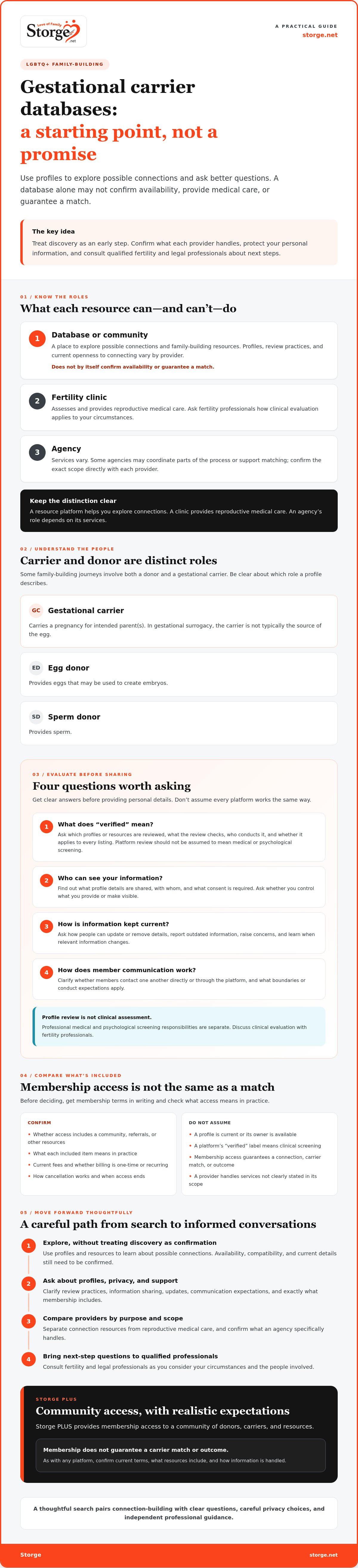
A careful process for moving from carrier search to informed conversations
Moving from discovery to a meaningful conversation takes care and shared understanding. There’s no single sequence that fits every family, but these steps can help you stay grounded without treating a profile as a decision or assuming a particular outcome.
- Clarify what you’re looking for. Consider your family’s hopes, questions, and practical needs. You don’t need every decision settled before reaching out, but knowing what matters most can help you communicate clearly.
- Learn what you can from the platform. Use an LGBTQ gestational carrier database to explore information and potential connections, while remembering that profile details may need direct confirmation. Keep discovery separate from medical or legal conclusions.
- Agree on how to communicate. Before personal topics arise, discuss preferred ways to stay in touch, privacy, boundaries, and how each person wants to approach decisions. Make room for questions and uncertainty.
- Consult independent professionals. Ask a fertility clinic about your individual medical pathway. Seek qualified legal counsel for questions about state-specific considerations and any agreements. The right professionals can explain what applies to your circumstances.
Prepare for a respectful first conversation
Start with mutual understanding, not an interview about a profile. You might ask what each person hopes for in communication, what feels important in a potential relationship, and which topics they’d prefer to discuss later. Share your own expectations, too. Either party can pause or decide not to continue; a respectful conversation leaves room for that choice.
Personal compatibility conversations serve a different purpose from professional evaluation. Qualified fertility and legal professionals should address clinical and legal questions, not a database profile or an informal introduction. A clinic can advise on medical assessment, while an attorney can explain legal questions and agreements relevant to your situation.
For support thinking through legal representation, explore this resource on finding an LGBTQ surrogacy attorney. The goal is not to rush toward a commitment. It’s to make each conversation more informed, respectful, and aligned with everyone’s needs.
If you’re ready to explore a community and family-building resources, learn about Storge’s gestational carrier search as one possible starting point. Storge connects people with resources and independent professionals; it isn’t a medical provider or law firm.
How Storge can support your LGBTQ gestational carrier search
After comparing resource platforms, clinics, and agencies, consider which kind of support fits your next step. Storge is a community and resource pathway for LGBTQ+ family building, not a medical provider or full-service surrogacy agency. Its role is to connect people with resources and independent professionals, while clinical care and legal representation remain separate responsibilities.
What Storge’s community and referrals can contribute
Storge PLUS is a paid membership that provides access to a community of donors and gestational carriers, along with verified resources. The community can be a place to explore connections and learn about resources as you consider your family-building path. Access doesn’t guarantee a carrier match, availability, compatibility, or a particular outcome.
Storge also offers referrals to fertility clinics and attorneys. These referrals connect members with independent professionals; clinics provide medical care, and attorneys provide legal services. A referral isn’t a guarantee of endorsement, fit, or results, so ask each professional about their qualifications, services, and responsibilities before moving forward.
Before joining or relying on a resource, confirm the current membership scope and access terms directly. Ask what “verified resources” means, how resources are reviewed, and what information about carriers is available. Don’t assume verification refers to medical or psychological screening, or that profile details reflect current availability.
Choose a next step that feels informed and manageable
You don’t need to resolve every question at once. Start by writing down what matters most to you, then compare platforms using the checklist in this guide. In particular, consider asking:
- What information can I access, and how is my privacy handled?
- What does membership include, and what are the current terms?
- What does resource verification mean, and who carries out any review?
- Which medical or legal questions should I take to independent professionals?
These answers can help you decide whether a community resource suits your needs now, or whether you’d rather begin with a fertility clinic or another professional. Take the time you need to understand the role and limits of any resource before sharing personal information or making decisions.
For current membership information, explore Storge PLUS and its LGBTQ+ family-building community.
Take your next family-building step with clarity
An LGBTQ gestational carrier database can help you explore potential connections, but it isn’t a substitute for medical evaluation, legal advice, or a clear understanding of each provider’s role. Ask how profiles and resources are reviewed, what information is shared, and what support access includes. Bring clinical and legal questions to qualified professionals.
Storge is an LGBTQ+ family-building platform serving a national U.S. audience. Through Storge PLUS, members can access a community that includes gestational carriers and donors, as well as referrals to fertility clinics and specialized legal representation from independent professionals. Membership doesn’t guarantee a match or a particular outcome.
If this community and resource pathway feels relevant, explore Storge PLUS and its LGBTQ+ family-building community. Take your time, ask thoughtful questions, and choose the next step that feels right for you.
Frequently Asked Questions
What is an LGBTQ gestational carrier database?
An LGBTQ gestational carrier database is a resource for exploring carrier-related profiles or potential connections, depending on the platform. Features and access vary, so ask what information is available and how it’s maintained. A database isn’t automatically a fertility clinic, surrogacy agency, or legal service, and access doesn’t guarantee a carrier will be available or that you’ll find a match.
How do I find a gestational carrier as an LGBTQ+ intended parent?
Start by clarifying your family-building goals, then compare what a community, database, fertility clinic, or agency may contribute. Before sharing personal information, ask about privacy, profile review, and the provider’s support scope. A clinic can discuss your individual medical pathway, while a qualified attorney can address legal questions based on your circumstances. These conversations can help you choose an informed next step without assuming one route fits everyone.
Is a gestational carrier database the same as a surrogacy agency?
No, the terms don’t necessarily describe the same service. A database or community may help people explore information and potential connections, while agency services can include different forms of matching or coordination. Ask for a written explanation of the provider’s role rather than inferring services from its label. Storge is a community and resource platform, not a full-service surrogacy agency, medical provider, or in-house law firm.
What should I ask before joining a gestational carrier database?
Ask what membership includes, how profiles and resources are reviewed, what “verified” means, and who performs any review. Clarify what personal information is visible, what consent governs sharing, and how privacy requests or outdated details are handled. Confirm current fees, billing, and cancellation terms directly. Also ask whether introductions, professional referrals, or other support are included. Don’t assume access means a carrier is available or a match is assured.
Does joining a gestational carrier database guarantee a match?
No. Membership in a database or community shouldn’t be taken as a guarantee of a match, timeline, or particular outcome. Availability and compatibility depend on the people involved and their circumstances, and platform terms differ. Review the current membership terms and ask directly what access provides. Keep medical decisions with qualified fertility professionals and legal questions with a qualified attorney who can consider your situation.
Do LGBTQ+ intended parents need a fertility clinic and an attorney when using a carrier database?
A database doesn’t replace individualized medical care or legal advice. The professionals and steps that may be appropriate depend on your circumstances and applicable state law. Ask a fertility clinic about clinical evaluation and care for your family-building plan. Consult a qualified attorney about legal questions, agreements, and parentage. This general information isn’t personal medical or legal advice, so discuss your specific questions with those professionals.
What is the difference between a gestational carrier and an egg donor?
A gestational carrier carries a pregnancy, while an egg donor provides eggs that may be used in assisted reproduction. These are different roles, though a family-building plan may involve both. The particular medical arrangement and any genetic relationships depend on individual circumstances, so don’t assume them from someone’s role alone. Ask a fertility clinic to explain the options and roles relevant to your family’s plan.


