

Could a carefully written donor agreement still leave your family needing another legal step? A Donor agreement lawyer for LGBTQ families can help clarify intentions around a known donor, but the agreement may not, by itself, establish who the law recognizes as a parent. That distinction matters because rules can vary by state.
If you’re hoping a signed document will settle every question, it’s understandable to want reassurance. A donor agreement can record important expectations and intentions, while legal parentage may require separate planning. The steps to discuss depend on your family-building path and the laws that apply to your circumstances.
This guide explains what donor agreements typically cover, what they may not decide on their own, and what to discuss with specialized legal counsel before conception. You’ll also learn why state-specific advice and affirming support matter, and how LGBTQ+-inclusive family-building resources, including Storge’s referrals to specialized legal representation, can help you find relevant guidance.
Key Takeaways
- A donor agreement can record participants’ intentions and expectations, but it may not settle legal parentage on its own.
- A Donor agreement lawyer for LGBTQ families can explain how your arrangement and applicable state law shape the questions to address.
- Known-donor and sperm-bank arrangements can involve different participants and documents, so focus on the legal questions relevant to your path.
- Before meeting with counsel, gather your plans, shared expectations, and questions. A generic online template may not fit your family’s circumstances.
- Storge connects LGBTQ+ families with referrals to specialized legal representation and other family-building resources. An attorney provides legal advice based on your circumstances.
Why LGBTQ+ families consider a donor agreement lawyer before conception
Donor conception planning often starts with medical questions: which route feels right, what treatment may involve, and who will participate. Legal questions also deserve attention. A donor agreement is a written record of participants’ intentions and agreed expectations. It can help everyone discuss their understanding before conception, but its wording and legal effect depend on the arrangement and applicable law.
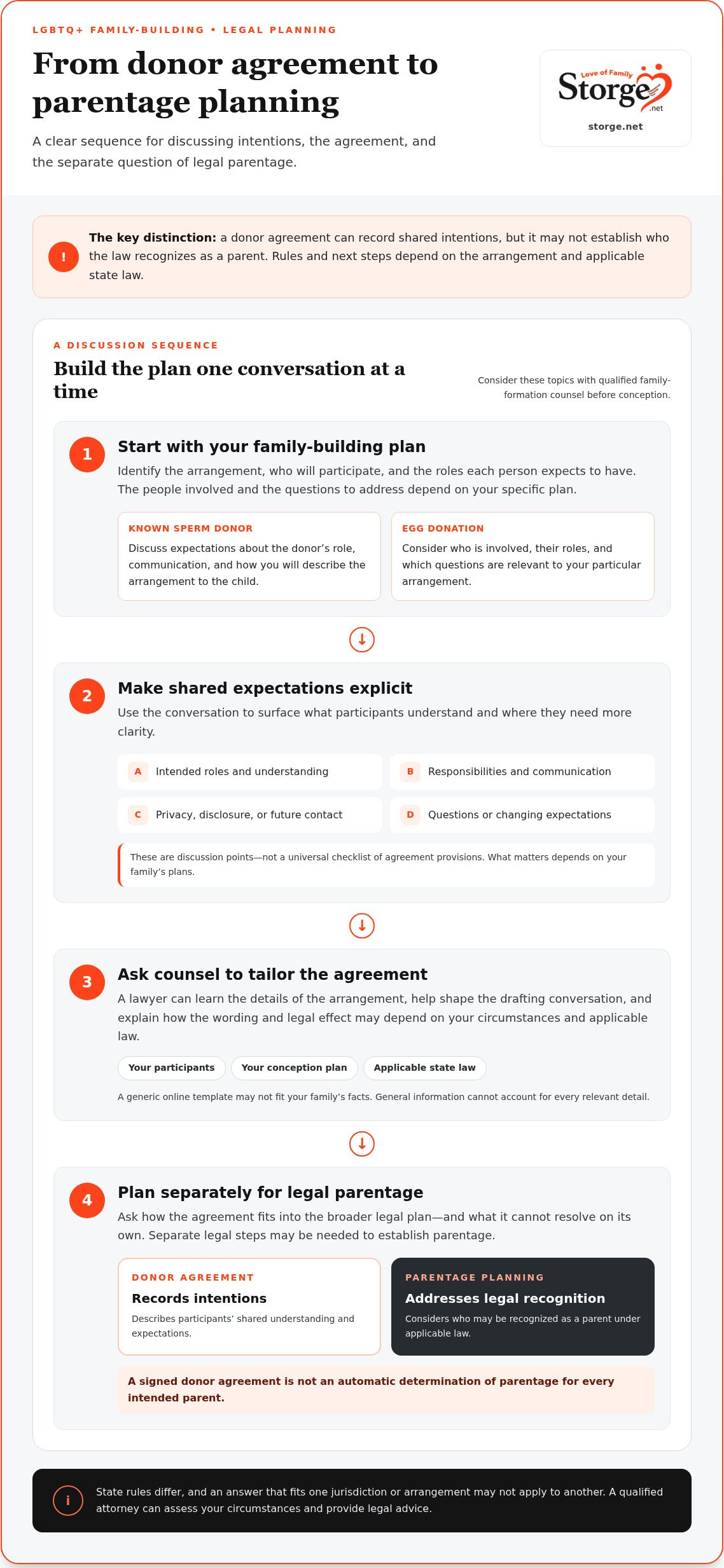
This distinction matters for LGBTQ+ families because a family-building plan may involve multiple people’s roles or more than one legal process. A document can describe what participants intend, while the law may separately determine parentage. A donor agreement records shared intentions; legal parentage planning addresses who is recognized as a parent under applicable law. A general explanation or signed document alone cannot resolve every family’s situation.
Which LGBTQ+ family-building paths may involve donor agreements?
A known sperm donor arrangement may involve one or more intended parents and a donor they know personally. Participants may want to discuss expectations about the donor’s role, communication, and how they will describe the arrangement to the child. Even when everyone feels aligned, these conversations can help make shared assumptions explicit for discussion with counsel.
Egg donation can raise its own questions, whether the donor is known or the arrangement involves other participants and professionals. Individuals, couples, and families with different structures may pursue different paths, including donor insemination or arrangements involving donated eggs. The people involved, their roles, and the questions to address depend on the specific plan. The overview of same-sex parenting describes a range of family-building paths, but it isn’t a substitute for legal guidance about your circumstances.
Why involve a lawyer before conception?
Speaking with a Donor agreement lawyer for LGBTQ families before treatment or conception gives participants time to raise uncertainties and discuss expectations before plans move forward. Counsel can learn the details of the arrangement, explain which issues may need attention, and distinguish between what participants hope to establish and what applicable law may recognize. That can make sensitive conversations more informed and reduce reliance on assumptions or informal promises.
General information can introduce concepts, but it can’t account for every relevant fact, including where participants live and how conception is planned. Rules differ by state, and an answer that fits one jurisdiction or arrangement may not apply to another. Ask qualified family-formation counsel to assess your circumstances and explain how donor-agreement planning relates to parentage planning. Seeking advice early creates time to address those questions, but it does not mean one document guarantees a particular legal outcome.
What a donor agreement can cover, and what it cannot decide
A donor agreement can give participants a shared place to describe their intentions and expectations. The conversation may be as important as the document: putting assumptions into words can reveal where people agree, where they need clarity, and which questions call for legal advice. The agreement’s language and legal effect depend on the facts of the arrangement and the law that applies.
Common subjects to discuss with donor-agreement counsel
Depending on the family’s plans, counsel may help participants discuss:
- Each person’s intended role and understanding of the arrangement.
- Expectations about responsibilities and communication during the process.
- Whether privacy, disclosure, or future contact are relevant to their plans.
- How participants want to handle questions or changes in expectations as circumstances evolve.
These are discussion points, not a universal checklist of agreement provisions. For example, a family planning future contact with a known donor may need to discuss expectations that don’t apply to another arrangement. A Donor agreement lawyer for LGBTQ families can tailor the drafting conversation to the participants, conception plan, and applicable state law. Clear wording matters, but a template cannot account for every family’s facts.
Where donor agreements meet parentage planning
Here’s the key distinction: contract terms and parentage recognition are related, but distinct. An agreement records intentions, while separate legal steps may be needed to establish parentage. A donor agreement alone may not answer every question about who will be recognized as a legal parent. The options and processes to discuss depend on the state, how conception takes place, and the family’s circumstances. Don’t treat a signed document as an automatic determination of parentage for every intended parent.
Ask counsel to explain how the agreement fits into the broader legal plan, what it can address, and what it cannot resolve by itself. A useful conversation will consider both the participants’ goals and the limits of what the document can accomplish. For additional LGBTQ+ family-law resources, the National Center for Lesbian Rights’ LGBTQ Family Law Institute offers information and a directory of practitioners.
Finding counsel who understands LGBTQ+ family formation can make complex questions feel more manageable. Storge connects LGBTQ+ individuals and couples with referrals to specialized legal representation, alongside other family-building resources. Explore LGBTQ+ family-building resources as you consider what support may fit your next steps.
Known donor or sperm bank: how the legal questions may differ
The route to donor conception can shape which documents and people are part of the legal conversation. With someone you know, intended parents and the donor may need to discuss expectations directly. A sperm bank or other donation program may have its own forms and procedures to review. Neither route automatically answers every question about parentage. The legal significance of the arrangement depends on its facts and applicable state law.
| Consideration | Known donor | Sperm bank or donation program |
|---|---|---|
| Participants | Intended parent or parents and a donor they know may be directly involved in discussing expectations. | The intended parent or parents interact with a program, whose documents and processes may also be relevant. |
| Documentation | Participants may discuss whether a written agreement should record their shared understanding. | Program forms and related records may be part of the documents for counsel to review. |
| Questions for counsel | How do the planned conception method, participants’ intentions, and state law affect the legal questions? | What do the program documents address, and what separate questions remain under applicable law? |
| Possible legal effect | Depends on the facts and jurisdiction. | Depends on the facts and jurisdiction; using a program doesn’t by itself settle every parentage question. |
Working with someone you know as a donor
Personal trust can be a meaningful foundation, but it doesn’t mean everyone has identical expectations or replace informed legal advice. Before conception, intended parents and the donor can talk through their understanding of roles, communication, and any expectations about future contact. Each participant may have distinct legal interests, so don’t assume one person’s understanding speaks for everyone. A lawyer can help clarify which issues need careful discussion and how they relate to the planned arrangement.
Using a sperm bank or other donation program
A program-based arrangement can differ from a private one because the program may use its own procedures and documentation. Those materials provide important context, but they don’t necessarily answer every legal question. Share relevant documents with counsel familiar with LGBTQ+ family formation and your circumstances. Discuss how the conception method, people involved, and applicable law may affect the legal analysis.
For example, a family using a bank may have program records to consider, while a family working with a known donor may need to focus on direct discussions and written expectations. The facts matter in both situations. A Donor agreement lawyer for LGBTQ families can help you understand the questions raised by your arrangement, rather than treating either route as a universal legal template. Use the comparison as a starting point for conversation, not as a prediction of legal outcomes.
How to prepare for a donor agreement lawyer conversation
A little preparation can help you make the most of the conversation, especially if you’re balancing personal hopes with practical decisions. If possible, speak with counsel before conception or treatment begins. That gives everyone a chance to identify questions early, rather than relying on assumptions once plans are underway. The steps below can help organize the discussion, but they aren’t a substitute for advice about your circumstances.
- Describe your planned family structure. Note who hopes to become a parent, who may participate as a donor, and how each person understands their role. Include details that could shape the legal discussion, even if they seem straightforward.
- Summarize the donation and conception plan. Explain whether you’re considering a known donor, a sperm bank, egg donation, or another arrangement, and describe the anticipated conception method. If plans are still developing, say so. Counsel can discuss questions raised by the options you’re considering.
- Gather relevant paperwork. Bring program documents, correspondence that helps explain the arrangement, or any draft agreement you already have. A generic online template may not reflect your family’s facts or applicable law, so treat it as material for review, not a ready-made solution.
- Write down your questions. List what you want to understand about participants’ intentions, parentage, privacy, future contact, and next steps. You don’t need every answer before the meeting. Identifying what feels uncertain is useful.
Information to gather before the first discussion
Keep your notes simple and factual. A short outline of who is involved, what arrangement you’re considering, and where relevant participants live can help counsel understand the context. Bring copies of existing documents and mark any language you don’t understand. You can also note which expectations are shared and which still need discussion, so the conversation can focus on your actual questions.
Questions to ask about representation and state law
Ask how the attorney works with donor agreements and LGBTQ+ family formation, and how the law applicable to your circumstances may affect the advice. You can also ask whether each participant should have separate legal representation and which parentage-related questions may require separate advice or proceedings. The answers depend on the facts and jurisdiction, so don’t assume one approach applies to every family.
If you’re still looking for counsel, Storge’s guide to how to find an LGBTQ family law attorney can help you think through the search. Storge also connects LGBTQ+ individuals and couples with referrals to specialized legal representation. Explore LGBTQ+ family-building resources as you prepare for your next conversation.
Find affirming donor-agreement resources through Storge
Choosing a donor-agreement lawyer is one part of a broader family-building journey. It can help to have a supportive place to find relevant information and connections as you consider your options. Storge is a national LGBTQ+ family-building platform and referral resource, connecting individuals and couples with resources that can include referrals to specialized legal representation.
Storge connects members with referrals to specialized legal representation, while an attorney provides advice based on your circumstances and applicable law. Through a referral, you can connect with specialized legal support and discuss your plans, understand your options, and receive guidance tailored to your situation. The right support makes room for your questions without assuming every family follows the same path.
How community and professional referrals can support the journey
Family-building decisions can feel personal and complex at once. A community can offer connection and help you locate relevant resources, while professional referrals can point you toward specialized support for questions that call for individual advice. These forms of support work alongside each other, not as substitutes: community context may help you feel less alone, and an attorney can address the legal details of your plan.
If you’re learning about the different ways LGBTQ+ families connect through donor arrangements, Storge’s LGBTQ donor community guide offers related family-building context. Use community information to shape the questions you want to ask, then bring those questions to qualified counsel. A Donor agreement lawyer for LGBTQ families can discuss how your arrangement and circumstances affect the legal issues you’re considering.
It may help to separate your next steps into two lists: questions that need legal advice and broader family-building questions where community or informational resources could be useful. For example, you might want counsel to explain how a donor agreement relates to parentage planning, while also seeking community perspectives as you consider what kind of support feels right. Keeping those needs distinct can make the process more manageable.
A gentle next step for LGBTQ+ families
You don’t need to solve every question at once. Start with the one that feels most immediate, such as understanding which documents to discuss with a lawyer, finding specialized legal representation, or learning more about donor connections. One clear question can be enough to move forward thoughtfully.
Storge brings family-building resources and supportive connections together for LGBTQ+ individuals and couples. If you’d like to explore community resources as you consider your next step, explore Storge’s family-building community. It can complement independent legal advice as you make informed choices for your family.
Take your next family-building step with support
Choosing your next step doesn’t mean you need to have every detail settled. You might begin by writing down the legal question you most want answered or identifying the kind of support that would help you feel more grounded as you plan. The right pace gives you room to make informed choices for your family.
A Donor agreement lawyer for LGBTQ families can provide advice tailored to your circumstances. Alongside that independent legal guidance, Storge offers a national online community focused on LGBTQ+ family building, with referrals to specialized legal representation and fertility clinics. Storge PLUS provides access to a vetted community of donors and gestational carriers, offering additional family-building resources as you explore your options.
Whether you’re beginning to plan or ready to move forward, supportive connections can make the process feel less isolating. Explore Storge’s LGBTQ+ family-building community to find resources for the questions ahead. Your family’s path is your own, and you can take it one thoughtful step at a time.
Frequently Asked Questions
Is a donor agreement legally binding in every state?
No, don’t assume a donor agreement has the same legal effect in every state. How a court may treat it can depend on state law, the document’s wording, and the facts surrounding conception. If participants live in different states or plan to move, raise that early with a qualified attorney. Ask how those details affect the agreement and whether additional legal steps should be considered.
Can a donor agreement be changed after everyone signs it?
It may be possible to change an agreement, but don’t assume one participant can revise it alone or that an informal conversation updates the signed document. The agreement’s terms and applicable law matter. If everyone wants to change an expectation, ask counsel how to document that clearly before relying on it. For example, a change to planned communication should be discussed and handled deliberately, not left to conflicting memories.
How much does a donor agreement lawyer cost?
There isn’t one standard fee. The amount can depend on whether you need an agreement drafted or reviewed, the complexity of the arrangement, and whether revisions or negotiation are involved. Before retaining counsel, ask what the estimate covers, how revisions are handled, and whether separate parentage advice falls outside that scope. A clear description of your needs can help you understand what the proposed legal work includes.
Can a single LGBTQ+ intended parent use a donor agreement?
Yes, a single intended parent can discuss a donor agreement with a lawyer. The questions may differ from those in a couple’s arrangement because there may be only one intended parent, but the donor’s role, conception plan, and applicable law still matter. For instance, explain whether the donor is known to you or involved through a program. Counsel can assess which terms and separate legal questions apply to your circumstances.
What happens if a donor and intended parent disagree about the agreement?
The next step depends on the disagreement and the agreement’s terms. If it arises before conception, consider pausing plans until everyone understands the issue and has received appropriate legal advice. If the disagreement occurs later, keep relevant communications and documents, and speak with your own lawyer before making decisions based on assumptions about the other person’s rights or obligations. Don’t rely on a general online explanation to resolve a specific dispute.
Can a donor agreement be signed electronically?
Possibly, but don’t assume an electronic signature is suitable for every agreement or situation. Rules about signing and any required formalities can depend on applicable law and the document involved. Before using an e-signature platform, ask counsel whether the agreement can be signed electronically, whether witnesses or notarization are relevant, and how each participant should receive a completed copy. Keep the final version with related records.


