

What if the path to holding your baby felt less like a clinical transaction and more like a community homecoming? For many, starting a family as a lesbian couple begins with a spreadsheet of costs and a list of legal hurdles that can feel daunting. You've likely spent hours researching donor vials and state laws, only to feel the weight of the medical coldness that often surrounds fertility banks. It's a journey that demands both a brave heart and a practical mind, especially when 2025 data shows that one-third of LGBTQ+ parents still don't feel they have the same legal rights as other families.
You aren't alone in feeling that the process should be as beautiful as the outcome. It's natural to want more than just a successful procedure; you want a foundation built on safety, legitimacy, and mutual support. Discover the essential medical, legal, and community-driven steps to begin your journey toward motherhood with confidence. This guide provides a clear roadmap of 2026 conception options, from reciprocal IVF to IUI, while ensuring you have the legal peace of mind and community connections necessary to protect your future family.
Key Takeaways
- Begin by defining your shared vision for parenthood and understanding the unique emotional roles each partner will play throughout the journey.
- Navigate the medical landscape by comparing the costs and success rates of various methods when starting a family as a lesbian couple, from IUI to reciprocal IVF.
- Learn how to choose a sperm donor by weighing the benefits of clinical banks against the warmth and connection found in a trusted community.
- Prioritize legal safety by securing your parental rights with professional documentation and attorney referrals before your child arrives.
- Build a lasting support network to ensure you have a safe space and expert guidance throughout every transition of your family building process.
Defining Your Vision: The First Step in Your Family Journey
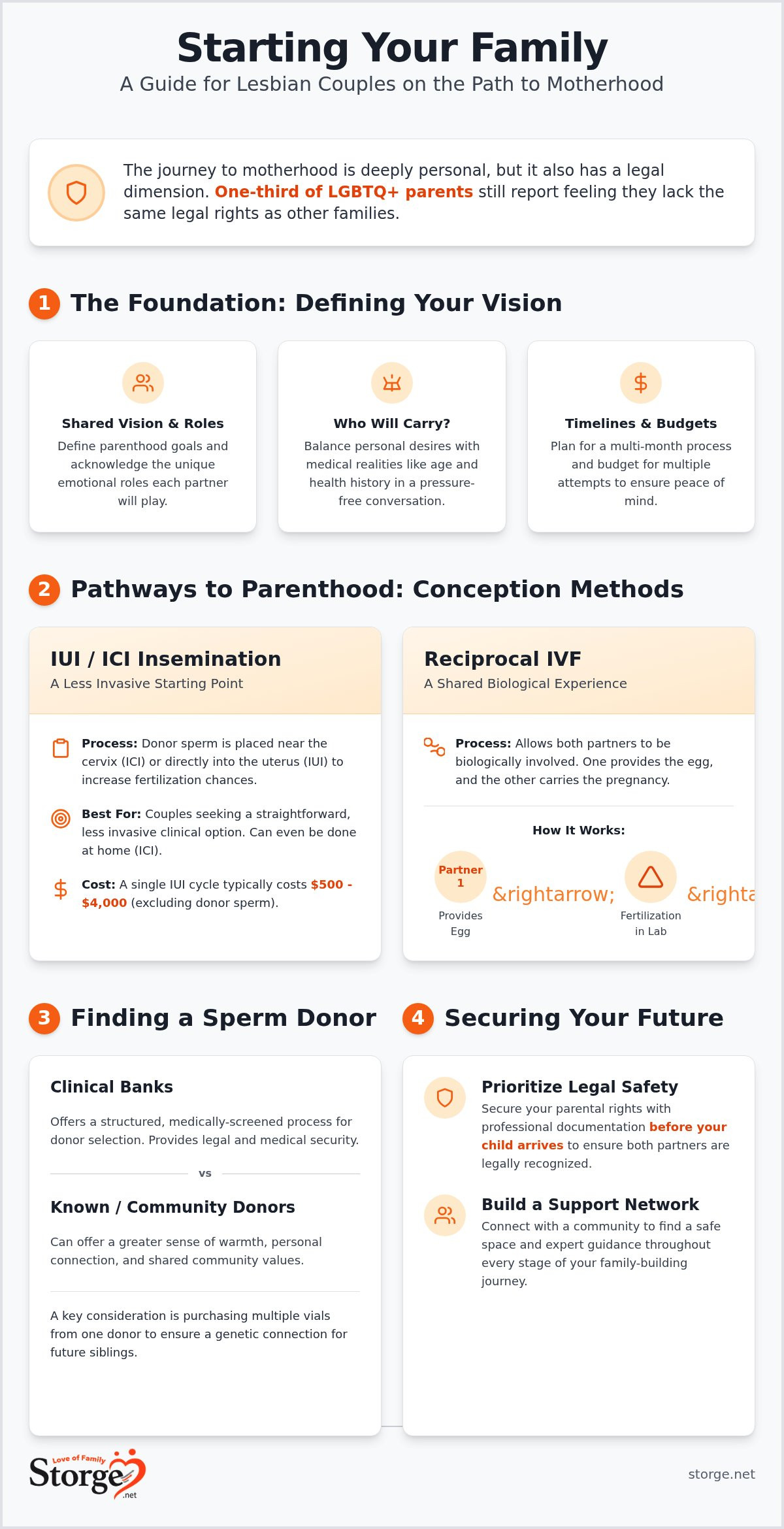
Before you book a single clinic appointment or browse a donor database, take a moment to sit together and dream. This visioning phase is the foundation of your future household. It's where you decide not just how you'll conceive, but how you'll parent. Discuss what daily life looks like with a child. Will one of you stay home? How will you balance career goals with late-night feedings? Starting a family as a lesbian couple is a deliberate act of love, and defining your primary goals early helps prevent friction when the process becomes more technical.
The emotional landscape of starting a family as a lesbian couple involves navigating roles that are both distinct and deeply intertwined. While one partner might carry the pregnancy, both of you are embarking on a transition into motherhood. The non-carrying partner's role is foundational; they provide the emotional safety and physical support that allows the carrying partner to focus on the pregnancy. Acknowledging these distinct yet equal contributions early ensures that both parents feel fully seen and valued from day one. You might also consider your long-term vision for siblings. Many couples choose to purchase multiple vials from a single donor at the start to ensure future children can share a genetic connection, a common consideration in modern Same-sex parenting.
Choosing Who Will Carry the Pregnancy
This decision is often a blend of deep personal desire and medical reality. You'll want to look at your individual health histories and talk openly about who feels a stronger pull toward the experience of pregnancy. For some, the choice is clear; for others, the idea of both partners carrying at different times feels right. Practical factors like age and ovarian reserve play a role here too. It's helpful to have these conversations with a sense of curiosity rather than pressure, allowing space for feelings to change as you gather more information from fertility professionals.
Setting Realistic Timelines and Budgets
Building a family takes time, often more than you might initially expect. Between selecting a donor, completing medical screenings, and synchronizing cycles, the preparation phase can span several months. It's also wise to prepare for the possibility of multiple attempts. Success rarely happens on the first try, so building a buffer into your timeline and your savings account provides much-needed peace of mind. Remember to include legal and administrative costs in your initial financial planning. These are the essential steps that turn a personal dream into a secure, protected reality for your future child.
Exploring Conception Methods: From IUI to Reciprocal IVF
Once you've defined your vision, the next step in starting a family as a lesbian couple is choosing the medical path that aligns with your biology and your budget. Every body is different, and there's no single "correct" way to build a family. Some couples prefer the simplicity of insemination, while others seek the shared biological connection offered by advanced reproductive technologies. It's helpful to view these options as a spectrum of care designed to meet you where you are, balancing your personal preferences with medical reality.
Determining which method is right for you involves a look at your health history and your long-term goals. While some methods are more accessible, others offer higher success rates per cycle or allow for a more shared experience. Consulting with inclusive fertility clinics is essential to assess your specific medical needs, such as ovarian reserve and uterine health, before committing to a specific path.
Intracervical and Intrauterine Insemination (ICI/IUI)
Intracervical Insemination (ICI) is the most straightforward method available. It involves placing donor sperm near the cervix, a process some couples choose for at-home attempts to maintain a sense of intimacy. Intrauterine Insemination (IUI) is a clinical step up. In this procedure, a professional places washed sperm directly into the uterus, bypassing the cervix to increase the chances of fertilization. According to 2026 data, a single IUI cycle typically costs between $500 and $4,000, excluding the cost of donor sperm. While these methods are less invasive, they often require multiple attempts to achieve a successful pregnancy.
Reciprocal IVF: A Shared Biological Connection
Reciprocal IVF has become a cherished option for many because it allows both partners to be biologically involved in the pregnancy. In this process, one partner undergoes egg retrieval to provide the genetic material. The resulting embryo is then transferred to the other partner, who carries the pregnancy to term. This method creates a unique bond where one parent is the genetic mother and the other is the gestational mother. It's a beautiful way to share the physical journey of starting a family as a lesbian couple.
It's important to note the higher technical complexity and financial investment required for this path. The cost for one cycle of reciprocal IVF generally ranges from $20,000 to $35,000. When you account for medications, donor sperm, and genetic testing, the total cost can realistically fall between $50,000 and $70,000. If you're looking for a provider who understands these intricacies, seeking vetted fertility clinic referrals can help you find a team that prioritizes both your medical success and your emotional well-being.
Finding the Right Sperm Donor: Community vs. Clinical Banks
Selecting the individual who will contribute half of your child’s genetic makeup is a profound milestone. It's a decision that balances medical safety with the personal values you hold as a future parent. When starting a family as a lesbian couple, you'll likely choose between the structured anonymity of a clinical sperm bank and the transparent, human-centric approach of a known donor. Both paths offer distinct benefits, and the right choice is the one that makes your family feel most secure and connected.
Clinical banks provide a high level of privacy and standardized medical screening, which can feel efficient for those who prefer a more detached process. However, many couples find the "clinical coldness" of these institutions a bit isolating. This is why more parents are gravitating toward finding a trusted sperm donor community. These spaces prioritize a more personal experience, allowing you to understand the donor's personality and motivations before making a commitment.
The Benefits of a Vetted Donor Community
Community-based donor searches offer a level of transparency that clinical banks simply can't match. Instead of reading a static profile, you have the opportunity to engage in a dialogue, ensuring there's a mutual sense of respect and shared intention. This emotional value is significant; it allows you to tell your child a more complete story about their origin. For many, knowing the person behind the donation transforms the process from a transaction into a partnership. If you're ready to explore this path, our 2026 guide for finding a sperm donor provides specific, actionable steps to help you find a donor who aligns with your family's vision.
Vetting Donors for Health and Compatibility
Safety remains the cornerstone of starting a family as a lesbian couple. Regardless of whether you choose a community donor or a clinical bank, rigorous vetting is non-negotiable. Donors must undergo comprehensive screening for infectious diseases and genetic conditions to ensure the health of both the carrying parent and the future child. It's equally vital to verify the donor’s willingness to provide future health updates. Genetics isn't a one-time snapshot; having a donor who is committed to sharing medical changes over the years provides long-term peace of mind. Finally, always formalize these arrangements with a clear legal agreement to define parental rights and donor expectations from the start.
Legal Protection: Ensuring Your Parental Rights are Secure
Biological connection is a beautiful part of the story, but it isn't always enough to guarantee legal parentage. When starting a family as a lesbian couple, you're building a future that requires proactive legal shielding. While marriage equality provides a foundation, the specific rights of the non-biological or non-carrying parent can still be vulnerable depending on your location. Laws vary significantly across state lines, making it essential to treat legal documentation as a primary step rather than a final detail. Securing your rights before your child arrives prevents future disputes and ensures your family is recognized in every jurisdiction.
The legal landscape for same-sex families is a patchwork of protections. Even in 2026, many couples find themselves in a gray area where administrative documents like birth certificates don't offer the full weight of a court order. Seeking professional guidance is the best way to move from a place of uncertainty to one of absolute confidence. You deserve the peace of mind that comes from knowing your parental status is ironclad and unquestionable.
Second-Parent Adoption and Parentage Orders
Many parents wonder if second-parent adoption is necessary if both names already appear on the birth certificate. The reality is that a birth certificate is an administrative record, while an adoption decree is a judicial judgment. A Judgment of Parentage or a second-parent adoption order must be recognized by every state under the "Full Faith and Credit" clause of the Constitution. This court-ordered protection ensures that both mothers have equal, irrevocable rights. Currently, 25 states and the District of Columbia offer specific pathways for second-parent adoption, providing a vital safety net for the non-biological parent.
Essential Legal Contracts for Donor Conception
If you're using a known donor or a community-based search, a formal donor agreement is your most important safeguard. This contract clearly outlines that the donor waives all parental rights and responsibilities, protecting your family from future claims. Equally important is a co-parenting agreement between you and your partner. This document serves as a clear record of your shared intentions and roles. These documents should never be "off-the-shelf" templates. They require the precision of specialized counsel who understands the nuances of assisted reproduction law. To ensure your family's foundation is secure, you can access attorney representation referrals through our platform to find LGBTQ-specialized family lawyers.
Building Your Support Network: Why Community Matters
Starting a family as a lesbian couple is a journey of profound joy, but the logistical and emotional weight can sometimes feel isolating. While friends and family offer love, they might not grasp the specific nuances of donor selection or the unique emotional roles of carrying and non-carrying partners. Finding your people is essential. Connecting with those who've already navigated these transitions provides a level of shared wisdom that medical textbooks can't provide. It turns a complex process into a shared experience, reminding you that your family's story is part of a larger, vibrant community.
It's vital to seek out LGBTQ donor community resources early in your process. Unlike informal social media groups where advice is often unvetted and inconsistent, a structured community provides a safe space for reliable dialogue. You deserve more than just crowdsourced opinions; you need verified information that respects the gravity of your decisions. Engaging with others who prioritize legal safety and medical transparency helps you build your own path with greater confidence and less anxiety.
Finding LGBTQ-Inclusive Fertility Clinics
Not every clinic is equipped to handle the specific needs of queer families. When vetting a provider, look closely at their intake forms. Do they use gender-neutral language? Do they offer space for both parents' information without forcing you into traditional boxes? Ask about their specific experience with donor coordination and reciprocal IVF. The "vibe" of the clinic is just as important as their success rates. You should feel seen and respected from the moment you walk through the door, ensuring your medical care is as affirming as it is effective. A clinic that understands your family dynamics will be a partner, not just a service provider.
Joining Storge PLUS for a Vetted Journey
To move from a place of research to a place of action, you need a partner who understands the intricacies of this specialized field. Storge PLUS serves as that bridge, connecting you with a vetted community of donors and carriers who share your values. We provide access to verified resources and professional referrals, from inclusive clinics to specialized attorneys. This isn't just a platform; it's a partnership based on understanding. By joining a community where you're seen and supported, you transform the practical reality of starting a family as a lesbian couple into a secure and hopeful experience. We invite you to join a space where your dream is respected and your future family is protected.
Your Future Family Begins Today
Building your family is one of the most significant transitions you'll ever undertake. By defining a clear vision and understanding your medical options, you've already taken the first brave steps toward motherhood. Whether you choose the shared biological connection of reciprocal IVF or the accessibility of IUI, your path is valid and full of potential. Remember that legal security is the invisible shield that protects your home; securing parentage orders and donor agreements early ensures your peace of mind remains intact as your child grows.
You don't have to navigate these complexities alone. Starting a family as a lesbian couple is a journey best shared with those who understand your values. Join Storge PLUS to access our vetted community of donors and resources, where you'll find a safe environment tailored to your needs. Our platform offers referrals to specialized LGBTQ+ family law attorneys and connections to a trusted community of donors and carriers. We're here to act as your steady guide, bridging the gap between your personal dream and a secure reality. Your story is just beginning, and we're honored to walk alongside you.
Common Questions About the Journey to Motherhood
How do lesbian couples decide who will be the biological mother?
Couples often decide based on a combination of personal desire to experience pregnancy and medical readiness. Factors like age, ovarian reserve, and overall health history are practical considerations that influence the choice. Some partners choose to both carry at different times or use reciprocal IVF to share the biological connection. It's a deeply personal decision that balances your emotional family goals with professional medical guidance.
Is IUI or IVF better for lesbian couples starting a family?
Choosing between IUI and IVF depends on your health profile, budget, and age. IUI is a less invasive and more affordable starting point, with cycles typically costing between $500 and $4,000. IVF offers higher success rates per cycle and is necessary for reciprocal IVF, though it involves higher technical complexity and costs ranging from $15,000 to $25,000. Your fertility specialist can help determine which method fits your medical needs.
Does the non-biological mother have legal rights to the child?
Parental rights aren't always automatic for the non-biological parent, even if you're married or listed on the birth certificate. Because laws vary significantly by state, it's crucial to secure a court-ordered Judgment of Parentage or complete a second-parent adoption. These legal steps ensure your rights are recognized nationwide. This provides the non-carrying mother with ironclad legal protection and essential peace of mind for the family's future.
How much does it cost to start a family as a lesbian couple?
The total cost of starting a family as a lesbian couple depends on the medical path you choose. IUI cycles range from $500 to $4,000, while traditional IVF costs between $15,000 and $25,000. Reciprocal IVF is more expensive, often totaling $50,000 to $70,000 when medications and donor sperm are included. Donor sperm itself can add $599 to over $2,397 per vial. Careful financial planning is vital for these investments.
Can we use a known friend as a sperm donor safely?
You can use a known friend, but it requires specific legal and medical steps to protect everyone involved. The donor should undergo rigorous infectious disease and genetic screening just as they would at a clinical bank. Most importantly, you must have a formal donor agreement drafted by a specialized attorney. This contract ensures the donor waives parental rights, protecting your family from future legal disputes while maintaining your personal connection.
What is reciprocal IVF and how does it work?
Reciprocal IVF is a process where one partner provides the eggs and the other partner carries the pregnancy. Eggs are retrieved from one mother, fertilized with donor sperm, and the resulting embryo is transferred to the other mother's uterus. This allows both parents to have a physical role in the journey: one as the genetic mother and the other as the gestational mother. It's a beautiful way to share the experience.
Do we need a lawyer to start our family journey?
Involving a lawyer is highly recommended to ensure your family's legal foundation is secure. Specialized LGBTQ+ family law attorneys help draft donor agreements and navigate the second-parent adoption process. Since biological connection doesn't always equal legal parentage, professional representation protects both parents' rights. Using attorney referrals can help you find counsel who understands the specific nuances of assisted reproduction and same-sex parenting laws in your specific area.
How do we find a fertility clinic that is truly LGBTQ-friendly?
Finding an inclusive clinic involves looking beyond general marketing. Evaluate their intake forms for gender-neutral language and ask directly about their experience with starting a family as a lesbian couple, specifically regarding reciprocal IVF. A supportive clinic should make both partners feel equally respected and seen throughout the process. Seeking referrals to vetted fertility clinics ensures you partner with professionals who prioritize your emotional safety alongside your medical success.


