

Could a family-law attorney be experienced yet unfamiliar with the parentage questions your path to parenthood raises? Finding legal counsel for LGBTQ family formation often means looking beyond broad family-law experience to consider how assisted reproduction, donor agreements, surrogacy, or adoption may affect your family’s legal protections. State rules vary, and a birth certificate alone may not secure a non-biological parent’s legal relationship with a child.
It’s understandable to want clear answers before taking another step. The right legal guidance can help you identify questions connected to your family-building plan and understand which options may apply in your state. This article explains when specialized counsel may help, what to prepare for an initial conversation, and how to assess an attorney’s experience with your path.
You’ll also learn how to find affirming, LGBTQ+-inclusive legal resources and distinguish a referral from an attorney-client relationship. Storge connects members with specialized legal representation referrals, offering a starting point for contacting a reproductive law attorney. The goal is to help you approach that conversation with greater clarity and confidence.
Key Takeaways
- Match your legal questions to your family-building path, whether it involves donor conception, surrogacy, or adoption.
- Finding legal counsel for LGBTQ family formation starts with considering relevant family-formation experience, jurisdiction, communication, and the scope of representation.
- Prepare for an initial conversation by outlining your plans and gathering relevant communications or draft documents.
- Use questions about your circumstances to make your first conversation with a reproductive law attorney more focused.
- Storge offers attorney representation referrals as a starting point for connecting with counsel, not legal representation itself.
Why Legal Counsel Matters When Forming an LGBTQ+ Family
Building a family is deeply personal, shaped by your relationships, hopes, and choices. It can also bring legal questions that deserve careful attention. A plan involving donor conception, a gestational carrier, or adoption may raise different questions about agreements, records, and how each intended parent’s relationship with a child is recognized. The relevant rules and procedures can depend on the states connected to your circumstances.
General information can help you identify topics to explore, but it can’t determine your family’s rights or predict a legal outcome. An attorney can consider your plans, documents, relationships, and applicable law, then offer advice tailored to your circumstances. Specialized legal guidance helps connect your family-building plan to the legal questions that matter for your path.
Which family-building plans can raise legal questions?
Each path has its own context. Donor conception may prompt questions about the arrangement and documentation, with relevant considerations depending on whether the donor is known or your plan takes another form. A gestational carrier arrangement can involve questions about the parties’ roles and establishing parentage. Adoption has its own procedures and documentation. These examples are starting points, not a checklist of steps every family must take.
Finding legal counsel for LGBTQ family formation begins with describing the path you’re considering rather than relying on a one-size-fits-all list. You might be at the early planning stage, already working with a donor or carrier, or preparing for adoption. A reproductive law attorney can help identify which questions apply and which decisions may benefit from legal advice before you move forward.
Why national guidance should account for state differences
Family-law rules and procedures can differ by jurisdiction, so information describing one state’s approach shouldn’t be assumed to apply nationwide. Your circumstances may involve more than one state, making it especially useful to explain the relevant details to counsel. A broad overview of LGBTQ+ rights in the U.S. can offer background, but it can’t replace advice about your specific family-building plan.
For an initial conversation, be ready to discuss the states involved and where you are in the process. You don’t need to arrive with every legal term or answer. A clear account of your plans and questions gives an attorney a useful starting point for explaining which laws and procedures may apply. Because legal rules can change, confirm current guidance with qualified counsel before relying on it.
Match Legal Guidance to Your Family-Building Path
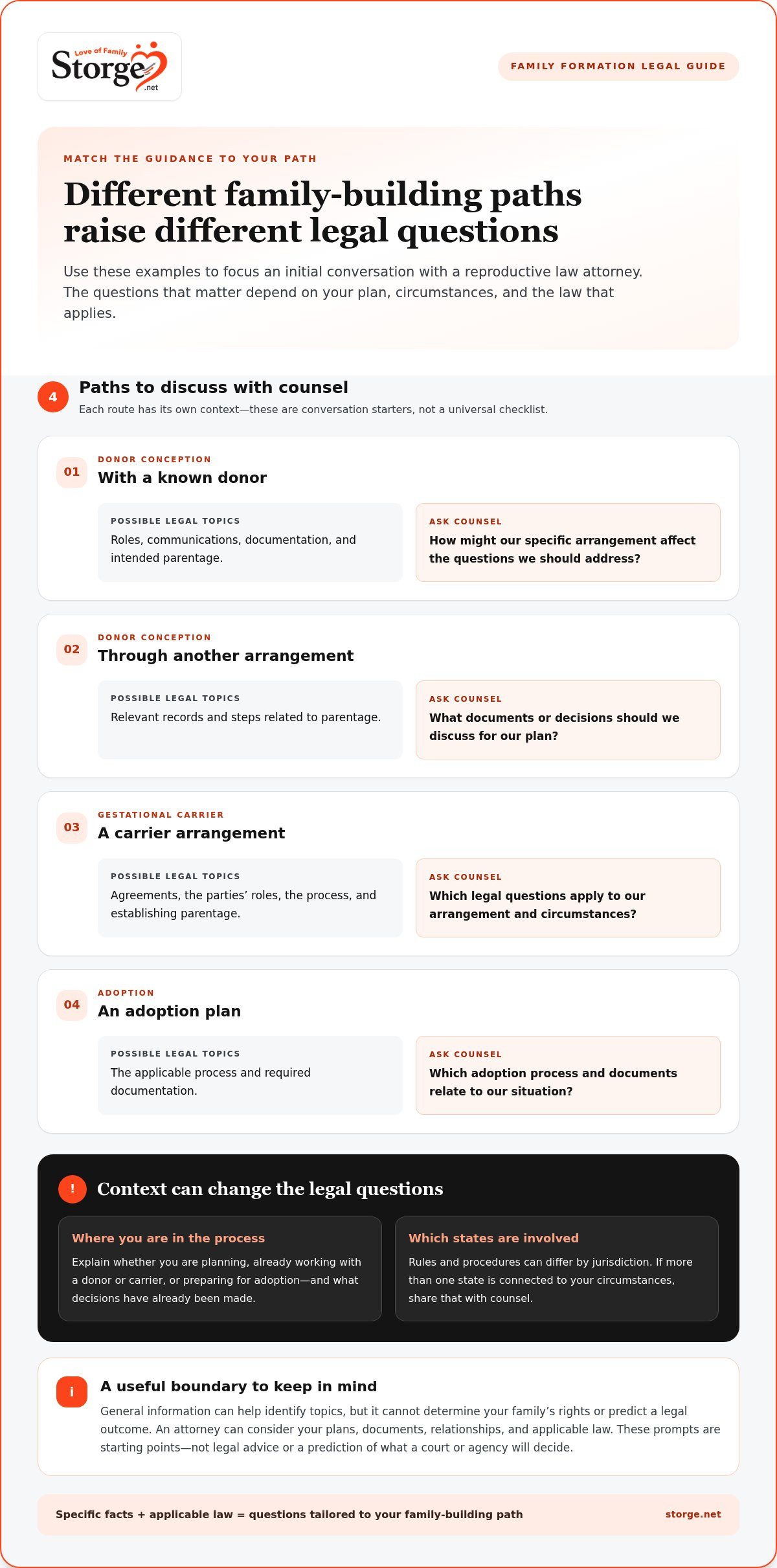
A useful first step is to describe how you hope to build your family. A known-donor arrangement, a gestational carrier arrangement, and adoption aren’t interchangeable, and each can bring different legal questions. Use the examples below to start a conversation, not as a checklist of steps every family must follow. A reproductive law attorney can help identify which questions fit your circumstances and the relevant jurisdiction.
| Family-building path | Possible legal topic | Question to raise with counsel |
|---|---|---|
| Donor conception with a known donor | Roles, communications, documentation, and intended parentage | How might our specific arrangement affect the questions we should address? |
| Donor conception through another arrangement | Relevant records and steps related to parentage | What documents or decisions should we discuss for our plan? |
| Gestational carrier arrangement | Agreements, process, and establishing parentage | Which legal questions apply to our arrangement and circumstances? |
| Adoption | Applicable process and required documentation | Which adoption process and documents relate to our situation? |
Donor conception and agreements
Donor conception can raise questions about the people involved, their expected roles, what has been discussed or documented, and how intended parentage may be addressed. The details can differ between a known-donor arrangement and other plans. Share the specifics with a reproductive law attorney rather than assuming a general template or informal understanding answers the legal questions. Counsel can explain which issues deserve attention under the law that applies to you.
Gestational carrier arrangements and adoption
A gestational carrier arrangement and adoption are distinct paths, each with its own process and considerations. For a carrier arrangement, ask about relevant agreements and parentage questions. For adoption, ask which process applies to your circumstances and what documentation may be involved. The right legal questions depend on your family-building route and the circumstances surrounding it. Be prepared to describe your plans and ask how the attorney would approach those specific facts.
These prompts are conversation starters, not legal advice or a prediction of what a court or agency will decide. Share where you are in the process, what decisions have already been made, and which states may be involved. That context helps counsel focus on questions relevant to your family rather than offering broad answers that may not fit.
Finding legal counsel for LGBTQ family formation is easier when you can name the path and the concerns you want to explore. If you’re also gathering family-building resources, Storge’s family-building community can be a starting point for connecting with specialized attorney representation referrals. A referral can help you begin contacting counsel; the attorney can discuss your circumstances and representation directly with you.
How to Assess Whether Counsel Fits Your Family-Formation Needs
A good fit involves more than a reassuring first impression. Assess relevant family-formation experience, jurisdiction, communication, and scope. This helps you move from “Does this attorney handle family law?” to “Can this attorney advise me about the path and circumstances I’m facing?” Use an initial conversation to understand the attorney’s approach, then decide whether it meets your needs.
- Relevant experience: Ask about the family-formation matters the attorney regularly handles, such as donor conception, gestational carrier arrangements, or adoption. Ask how they would approach your path and what factors in your circumstances could shape the advice. Broad family-law experience may not address every issue raised by assisted reproduction or another specific route.
- Jurisdiction: Explain which states are connected to your plans and ask how those jurisdictions may affect your questions. If your circumstances involve more than one state, raise that early. Counsel should be able to discuss how jurisdiction relates to your situation without treating one state’s procedures as a nationwide rule.
- Communication: Talk about how you’ll receive updates, how quickly you can generally expect a response, and how advice and decisions will be handled. Notice whether the attorney listens carefully, explains unfamiliar terms clearly, and uses LGBTQ+-inclusive language. You should feel able to ask questions and share relevant details without having to justify your family.
- Scope: Before proceeding, clarify who the attorney will represent, what work the engagement covers, and any limits. Ask how billing is structured, what work is anticipated, and how changes in the matter could affect the scope or billing. These questions can help you understand what to expect without assuming a particular fee or outcome.
Questions that reveal relevant experience
Specific questions can make an attorney’s experience easier to assess. Ask which family-formation matters they regularly handle and how they approach communication with LGBTQ+ clients, including terminology and family roles. Describe your plan, then ask what legal questions or jurisdictional factors they would explore first. Look for a thoughtful explanation connected to your facts, not a promise that every case follows the same path.
Communication, representation, and scope
Clarity matters before you share sensitive information or begin work. Ask how decisions are made, who will communicate with you, and how you’ll receive legal advice. Confirm the client relationship in writing, including who is represented and what tasks are covered. If a donor, carrier, or another participant is involved, ask how potential conflicts are identified and handled. Each person’s interests may differ, so don’t assume one attorney can advise everyone involved.
Finding legal counsel for LGBTQ family formation is a personal decision as well as a practical one. After the conversation, consider whether the attorney understood your priorities, answered questions plainly, and described a clear scope of representation. Use those points to compare your options and choose counsel with greater confidence.
Prepare for an Initial Conversation With a Reproductive Law Attorney
You don’t need to arrive with every answer. A short, organized snapshot of your plans can help a reproductive law attorney understand what you’re considering and focus the conversation on relevant questions. Before the meeting, note who is involved, which family-building path you’re exploring, decisions already made, and what still feels uncertain.
Gather useful background materials, too. These might include relevant communications, notes about conversations, or draft documents related to your plans. Bring them as context, not as proof that an arrangement is legally complete or sufficient. An attorney can review the materials and explain what they mean for your circumstances.
Bring a clear snapshot of your plans
A brief written summary can keep the first conversation grounded in your situation. Include the states or jurisdictions connected to your plans, such as where relevant participants live or where you expect part of the process to take place. You don’t need to decide which jurisdiction’s rules apply; sharing the locations gives counsel a chance to assess that question.
It may help to organize your notes into three parts:
- Current plan: Describe the family-building path you’re considering and the people involved, using the language that feels right to you.
- Decisions and open questions: Note what you’ve decided, what remains unresolved, and any concerns about process, parentage, or documentation.
- Relevant materials: Gather communications or drafts that provide context, and flag anything you’d like the attorney to review.
Keep a separate list of questions so you can use the meeting time well. Ask which jurisdiction or jurisdictions may matter, what timing considerations relate to your plan, who the attorney would represent, what work the engagement might cover, and what next steps they recommend. You can also ask how and when to share updates if your plans change. Finding legal counsel for LGBTQ family formation includes finding a way to keep advice connected to the choices you’re actually making.
Coordinate legal guidance with other professionals
Legal and clinical professionals have different roles. A clinician can discuss medical care and clinical processes; a reproductive law attorney can address legal questions within their representation. If you’re working with a clinic, ask your attorney how to coordinate relevant legal questions with your other professionals. Share changes that could affect the plan, such as a shift in participants, timing, or the path you’re pursuing, so counsel can advise you based on current information.
If selecting a clinic is also part of your next steps, the LGBTQ-friendly fertility clinic questions guide can help you prepare for that separate conversation. To explore a supportive starting point for family-building resources, visit Storge’s family-building community, which connects members with specialized legal representation referrals. A referral can help you begin contacting an attorney; it isn’t a substitute for a direct conversation about representation.
Find Supportive Family-Formation Legal Resources Through Storge
Finding legal counsel for LGBTQ family formation can involve more than identifying an attorney. It can also mean finding a supportive place to discover resources relevant to your plans. Storge is a community platform connecting LGBTQ+ individuals and couples with family-building resources, including specialized attorney representation referrals. Storge does not provide legal representation; a referral is a starting point for contacting an attorney, not a guarantee of representation or a particular outcome.
Storge PLUS provides access to a community connecting members with legal representation referrals, fertility clinics, donors, and gestational carriers. Access is available for a small fee that offsets operating costs. If you’re looking for broader guidance on the attorney search itself, Storge’s LGBTQ family law attorney finding guide offers another resource to explore as you consider your next steps.
Use referrals as a starting point, not a substitute for legal advice
A referral can help you connect with an attorney whose work relates to family formation. It doesn’t establish an attorney-client relationship or mean the attorney has agreed to represent you. In your direct conversation, discuss whether the attorney can take on your matter, who would be represented, and what work the engagement would cover. Only an attorney who has considered your specific facts can give legal advice about your circumstances.
That distinction helps keep expectations clear. Storge can serve as a connection point, while legal advice and representation come from the attorney you choose to engage. Before relying on guidance, share relevant details about your plans and ask the attorney how current law applies to them. A referral can open a door, but the attorney-client relationship and advice are established directly with counsel.
Keep community and legal guidance in their proper roles
Community connection can make a complex process feel less isolating. Hearing from others may help you think through questions, feel understood, and learn about resources, but peer experiences aren’t a substitute for individualized legal advice. Each family’s plan and circumstances are its own. Use community support alongside conversations with qualified professionals, not as a replacement for them.
If you’re exploring donor pathways, Storge’s LGBTQ donor community guide can help you learn more about that part of family building. For a supportive place to explore resources for your plans, explore Storge family-building resources. You don’t have to solve everything at once; you can take the process one informed step at a time.
Take Your Next Step With Confidence
You don’t need to have every detail settled before moving forward. Choose one practical next step: write down the legal question you most want answered, organize information that could help explain your plans, or arrange a conversation with a reproductive law attorney. A focused question can make the process feel more manageable.
Finding legal counsel for LGBTQ family formation means seeking guidance that respects your family and responds to your circumstances. Storge can help you explore relevant family-building resources, including a community with egg donors, sperm donors, and gestational carriers through Storge PLUS. Its attorney representation referrals are a starting point for connecting with counsel, not in-house legal representation or a substitute for advice from an attorney.
Explore Storge family-building resources as you consider what support may be useful for your next step. Your path is your own, and you can move forward one informed decision at a time.
Frequently Asked Questions
Can we use an attorney licensed in a different state?
Possibly, but the right approach depends on your circumstances and the process you’re planning. Relevant jurisdictions may be shaped by where people involved live or where parts of the family-building process take place. Ask the attorney how they assess those jurisdictional questions and whether additional counsel may be appropriate. There isn’t one answer that fits every family, so treat this as a question for individualized legal guidance.
Is an online donor agreement template enough for our family?
A template can’t evaluate your family’s particular circumstances or the law that may apply to your arrangement. If you’ve found a form online or received a draft from someone involved, save it and ask a reproductive law attorney to review it before relying on it. The attorney can explain what questions it raises and whether it fits your situation. A template alone can’t establish what legal effect an agreement may have.
What should we do if our family-building plans change after speaking with an attorney?
Tell your attorney when a material part of the plan changes, such as who is involved or which family-building path you’re considering. For example, moving from one donor arrangement to another may raise different questions than the ones discussed earlier. Counsel can assess whether the change affects prior advice or draft documents. Don’t assume earlier guidance still applies unchanged; the effect depends on your facts and applicable law.
Can a fertility clinic answer our legal questions about parentage?
A clinic can discuss its own clinical services and processes, but questions about legal parentage call for advice from a qualified attorney. If a clinic explains its forms or procedures, consider asking counsel how that information relates to your legal questions. Bring unresolved parentage concerns to a reproductive law attorney, and coordinate relevant information between your legal and clinical professionals. A clinic’s administrative process shouldn’t be treated as a substitute for individualized legal advice.
Should we tell an attorney about informal agreements or earlier conversations?
Yes. Share relevant communications, draft documents, and prior understandings so the attorney can see the context behind your current plans. For instance, explain what participants discussed even if nothing was signed or the conversation happened informally. Sharing that history doesn’t determine its legal effect or predict how a court or other authority would view it. Ask counsel how those details matter under the law applicable to your circumstances.
How can we discuss sensitive family-building details while protecting privacy?
Before sharing sensitive information, ask the attorney how communications, records, and confidential details are handled. Clarify who may access information you provide, especially if several people are involved or documents include details about a donor or carrier. Ask which communication methods the attorney recommends and use those for sharing sensitive materials. These questions can help you make informed choices about what to send and how, without assuming privacy protections work the same way in every situation.


