

Could a parent who has loved and cared for a child still need an additional legal step to protect that relationship? For some LGBTQ+ families, the answer depends on how their child was conceived or adopted and which state’s laws apply. A Parental rights attorney for LGBTQ couples can help clarify the options, but knowing when to seek guidance and what to ask can feel like a lot to take on.
It’s understandable to want clear answers, especially when laws about marriage, adoption, and assisted reproduction can vary by state. This guide explains when legal advice may be useful, how to prepare for a conversation with an attorney, and what information about your family may help. It also covers how donor conception, fertility treatment, and gestational carrier arrangements can shape the questions to discuss.
You don’t need to have every answer before you begin. Storge offers educational resources and connections to specialized legal representation referrals, giving LGBTQ+ individuals and couples a supportive starting point as they explore their options. An attorney can help you understand how the law applies to your family’s circumstances.
Key Takeaways
- A Parental rights attorney for LGBTQ couples can help clarify parentage questions shaped by your family’s circumstances and applicable state law.
- Your path to parenthood, including adoption or assisted reproduction, can affect which legal questions to raise.
- Look for an attorney with relevant experience supporting LGBTQ+ families and familiarity with your family-building path and jurisdiction.
- Prepare for a first conversation by outlining your plans, gathering relevant records, listing questions, and noting your priorities.
- Storge connects members with verified resources and referrals to specialized legal representation; legal advice and representation come from an attorney, not Storge.
When an LGBTQ Couple May Need a Parental Rights Attorney
Wanting clarity about each parent’s legal relationship to a child is reasonable. The care you give and your legal status are related, but they aren’t always the same question. A Parental rights attorney for LGBTQ couples advises on parentage and related family-law matters, helping parents understand which rules may apply to their circumstances.
There isn’t one nationwide process that answers every family’s questions. The relevant jurisdiction, how a child joined the family, and any documents or legal steps already completed may all matter. General information can help you identify topics to discuss, but it can’t determine an individual family’s legal rights. An attorney can consider your facts and the law that governs them.
What does a parental rights attorney help LGBTQ parents understand?
An attorney can explain questions about establishing, recognizing, or documenting a parent-child relationship. Depending on your situation, that might involve discussing whether an existing record reflects both parents’ status or what legal process may apply if it doesn’t. Relevant questions may extend beyond a child’s birth certificate to other legal documents or court actions.
Legal parentage is distinct from day-to-day parenting. Two adults may share caregiving, decision-making, and emotional responsibility, while the law assesses their parent-child relationships separately. An attorney can explain how those roles relate under the governing law without assuming that caregiving, marriage, or a biological connection alone resolves every legal question.
For broader context on the ways LGBTQ+ families are formed and recognized, the overview of LGBT parenting may be a useful starting point. It isn’t a substitute for advice about your own circumstances.
Why can family-building plans affect legal questions?
Family-building paths can raise different legal questions, so explain how your family came together rather than assume there is one standard route. Adoption and assisted reproduction are distinct contexts for planning, and each may involve different records, arrangements, or procedures. A lawyer can identify which rules and steps are relevant to your path and jurisdiction.
For example, a couple who welcomed a child through donor-assisted conception may have different questions from a couple whose child joined their family through adoption. In either situation, it may be important to discuss how each parent’s relationship is established and documented. If a gestational carrier was involved, the agreements and parentage questions connected to that arrangement may also be relevant. These examples don’t determine what any family must do; they show why the details matter.
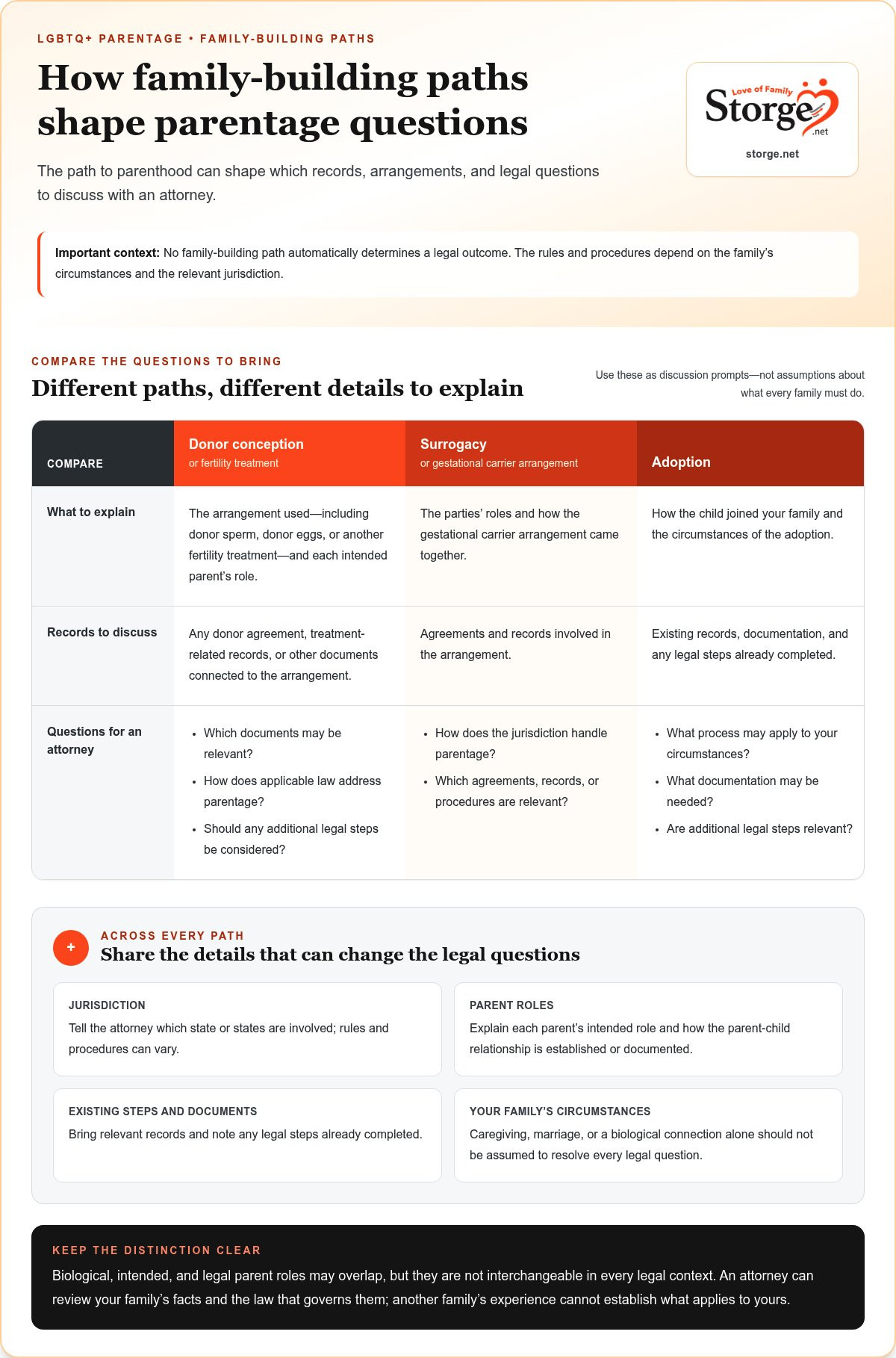
Biological, intended, and legal parent roles may overlap, but they aren’t interchangeable in every legal context. Marriage also shouldn’t be treated as a universal answer. Before drawing conclusions, share your family-building plan, the state or states involved, and any existing documents with the attorney. That conversation can help turn uncertainty into a clearer set of questions and possible next steps.
How Family-Building Paths Shape LGBTQ Parentage Questions
The way a family grows can shape the legal questions to bring to an attorney. Donor conception, fertility treatment, surrogacy, and adoption each involve different circumstances, records, and potential procedures. No path automatically leads to a particular legal outcome. A reproductive law attorney can review your family’s facts and identify which rules and steps may apply in the relevant jurisdiction.
Parentage questions depend on both how a family is formed and the law that governs its circumstances. Because rules and procedures vary, another family’s experience may offer context but can’t establish what applies to yours. The National Center for Lesbian Rights on LGBTQ+ Parenting offers broader legal information for LGBTQ+ parents, while an attorney can help interpret your situation.
Questions that may arise with donor conception or fertility treatment
If you’re considering or have used donor sperm, donor eggs, or another fertility treatment, explain the arrangement to counsel, including each intended parent’s role and any records or agreements. Ask which documents may be relevant, how parentage is addressed under the applicable law, and whether additional legal steps should be considered. An attorney may review a donor agreement, but don’t assume that the agreement alone establishes or determines legal parentage.
For family-building context, Storge’s LGBTQ donor community guide discusses donor connections and family-building. Bring questions prompted by your research to a qualified attorney, who can assess how your arrangements and records relate to the law.
Questions that may arise with surrogacy or adoption
Surrogacy and adoption are distinct paths, with different legal questions and processes. In a surrogacy arrangement, an attorney may need to understand the parties’ roles, the agreements and records involved, and how the jurisdiction handles parentage. For adoption, ask what process may apply to your circumstances, what documentation may be needed, and whether any additional legal steps are relevant. These are questions to discuss, not assumptions about what every family must do.
The gay surrogacy guide offers family-building context, but it can’t determine the legal requirements for an individual arrangement. Explain where the relevant people and events are connected, since more than one jurisdiction may be relevant to an attorney’s analysis. The lawyer can clarify which law and procedure apply instead of relying on a process described for a different place or family.
If you’re still learning about possible family-building paths, Storge’s family-building resources offer a supportive place to explore information and professional referrals. Use that background to prepare for a conversation with an attorney, not as a substitute for individualized legal advice.
How to Assess Whether an Attorney Fits Your Family's Needs
Finding a lawyer whose experience and approach fit your family can make a complex conversation more manageable. Look beyond general family-law practice for relevant experience with LGBTQ+ families and your family-building path, as well as an ability to explain how the law may apply to your circumstances. Legal guidance can be useful even when parents agree: understanding and documenting parentage can be part of thoughtful family planning, not just a response to conflict.
| What to assess | What to listen for | Questions to ask |
|---|---|---|
| Relevant experience | Work involving LGBTQ+ parentage and circumstances like yours, such as adoption, donor conception, or surrogacy. | Have you advised families with a similar path to parenthood? |
| Jurisdiction knowledge | An explanation grounded in the law that applies to your situation and current legal information. | Which jurisdiction’s rules are relevant to our family? |
| Communication style | Clear explanations of options, uncertainties, and possible next steps, without pressure or guarantees. | Can you explain what’s known and what may need further review? |
Experience and jurisdiction: what should you look for?
Ask about experience with parentage questions that resemble your family’s circumstances, not just general family-law practice. If your child joined your family through adoption or assisted reproduction, for example, ask whether the attorney has worked with similar situations. A concise overview can help establish whether the relevant experience is a fit; you don’t need to share every detail at the outset.
Jurisdiction matters because family-law rules and procedures aren’t identical everywhere, and they can change. Ask how the attorney will identify the law that applies to your family, especially if more than one state is connected to your circumstances. A directory entry or referral may help you find someone to speak with, but it doesn’t establish a lawyer’s expertise or predict an outcome.
Communication and affirming support: what should feel clear?
Notice whether the attorney listens carefully, uses your names and terms respectfully, and treats your family structure as ordinary and worthy of clear guidance. You should be able to ask questions without feeling you need to justify your relationship or family-building choices. The guide to finding an LGBTQ family law attorney offers additional considerations as you evaluate fit.
A strong conversation won’t necessarily produce a simple answer. It should help you understand which issues appear relevant, what information is still needed, and what the attorney can and can’t conclude. A Parental rights attorney for LGBTQ couples provides legal advice based on applicable law and your facts, not a promise of a particular result. Clear, respectful communication can help you make informed decisions, whether you’re planning ahead or reviewing an existing parentage arrangement.
How to Prepare for a Parental Rights Attorney Conversation
You don’t need to arrive with every answer or a perfectly organized file. A little preparation can help you explain what matters, use the conversation well, and leave with a clearer sense of what to explore next. A Parental rights attorney for LGBTQ couples can assess your situation more effectively when you share the family-building context, relevant records you have, and the questions on your mind.
Before the conversation, summarize your family plans, gather relevant records, write down your questions, and note your priorities. Use this sequence as a guide, not a test. If information or paperwork isn’t available, say so; an attorney can tell you what may matter.
- Summarize your family plans. Describe how your child joined or may join your family, the people involved, and each intended parent’s role. Include relevant context such as donor conception, fertility treatment, surrogacy, or adoption, without trying to decide its legal significance yourself.
- Gather records you already have. Depending on your circumstances, these might include relevant agreements, adoption records, or fertility-related documents. Bring copies if useful, and explain if records are incomplete or still being prepared. No single document is necessary in every case.
- List your questions. Write down what you most want clarified, including which jurisdiction’s law may apply, what legal issues the attorney sees, and what options or processes may be relevant.
- Note your priorities. Identify what you hope to understand or plan for, and any concerns about timing, privacy, or communication. This helps the attorney focus the discussion on what matters to your family.
What information can help explain your family's situation?
Keep your summary practical: how your family came together or plans to, who was involved, and what steps have already happened. If available, relevant agreements, adoption records, or fertility-related documents may give the attorney useful context. Share what you know about where the people or events involved are connected, since that may help the attorney assess which jurisdiction’s law to consider. These are possible materials, not a universal document checklist.
What questions can make the conversation more useful?
Ask how the attorney will assess your family’s circumstances and determine which jurisdiction’s law applies. Then ask for a clear outline of the issues they see, possible next steps, and what remains uncertain or requires more information. You can also ask how you’ll receive updates, whom to contact with follow-up questions, and what the attorney needs from you next. It’s reasonable to ask for plain-language explanations and to pause when something isn’t clear.
Preparation can make a first conversation feel less daunting, but you don’t need to solve the legal questions in advance. If you’re looking for a supportive starting point for family-building information and specialized legal representation referrals, explore Storge’s family-building resources. Storge connects members with resources; legal advice comes from a qualified attorney.
Finding Affirming Parental Rights Resources Through Storge
Family-building decisions bring practical questions alongside legal ones: where to learn about possible paths, how to understand the people and resources involved, and who can advise you about your circumstances. Storge offers LGBTQ+ individuals and couples a supportive starting point through educational resources, a family-building community, and connections to specialized legal representation referrals and fertility clinics.
Keep those roles distinct. Storge does not provide in-house legal representation. Its resources and referrals can help you find information and connect with professionals, but they don’t replace legal advice from a Reproductive Law attorney. A Parental rights attorney for LGBTQ couples can assess your family’s facts and explain how applicable law may affect your questions.
How Storge can support a family's resource search
Storge’s educational resources cover adoption, fertility treatments, and related family-building topics. Storge PLUS connects members with verified resources and a community that includes egg donors, sperm donors, and gestational carriers. It also connects members with specialized legal representation referrals and fertility clinics, bringing information and potential professional connections together in one supportive platform.
For a closer look at the community and resources available through membership, explore the Storge PLUS family-building community. Storge PLUS provides access to this community and verified resources for a small fee that offsets operating costs. These resources can help you learn and prepare; questions about legal rights or the steps that apply to your family belong with an attorney.
You might use educational information to identify questions about adoption or fertility treatment, then bring those questions to a professional who can address your circumstances. A referral is a connection, not a legal opinion or a promise of a particular result. Community support and individualized legal guidance serve different purposes.
When to reach out to a Reproductive Law attorney
Reach out to a Reproductive Law attorney when you want advice about how parentage rules may apply to your family, what legal steps could be relevant, or how to understand documents related to your family-building path. You don’t need to wait for a disagreement or a crisis to ask for guidance. A conversation can help you identify what is clear, what requires further review, and what questions to consider next.
Storge supports your resource search through community, education, and referrals; an attorney provides legal advice and representation. If you’d like a welcoming starting point for information and connections, explore Storge PLUS and its family-building resources.
Take Your Next Step With Support
You don’t need to have every legal question answered before you begin. One manageable next step is to write down what you want clarity about, then speak with a qualified attorney who can consider your family’s circumstances. A Parental rights attorney for LGBTQ couples can help you understand the legal questions that apply to your situation as you decide what feels right for your family’s path.
Support can include both professional guidance and a community that understands the hopes and decisions involved in building a family. Storge PLUS connects members with a community that includes egg donors, sperm donors, and gestational carriers, along with verified resources and connections to specialized legal representation referrals and fertility clinics. These connections can help you explore resources; legal advice comes directly from an attorney.
Move at a pace that feels comfortable. Explore Storge PLUS and connect with family-building resources as you consider your next step. You deserve information and support that respect your family and help you move forward with care.
Frequently Asked Questions
When should an LGBTQ couple speak with a parental rights attorney?
An LGBTQ+ couple can speak with a parental rights attorney before a family-building step, during pregnancy planning, after a child’s arrival, or when circumstances change. If you’re considering donor conception or adoption, an early conversation may help you understand which questions to ask before plans advance. You don’t need to wait for a disagreement; individualized guidance can support thoughtful planning while details are fresh.
Do same-sex couples automatically share parental rights when they marry?
No, marriage alone doesn’t settle every parentage question in every jurisdiction. Some laws may recognize a marital presumption for a spouse when a child is born, but how that applies depends on the governing law and the family’s circumstances. If you’re married and expecting or raising a child, ask a qualified attorney whether your spouse’s legal parentage is recognized and whether any additional steps may be relevant.
Can both partners be legal parents if only one has a biological connection to the child?
Yes, it may be possible for both partners to be legal parents even if only one has a biological connection, but the answer depends on the family’s circumstances and applicable law. The child’s birth or adoption circumstances, existing records, and steps already taken may all matter. Share those details with a qualified attorney, who can explain what options may apply without assuming a particular process or result.
What does a parental rights attorney do for LGBTQ families?
A parental rights attorney advises on legal questions connected to a parent-child relationship and explains processes that may fit a family’s circumstances. For example, the attorney may review a birth record or adoption paperwork and discuss what questions those records raise under applicable law. An attorney’s experience and scope of practice can vary, so describe the issue you need help with and ask what guidance they can provide.
How do surrogacy and donor conception affect parental rights?
Surrogacy and donor conception can raise different parentage questions because the people involved, agreements, and circumstances differ. An agreement or biological connection may be relevant, but neither should be assumed to determine legal parentage in every situation. If you’re planning either path, keep records of the arrangements and discuss them with a Reproductive Law attorney, who can explain how the law that applies to your family treats those details.
What should we bring to a parental rights attorney consultation?
Bring a short account of your family-building plans, relevant records you have, and written questions. Depending on your circumstances, available records might include an agreement, adoption paperwork, or fertility-related documents. You can also note where the people or events involved are connected, since that may help the attorney identify which law to consider. Don’t worry if something is missing; what’s useful or needed varies by case.
Does Storge provide legal representation for LGBTQ couples?
No. Storge doesn’t provide in-house legal representation. It offers educational resources and connects members with specialized legal representation referrals and fertility clinics, alongside a family-building community. For advice about your family’s legal circumstances, reach out to a Reproductive Law attorney. Storge helps you find relevant resources and connections, not interpret the law or promise a legal outcome.


