

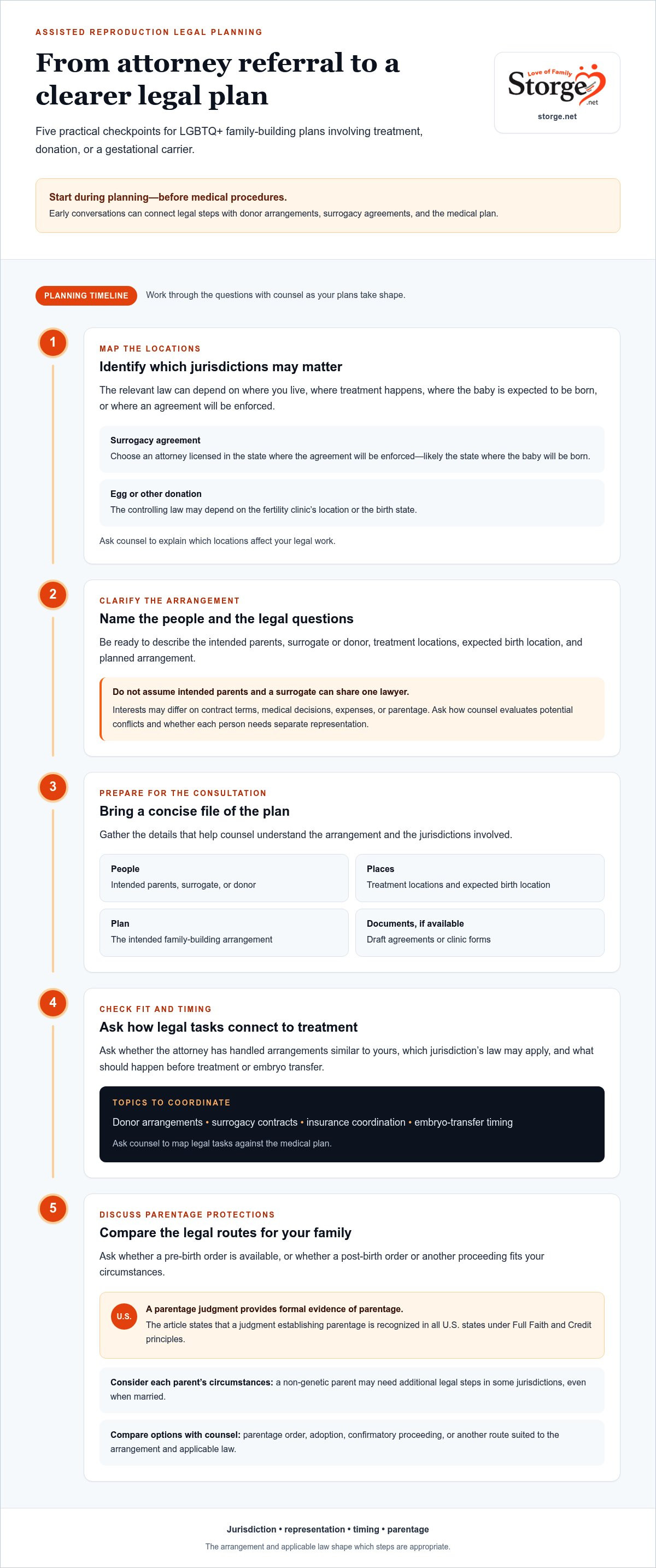
Intended parents and a gestational carrier shouldn’t assume they can share one lawyer. Each person’s legal interests need careful consideration before representation is arranged. For a surrogacy matter, the attorney should be licensed in the state where the agreement will be enforced, likely the state where the baby will be born. Attorney referrals for LGBTQ assisted reproduction can help intended parents find counsel suited to the jurisdiction and process.
It’s understandable to want a clear, coordinated path through decisions that are deeply personal and legally complex. The right attorney can answer questions, help protect your legal rights, and support you as plans take shape. Starting those conversations early can also help you understand how your family-building choices connect to parentage protections.
This article explains what to look for in an assisted reproduction attorney in DC, Maryland, and Virginia, how to assess parentage protections, and what to consider when deciding whether intended parents and a surrogate can share counsel. You’ll also learn how an attorney referral can be a practical next step as you plan your family’s journey.
Key Takeaways
- Match your attorney’s licensing to the state where a surrogacy agreement will be enforced, and consider where treatment and birth will take place.
- Ask how a parentage judgment could protect your legal relationship with your child across state lines.
- Before deciding whether intended parents and a surrogate can share counsel, consider whether each person’s legal interests are represented independently.
- Look for clear, supportive communication and ask about the attorney’s experience with cases like yours.
- Begin legal planning early so donor arrangements, surrogacy agreements, and parentage steps can be considered before medical procedures.
ART legal services in the District of Columbia, Maryland, and Virginia
Assisted reproductive technology (ART) legal services help intended parents understand rights and plan legal steps. The relevant jurisdiction often depends on where treatment, birth, or contract enforcement occurs.
Regional ART Legal Services
Legal advice may cover donor arrangements, gestational carrier agreements, parentage steps, and clinic consent forms. For surrogacy, choose an attorney licensed where the contract will be enforced, likely where the baby will be born. For egg or other donation, the controlling law may depend on the fertility clinic’s location or the birth state.
These distinctions matter when families live in one place and pursue treatment or birth elsewhere. For example, intended parents in one state might consider a neighboring clinic or birth plan. They can ask counsel to explain which jurisdictions matter and how those locations affect the legal work.
Intended parents and a surrogate shouldn’t assume they can share one lawyer. Their interests may differ on contract terms, medical decisions, expenses, or parentage. Ask how Storge evaluates potential conflicts and whether each person needs separate representation. The arrangement and applicable law shape that discussion.
Legal Information and Attorney Referrals
Attorney referrals for LGBTQ assisted reproduction can help intended parents identify counsel whose work fits their family-building plans. A referral is a starting point for a direct discussion about your matter, the relevant jurisdiction, and your legal needs. Ask whether the attorney has handled arrangements similar to yours.
Prepare a concise consultation file: list the intended parents, surrogate or donor, treatment locations, expected birth location, and planned arrangement. Include draft agreements or clinic forms if available. Ask which jurisdiction’s law may apply and what legal steps should happen before treatment or embryo transfer.
Attorney referrals for LGBTQ assisted reproduction can be especially useful when a family needs to discuss multiple parts of its plan. Contact counsel during planning, before medical procedures. Donor arrangements, surrogacy contracts, insurance coordination, and embryo-transfer timing may need coordinated attention. Ask counsel to map legal tasks against the medical plan.
If your family has a connection to a particular location, raise it during the first consultation, including residence, treatment, or planned birth. If a surrogacy contract will be enforced there, discuss whether counsel licensed in the relevant state should advise on it. Identifying each location early helps keep legal planning connected to your arrangement.
Is it important to get a court judgment reflecting that I am a parent?
A court judgment can provide formal evidence of parentage, including when a parent has no genetic connection to the child. State law and your family’s arrangement shape which legal steps apply.
Parentage Judgments and Assisted Reproduction
For families formed through fertility treatment or surrogacy, a parentage judgment can establish both intended parents’ legal relationship with their child. A judgment establishing parentage is recognized in all U.S. states under Full Faith and Credit principles. Ask counsel whether a pre-birth order is available, or whether a post-birth order or another proceeding fits your circumstances.
Both intended parents should discuss how the judgment addresses their specific arrangement. For example, a non-genetic parent may need additional legal steps in some jurisdictions, even when married. A birth certificate is important documentation, but the legal route to parentage deserves separate attention.
Second-Parent and Confirmatory Adoption
Second-parent adoption can establish a legal parent-child relationship for a parent who isn’t already recognized. Stepparent adoption has been available in every U.S. state to married same-sex couples since marriage equality became recognized nationwide. Ask whether adoption is appropriate for your family or whether a parentage order or confirmatory proceeding better fits your history.
Timing matters: co-parent and stepparent adoptions can take months, leaving a child without the security of two legal parents during that period. Discuss any required consent, termination of parental rights, and the effect on existing legal relationships before choosing a route. A court judgment may offer a formal record of parentage for recognition across state lines.
State Laws and LGBTQ Parentage
For same-sex couples and single parents, the available parentage route can differ by state and arrangement. Laws where intended parents live, treatment occurs, and birth takes place can each affect the analysis. Some jurisdictions may consider genetic connection, so marriage alone may not resolve every parentage question.
Federal law requires every state to offer a voluntary acknowledgment process for establishing parentage. Those acknowledgments are intended to receive full faith and credit, although courts haven’t tested them for LGBTQ parents. Ask counsel to compare an acknowledgment with a court judgment, adoption, or confirmatory proceeding for your family’s circumstances.
Donation Agreements and Legal Steps
For sperm, egg, or embryo donation, discuss a written agreement that records the parties’ intentions and planned roles before treatment. The applicable law may depend on the clinic’s state or where the child will be born. New York’s Child-Parent Security Act provides one example: a donor who consents in writing isn’t a parent of the resulting child.
With a gestational surrogate, legal planning includes addressing the surrogacy contract and parentage steps before medical procedures. Intended parents should coordinate donor arrangements, contract timing, and insurance considerations before embryo transfer. A focused attorney referral resource can help you take the next step toward discussing parentage protections with counsel.
Assessing communication style and trust
An attorney’s communication style shapes how you understand decisions during family formation. Use an initial conversation to assess whether their explanations are clear, respectful, and responsive to your questions.
Arrange a phone call, video conference, or email exchange, then notice whether the attorney explains unfamiliar terms in plain language. For example, ask what a parentage order could address in your arrangement. A useful answer should distinguish the legal question from the next practical step, rather than leaving you unsure what to do.
Bring a short list of priorities: parental rights, donor plans, a surrogacy agreement, or how a birth certificate may reflect your family. Ask the attorney to explain which details could affect those priorities. You’re assessing both knowledge and listening: do they respond to your actual concern, or move quickly to a prepared answer?
Pay attention to how the attorney speaks about LGBTQ families, including unmarried parents and people using donor conception. Respectful language matters, as does precision. If you describe a sperm donation arrangement, for instance, the attorney should clarify the parties’ roles and explain which legal questions need attention, without making assumptions about your relationship.
Communication also includes process. Ask who will answer routine questions, how updates are shared, and how documents will be explained before you make decisions. A clear response helps you understand the working relationship. If you need written summaries after conversations, say so and ask how the attorney handles that request.
Use these prompts during the consultation:
- “How would you explain the next legal step in my family’s formation?”
- “What information do you need about the donor, surrogate, or intended parents?”
- “How will you help me understand a draft agreement before I decide?”
- “What should I do if a question comes up between scheduled conversations?”
Notice whether answers address your circumstances, including where treatment and birth may occur. If you’re married, ask how that fact relates to the parental-rights plan; if you aren’t, ask what the attorney would examine instead. The goal is a clear explanation, not a one-size-fits-all answer.
Trust grows through specific, consistent communication. After the meeting, write down what you understood, any unanswered questions, and the next steps discussed. If you can explain the proposed process in your own words, that’s a practical sign the conversation helped you make an informed decision.
Assisted reproduction and ART
Assisted reproductive technology can involve IVF, donor sperm or eggs, embryos, and gestational carriers. Each route raises legal questions alongside medical decisions. Before treatment begins, intended parents can map the people involved, the locations connected to treatment and birth, and the parentage steps they hope to pursue. That outline gives counsel a practical starting point for a focused consultation.
Location can shape which law applies. For LGBTQ+ family formation, consider the states where intended parents live, treatment occurs, and a child may be born. Donation matters may be governed by the clinic’s state or the birth state. In surrogacy, the relevant law can depend on where the contract will be enforced. Share these locations early, especially when a plan crosses state lines.
New York’s Child-Parent Security Act took effect on February 15, 2021, according to the New York State Legislature. The law provides a state-specific example of how legislation addresses assisted reproduction. Its timing and provisions shouldn’t be assumed to apply in DC, Maryland, or Virginia. Ask counsel to explain how the governing state’s rules relate to your particular treatment and parentage plan.
Surrogacy arrangements also differ. In gestational surrogacy, the carrier has no genetic connection to the child; in traditional surrogacy, the carrier’s own egg is used. Traditional surrogacy is restricted or discouraged in many jurisdictions because parental rights can be more complex to secure. Clarify which arrangement is planned before reviewing contract language or mapping parentage steps.
Clinic paperwork deserves attention before signing. IVF consent forms may address what happens to embryos in circumstances such as separation, death, or disagreement. Ask independent counsel to review embryo-disposition provisions and explain how they relate to your intentions. A conversation before treatment can help the parties identify unanswered decisions and document their agreement clearly.
Prepare for a legal consultation by bringing your treatment plan, draft donor or carrier documents, and questions about parentage. Include the parties’ names and roles, the clinic’s location, and the expected birth state. Then ask which legal tasks should be completed before medical procedures and embryo transfer. A written sequence helps connect legal planning to treatment milestones.
Assisted reproduction has helped millions of people become parents since the first “test tube baby” was born in England in 1978. That history spans changing technologies and legal approaches. For your own plan, discuss legal fees as part of the overall costs, alongside the proposed arrangement, documents, and jurisdictions involved. The relevant factors help counsel describe the work required without relying on a general estimate.
Finding an experienced assisted reproduction attorney
Experience with assisted reproductive technology matters because donor agreements, egg donation, and surrogacy can raise different legal questions. Look for a lawyer whose recent work matches your planned arrangement, not only general family law. Ask how many similar cases they handled in the past five years and what kinds of matters those cases involved.
Licensing is another practical filter. Verify the attorney’s license through the relevant state bar, especially if treatment, contract enforcement, or birth connects your family to more than one state. For a surrogacy agreement, the attorney should be licensed where the contract will be enforced, likely where the baby will be born. Donation matters may turn on the clinic’s location or birth state.
Ask for examples of comparable case outcomes, including whether the matters succeeded and what roadblocks arose. An attorney should be able to explain how prior experience relates to your situation without promising the same result. For instance, ask how they handled parentage planning for intended parents using a gestational carrier or legal documentation for donor conception.
Professional communities can offer another route to referrals. The Academy of Adoption and Assisted Reproduction Attorneys requires its Fellows to have extensive and diverse experience in assisted reproduction. You can also seek referrals from ART-related organizations and speak with individuals who have completed a similar process. Compare each referral with your needs and jurisdiction.
During a consultation, bring a short case outline: the parties, treatment location, planned arrangement, and any draft agreement. Then ask who would handle your matter, what steps the attorney expects, and how they explain complex documents. A clear discussion helps you assess both subject knowledge and whether their communication style suits your family.
Attorney fees depend on the case and are provided after a quote request; the scope of work, jurisdiction, agreement review, and parentage proceedings affect the estimate. Ask what work the proposed fee covers and how additional tasks are addressed. Understanding the engagement terms lets you compare the work being proposed, rather than relying on a number without context.
For international surrogacy or donation agreements involving another state or country, ask about experience coordinating across jurisdictions. The relevant lawyer should have international reach and local connections for the places involved. This is especially useful when an agreement, treatment, and intended parents’ residence span different legal systems.
If you’re ready to take this step, request an attorney referral suited to your assisted reproduction plans.
Storge: Storge PLUS Membership
Storge PLUS Membership is one way to explore fertility resources as you plan your family. If your next step is finding legal counsel, Storge’s Attorney Representation Referrals can connect you with an attorney for your assisted reproduction matter. Fertility Clinic Referrals and Donor Egg / Sperm Search can support other parts of your planning.
Consider these resources as your needs become clearer. You might be preparing to discuss a donor arrangement, seeking a clinic, or looking for a lawyer to advise on parentage and agreements. Legal advice comes from the attorney who represents you; Storge offers referrals rather than in-house legal services.
If these resources fit your next step, visit Storge to explore them at your own pace.
Take Your Next Step With Clarity
Your next step can be a simple planning note: identify the decisions still open, the people involved, and the questions you want answered. This gives you a grounded starting point for a conversation with counsel and helps keep your family-building plans connected to your priorities. You don’t need to have every detail settled before beginning that conversation.
Attorney referrals for LGBTQ assisted reproduction can help you find legal representation relevant to your plans. Storge offers Attorney Representation Referrals, Fertility Clinic Referrals, and Storge PLUS Membership for people seeking fertility resources. Each can support a different part of your path, from finding counsel to exploring clinic options.
Choose the next step that fits where you are today. Contact Storge about attorney referrals and continue planning at a pace that feels right for your family.
Frequently Asked Questions
Can intended parents and a surrogate use the same lawyer?
Intended parents and a surrogate shouldn’t assume one lawyer can represent everyone’s interests. They may have different priorities about contract terms, medical decisions, and parentage. Discuss potential conflicts and independent representation before anyone signs. For example, ask how each party can receive advice about proposed changes to the agreement. State rules also matter: Delaware requires all parties to a gestational carrier agreement to have independent counsel.
What Are Important Aspects of an LGBTQ Fertility Case?
Key considerations include who intends to become a legal parent, how donors or a carrier fit into the plan, and which jurisdictions connect to treatment and birth. For example, a couple using donor eggs and a gestational carrier has distinct agreements and parentage questions to address. Keep a shared record of the parties’ roles, clinic documents, and unresolved decisions. That overview can help counsel identify issues specific to your family’s arrangement.
What if I am already on my child’s birth certificate?
Being named on a birth certificate does not, by itself, establish a legal parent-child relationship. Ask a family-building attorney to review how parentage was established and whether a court judgment, adoption, or other proceeding is relevant. Bring the certificate and any orders, agreements, or acknowledgments connected to your child’s birth. This is especially useful if your family expects to move or travel across state lines.
How can LGBTQ intended parents find an attorney who specializes in assisted reproduction?
Start by seeking referrals from local ART-related organizations and people who have pursued a similar arrangement. Then verify the lawyer’s license with the relevant state bar and ask about experience with your specific matter, such as egg donation or gestational surrogacy. Storge offers Attorney Representation Referrals for intended parents seeking legal counsel. Use an initial conversation to understand whether the attorney’s experience fits your family’s plan.
What qualifications and experience should an LGBTQ family-building attorney have?
Look for an attorney licensed in the relevant jurisdiction and experienced with your type of assisted reproduction matter. Ask how many similar cases they handled in the past five years, what outcomes and roadblocks arose, and how that experience relates to your situation. The Academy of Adoption and Assisted Reproduction Attorneys requires its Fellows to have extensive and diverse assisted-reproduction experience. Consider that experience alongside clear communication and familiarity with your arrangement.
Which organizations provide attorney referrals for LGBTQ assisted reproduction in the United States?
Local ART-related organizations can be a source of attorney referrals, and people with experience in a similar family-building process can share leads. Storge also offers Attorney Representation Referrals. The Academy of Adoption and Assisted Reproduction Attorneys is another useful professional resource: its Fellows must have extensive and diverse assisted-reproduction experience. Treat each referral as a starting point, then discuss your matter, jurisdiction, and needs directly with the attorney.
What legal risks should LGBTQ intended parents consider before fertility treatment?
Before treatment, consider whether donor or carrier agreements match everyone’s intentions, how clinic forms address embryos, and what steps establish each intended parent’s legal relationship. For example, embryo-disposition language can become important if the parties later disagree about stored embryos. Also map the states connected to residence, treatment, contract enforcement, and birth. Reviewing these details early helps identify questions to resolve before treatment decisions become harder to change.
When should intended parents consult an attorney during the assisted reproduction process?
Consult an attorney during planning, before medical procedures begin. Early advice gives intended parents time to address agreements, clinic consent forms, and parentage planning in a coordinated way. For example, someone considering donor conception can ask about documentation before choosing a treatment schedule. Those pursuing surrogacy can discuss contract timing alongside the medical plan. Bring the intended arrangement and treatment locations to the first discussion, even if some choices remain open.


