
Building your family shouldn't feel like a cold, clinical transaction. For many LGBTQ+ parents, the digital search for a donor often feels more like scrolling through a spreadsheet than starting a legacy. It's natural to feel overwhelmed by the sheer volume of medical data or worried about the legal complexities of parental rights. You want to feel confident that your future child's health and your own legal security are protected from the very first click.
Learning how to choose a sperm donor online requires more than just looking at a profile; it's about finding a balance between medical safety, legal clarity, and a shared sense of values. We understand the weight of these decisions and the desire for a path that feels both safe and human. This 2026 guide provides a clear framework to help you move forward with peace of mind. We'll walk through the essentials of vetting medical histories, managing the costs of commercial banks, and securing the professional legal referrals you need to ensure your standing as a parent is never in question.
Key Takeaways
- Understand why vetted communities are replacing traditional anonymous banks as the preferred choice for modern LGBTQ+ families seeking transparency.
- Master the medical essentials, including what FDA clearance really means and why genetic carrier screening is a non-negotiable step for your child's health.
- Learn exactly how to choose a sperm donor online by comparing the high-inventory approach of commercial cryobanks with the value-driven focus of community searches.
- Protect your parental rights by identifying why standard bank contracts often fall short and why a specialized Donor Agreement is vital for your security.
- Access a curated network of inclusive fertility clinics and legal experts who understand the specific needs of your family building journey.
Starting Your Search: The Landscape of Online Sperm Donation in 2026
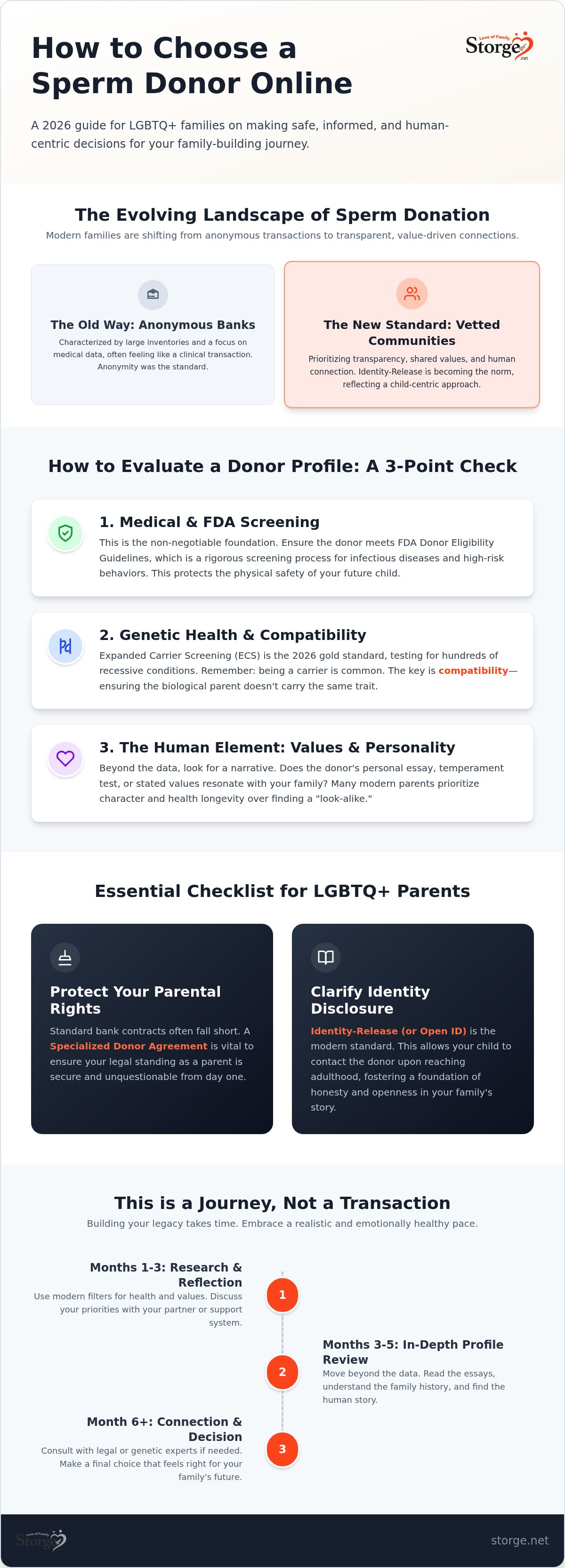
The journey to parenthood often begins with a screen, but it's fueled by a deep, personal hope. For LGBTQ+ families, learning how to choose a sperm donor online has become the modern standard, offering a level of autonomy and variety that traditional clinical routes previously lacked. While commercial cryobanks have long dominated the field with their vast inventories, 2026 has seen a significant rise in vetted communities like Storge. These platforms prioritize transparency and shared values over simple transactions, helping you find a donor who feels like a part of your story rather than just a data point in a database.
As you begin your exploration, you'll encounter different donor categories that impact your future family dynamics. Anonymous donation is becoming less common as the industry moves toward Identity-Release or Open ID models. These options allow a child to contact the donor once they reach adulthood, reflecting a more child-centric approach to family building. For a broader sperm donation overview, it's helpful to understand how legal and ethical standards have evolved to support these transparent connections. Whether you choose an ID-disclosure donor or a known donor, the goal is to establish a foundation of honesty and security from the very start.
Digital Search Tools and Filters
Modern databases now use sophisticated filters that go far beyond eye color or height. You can sort by detailed genetic carrier status, specific ancestral heritage, and even values-based criteria. AI-assisted matching is also playing a larger role, helping to highlight donors whose profiles align with your family's health history and educational priorities. Interestingly, many parents are moving away from "look-alike" features. Instead of trying to find a physical mirror of themselves, they're focusing on health longevity and personality traits that resonate with their lifestyle and values.
The Emotional Reality of Online Selection
It's easy to get caught up in the "catalog" feel of online databases, but remember that this is a deeply human process. Take the time to discuss donor profiles with your partner or support system, looking for the narrative between the data points. Does the donor's personal essay reflect a worldview you admire? Setting a realistic search timeline is also vital for your peace of mind. Most families spend several months researching and reflecting before making a final choice. This isn't a race; it's the first step in building your legacy. When you're figuring out how to choose a sperm donor online, the pace should respect the emotional weight of the decision.
Evaluating Donor Profiles: Medical, Genetic, and Physical Criteria
Once you've identified the right platform, the next step in learning how to choose a sperm donor online is peeling back the layers of a donor profile. It’s easy to get distracted by physical attributes, but the foundation of a healthy family begins with medical and genetic data. Every reputable donor profile should indicate compliance with FDA Donor Eligibility Guidelines. This isn't just a label; it’s a rigorous screening process for infectious diseases and high-risk behaviors. While commercial banks often tout low acceptance rates, you should focus on the specific screening results that ensure the physical safety of your future child.
Aesthetics often draw us in, but character is what lasts. You might find yourself searching for a donor who shares your chin or your love for music. While these connections are beautiful, prioritize the personality markers found in premium profiles. Tests that measure temperament or social-emotional traits can offer a glimpse into the donor's nature. This balance between physical likeness and internal character helps you build a family story that feels authentic and grounded.
Genetic Health and Family History
Genetic screening has become incredibly sophisticated. In 2026, Expanded Carrier Screening (ECS) is the gold standard, often testing for hundreds of recessive conditions. It’s vital to remember that being a carrier doesn't disqualify a donor. Instead, it’s about compatibility. If a donor carries a trait for a specific condition, you’ll need to ensure the biological parent doesn't carry that same trait. Reviewing a multi-generational health tree can feel like learning a new language, so don't hesitate to reach out for a professional referral to a genetic counselor if the data feels dense.
Beyond the Vials: The Human Element
While the medical data provides safety, the extended profile provides soul. Many families find that audio clips and personal essays reveal more about a donor’s character than a list of physical traits. Look for signs of altruism in their writing. Why did they choose to donate? Staff impressions are also invaluable; they offer a third-party perspective on the donor’s reliability and temperament during their visits to the clinic. If you find the process of sifting through these details overwhelming, a vetted donor search can help streamline your options by focusing on donors who align with your family's specific values.
Choosing Your Path: Commercial Cryobanks vs. Vetted Communities
Deciding where to look is just as important as the criteria you use for selection. As you research how to choose a sperm donor online, you'll likely find yourself at a crossroads between the established clinical model of commercial cryobanks and the emerging, human-centric model of vetted communities. Each path offers a different emotional and practical experience. While one emphasizes immediate inventory and clinical efficiency, the other prioritizes transparency, shared values, and the long-term well-being of the donor-conceived child and the parents alike.
Private arrangements with known donors found through online forums also exist, though they carry a unique set of risks and rewards. These "directed donations" can offer a deeper sense of connection and lower initial costs, but they require a high level of trust and rigorous legal preparation. Regardless of the path you choose, the goal is to find a donor whose presence in your life, whether through a vial or a personal connection, feels like a natural and secure fit for your family's future.
The Commercial Bank Experience
Commercial cryobanks are the traditional choice for many, offering a streamlined process that feels very much like a professional medical service. The primary advantage is immediate availability; vials are often processed, frozen, and ready to ship to your clinic the moment you make a selection. These institutions also handle the heavy lifting of medical vetting and FDA compliance. However, this convenience comes with a high price tag per vial and a more detached, anonymous atmosphere. Many families also express concern over "sibling saturation," where a single donor may have a high number of donor-conceived offspring, potentially complicating future community dynamics for your child.
The Vetted Community Advantage
Vetted communities like Storge represent a shift toward a more intentional and supportive way of building a family. Understanding why finding your people changes the donor search experience is crucial for those who value transparency. In these spaces, donors are often more aligned with LGBTQ+ family goals and are open to varying levels of identity disclosure. This community-first approach helps demystify the search process and provides a sense of belonging that clinical banks often lack.
When you're figuring out how to choose a sperm donor online within a community, you gain access to peer support that can be vital during the comparison stage. Instead of feeling like you're shopping in a vacuum, you're part of a network where shared experiences lead to better decisions. Memberships, such as Storge PLUS, focus on providing a curated network of donors and professional referrals, ensuring that your search is backed by both community trust and expert guidance. This model moves the focus from a one-time transaction to a lifetime of supported parenting.
The LGBTQ+ Checklist: Legal Protection and Identity Disclosure
Establishing your family is a profound act of love, but it also requires a sturdy legal foundation. When you are researching how to choose a sperm donor online, the legal paperwork can often feel like an afterthought compared to the excitement of selecting a donor. However, for LGBTQ+ parents, the legal landscape is rarely a one-size-fits-all experience. A standard contract provided by a commercial bank might protect the bank from liability, but it doesn't always address the specific vulnerabilities of same-sex couples or single parents by choice. Ensuring your parental rights are airtight from the moment of conception is the most important gift you can give your future child.
A comprehensive Donor Agreement is vital because it clearly defines parental intent before the child is even conceived. This document outlines that the donor has no parental rights or obligations, while the intended parents hold all responsibilities. Because laws regarding sperm donation vary significantly from state to state, relying on a generic form can be risky. Some jurisdictions have specific requirements regarding whether the donation happens at a clinic or at home. Having a specialized legal framework ensures that your standing as a parent is respected regardless of where you live or travel.
Securing Parental Rights
Proactive legal steps are the cornerstone of a secure family unit. Understanding the nuances of LGBTQ family building in 2026 means recognizing that a donor contract is only the first step. Even if both parents are listed on the birth certificate, many legal experts still recommend completing second parent adoption requirements to ensure full legal protection across all fifty states and internationally. This process creates a court order that must be recognized by other jurisdictions, providing a level of security that a birth certificate alone cannot offer. To manage these complexities, we recommend connecting with an attorney who specializes in assisted reproductive technology (ART) law. You can find specialized support through our attorney representation referrals to ensure your family's future is legally sound.
Donor Conception Disclosure
Choosing a donor also involves thinking about the conversations you will have with your child a decade from now. The shift toward Open ID or Identity-Release donors reflects a growing understanding of a child's right to know their biological origins. When you decide how to choose a sperm donor online, consider how much information you want your child to access. An Open ID donor agrees to at least one contact when the child turns eighteen, which can be a vital resource for their identity development. Many families also utilize the Donor Sibling Registry to connect with other families who used the same donor. These connections can provide your child with a wider community of peers who share a similar origin story, making the donor's role a transparent and healthy part of your family's narrative.
Essential LGBTQ Parenting Resources for Your Donor Journey
Learning how to choose a sperm donor online is a significant first step, but it's rarely a solo endeavor. To move from a digital search to a successful pregnancy and secure parenthood, you need a support system that understands the specific nuances of queer family building. You shouldn't have to spend your energy explaining your family structure to every professional you meet. Instead, you deserve a team of experts who already speak your language and respect the intentionality of your journey. Surrounding yourself with inclusive resources acts as a bridge between your dream and the practical reality of holding your child.
Professional Referral Networks
Your journey often involves multiple experts, starting with a fertility clinic. We maintain a directory of inclusive fertility clinics that have proven track records of working with LGBTQ+ families. These clinics provide an environment where your family is celebrated rather than just tolerated. Alongside medical care, specialized legal networks are vital. These attorneys focus exclusively on assisted reproductive technology (ART) law, ensuring your donor contracts and parental rights are ironclad from day one. Additionally, don't overlook the value of mental health professionals who specialize in donor-conception counseling. They offer a safe space to navigate the emotional nuances of this path, ensuring you're ready for the beautiful complexities of raising a donor-conceived child.
Educational and Community Tools
Knowledge is your greatest asset, and the LGBTQ+ community has a rich tradition of sharing wisdom through books, workshops, and peer support. There are numerous resources specifically designed for intended parents that cover everything from the medical basics of IUI and IVF to the social aspects of queer parenting. While general online forums can offer quick anecdotes, vetted community platforms provide a safer, more focused space for deep connection. These tools allow you to connect with other families who have walked this path before you, offering a sense of belonging that clinical banks often lack. Using a clear checklist to vet a donor's alignment with your family values can also help you stay grounded as you figure out how to choose a sperm donor online.
Navigating these resources individually can be an exhausting and overwhelming task. A Storge PLUS Membership integrates these vital connections into one seamless journey. Instead of spending hours searching for queer-friendly experts, you gain immediate access to our vetted network of donors, inclusive clinics, and specialized legal referrals. This community-backed approach ensures that your search is supported by the best professional and peer resources available in 2026. You're not just finding a donor; you're joining a partnership dedicated to your family's long-term peace of mind and success.
Building Your Family Legacy with Confidence
Finding the right donor is more than a simple logistical task; it's the first chapter of your family's unique history. You now have the framework to balance complex clinical data with the personal values that matter most to your future. By understanding the medical essentials, the necessity of legal protection, and the shift toward community-backed searches, you've moved from a place of uncertainty to a clear, actionable plan. Learning how to choose a sperm donor online is about more than just adjusting digital filters. It's about finding a partner in your dream who respects your identity and shares your vision for a transparent, secure future for your child.
You don't have to navigate these heavy decisions alone. We're here to provide the steady guidance and professional reliability you need to feel safe and seen throughout this transition. Join Storge PLUS to access our vetted community of donors and experts, where you will find specialized legal referrals and an LGBTQ-inclusive fertility clinic directory designed for your success. Your family's legacy is waiting to begin, and we're honored to be your companion on this hopeful path toward parenthood.
Frequently Asked Questions
Is it safe to find a sperm donor on social media or apps?
Finding a donor on social media or unregulated apps is generally unsafe because it lacks the medical and legal protections found in professional settings. Without a structured platform, you have no verified proof of the donor's health history or infectious disease status. These arrangements often lack the legal frameworks necessary to protect your parental rights. Choosing a vetted community ensures every donor has undergone rigorous screening and follows established safety protocols for your peace of mind.
What is the average cost of choosing a sperm donor online in 2026?
The cost of finding a donor online involves several factors, including vial prices, shipping fees, and membership costs for access to donor databases. While prices for vials vary between commercial banks, you should also account for long-term storage fees and genetic testing. Instead of focusing solely on the initial transaction, consider the value of a platform that provides comprehensive legal and medical referrals to protect your family's future standing and security.
How do I know if a sperm donor's health information is true?
You can verify health information by choosing platforms that require medical documentation and FDA-compliant testing. Professional donor searches involve extensive background checks, genetic carrier screening, and multi-generational health histories. When you are learning how to choose a sperm donor online, look for communities that prioritize transparency. These platforms provide detailed medical profiles reviewed by fertility experts before the donor is ever made available to intended parents.
Do I need a lawyer if I buy sperm from a commercial cryobank?
Yes, consulting an attorney is vital even when using a commercial cryobank. While banks provide standard purchase agreements, these documents primarily protect the bank, not your parental rights. LGBTQ+ families often face unique legal hurdles that require a specific Donor Agreement or second-parent adoption to ensure both parents are legally recognized in every jurisdiction. Securing professional legal referrals is a critical step in the family-building process to avoid future complications.
What is the difference between an anonymous donor and an open-identity donor?
The primary difference lies in the child's future access to the donor's identity. Anonymous donors provide no identifying information and have no intent of future contact. In contrast, open-identity or "Identity-Release" donors agree to have their contact information shared with the child once they reach age eighteen. This model is increasingly popular in 2026 as it supports the child's right to understand their biological origins and genetic history as they grow into adulthood.
Can a sperm donor claim parental rights later?
A sperm donor cannot typically claim parental rights if the donation is handled through a licensed clinic and a legal Donor Agreement is signed. These documents clearly state the donor's intent to waive all rights and responsibilities. However, state laws differ on donations performed without medical supervision. To ensure your security, it's essential to work with legal experts who specialize in assisted reproductive technology to draft a contract that reflects your specific state's legal requirements.
How many vials of sperm should I buy for one pregnancy?
Most fertility specialists recommend purchasing between two and four vials for every child you hope to conceive. This allows for multiple attempts if the first cycle isn't successful and ensures you have identical genetic material for future siblings. Many families choose to store these vials at a clinic or a long-term storage facility. Understanding how to choose a sperm donor online also means planning ahead for the total number of vials you might need for your family.
What are the first steps to take before looking for a donor online?
Your first steps should include consulting with a fertility clinic and an attorney who understands LGBTQ+ family law. These professionals help you understand the medical requirements and legal protections you need before you start browsing profiles. You should also sit down with your partner or support system to define the values, traits, and level of identity disclosure you want in a donor. Having this framework ready makes the digital search process much more manageable and less overwhelming.


