What if the most complex part of starting a family isn't the journey itself, but simply knowing where to begin? For any same-sex couple starting a family, that question can feel both exciting and overwhelming in equal measure. The path forward is real, it's achievable, and it's being walked by thousands of couples just like you.
You already know that building your family will look different from the conventional roadmap, and that's okay. The legal questions, the medical options, the financial considerations, and yes, the occasional sting of societal judgment, these are valid concerns that deserve honest, clear answers. You're not alone in feeling unsure about where to start.
This guide is here to change that. Inside, you'll find a clear breakdown of every major family-building option available to same-sex couples, from adoption and fostering to surrogacy, sperm donation, and reciprocal IVF. You'll also find guidance on the legal and medical processes involved, along with the supportive resources and communities that can make this journey feel far less daunting. Consider this your steady, informed starting point.
Key Takeaways
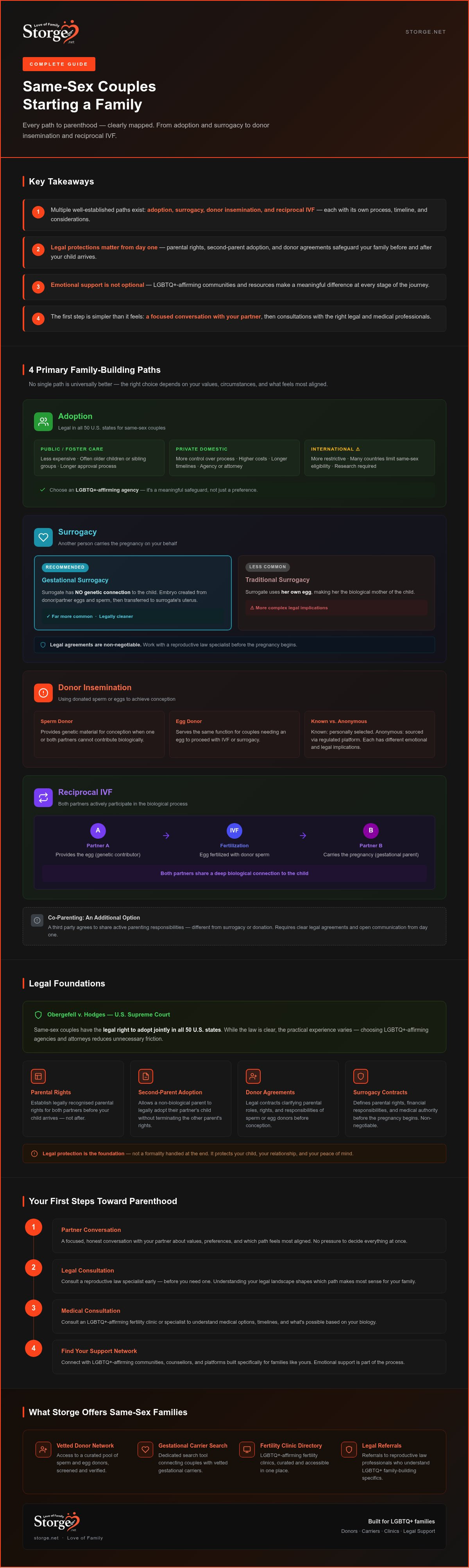
- Every same-sex couple starting a family has multiple paths forward, including adoption, surrogacy, donor insemination, and reciprocal IVF, each with its own process, timeline, and considerations.
- Legal protections matter from day one: understanding parental rights, second-parent adoption, and donor agreements can safeguard your family before and after your child arrives.
- Emotional support is not optional - connecting with LGBTQ+-affirming communities and resources can make a meaningful difference throughout every stage of your journey.
- Taking the first step is simpler than it feels: a focused conversation with your partner, followed by consultations with the right legal and medical professionals, creates a clear path forward.
- Platforms like Storge offer same-sex couples access to a vetted network of donors, gestational carriers, fertility clinics, and legal referrals, all designed with LGBTQ+ families in mind.
Understanding Your Family-Building Options as a Same-Sex Couple
Before any decisions get made, it helps to see the full landscape clearly. For any same sex couple starting a family, there are several well-established paths forward, each with its own emotional texture, practical demands, and legal considerations. None of them is universally "better" than another. The right choice depends on your circumstances, your values, and what feels most aligned with the family you're building together.
The four primary routes are adoption, surrogacy, donor insemination, and reciprocal IVF. Some couples feel drawn immediately to one option; others need time to weigh them all. Either approach is completely valid. What matters is that you're making an informed choice, not one shaped by incomplete information or assumptions about what's available to you.
Donors play a central role in several of these paths. A sperm donor provides the genetic material needed for conception when one or both partners cannot, or choose not to, contribute biologically. An egg donor serves the same function for couples who need an egg to proceed with IVF or surrogacy. Donors can be known, meaning someone you've selected personally, or anonymous, sourced through a regulated donor platform. Each arrangement carries different emotional and legal implications worth thinking through carefully.
Co-parenting is another arrangement some couples explore, typically involving a third party who agrees to share parenting responsibilities. This works differently from surrogacy or donation, as the co-parent maintains an active role in the child's life. It requires clear legal agreements and open, honest communication from the very beginning.
Adoption: A Path to Parenthood
Adoption remains one of the most common routes for same-sex couples. It comes in three main forms: public adoption through the foster care system, private domestic adoption arranged through an agency or attorney, and international adoption. Public adoption is generally less expensive and often involves older children or sibling groups. Private adoption tends to offer more control over the process but comes with higher costs and longer timelines. International adoption has become significantly more restrictive in recent years, with many countries limiting eligibility for same-sex couples, so researching destination-country policies is essential before pursuing this route.
Legally, same-sex couples have the right to adopt jointly in all U.S. states following the Supreme Court's Obergefell v. Hodges ruling, though the practical experience of navigating agencies can still vary. Choosing an LGBTQ+-affirming adoption agency is not just a preference; it's a meaningful safeguard. Affirming agencies actively support same-sex applicants, understand the nuances of your situation, and are less likely to introduce unnecessary friction into an already complex process.
Surrogacy: Navigating the Journey
Surrogacy involves another person carrying a pregnancy on your behalf. There are two types. In gestational surrogacy, the surrogate has no genetic connection to the child; the embryo is created using donor or partner eggs and sperm, then transferred to the surrogate's uterus. In traditional surrogacy, the surrogate uses her own egg, making her the biological mother. For this reason, gestational surrogacy is far more common and legally cleaner for intended parents.
Legal agreements are non-negotiable in any surrogacy arrangement. A properly drafted surrogacy contract protects everyone involved, defining parental rights, financial responsibilities, and medical decision-making authority before the pregnancy begins. Working with an attorney who specializes in reproductive law is essential here, not optional.
Finding the right gestational carrier is one of the most significant steps in this process. Platforms like Storge offer a dedicated gestational carrier search, connecting couples with vetted candidates and providing referrals to legal professionals who understand the specific needs of LGBTQ+ families. That kind of targeted support makes a real difference when the stakes are this high.
Legal Considerations for Same-Sex Couples Starting a Family
Legal protection isn't a formality you handle at the end of the process. For any same sex couple starting a family, it's the foundation everything else is built on. Getting the right documents in place early doesn't just protect your parental rights; it protects your child, your relationship, and your peace of mind through every stage of the journey ahead.
The good news is that the legal landscape in the United States has shifted significantly in favor of LGBTQ+ families. The challenge is that "legally permitted" and "practically straightforward" aren't always the same thing. State laws vary, agency policies differ, and the specific path you choose, whether adoption, surrogacy, or donor conception, each carries its own set of legal requirements. Understanding those distinctions before you begin is far less stressful than untangling them later.
Essential Documentation
The documents you'll need depend on your family-building route, but several apply broadly across most paths:
- Second-parent adoption orders: Even when one partner is the biological or legal parent, the other partner's parental rights are not automatically recognized in every state. A second-parent adoption establishes legal parentage for both partners, regardless of biological connection.
- Donor agreements: Whether you're working with a known donor or sourcing through a platform, a written donor agreement clarifies each party's rights and responsibilities, including whether the donor will have any legal claim to the child. Without this document, ambiguity can create serious complications.
- Surrogacy contracts: As covered earlier, these agreements govern the entire gestational surrogacy arrangement. They must be drafted before the pregnancy begins, and they need to be enforceable in the state where the surrogate resides.
- Pre-birth orders: In states where they're available, a pre-birth order establishes both intended parents on the birth certificate before the child is born, removing the need for post-birth legal proceedings.
Working with a reproductive law attorney isn't optional here. It's the single most important professional relationship you'll build during this process. An attorney who specializes in LGBTQ+ family law understands the specific vulnerabilities in each arrangement and knows how to close them.
Navigating State Laws
State law governs almost every aspect of family-building, from surrogacy enforceability to adoption eligibility to birth certificate procedures. Some states have well-established, LGBTQ+-affirming legal frameworks; others are more complex to navigate. If you and your gestational carrier, donor, or adoption agency are in different states, multiple jurisdictions may apply simultaneously.
The National Center for Lesbian Rights and GLBTQ Legal Advocates and Defenders (GLAD) both maintain updated, state-by-state legal resources that are worth bookmarking early. Knowing your state's position on pre-birth orders, second-parent adoption, and donor agreements before you commit to a specific path can save significant time and cost down the line.
Finding the right legal professional matters as much as finding the right clinic or agency. Storge offers attorney representation referrals specifically for LGBTQ+ families, connecting couples with legal professionals who already understand the terrain you're navigating.
Emotional Support and Community Resources
The practical steps of building a family, the legal paperwork, the medical consultations, the financial planning, can absorb so much energy that the emotional dimension gets quietly pushed aside. For any same sex couple starting a family, that's a pattern worth resisting. The process is genuinely demanding, and the weight of it is real. Acknowledging that isn't weakness; it's wisdom.
What makes a meaningful difference isn't just having the right professionals in your corner. It's having people around you who understand what you're actually going through, not in a general sense, but specifically. People who've navigated the same questions, faced the same uncertainties, and come out the other side with their families intact.
Building Your Support Network
Finding community doesn't require a grand gesture. It starts with small, intentional steps. PFLAG operates chapters across the country and offers family-focused support that extends well beyond its origins. RESOLVE, the National Infertility Association, includes LGBTQ+-specific resources and peer-led support groups for those navigating fertility challenges. Many fertility clinics also host patient community groups, and some LGBTQ+ centers run family-building workshops where you can meet couples at every stage of the journey.
Online spaces have expanded these options significantly. Private Facebook groups, Reddit communities, and dedicated forums connect couples across geographic boundaries, offering real-time support from people who genuinely get it. The value of hearing "we went through the exact same thing" from someone a few steps ahead of you shouldn't be underestimated.
Storge's membership connects same sex couples starting a family with a broader community of donors, carriers, and professionals who are already aligned with your values and your needs. That kind of curated network matters when you're trying to build trust quickly in an unfamiliar process.
Mental Health Considerations
The emotional toll of this journey is legitimate and layered. Grief over paths that aren't available to you, anxiety about legal vulnerabilities, the strain of waiting, and the occasional exhaustion of having to advocate for your own family's validity in spaces that should simply be welcoming: these experiences deserve proper attention.
Seeking support from a therapist who specializes in LGBTQ+ family issues isn't a sign that something is wrong. It's a sign that you're taking the journey seriously. The Psychology Today therapist directory allows you to filter by LGBTQ+ specialty and family-building experience, making it easier to find someone who won't need a lengthy orientation before they can actually help you.
Self-care during this process looks different for every couple. For some, it's regular check-ins with each other. For others, it's protecting certain evenings from research and planning. What matters is that you're building in space to breathe, not just space to prepare.
Taking the First Steps Towards Parenthood
Knowing what's possible is one thing. Taking deliberate action is another. For any same sex couple starting a family, the distance between research and momentum is often bridged by a single decision: to stop waiting for perfect clarity and start moving through the process one step at a time. The five steps below give you that structure.
Step 1: Research your options and talk honestly with your partner. This isn't a solo exercise. The conversations you have now, about biological connection, timelines, emotional readiness, and what you're each willing to navigate, will shape every decision that follows. Give those conversations real space before anything else.
Step 2: Consult with legal and medical professionals early. These aren't conversations to schedule after you've made your decision. They inform the decision. A reproductive law attorney can clarify what's enforceable in your state; a fertility specialist can tell you what's medically realistic for your specific situation.
Step 3: Connect with community and support resources. As covered earlier, the emotional dimension of this journey deserves as much investment as the logistical one. Find your people before the hard moments arrive.
Step 4: Build your plan. Once you've gathered information, make it concrete. A written plan with realistic timelines, a working budget, and clear roles between partners transforms an abstract goal into an actionable one.
Step 5: Begin. Schedule the first appointment. Submit the first application. Make the first call. The journey starts when you do.
Creating Your Family-Building Plan
A plan that doesn't account for cost and time isn't really a plan. Different paths carry genuinely different financial profiles, and timelines vary widely depending on the route you choose and the professionals you work with. Sit down together and map out what you're working with financially, what timeline feels sustainable, and who takes the lead on which parts of the process. Dividing responsibilities clearly reduces friction and prevents the planning stage from falling entirely on one partner's shoulders.
Finding the Right Professionals
The quality of your experience depends heavily on who you work with. When evaluating fertility clinics, ask directly about their experience treating LGBTQ+ patients and what their protocols look like for same-sex couples. For legal advisors, look specifically for reproductive law specialists, not general family law practitioners. When researching and vetting potential donors or gestational carriers, prioritize platforms that conduct thorough screening and operate transparently.
Storge's membership gives couples access to a vetted network spanning donor egg and sperm searches, gestational carrier matching, fertility clinic referrals, and attorney representation referrals, all built with LGBTQ+ families as the intended audience, not an afterthought.
Why Choose Storge for Your Family-Building Journey
Every platform that serves LGBTQ+ families is not created equal. Some treat same-sex couples as an edge case within a system built for someone else. Storge was built differently, designed from the ground up with LGBTQ+ families as the intended audience, not an afterthought. For any same sex couple starting a family, that distinction matters more than it might initially seem.
What Storge offers isn't a single service. It's a connected ecosystem of vetted donors, gestational carriers, fertility clinics, and legal professionals, all accessible through one membership and all selected with your specific needs in mind. The platform removes the friction of piecing together a support network from scratch, which is exactly the kind of friction that makes an already complex process feel unnecessarily harder.
The Benefits of Storge PLUS Membership
Storge PLUS membership opens access to resources that would otherwise require weeks of independent research to locate and evaluate. Through a single membership, couples can search for egg and sperm donors, explore gestational carrier profiles, access fertility clinic referrals, and connect with attorney representation referrals from legal professionals who specialize in reproductive and LGBTQ+ family law. These aren't generic directories. They're curated connections built around the realities of your journey.
Membership also means belonging to a community of people who are on the same path. That peer connection, the kind that comes from shared experience rather than professional obligation, is genuinely difficult to replicate elsewhere. Hearing from couples who've navigated the same questions, worked with the same kinds of professionals, and built their families through the same routes provides a kind of reassurance that no checklist can offer.
The practical benefits are equally concrete:
- Donor egg and sperm search: Browse vetted donor profiles in one place, without having to cross-reference multiple unrelated platforms.
- Gestational carrier search: Connect with candidates who've been screened and are aligned with the needs of LGBTQ+ intended parents.
- Fertility clinic referrals: Access clinics that understand same-sex family-building protocols, not clinics that require you to explain your situation from the beginning.
- Attorney representation referrals: Connect with reproductive law specialists who already know the terrain, from pre-birth orders to donor agreements to second-parent adoption.
- Hospital search: Find hospitals equipped to support your family from the earliest stages of your child's arrival.
Join Our Community
Getting started is straightforward. Storge PLUS membership gives you immediate access to the full network, including search tools, referral connections, and the broader community of families building their lives on the same terms as yours. If you have questions before you commit, ask them. The platform is built around the understanding that this process raises a lot of questions, and that asking them is exactly the right thing to do.
You don't have to have everything figured out before you reach out. Most couples who find Storge are still in the early stages of understanding their options. That's precisely the right time to connect, before decisions get made in isolation, and before the process feels more overwhelming than it needs to be. Your family is worth building with the right people around you from the very beginning.
Your Family Is Worth Building Right
The path forward for any same sex couple starting a family is clearer than it might feel right now. You've seen the full range of options available, from adoption and surrogacy to donor conception and reciprocal IVF. You understand why legal protection matters from day one, and why emotional support belongs in the plan alongside every practical step.
Three things are worth carrying forward: your options are real and achievable, the right professionals make an enormous difference, and you don't have to piece this together alone. That last point matters more than most couples expect before they begin.
Storge exists precisely for this moment. With access to a trusted community of donors, carriers, and LGBTQ+-affirming professionals, and expert support built specifically for families like yours, membership gives you a connected starting point instead of a scattered one.
Your family deserves that foundation. Join Storge to start your family-building journey today and take the first step with the right people already in your corner.
Frequently Asked Questions
What are the options for same-sex couples to start a family?
Same-sex couples have four primary paths to parenthood: adoption, surrogacy, donor insemination, and reciprocal IVF. Each works differently depending on whether one or both partners want a biological connection to the child, your medical circumstances, and your timeline. Co-parenting arrangements with a third party are also pursued by some couples, though they require clear legal agreements from the outset.
No single option is universally right. The best choice depends on your personal values, financial situation, and what each partner is emotionally prepared to navigate. Gathering information across all options before narrowing your focus gives you a clearer, more confident starting point.
How can same-sex couples navigate legal requirements for parenting?
Working with a reproductive law attorney who specializes in LGBTQ+ family law is the most important step you can take. State laws govern surrogacy enforceability, birth certificate procedures, and second-parent adoption eligibility, and those laws vary significantly. Documents like donor agreements, pre-birth orders, and second-parent adoption orders protect both partners' parental rights and should be in place before your child arrives, not after.
If your gestational carrier, donor, or adoption agency is located in a different state than you, multiple jurisdictions may apply simultaneously. Organizations like GLAD and the National Center for Lesbian Rights maintain updated state-by-state legal resources worth consulting early in your planning.
What emotional support resources are available for LGBTQ+ families?
PFLAG chapters, RESOLVE's LGBTQ+-specific peer groups, and LGBTQ+ community center workshops all offer structured support for families at every stage of the journey. Online communities, including private forums and dedicated social media groups, connect couples across geographic boundaries with people who've navigated the same questions firsthand.
Therapists who specialize in LGBTQ+ family-building are also worth seeking out proactively, not only during difficult moments. The Psychology Today directory lets you filter by LGBTQ+ specialty and family-building experience. Platforms like Storge also connect couples with a broader community of donors, carriers, and professionals who understand the specific emotional landscape of this process.
How do we find a suitable donor or surrogate?
Start by deciding whether you want a known donor, someone you've chosen personally, or an anonymous donor sourced through a regulated platform. Each carries different emotional and legal considerations. For gestational carriers, thorough screening matters enormously; you're looking for alignment on values, communication style, and expectations, not just medical eligibility.
Storge's donor egg and sperm search, along with its gestational carrier search, gives same-sex couples access to vetted profiles in one place, without the need to cross-reference multiple unrelated platforms. Every connection is made with LGBTQ+ intended parents in mind, which reduces the friction of explaining your situation from scratch to each new contact.
What should we consider when budgeting for family-building?
Different paths carry genuinely different cost profiles, and timelines affect costs too. Surrogacy is typically the most significant financial undertaking, encompassing medical procedures, legal fees, carrier compensation, and agency or platform costs. Adoption costs vary widely depending on whether you pursue public foster care adoption, private domestic adoption, or international adoption. Donor insemination and reciprocal IVF sit between those extremes.
Build your budget around realistic ranges for your chosen path, and factor in legal fees from the beginning rather than treating them as an afterthought. Unexpected delays can extend timelines and increase costs, so building a contingency buffer into your plan is practical rather than pessimistic. Dividing financial research responsibilities between partners also prevents the planning stage from becoming one person's burden.
Are there LGBTQ+-friendly fertility clinics we can approach?
Yes, and the distinction between an LGBTQ+-affirming clinic and a general fertility clinic is meaningful in practice. Affirming clinics have established protocols for same-sex couples, understand the specific requirements of reciprocal IVF and donor conception, and won't require you to spend your first appointment explaining your family structure. Asking directly about a clinic's experience with LGBTQ+ patients during your initial consultation is completely appropriate.
Storge's fertility clinic referrals connect couples with clinics that already understand same-sex family-building processes. That targeted access saves time and reduces the emotional labor of vetting providers who treat your situation as unfamiliar territory.
What are the first steps we should take to start our family journey?
For any same-sex couple starting a family, the first step is an honest conversation with your partner about biological connection, emotional readiness, and what each of you is genuinely willing to navigate. Those conversations shape every decision that follows, so giving them real space before anything else is time well spent. From there, scheduling consultations with a reproductive law attorney and a fertility specialist gives you the factual foundation to make informed choices.
Connect with community resources early, before the hard moments arrive rather than during them. Then build a written plan with realistic timelines, a working budget, and clearly divided responsibilities. Storge's membership provides a connected starting point, bringing together donor searches, carrier matching, clinic referrals, and legal referrals in one place so you're not assembling your support network from scratch.


