
What if the most critical part of your journey to parenthood isn't the medical science, but the strength of the legal and community foundation you build around it? You likely already feel that LGBTQ family building is a path of deep intention, yet it's often clouded by the stress of shifting 2026 legal landscapes and the rising costs of procedures like reciprocal IVF or surrogacy. It's completely natural to feel a sense of vulnerability when the rules for parental recognition can vary so much between states, leaving you searching for experts you can actually trust.
This guide provides a clear roadmap to help you move forward with confidence. You'll gain expert insights into biological paths, essential legal protections, and the security that comes from connecting with a vetted community of providers. We'll explore the latest fertility trends, explain how to secure your parental rights beyond a birth certificate, and show you how a supportive network makes the dream of family a practical, joyful reality. Peace of mind is possible when you have the right partners by your side.
Key Takeaways
- Understand how the landscape of LGBTQ family building has evolved in 2026, shifting from simply finding a path to choosing a vetted, secure journey tailored to your needs.
- Explore the nuances of collaborative reproduction, including the differences between modern gestational surrogacy and reciprocal IVF options for your family.
- Learn why specialized legal representation and comprehensive contracts act as the essential "insurance policy" for protecting your parental rights.
- Discover the step-by-step process for assembling a professional support team, from finding inclusive fertility clinics to accessing expert attorney referrals.
- See how joining a vetted community like Storge PLUS helps you avoid the risks of unverified donor searches while providing a safe space for connection.
Navigating the Landscape of LGBTQ Family Building in 2026
LGBTQ family building is a broad spectrum of medical, legal, and collaborative efforts that our community uses to bring children into our lives. It's an intentional process that encompasses everything from choosing a donor to navigating the complexities of second-parent adoption. In 2026, the conversation has moved beyond just figuring out if parenthood is possible. We've entered an era where the focus is on choosing the most secure, vetted path that aligns with your specific values and needs. This shift means you don't have to settle for the uncertainty of unverified online groups. Instead, you can prioritize safety and professional reliability from the very first step.
Before you look at success rates or legal retainers, it's vital to validate your unique vision for your family. A clinical approach often misses the heart of the matter. You aren't just a patient; you're a parent-to-be embarking on a deeply personal transition. Extensive research on same-sex parenting shows that children thrive in these intentional environments, regardless of the path taken to reach them. Starting with a human-centric perspective allows you to ground the upcoming logistics in the love and purpose that started this dream in the first place.
Understanding Your Unique Starting Point
What does success look like for you? For some, a biological connection is a priority, leading toward paths like reciprocal IVF or egg donation. For others, the focus is on legal parentage and finding the most direct route to a secure home. Assessing your emotional readiness for collaborative reproduction is a major step. It's helpful to see this journey as an empowering transition. You're not just overcoming a medical hurdle. You're building a legacy with intention. Identifying these goals early helps you choose the right experts who respect your specific family structure.
The Emotional Architecture of Queer Family Planning
The process can be long. "Fertility fatigue" is a real experience, especially when you face unique stressors that non-LGBTQ+ parents might not encounter. This is where your support network becomes your greatest asset. Connecting with peers who have navigated similar paths provides more than just practical advice; it offers a sense of hope and belonging. A vetted community helps you manage the emotional weight, ensuring you don't have to carry the burden of uncertainty alone. When you surround yourself with people who understand the nuances of LGBTQ family building, the logistics feel much more manageable.
Biological and Collaborative Paths to Parenthood
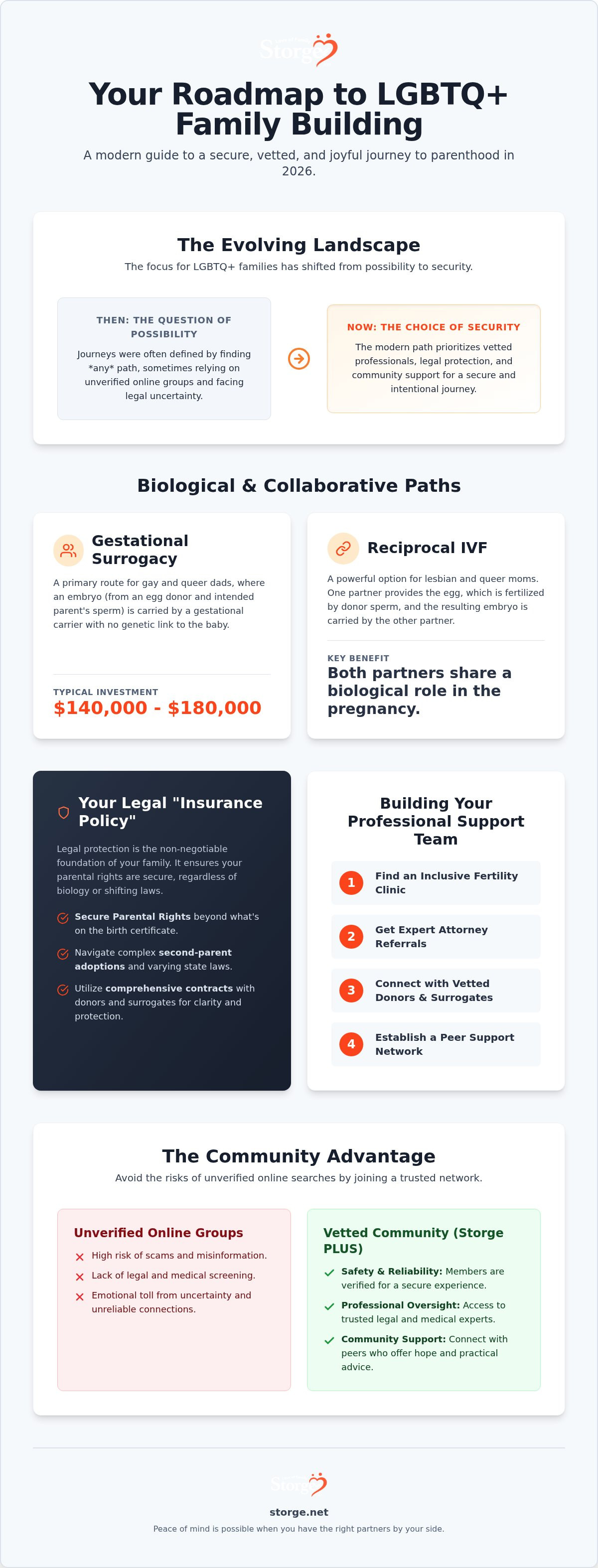
Choosing a biological path is a significant milestone in your LGBTQ family building journey. Unlike traditional paths, collaborative reproduction involves a team of people, from donors to gestational carriers, to bring a child into your life. Modern families often choose between gestational surrogacy, where the carrier has no genetic link to the baby, and traditional surrogacy, which is less common in 2026 due to its legal complexities. Understanding these medical options for LGBTQ+ family building helps you decide which method feels most aligned with your vision. While the financial investment is significant, with gestational surrogacy often ranging from $140,000 to $180,000, the result is a family built on deep intention.
Egg and sperm donation offer additional layers of choice. You can work with anonymous banks, known donors, or vetted community members. Many couples now prefer community-sourced donors because they allow for a greater sense of connection and shared history. If you're feeling overwhelmed by the search, exploring a vetted donor egg or sperm search can provide the security you need to move forward without the uncertainty of unverified groups.
Surrogacy for Gay and Queer Dads
For many dads, gestational surrogacy is the primary route to a biological connection. In this process, an embryo is created using an egg donor and the sperm of one or both parents, then transferred to a gestational carrier. It's a journey that requires you to embrace your identity as an "intended parent" long before the birth. Balancing the professional structure of an agency with the personal connection of a community-driven search allows you to find a carrier who truly shares your values.
Fertility Options for Lesbian and Queer Moms
Moms and non-binary parents often choose between intrauterine insemination (IUI) and in vitro fertilization (IVF). IUI is a simpler, less expensive option, costing approximately $4,000 per round. However, reciprocal IVF has gained immense popularity because it fosters a shared experience. One partner provides the eggs while the other carries the pregnancy, creating a unique biological bond for both. Research from 2023 indicates that reciprocal IVF can have a live birth rate as high as 66.1%, making it a highly effective and emotionally rewarding path.
Transgender and Non-Binary Family Planning
Parenthood is a right that belongs to everyone. For trans and non-binary individuals, family planning often involves fertility preservation, such as freezing eggs or sperm, before or during a medical transition. Finding a clinic that prioritizes gender-affirming care is essential. You deserve a medical team that understands your body and respects your identity. Many inclusive clinics now offer specialized protocols to ensure that your reproductive goals are met with dignity and expertise.
The Critical Role of Legal Protection and Vetted Resources
Legal protection is the quiet foundation of a successful family journey. While medical procedures often grab the headlines, your legal contracts act as the essential insurance policy for your future. In 2026, the legal environment for non-traditional parentage remains a patchwork of state laws, making specialized attorney representation a non-negotiable part of LGBTQ family building. You need an expert who understands the nuances of gestational carrier agreements and donor contracts to ensure that your intent to parent is legally ironclad from the start. Relying on generic templates or unvetted advice can leave your family vulnerable during a time that should be focused on joy.
Moving beyond providers who are simply "friendly" to those who are "experts" is a vital distinction. An inclusive clinic should do more than put a rainbow sticker on the door. They must have established protocols for reciprocal IVF, experience with multi-party legal clearances, and a deep understanding of the unique stressors our community faces. Utilizing National Infertility Association resources can help you understand the broader legislative landscape, but finding a vetted, community-verified professional ensures your specific case is handled with precision. This level of vetting significantly reduces the risk of legal complications or the heartbreak of fraud that can occur in unmonitored spaces.
Securing Parental Rights from Day One
A common misconception is that a birth certificate provides total security. In reality, a birth certificate is an administrative document, not a legal finding of parentage. To protect your rights across state lines, you often need a court order, such as a second-parent adoption or a pre-birth parentage order. These legal steps ensure that both parents have equal rights, regardless of biological connection. Specialized attorneys play a critical role here. They draft donor and carrier agreements that clearly define the roles of everyone involved, leaving no room for future ambiguity or legal challenges.
Vetting Fertility Clinics and Hospitals
When choosing a clinic, look for evidence of true cultural competency. Do their intake forms use gender-neutral language? Do they have experience with transgender fertility preservation? The hospital experience is equally important. You want a delivery team that respects your family structure and understands how to handle the administrative side of surrogacy or donor-conceived births. Don't hesitate to ask direct questions about their history with queer families. You deserve a support team that sees your family as legitimate and worthy of the highest level of care.
Building Your Professional Support Team
Transitioning from the research phase to taking your first concrete steps can feel like a daunting leap. In 2026, the most successful journeys are those that move away from high-pressure agency models and toward a curated team of independent experts. This isn't just about hiring professionals; it's about surrounding yourself with partners who respect your family's unique architecture. By following a methodical roadmap, you can transform LGBTQ family building from an overwhelming list of tasks into a manageable, empowering experience.
- Step 1: Confirm your primary path. Whether it's surrogacy, reciprocal IVF, or donation, your path dictates the specific expertise you'll need first.
- Step 2: Select a clinic that aligns with your values. You deserve a medical team that uses inclusive language and has established protocols for your specific family structure.
- Step 3: Engage a family law attorney early. Legal strategy should be established before any medical procedures begin to ensure your parentage is protected from the start.
- Step 4: Connect with a vetted community. Moving your search for donors or carriers into a trusted space reduces risk and fosters genuine connection with people who share your goals.
- Step 5: Establish an emotional support network. This journey is a marathon, and having peers or mentors who understand the weight of the process is vital for your long-term peace of mind.
The Importance of Independent Legal Counsel
A common mistake in collaborative reproduction is attempting to share a single attorney to save costs. To ensure your interests are fully protected, each party, including intended parents and gestational carriers or donors, must have their own independent legal counsel. This prevents conflicts of interest and ensures that every contract is scrutinized from your specific perspective. Storge simplifies this by providing attorney representation referrals to professionals who specialize in the complexities of queer parentage. Having a dedicated advocate ensures your voice is heard and your rights are secure throughout the entire process.
Coordinating Between Medical and Legal Teams
Your journey involves two distinct but overlapping streams: the medical and the legal. Friction often occurs when these teams aren't on the same page regarding timing. For example, a clinic may be ready for an embryo transfer before the legal contract is finalized. You need a clear communication plan to manage the flow of information between your support professionals. Ensuring that your attorney and clinic are in sync regarding medical clearances and legal sign-offs prevents unnecessary delays. This level of coordination allows you to focus on the emotional excitement of growing your family rather than the stress of administrative bottlenecks.
Ready to assemble your expert team? Connect with our network of professionals by joining the Storge PLUS Membership today.
Joining a Trusted Community: The Storge PLUS Advantage
The journey of LGBTQ family building shouldn't feel like a solitary trek through an unvetted "Wild West" of online groups. Many prospective parents begin their search in public forums, only to find themselves overwhelmed by conflicting advice or the risk of potential fraud. Storge PLUS was created to be the antidote to that uncertainty. By providing a gated, community-verified space, we ensure that every donor, carrier, and professional you meet shares a baseline of commitment and legitimacy. This isn't just about finding a service; it's about entering a partnership built on shared values and mutual respect.
Our community-based fee model acts as a vital filter for commitment. It helps offset the rigorous operating costs of vetting while ensuring that everyone in the network is serious about their role in your family's future. This higher standard of entry fosters a sense of safety that public groups simply cannot replicate. You aren't just a username in a forum. You're a member of a protective circle designed to prioritize your peace of mind and long-term success.
Accessing a Vetted Network of Donors and Carriers
Finding a donor or gestational carrier is one of the most personal steps you'll take. Within Storge PLUS, you can conduct your search with the confidence that comes from community-focused verification. This trusted environment allows for more authentic connections, where stories of families built through community-driven searches become your reality. We maintain a high bar for entry because we know the gravity of the decisions you're making, and you deserve a search process that is as intentional as your desire to be a parent.
Your All-in-One Resource for LGBTQ Family Building
Building a family requires a village of experts who truly understand your needs. Storge PLUS acts as your central hub, offering verified resources to guide you through every phase of the journey. We provide a streamlined path to the professionals you need most, including:
- Attorney Representation Referrals: Connect with legal experts who specialize in queer parentage and second-parent adoption.
- Fertility Clinic Referrals: Find clinics with a proven track record of inclusive care and cultural competency.
- Donor and Carrier Searches: Access a secure directory of individuals who have been vetted by our community.
- Hospital Search: Identify birth facilities that respect and affirm your family structure during the delivery experience.
We're here to provide the continuity and support you need to move forward without the constant worry of who to trust. Join the Storge PLUS community and start your journey with confidence today.
Embracing Your Future with Confidence
Building a family is a journey of profound intention. Success in LGBTQ family building requires more than just medical science; it demands a foundation of legal security and a network of professionals who truly see your family as legitimate. By prioritizing vetted resources over unverified searches, you protect your parental rights and your peace of mind. You've already explored how to identify the right biological paths, secure your legal standing through specialized representation, and find clinics that offer culturally competent care. It's about moving from the research phase into a space of action and safety.
You don't have to navigate these complexities alone. With access to a vetted community of donors and carriers, referrals to specialized LGBTQ+ family law attorneys, and verified fertility clinic and hospital directories, you can focus on the joy of what's to come. Start building your family with the Storge PLUS community and join a partnership designed for your long-term success. Your dream of parenthood is valid, and the path forward is clearer than ever. We're honored to walk beside you as you turn that dream into a reality.
Frequently Asked Questions
What is the first step in LGBTQ family building?
The first step in LGBTQ family building is identifying your long-term goals for biological connection and legal parentage. You'll want to decide if a genetic link is a priority for one or both parents, as this choice shapes every subsequent medical and legal decision. Once your vision is clear, you can begin assembling a professional support team of vetted experts who respect your family structure.
How much does LGBTQ surrogacy typically cost in the US?
Surrogacy in the United States typically costs between $140,000 and $180,000, though prices can rise to $200,000 in certain high-cost regions or states. These totals include surrogate compensation, agency fees, IVF procedures, and egg donor fees. While the financial commitment is substantial, many families utilize the Federal Adoption Tax Credit, which in 2026 has a maximum value of $17,670, to help manage these costs.
Do I need a lawyer for a known donor agreement?
You absolutely need independent legal counsel when drafting a known donor agreement. Each party requires their own attorney to ensure there's no conflict of interest and that parental rights are clearly defined before conception. A specialized attorney will help you navigate the specific laws in your state, providing an essential layer of security that a generic online template simply cannot offer your family.
What is second-parent adoption and why is it necessary?
Second-parent adoption is a legal procedure that allows a non-biological parent to establish a permanent, legal bond with their child. It's a critical step because a birth certificate alone may not be sufficient to protect your parental rights if you travel or move to a more restrictive state. In 2026, legal and court fees for this process typically range from $2,000 to $5,000.
How do I find an LGBTQ-inclusive fertility clinic?
Finding an inclusive fertility clinic involves looking for providers who demonstrate genuine cultural competency beyond basic marketing. You should ask about their specific experience with reciprocal IVF, transgender fertility preservation, and their intake protocols for non-traditional families. Storge provides LGBTQ family building support through verified fertility clinic referrals, connecting you with medical teams that prioritize gender-affirming and affirming reproductive care from day one.
What is the difference between a gestational carrier and a traditional surrogate?
A gestational carrier has no genetic link to the child, while a traditional surrogate uses her own eggs and is biologically related to the baby. In 2026, gestational surrogacy is the preferred modern path because it offers clearer legal protections for intended parents. This method involves creating an embryo via IVF using a donor or intended parent's egg before transferring it to the carrier.
How does Storge PLUS help with my donor or carrier search?
Storge PLUS helps by moving your donor or carrier search into a gated, community-verified environment. This membership allows you to avoid the risks associated with unvetted online groups, providing a safe space to connect with individuals who share your commitment to building a family. You'll also gain access to professional referrals for attorneys and clinics who specialize in queer family planning.
Can single LGBTQ+ individuals use surrogacy or egg/sperm donation?
Single LGBTQ+ individuals have full access to surrogacy and egg or sperm donation paths to achieve parenthood. Many fertility clinics and agencies offer specialized support for solo parents-to-be, helping them navigate the unique financial and emotional aspects of the journey. Whether you're seeking a gestational carrier or a donor, the process is designed to be inclusive of all family structures, including single-parent households.


