

IVF can be an eligible medical expense, but not every fertility-related bill qualifies. IRS Publication 502 lists in vitro fertilization as an eligible expense for procedures to overcome an inability to have children, so using a health savings account for fertility treatments may help cover qualified costs for you, your spouse, or an eligible tax dependent. Medical necessity and the type of expense matter.
If you’re weighing how to use HSA or FSA funds while planning fertility care, it’s understandable to want a clear answer before making financial decisions. This guide explains which IVF expenses may qualify, which costs could be excluded, and what documentation may support reimbursement. It also explores how pre-tax funds can lower the after-tax cost of eligible care, so you can approach the financial details with more clarity.
Key Takeaways
- Learn which IVF-related expenses may qualify for HSA or FSA reimbursement, and why eligibility depends on the person receiving care and the type of cost.
- Understand why long-term storage and gestational surrogacy expenses may fall outside eligible medical costs.
- See which records, including a Letter of Medical Necessity, may help support a reimbursement claim.
- Explore how using pre-tax funds for eligible expenses may reduce their after-tax cost, depending on your tax bracket.
Embryo storage and other potentially excluded expenses
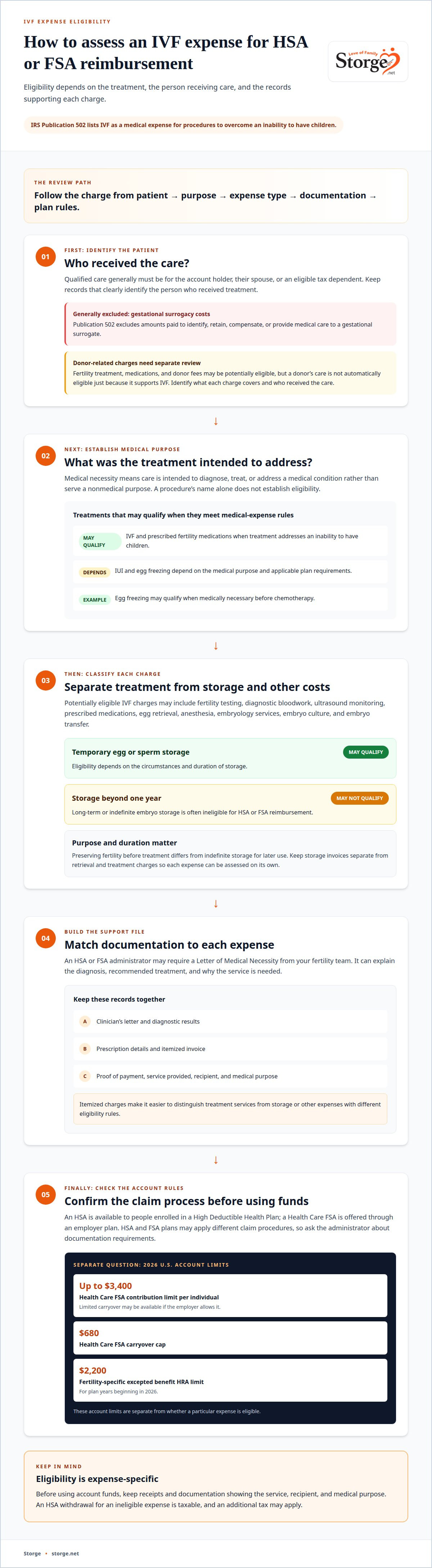
Some IVF expenses may qualify, while storage duration and who receives care can change the outcome. IRS Publication 502 lists in vitro fertilization as a medical expense for procedures to overcome an inability to have children. That does not make every fertility-related charge eligible. For example, a clinic’s IVF procedure and a separate long-term embryo-storage bill may receive different treatment.
Temporary egg or sperm storage may qualify, while storage beyond one year may not. Long-term or indefinite embryo storage is often ineligible for HSA or FSA reimbursement. Egg freezing may qualify when medically necessary, such as before chemotherapy. The purpose and duration matter: preserving fertility before treatment differs from indefinite storage for later use. Keep storage invoices separate from retrieval and treatment charges so each expense can be assessed on its own.
Surrogacy costs are generally excluded because eligible care is limited to the account holder, their spouse, or an eligible tax dependent. IRS Publication 502 excludes amounts paid to identify, retain, compensate, or provide medical care to a gestational surrogate. Donor-related charges need separate consideration: fertility treatment, medications, and donor fees may be potentially eligible, but a donor’s care is not automatically eligible simply because it supports IVF. Identify what each charge covers and who received the care.
Account limits are separate from expense eligibility. According to the Internal Revenue Service, the 2026 U.S. Health Care FSA contribution limit is up to $3,400 per individual, with limited carryover if the employer allows it. The Internal Revenue Service sets the 2026 U.S. health FSA carryover cap at $680. The U.S. Departments of Labor, Health and Human Services, and the Treasury set the 2026 limit for a U.S. fertility-specific excepted benefit HRA at $2,200 for plan years beginning in 2026.
An HSA withdrawal for an ineligible expense is taxable, and an additional tax may apply. Before using account funds, keep receipts and documentation showing the service, recipient, and medical purpose.
Letters of medical necessity and supporting documentation
Strong documentation connects each fertility charge to the treatment and the person receiving care. IRS Publication 502 specifically lists in vitro fertilization for procedures to overcome an inability to have children.
Medical Necessity Documentation
Medical necessity means care is intended to diagnose, treat, or address a medical condition rather than serve a nonmedical purpose. An HSA or FSA administrator may require a Letter of Medical Necessity from your fertility team to support a claim. The letter can explain the diagnosis, recommended treatment, and why the service is needed. Keep it with itemized bills and proof of payment.
For an IVF cycle, records may include diagnostic bloodwork, ultrasound monitoring, prescribed medications, egg retrieval, anesthesia, embryology services, embryo culture, and transfer. These expenses are commonly eligible when IVF is treated as a medical expense. Match each receipt to the specific service: a bundled clinic invoice can make it harder to identify what a payment covered.
Fertility Treatment Purpose and Family Member Eligibility
Both the purpose and the patient matter: an expense must meet medical-expense rules, and funds generally cover qualified care for the account holder, spouse, or eligible tax dependent. Treatment pursued solely for elective or social reasons isn’t automatically eligible; medical necessity remains important. HSA funds may cover a spouse’s or dependent’s qualified fertility treatment, but keep records identifying who received care.
IVF and prescribed fertility medications may qualify when treatment addresses an inability to have children. IUI and egg freezing depend on the medical purpose and applicable plan requirements. Egg freezing may qualify when medically necessary before chemotherapy. A procedure’s name alone doesn’t establish eligibility.
Checking Treatment Eligibility
Eligibility review means matching a specific charge to IRS Publication 502 and your account administrator’s requirements. For an unfamiliar service, identify the procedure, medication, recipient, and medical reason, then compare those details with the publication’s medical-expense guidance. Ask the administrator about documentation requirements before payment, since HSA and FSA plans may apply different claim procedures.
Keep the clinician’s letter, diagnostic results, prescription details, itemized invoice, and payment record together. For example, separate an ultrasound charge from an embryo-storage invoice rather than treating both as one IVF expense. This gives the administrator clear evidence of the service and its purpose.
IVF eligibility for FSA and HSA reimbursement
IRS Publication 502 lists in vitro fertilization as a medical expense for procedures to overcome an inability to have children. That makes qualifying IVF expenses potentially eligible for HSA or FSA funds. The expense must relate to eligible care, and the person receiving treatment generally must be the account holder, spouse, or eligible tax dependent.
Eligible charges may include more than the procedure itself. Fertility testing, diagnostic bloodwork, ultrasound monitoring, prescribed IVF medications, egg retrieval, anesthesia, embryology services, embryo culture, and embryo transfer may qualify when IVF is treated as a medical expense. Separate itemized charges help distinguish treatment services from storage or other expenses with different eligibility rules. Using a health savings account for fertility treatments may also help cover eligible charges for a spouse or dependent.
HSA and FSA access works differently. An HSA is available to people enrolled in a High Deductible Health Plan, while a Health Care FSA is offered through an employer plan. HSA funds can generally pay qualified expenses for an account holder’s spouse or eligible tax dependent. FSA funds may also cover qualified IVF expenses for those family members.
- Review the invoice for the service provided, such as egg retrieval or embryo transfer.
- Match the charge to the person who received care and the treatment’s medical purpose.
- Keep itemized bills and payment records with any supporting medical documentation.
HSA funds may pay a fertility clinic bill directly, such as with an account payment card, or reimburse you for an eligible expense you paid yourself. Keep the receipt and treatment details with the transaction records. When using a health savings account for fertility treatments, retain the payment date and documentation, especially for an earlier expense. FSA reimbursement follows the employer plan’s claim process, so keep records for each submitted charge.
Potential tax savings from using pre-tax funds
Pre-tax HSA or FSA funds can reduce the after-tax cost of eligible fertility care. The estimated savings depend mainly on your tax bracket and the amount paid with eligible account funds. Estimates place the reduction at roughly 20-30%, but this applies to qualifying expenses, not every fertility-related bill.
Consider a $7,295 IVF cycle. The account pays the eligible bill, while the tax advantage comes from using money set aside before taxes.
The same example changes at higher brackets. These are estimates, not a discount from the clinic.
Account type affects your planning. HSA contributions are available to people enrolled in a High Deductible Health Plan, and HSA balances roll over without expiring. A Health Care FSA is offered through an employer plan and typically follows a use-it-or-lose-it rule, although some plans allow limited carryover or a grace period. That difference can shape how much you set aside for anticipated treatment.
Before relying on a tax estimate, separate eligible IVF charges from expenses that may not qualify, such as certain long-term storage or gestational-surrogacy costs. Keep receipts and medical documentation with each payment. A tax-bracket estimate also doesn’t account for every detail of your individual tax situation, so use it as a planning comparison, not a guaranteed result.
As you plan both costs and care, explore fertility care planning support that can help bring the next steps into focus.
Storge: Fertility Clinic Referrals
Storge offers fertility clinic referrals for LGBTQ+ individuals and couples planning fertility care. Once you understand how HSA and FSA rules may apply, a clinic referral can help you explore treatment options and the documentation relevant to your care.
A clinic referral may be a helpful next step if you’re exploring IVF, donor conception, or gestational carrier options and want fertility resources. Storge also offers donor egg and sperm searches and attorney referrals to support other parts of family-building planning. These resources complement your financial research; they don’t replace guidance from your tax professional or account administrator about a specific expense.
If you’d like support finding fertility resources, contact Storge.
Make Your Next Step Feel More Manageable
Financial planning is one part of building a family. A next step may be shaping a care plan around your goals, relationships, and the support you need. Using a health savings account for fertility treatments is easier to plan for when you understand how the account fits into your wider family-building decisions.
Storge offers fertility clinic referrals, Storge PLUS membership, and attorney referrals to support different parts of family building, from exploring care to finding a legal professional. Storge PLUS connects LGBTQ+ individuals and couples with egg donors, sperm donors, and gestational carriers. Consider which kind of support best fits your plans.
If questions about your next steps are still on your mind, contact Storge with your questions. You deserve space to make informed decisions at a pace that feels right, with practical support as your plans take shape.
Frequently Asked Questions
Is IVF FSA or HSA Eligible?
Yes, qualified IVF care may be eligible for HSA or FSA reimbursement. IRS Publication 502 lists in vitro fertilization as a medical expense for procedures to overcome an inability to have children. For example, an IVF charge may qualify when it relates to medically necessary treatment for you or an eligible family member. Separate charges for storage or other services may have different eligibility rules.
Can I use my HSA or FSA for egg freezing?
Egg freezing may qualify when it’s medically necessary, such as preserving fertility before chemotherapy. The reason for freezing matters: elective preservation may be treated differently from care connected to a medical condition. Keep the clinician’s explanation with the itemized bill so the medical purpose and specific service are clear if you submit a reimbursement claim.
Can I use my HSA or FSA to help with surrogacy costs?
Generally, HSA or FSA funds can’t cover expenses for a gestational surrogate’s services or care. IRS Publication 502 excludes amounts paid to identify, retain, compensate, or provide medical care to a gestational surrogate. This differs from qualified treatment for the account holder, spouse, or eligible tax dependent. Keep surrogacy-related bills distinct from other fertility expenses when organizing records.
Can you use HSA for IVF?
Yes, HSA funds may pay for qualified IVF expenses when treatment meets medical-expense rules. IRS Publication 502 includes IVF procedures to overcome an inability to have children. An HSA also requires enrollment in a High Deductible Health Plan for contributions. For example, a qualifying IVF bill for an eligible spouse may be treated differently from an expense for someone outside the account’s eligible family relationships.
Do You Need a Letter of Medical Necessity?
A Letter of Medical Necessity may not be required for every claim, but an HSA or FSA administrator may request one. The letter can explain the diagnosis, recommended service, and medical reason for treatment. For example, a clinician’s letter could connect fertility testing to a diagnosis and planned care. Keep it with the invoice and payment record, and follow the documentation process for your account.
How Much Can FSA or HSA Save You on IVF?
Pre-tax payments may lower the effective cost of eligible IVF care by roughly 20-30%, depending on your tax bracket. The exact benefit depends on how much eligible care you pay with account funds and your tax circumstances. Treat any estimate as a planning aid, not a clinic discount. Expenses that don’t qualify won’t receive the same tax treatment, so distinguish them before budgeting.


