

What if the most helpful thing you can say is simply, “I’m thinking of you”? Dealing with grief after a surrogate’s miscarriage means making room for more than one person’s pain. The surrogate may be coping with physical recovery and emotional loss while also caring about the intended parents’ hopes. The loss isn’t her fault, and she shouldn’t have to carry anyone else’s expectations.
It can be hard to know what to say, especially when everyone is grieving differently. A gentle message, a quiet offer to listen, or asking whether she wants to talk can show care without asking her to explain or comfort others. Avoid minimizing the loss or sharing her experience without permission.
This article explores supportive words, privacy, and different ways of grieving, as well as how miscarriage may affect a surrogate emotionally and physically. It explains why recovery looks different for each person and how to offer compassion without pressure, blame, or assumptions about what comes next.
Key Takeaways
- Offer a simple, caring message and ask whether the surrogate wants to talk before sharing advice or opinions.
- Respect her privacy by getting permission before telling anyone about the loss, and allow her to grieve in her own way.
- Recognize that miscarriage can bring both emotional grief and physical recovery, and avoid placing blame or pressure on the surrogate.
- Make space for support that fits her needs, including time to rest and help from a qualified mental health professional when needed.
Compassionate support during surrogacy and other family-building journeys
After a pregnancy loss, a surrogate may grieve her own experience and the intended parents’ loss of their hoped-for future. Support works best when it makes room for both, without assigning blame or asking the surrogate to manage everyone’s feelings.
Support Groups and Mental Health Care
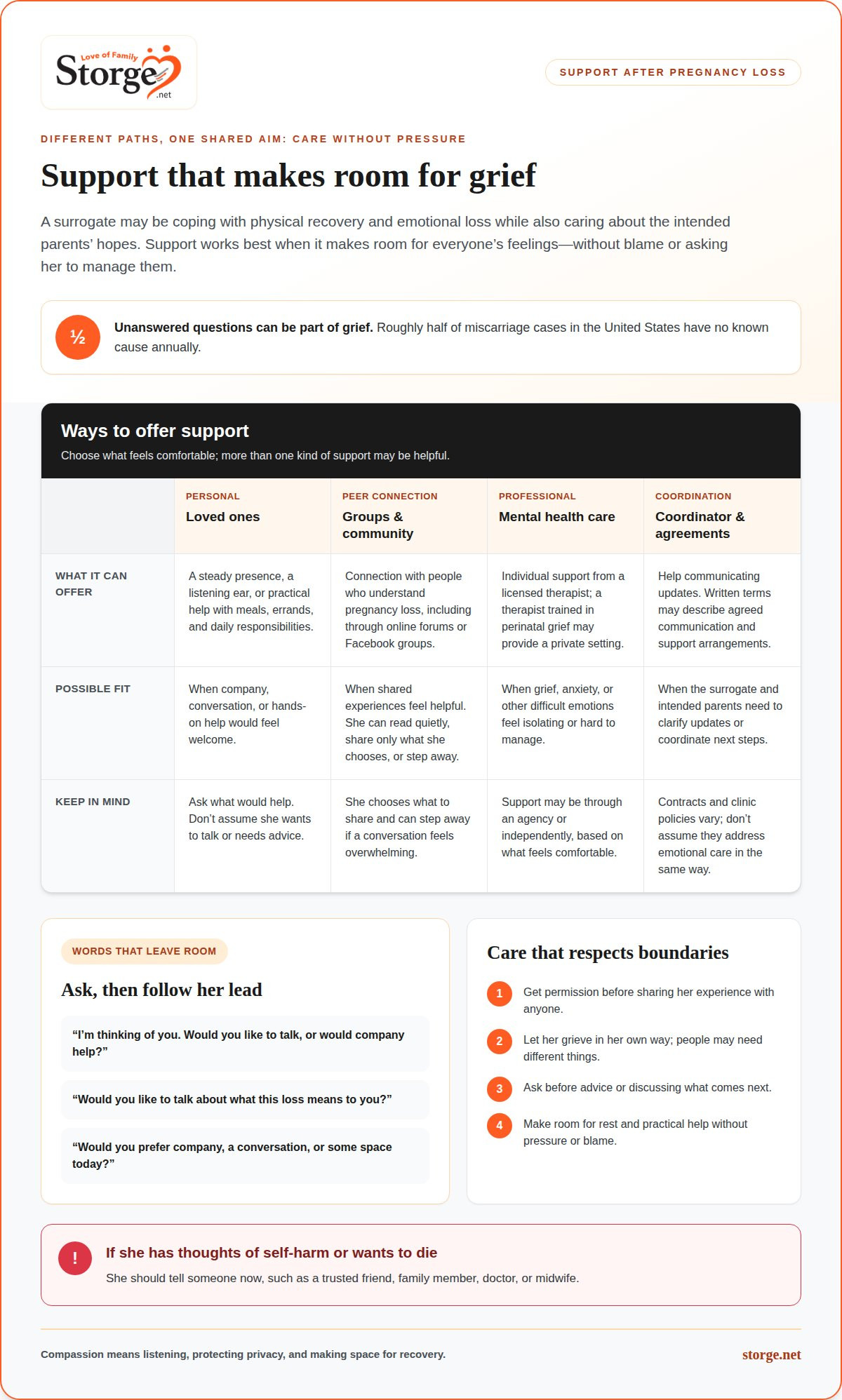
Support groups can connect grieving people with others who understand pregnancy loss, while mental health professionals offer individual support. Both may help when grief, anxiety, or other difficult emotions feel isolating during the surrogacy journey. A surrogate can look for a group focused on pregnancy loss or surrogacy, or seek a licensed therapist. She may choose support through an agency or independently, based on what feels comfortable.
Support from Loved Ones and a Coordinator
Loved ones and a surrogacy coordinator can offer practical help and a steady point of contact. A friend might say, “I’m thinking of you. Would you like to talk, or would company help?” A coordinator can help communicate updates between the surrogate and intended parents while respecting her privacy. If she has thoughts of self-harm or wants to die, she should tell someone now, such as a trusted friend, family member, doctor, or midwife.
Finding Community After a Loss
Community support can ease the loneliness of grief by making space for shared experiences without expecting everyone to grieve in the same way. Online forums and Facebook groups can help a surrogate connect with people who have also experienced pregnancy loss. She can read quietly, share only what she chooses, or step away if a conversation feels overwhelming. A therapist trained in perinatal grief may offer a more private setting to explore difficult feelings.
Contracts, Clinic Policies, and Emotional Support
Surrogacy contracts and clinic policies may describe agreed communication and support arrangements after a miscarriage, but their wording and scope vary. They may clarify who shares updates and how the parties coordinate next steps. Reviewing the written terms can help the surrogate and intended parents understand the process, without assuming every agreement addresses emotional care in the same way. Direct conversations can cover support needs the documents don’t resolve.
Why Is Pregnancy Loss So Difficult to Talk About?
Pregnancy loss can be hard to discuss when grief comes with unanswered questions about its cause. Roughly half of miscarriage cases in the United States have no known cause annually.
Emotional Isolation After Pregnancy Loss
Emotional isolation can follow pregnancy loss when people around the surrogate don’t know what to say or focus only on what happens next. That silence can make grief feel private, even when intended parents and loved ones are affected too. Someone coping with infertility or trying to build a family may find it difficult to explain how the loss changes the journey.
Self-compassion can mean allowing sadness without treating it as a failure to cope. Resting, accepting help with meals, or postponing a conversation about trying again can create space to recover. The reason for the loss may be unclear, and the surrogate doesn’t need to find an explanation before acknowledging how deeply it affects her.
A small ritual can give grief a meaningful expression. Someone might write a goodbye letter, plant a tree, keep a piece of jewelry, or hold a private ceremony. These choices don’t need to be public or shared with the intended parents. What matters is whether the gesture feels right to the person grieving.
Acknowledging Pregnancy and Infant Loss
Acknowledgment can be as simple as recognizing that the pregnancy mattered and the surrogate’s physical recovery is real. The Wave of Light, observed on October 15, invites people to light candles in remembrance of pregnancy and infant loss. Someone may mark the date privately or join others. No one owes friends or family a full account for the loss to matter.
Practical care can also show that the loss is recognized. Loved ones might offer help with meals, errands, or daily responsibilities while the surrogate recovers. Asking what would make the day easier gives her room to name her needs without explaining the loss or deciding how she should feel.
Respecting privacy and different ways of grieving
After a loss, intended parents and their surrogate can agree on what to share, with whom, and when. They can offer support without blame by asking what she needs, listening to her answer, and getting permission before sharing her experience.
Grieving Alongside Intended Parents
Grieving alongside intended parents means recognizing that each person may experience the loss differently. The surrogate may be processing her own experience while caring about the intended parents’ hopes. Neither person needs to hide their feelings to protect the other. A difficult conversation can begin with, “Would you like to talk about what this loss means to you?” instead of assuming everyone is ready.
Differences in How Partners Grieve
Partners may express grief differently: one might want to talk, while another needs quiet or time alone. Those differences don’t mean either person cares less. Rather than interpreting silence as indifference, a surrogate or intended parent can ask, “Would you prefer company, a conversation, or some space today?” If feelings become hard to manage, professional mental health support can help.
Communicating After Pregnancy Loss
Communication after pregnancy loss works best when everyone involved agrees on a pace and boundaries. The surrogate and intended parents can decide whether updates should come by text, through a coordinator, or in a conversation. They can also ask before discussing next steps: “Would you like to talk about options now, or would you rather wait?” This makes room for different needs.
Supporting a Surrogate Without Overstepping
Supporting someone without overstepping means offering care without taking control of the surrogate’s story or choices. Intended parents can say, “I’m thinking of you. What would feel supportive right now?” They should avoid comments that begin with “at least,” which can minimize grief, and never suggest the surrogate caused the loss. Friends and family should ask permission before sharing news or details, even with good intentions.
The emotional and physical impact of miscarriage on a surrogate
A surrogate can experience physical recovery and emotional grief at the same time. She may also feel she has let the intended parents down, but miscarriage is not her fault. The cause may be unknown, and responsibility does not belong to the person who carried the pregnancy. Compassion means recognizing her recovery and feelings without asking her to reassure everyone else. For someone dealing with grief after a surrogate's miscarriage, it can help to separate concern for the intended parents from self-blame.
Medical follow-up should address her symptoms and recovery, and her doctor can advise when gentle exercise is appropriate. She should wait for medical clearance before resuming exercise. If she is considering trying to conceive again, she can discuss timing with her doctor and consider whether she feels emotionally ready. These decisions need room for both physical healing and mental health.
Emotional effects can include anxiety, grief, or panic attacks. Tommy’s says panic attacks can feel frightening but are not dangerous. A therapist can help a surrogate process what she is going through, especially if distress makes daily tasks difficult or persists. Dealing with grief after a surrogate's miscarriage can also mean recognizing that healing has no fixed deadline. Support should not come with pressure to begin another surrogacy journey.
Surrogacy costs and insurance coverage after miscarriage depend on the agreement and applicable insurance terms. The contract may describe financial responsibilities and what happens after pregnancy loss. Reviewing those provisions can clarify the parties’ next steps. Financial arrangements are separate from the surrogate’s emotional and physical care, which deserves attention regardless of the outcome.
Everyone involved can support recovery by asking what would help, respecting privacy, and allowing time away from usual responsibilities when needed. If the surrogate is considering a future journey, explore gestational carrier search resources when she feels ready to consider that possibility.
Storge
Storge can help LGBTQ+ individuals and couples explore family-building resources when they feel ready to consider what comes next. After a loss, that next step might be gathering information, revisiting options, or simply pausing until the timing feels right. Storge offers fertility clinic and attorney referrals, donor egg and sperm searches, and surrogacy or gestational carrier searches. These resources can support planning, but they don’t replace medical care or emotional support during grief.
There’s no need to decide about another journey before the surrogate has had space to recover. When you’re ready to discuss family-building options, contact Storge to explore resources that may fit your path.
Let the next step be yours
There’s no fixed timeline for deciding what comes next after a loss. You can focus on recovery now and return to family-building questions when you feel ready. Dealing with grief after a surrogate’s miscarriage may also mean giving yourself permission to pause, rather than treating a new decision as a measure of hope.
If and when you want to explore future possibilities, Storge can help you consider family-building resources at your own pace. Storge offers PLUS Membership, along with fertility clinic and attorney representation referrals. These options can help you find information and connections as you think through what feels right for your path.
There’s no pressure to have every answer before reaching out. Contact Storge for compassionate support when you’re ready to talk about possible next steps. Your journey can continue in a way that respects your needs, your timing, and the meaning of this loss.
Frequently Asked Questions
What Should You Say Instead?
Try a simple, specific offer: “I’m sorry this happened. Would it help if I brought dinner or sat with you?” This acknowledges the loss without trying to explain it. Avoid phrases such as “at least” or statements that predict what may happen next. If you’re unsure whether she wants to talk, ask first, then respect a brief answer or request for quiet.
How can intended parents cope with grief after a surrogate miscarriage?
Intended parents can make room for their grief without expecting the surrogate to comfort them. They might set aside time with a partner or trusted friend to talk about what they lost, write down their feelings, or mark the pregnancy privately. If discussing future family-building plans feels too soon, they can pause the conversation. Each person can seek support separately, then reconnect when ready.
What grief reactions are common after a miscarriage in surrogacy?
Grief can include sadness, anger, numbness, anxiety, guilt, or difficulty concentrating. A surrogate may worry she disappointed the intended parents, while intended parents may feel sorrow or uncertainty about the future. Reactions can change over time and differ within the same relationship. If distress makes everyday tasks unmanageable or persists, professional mental health support can help someone explore what they’re experiencing.
What counseling or support groups help people grieving a surrogacy miscarriage?
A licensed therapist with experience in perinatal grief can provide one-to-one space to process the loss. Pregnancy-loss groups, including online communities, may help people connect with others who understand, without requiring them to share more than they want. A surrogate or intended parent can choose individual counseling, a group, or both. If a group feels overwhelming, it’s okay to leave or try another format.
How can partners and family members support someone grieving a surrogacy loss?
Offer practical help that’s easy to accept or decline: “Can I take care of groceries this week?” Partners can check in privately rather than assuming they share the same feelings or pace. Family members and friends should keep pregnancy details private unless they have permission to share them. Remember meaningful dates if the person welcomes it, and keep checking in after the first wave of messages fades.


