

Plan beyond a single transfer. Knowing how to budget for reciprocal IVF means accounting for both partners’ treatment, donor sperm, medication, testing, and possible frozen embryo transfers.
In reciprocal IVF, one partner provides the eggs and the other carries the pregnancy, so your budget should reflect both treatment roles. Some expenses belong to the initial cycle, while others may arise if you need additional transfers or cycles. This guide outlines the main cost categories, what to review in insurance coverage, and how to allow for contingencies without assuming one attempt will cover every step. A clear breakdown can help you plan together while leaving room for your family’s path.
Key Takeaways
- Build your budget around both partners’ treatment needs, including medications, testing, monitoring, donor sperm, and any embryo-transfer expenses.
- Review your insurance plan’s fertility coverage and eligibility criteria, and account for employer fertility benefits that may help offset costs.
- Leave room in your financial plan for additional cycles, frozen transfers, storage, and unexpected changes to a treatment cycle.
- Understand how donor sperm, medication choices, and transfer type affect the overall plan so you can prepare for costs beyond the initial cycle.
IVF medications, testing, monitoring, and donor sperm expenses
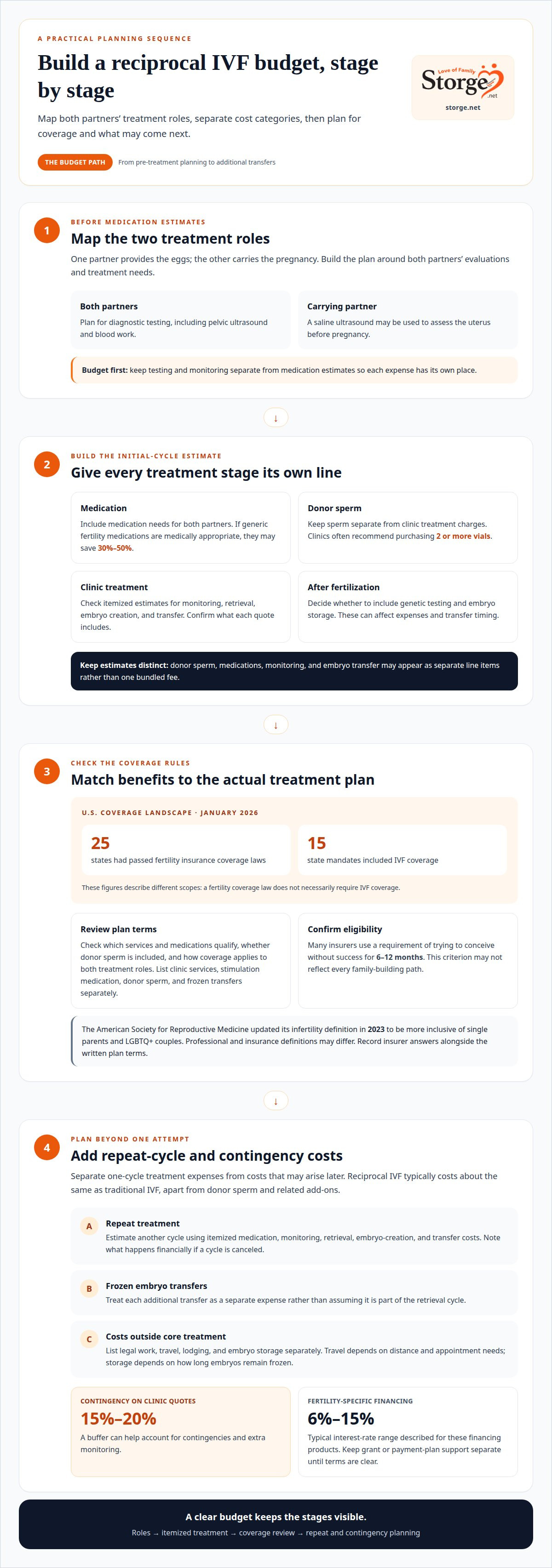
Reciprocal IVF involves distinct treatment roles: one partner provides the eggs, and the other carries the pregnancy. Both partners should plan for diagnostic testing, such as a pelvic ultrasound and blood work. The carrying partner may also have a saline ultrasound to assess the uterus before pregnancy. These evaluations help shape the treatment plan before medication costs begin.
Medication budgets can cover both partners’ treatment needs. Ask the clinic to separate medication estimates from testing and monitoring, so each expense has its own place in the budget. If generic fertility medications are medically appropriate, they may save 30% to 50%. That potential saving depends on which medications are suitable for the treatment plan.
Donor sperm is used to fertilize the retrieved eggs in a laboratory. Clinics often recommend purchasing two or more vials, so include the expected quantity in your estimate. Depending on the state, a clinic may recommend consulting a family law attorney. The non-carrying partner may also be advised to pursue a second-parent adoption.
Genetic testing and embryo storage are separate budget decisions. After retrieval and fertilization, embryos may be frozen before transfer to the carrying partner. Include your planned testing and storage in the budget, since these expenses arise after fertilization and may affect transfer timing.
Insurance coverage
Insurance may reduce out-of-pocket costs, but coverage depends on the plan and eligibility terms. As of January 2026, 25 U.S. states had passed fertility insurance coverage laws, and 15 state mandates included IVF coverage. These figures describe different scopes: a fertility coverage law does not necessarily require IVF coverage. A useful first step in how to budget for reciprocal IVF is understanding which state rules and plan provisions apply to your treatment.
Review the benefit summary to see which services and medications qualify, whether donor sperm is included, and how coverage applies when one partner provides eggs and the other carries the pregnancy. List clinic services, stimulation medication, donor sperm, and frozen transfers separately. This breakdown clarifies which expenses benefits may offset.
Eligibility can also depend on an insurer’s definition of infertility. Many insurers use a requirement of trying to conceive without success for 6 to 12 months. That criterion may not reflect the family-building path of LGBTQ+ couples or single parents. The American Society for Reproductive Medicine updated its infertility definition in 2023 to be more inclusive of single parents and LGBTQ+ couples. Professional and insurance definitions may differ.
If you’re considering how to budget for reciprocal IVF, ask your insurance provider how the plan applies its eligibility criteria and which treatment categories it covers. Record the answers alongside the plan’s written terms so your budget reflects actual coverage rules, rather than assuming every fertility benefit applies to every expense.
When you’re aligning insurance terms with treatment roles, fertility clinic referrals can connect your planning with a clinic familiar with fertility care.
Budgeting for multiple cycles and contingency costs
Plan for more than one attempt by separating cycle costs from expenses that may come later. A useful budget accounts for treatment, additional transfers, and a contingency reserve.
Costs Across Multiple Cycles
A cycle budget estimates treatment expenses for one attempt; a multi-cycle budget accounts for repeat treatment. Reciprocal IVF typically costs about the same as traditional IVF, apart from donor sperm and related add-ons. Compared with IUI, it involves additional stages, including egg retrieval and embryo transfer, rather than a single insemination procedure.
Compare itemized estimates for medications, monitoring, retrieval, embryo creation, and transfer, then note what happens if a cycle is canceled. Fertility-specific financing products typically have interest rates of 6% to 15%; keep any grant or payment-plan support separate until its terms are clear.
Retrieval and Embryo Creation Costs
Retrieval and embryo creation include stimulation medications, egg retrieval, and laboratory fertilization. These items may appear separately or together in a clinic estimate. Check what each quote includes before estimating the cost of another cycle.
Legal, Travel, and Storage Costs
Expenses outside core reproductive treatment can add up across visits or while embryos are stored. List legal work, travel to the clinic, lodging, and storage as separate budget items. Travel costs depend on distance and appointment needs; storage costs depend on how long embryos remain frozen. Separating these items from treatment costs shows how clinic location and transfer timing affect the overall plan.
Additional Embryo Transfer Costs
An additional embryo transfer is a separate treatment expense when frozen embryos are transferred after retrieval. Add transfer costs individually rather than assuming they’re part of the retrieval cycle. A 15% to 20% buffer on clinic quotes can help account for contingencies and extra monitoring.
What are the typical costs for donor sperm, medications, monitoring, and embryo transfer in reciprocal IVF?
Break estimates down by treatment stage to see how each item contributes to your reciprocal IVF budget. Donor sperm, stimulation, monitoring, and transfer may appear as separate line items rather than one bundled fee. Reciprocal IVF typically costs about the same as traditional IVF, apart from donor sperm and related add-on services.
Clinics often recommend purchasing two or more vials, so the total depends partly on the quantity needed. Keep donor sperm separate from clinic treatment charges in your estimate. This makes the donor-related expense clear and avoids confusing it with retrieval, fertilization, or transfer costs.
Medication and monitoring estimates depend on the treatment stages included. This is a separate estimate from broader medication or monitoring budgets, so identify which items the clinic has grouped together. For example, a quote may list cycle synchronization separately from ovarian stimulation or transfer medication. Comparing categories helps prevent counting the same expense twice.
Treat this as an estimate for the transfer stage, separate from egg retrieval and embryo creation. Include it as a potential add-on rather than blending it into the standard transfer estimate. This makes the budget easier to adjust if the treatment plan includes ICSI.
For a practical comparison, group estimates under donor sperm, synchronization, stimulation, monitoring, retrieval and embryo creation, ICSI, and transfer. Check whether each total includes medication, monitoring for both partners, and a fresh or frozen transfer. This breakdown highlights which treatment stages account for differences and helps you plan funds for the approach being considered.
Storge
Storge connects LGBTQ+ individuals and couples with fertility resources for family building. If you’re weighing clinic options, Storge offers Fertility Clinic Referrals. If donor selection is a key next step, its Donor Egg / Sperm Search can support your search. Storge also offers Attorney Representation Referrals to connect members with legal support for questions related to their arrangement.
Storge PLUS Membership provides access to a community network and verified fertility resources as you plan. It can support next steps such as donor selection and clinic referrals, and connect you with legal resources. These referrals do not replace medical treatment or legal advice, but can help you find resources relevant to your path.
For help finding fertility resources for your reciprocal IVF journey, explore Storge PLUS and connect with the community.
Plan for the family-building choices ahead
A thoughtful approach to how to budget for reciprocal IVF does more than organize expenses. It gives both partners room to discuss how treatment decisions fit their shared hopes, priorities, and financial comfort. Those conversations may evolve as you learn more, so treat your budget as a flexible guide, not a measure of how ready you are to begin.
Decide which choices you want to make together first, such as how to approach donor selection or divide responsibilities during treatment. Discussing those priorities with fertility and legal professionals can connect practical planning with the family you hope to build. Clear information and support should respect both partners’ roles in the journey.
If you’re ready to explore support for your next steps, Contact Storge to discuss your options. You can move forward thoughtfully, one decision at a time.
Frequently Asked Questions
What Is Reciprocal IVF?
Reciprocal IVF is a fertility treatment in which one partner provides the eggs and the other carries the pregnancy. Donor sperm fertilizes the eggs in a laboratory, creating embryos for transfer. This arrangement lets both partners take part in different stages. The egg provider undergoes treatment leading to retrieval, while the carrying partner prepares for embryo transfer and pregnancy.
How Does the Process Work?
The process starts with fertility assessments and a treatment plan for both partners. The egg provider takes ovarian stimulation medication before egg retrieval. In the laboratory, the retrieved eggs are fertilized with donor sperm, and the resulting embryos are prepared for transfer or freezing. The carrying partner’s treatment is coordinated with the planned transfer. A clinic then uses a pregnancy blood test to assess whether implantation occurred.
Quick Answer: What Does Reciprocal IVF Cost?
That planning range covers more than one treatment stage, so separate anticipated expenses by cycle and transfer. This breakdown can help you identify which costs insurance might cover and which may require personal savings or other funding.
Reciprocal IVF: Who gives the eggs, and who carries the baby?
One partner provides the eggs, and the other carries the pregnancy. The egg provider undergoes stimulation and retrieval, while the carrying partner prepares for embryo transfer and pregnancy. Partners can choose roles based on their preferences and treatment circumstances. For a later pregnancy, they may choose to switch roles, giving each person the opportunity to experience pregnancy and a genetic connection.
The Reality Check: How Many Cycles Will You Need?
A useful planning guideline is to budget for 2 to 3 reciprocal IVF cycles unless fertility testing suggests otherwise. This is a financial planning range, not a prediction that every couple will need multiple attempts. Testing can inform the treatment plan, while the number of embryos available and whether additional transfers are needed affect how funds are used. Keep cycle and transfer estimates distinct as plans develop.
What is the average cost of reciprocal IVF in the United States?
For budgeting, distinguish the estimate for one cycle from a broader treatment plan that includes repeat attempts or frozen transfers.


