

The most recognizable fertility clinic isn’t automatically the right fit. The top fertility clinics for LGBTQ individuals clearly describe how they support diverse families, provide care relevant to your family-building path, and address legal considerations in your state. Transgender and gender-diverse people can also explore fertility preservation before transition, including egg or sperm freezing.
It’s understandable to want more than a list of clinic names. Inclusive language, staff training in LGBTQ+ issues, patient testimonials, and details about treatments relevant to your goals can help you assess whether a clinic’s approach fits your needs.
This guide explains how to review clinic websites and testimonials, compare care options, and consider questions about treatment outcomes and legal issues. It also covers paths such as reciprocal IVF, donor sperm or eggs, and gestational surrogacy, including fertility-preservation considerations for transgender and gender-diverse patients. The goal is to help you build an informed shortlist at a pace that feels right for you.
Key Takeaways
- Look for clear signs of LGBTQ+-inclusive care, including affirming language, trained staff, and support for diverse family structures.
- Use clinic websites and patient testimonials to assess whether a clinic’s communication and treatment options align with your needs.
- Compare clinics based on success rates for treatments relevant to your family-building plan, rather than relying on rankings alone.
- Explore pathways such as reciprocal IVF, donor sperm or eggs, and gestational surrogacy, and consider fertility preservation before transition.
- Use recommendations from support groups or advocacy communities to broaden your search and identify clinics to consider.
Inclusive fertility care for LGBTQ+ individuals and couples
Inclusive fertility care connects your family-building goals with treatment options, respectful communication, and state-specific planning. Compare how each fertility center supports LGBTQ+ patients, from the initial consultation through decisions about pregnancy and parentage.
Specialized LGBTQ+ Fertility Care
A fertility center experienced in LGBTQ+ care recognizes that individuals and couples may take different paths to parenthood. Look for clear information about donor conception, intrauterine insemination, IVF, and gestational carrier arrangements. Staff trained in LGBTQ+ issues can use affirming language and discuss who may provide eggs or sperm, or carry a pregnancy, without making assumptions about gender or family roles.
Check how the center explains its services for different family-building plans. For example, a couple considering donor sperm may want to discuss insemination, while a family using a gestational carrier needs coordinated medical and legal planning. These details help you assess whether the clinic’s care fits your path.
Personalized and Gender-Affirming Treatment
Personalized fertility care starts with your goals, health history, and preferred role in treatment. A clinician can discuss who may provide eggs or sperm, who hopes to carry a pregnancy, and whether options such as intrauterine insemination or IVF fit your plan. Gender-affirming communication includes using your name, pronouns, and preferred language for your body during appointments and in records.
For transgender and gender-diverse people, fertility preservation can be part of planning before transition, including egg or sperm freezing. Discuss timing and preservation options with a fertility professional. This conversation can help you consider how treatment fits your future family-building goals.
Insurance Coverage and Eligibility
Which insurance plans cover fertility treatment for LGBTQ+ patients, and what eligibility rules apply? Coverage varies by plan, and eligibility depends on the benefits and requirements in its terms. Before treatment begins, obtain written verification of your insurance benefits and review coverage for the treatment you’re considering, such as donor insemination, egg donation, IVF, or IUI.
Written benefit details can clarify which services are covered and what plan conditions apply. Keep the response with your treatment information, then compare how different pathways fit your benefits. This gives you concrete information to consider before choosing a treatment plan.
Medical, Emotional, and Legal Risks
What medical, emotional, and legal risks should LGBTQ+ patients consider when pursuing fertility treatment? Medical planning depends on the treatment pathway and everyone’s role, including whether donor eggs, donor sperm, or a gestational carrier is involved. Everyone in a surrogacy arrangement should complete necessary medical tests and legal steps to protect their health and interests.
Decisions about genetic connection, pregnancy, and family roles can carry emotional weight. Make space to discuss these choices together and identify the support you want during treatment. Legal requirements for donor conception and gestational surrogacy vary by state, so consider the arrangement and location when planning for parentage.
Reviewing clinic websites and patient testimonials
A clinic website offers an early view of patient experiences, not just available procedures. Read its LGBTQ+ information alongside treatment descriptions, staff details, and testimonials to see whether the clinic addresses your path to parenthood.
Read for specific signs of inclusion
Look for direct statements about serving LGBTQ+ patients, couples, and individuals, rather than relying on general claims about welcoming everyone. Check whether the site describes staff training, uses inclusive language, and gives examples of care for lesbian couples, transgender patients, and families using a gestational carrier. These details can show whether inclusion is reflected in the clinic’s services and communication.
Testimonials can add useful context. Notice whether patients describe clear explanations, respectful interactions, and support through treatment steps such as donor insemination or IVF. One story can’t predict your experience, but several accounts may reveal recurring strengths or concerns. Compare patient accounts with the clinic’s own service descriptions.
Compare outcomes and treatment costs
What are the success rates for IVF and other treatments by clinic and patient age? Rates vary by treatment type and patient age, so compare reported outcomes for the treatment you’re considering, such as IVF, donor insemination, egg donation, IUI, or surrogacy. Use the same outcome definition for each clinic.
How much do IVF, IUI, reciprocal IVF, and fertility preservation cost at LGBTQ+-friendly clinics? Costs depend on the case and are provided after a quote request. Factors may include treatment type, medication, laboratory procedures, donor materials, and storage. Review what each estimate includes to compare treatment plans on a like-for-like basis.
Prepare for the first consultation
Use the clinic’s website to learn about its consultation process and the testing it describes. Bring a short list of goals, such as using donor sperm, considering reciprocal IVF, or preserving eggs or sperm. Ask how the initial evaluation informs treatment choices and which tests apply to each person contributing eggs or sperm.
For a partner providing sperm, semen analysis can assess motility, volume, concentration, and morphology. Look for an explanation of how testing relates to possible next steps, rather than results presented without context. A clear outline helps couples and individuals prepare for a useful conversation.
Review laboratory and genetic testing information
Clinic pages may describe IVF, ICSI, embryo testing, egg freezing, and storage of donated eggs or sperm. Read how each option fits the treatment pathway you’re considering. For example, some female couples may consider genetic testing on embryos when exploring family balancing. The clinic’s materials should explain how testing relates to that decision.
Keep notes on questions, treatment terms, and patient experiences as you compare sites. A structured clinic search can help you organize what you learn and identify which care details matter most to your family.
Finding LGBTQ+-inclusive fertility clinics
Build a shortlist using community recommendations, clinic information, and the reproductive care you need. Compare how each option supports your family-building plan, from donor sperm to gestational carrier arrangements or fertility preservation.
Clinic Selection Criteria
Start with clinics that explicitly describe care for LGBTQ+ patients and diverse families. Then compare their services with your plan, such as donor sperm, egg freezing, or treatment involving a gestational carrier. Clear descriptions help you identify relevant reproductive specialists without assuming every clinic offers the same pathways.
Ask trusted online forums, support groups, and advocacy groups for clinic recommendations. Someone who used donor sperm or pursued fertility preservation may share useful details about communication and care. Treat personal accounts as one perspective, then compare them with the clinic’s published information.
Clinic Rankings
Rankings can help you discover clinics, but your needs should guide the final comparison. A clinic’s position on a list doesn’t show whether it supports your specific treatment, such as genetic testing, donor conception, or fertility care for transgender patients.
Compare success rates for treatments relevant to your goals instead of relying on a single overall ranking. For example, look for IVF data if that is your planned treatment. Keep the treatment type consistent across comparisons so you’re assessing similar outcomes.
Make a simple shortlist with columns for location, relevant treatments, LGBTQ+ inclusion information, and community recommendations. Add a note about each clinic’s stated support for fertility preservation or freezing eggs and sperm. This turns broad searching into a practical comparison you can revisit with a partner or support person.
Use the first consultation to explore how a clinic handles your particular pathway. If you’re considering donor sperm, ask how donor conception fits into treatment planning. If your plan includes a gestational carrier, note whether the clinic describes related medical coordination. These details help distinguish general reproductive care from services relevant to your goals.
Recommendations from local advocacy groups can also point you toward specialists familiar with LGBTQ+ family-building in your area. Bring those suggestions together with clinic website details and treatment-specific success rates. Your shortlist should reflect the care you seek, whether that involves insemination, genetic testing, or fertility preservation, rather than a ranking alone.
Look for inclusive language, straightforward statements, and patient testimonials on clinic websites. These details can help indicate whether a clinic serves the LGBTQ+ community and supports diverse families.
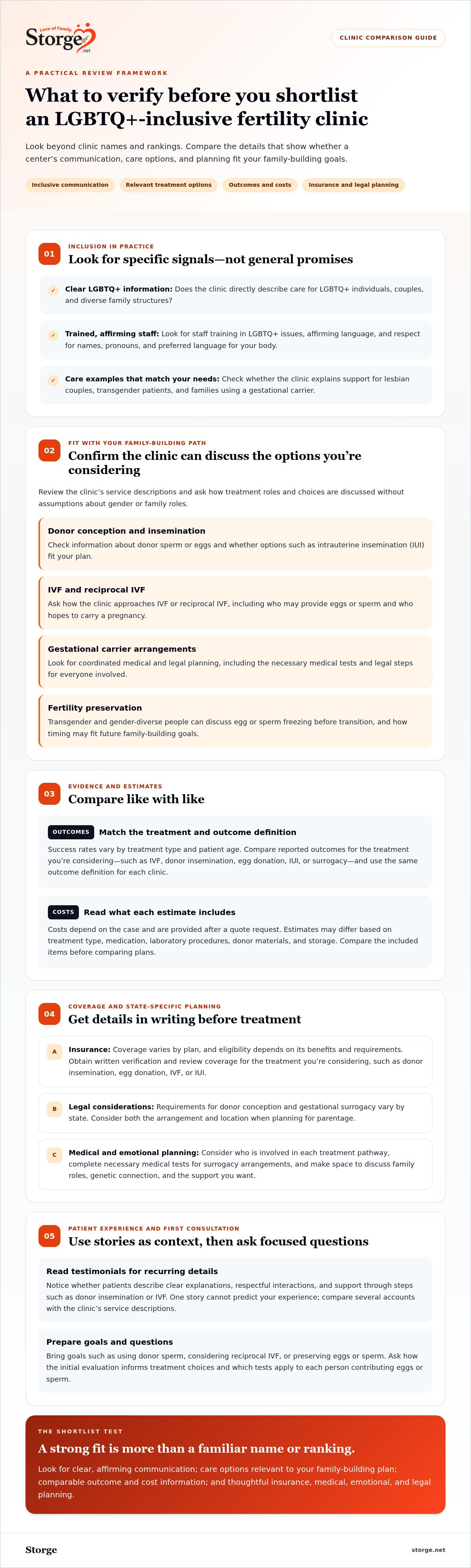
What criteria and rankings identify the best LGBTQ+-inclusive fertility clinics?
No single ranking can identify the right clinic for every family-building plan. Compare clinics based on your treatment needs, their stated LGBTQ+ support, relevant success rates, and their approach to state-specific legal considerations.
Start with a shortlist, then assess each clinic using the same criteria. A simple comparison table can keep your decision grounded in care details rather than reputation alone.
- Inclusive practice: Look for explicit support for LGBTQ+ patients and staff training in LGBTQ+ issues.
- Treatment fit: Match the clinic’s services to your plan, such as donor insemination, IVF, or fertility preservation.
- Relevant outcomes: Compare success rates for treatments you may use, not unrelated procedures.
- Family-building support: Note how the clinic addresses donor conception, gestational carriers, and parental-rights considerations.
- Patient experience: Consider whether clinic materials and testimonials describe respectful communication and clear treatment explanations.
When comparing top fertility clinics for LGBTQ individuals, focus on success rates for treatments relevant to your goals. For example, compare IVF outcomes with IVF outcomes rather than using a clinic’s overall rate to judge donor insemination. Ask how the clinic reports results for your planned treatment. Patient age can also be relevant when interpreting outcomes, so look for information organized to support meaningful comparisons.
Then consider whether the clinic’s care fits your family structure and goals. A clinic may explain IVF clearly but provide little information about donor conception or gestational carrier arrangements. Another may describe those pathways directly. Note the difference, especially if your plan depends on coordination among intended parents, donors, and a carrier.
Rankings can help you discover options, but their criteria may not reflect your priorities. A high position alone doesn’t show whether a clinic offers treatment that fits your needs or understands family-building considerations in your state. Read how a ranking was compiled, then compare its criteria with your own shortlist of top fertility clinics for LGBTQ individuals.
Use consultations to fill practical gaps. Bring your comparison table and ask focused questions about relevant treatment outcomes, services, and care for LGBTQ+ patients. Record the answers in the same format for each clinic. This makes it easier to distinguish a strong overall reputation from a strong fit for your path to parenthood.
The best fit is a clinic that aligns with your treatment needs and gives you clear, relevant information. Review success rates for procedures you may pursue, weigh them alongside inclusive care, and treat any ranking as a starting point rather than a final decision.
Which clinics offer reciprocal IVF, donor sperm, donor eggs, and gestational surrogacy?
Look for fertility clinics that describe the specific treatments and third-party reproduction pathways you need. Options may include intrauterine insemination (IUI), IVF, reciprocal IVF, donor sperm, donor eggs, and care involving a gestational carrier. The clinic’s treatment information should explain how its services relate to your family-building goals and the roles different participants may take.
In reciprocal IVF, one partner provides the eggs and the other carries the pregnancy. For lesbian partners with two egg providers, primary treatment options include IUI and IVF, including reciprocal IVF. Discussing these approaches can help partners consider who may provide eggs, who hopes to carry, and how each person wants to participate in treatment.
Gay men or couples with two sperm providers who want a biological family will need an egg donor, a gestational surrogate, and IVF. Donor sperm may come from a known donor, such as a friend or a partner’s family member, or an anonymous donor, usually through a sperm bank. Clinic information can help you understand how donor choices fit into treatment planning.
For gay couples pursuing IVF, treatment planning may involve donor eggs and a gestational carrier, alongside medical and legal considerations. A gestational carrier carries a baby throughout pregnancy for another person. The carrier may be someone the intended parent knows or someone selected with help from a reproductive law attorney or gestational carrier agency.
Clinic descriptions can help you understand how procedures connect to each pathway. In IVF, eggs are fertilized with sperm in a laboratory, and an embryo is transferred into the uterus of the intended parent or a surrogate. Third-party reproduction can also involve donor eggs, donor sperm, gestational carriers, or traditional surrogacy. Compare the clinic’s described options with the roles your family expects to take.
Before pursuing a surrogacy arrangement, everyone involved should complete necessary medical tests and legal steps to protect their health and interests. State legal considerations also matter when planning for parental rights. Reviewing these elements alongside treatment options helps you understand the full process, not just the procedure.
Use these details to shortlist clinics based on the combination of treatment, donor, and carrier support your plan involves. To explore resources for your family-building path, get fertility clinic referrals as you consider your next steps.
Storge: Storge PLUS Membership
Storge PLUS Membership can support your family-building journey as you compare clinics and treatment pathways. Storge offers Fertility Clinic Referrals and Donor Egg / Sperm Search to connect your plans with relevant resources. Attorney Representation Referrals can help you find legal representation for family-building matters.
Consider these options when you’re ready to move from research toward a clinic referral or donor search. Explore the support that aligns with your needs at your own pace, while keeping medical care with your chosen fertility professionals.
Visit storge.net to learn more about Storge’s support.
Choose a Next Step That Feels Right for You
Your search for the top fertility clinics for LGBTQ individuals can lead to more than a name on a shortlist. It can help you clarify what support would make the next stage feel manageable, whether you’re ready to explore a clinic referral or still shaping your family-building plan. You don’t need to have every decision settled before seeking guidance.
Storge offers Storge PLUS Membership, Fertility Clinic Referrals, and Attorney Representation Referrals to support different parts of the process. These resources can help connect your priorities with potential next steps, while treatment decisions remain with your medical professionals.
When you’re ready, contact Storge to explore your options. Take the next step at your own pace, with your hopes and needs at the center of the journey.
Frequently Asked Questions
Which U.S. fertility clinics are highly rated for LGBTQ+ patient care?
Specialized centers offering inclusive family-building options are discussed across the industry, rather than a single ranked list of providers. Top fertility clinics for LGBTQ individuals often describe comprehensive services such as IVF involving an intended parent or surrogate, as well as IUI and reciprocal IVF for lesbian partners. Compare clinics using treatment-specific outcomes and patient experiences relevant to your needs.
How do clinics support transgender and nonbinary patients during fertility treatment?
Clinics can support transgender and nonbinary patients by discussing fertility preservation, including egg or sperm freezing, before transition. Practical signs of respectful care during appointments include using your name and pronouns and accurately recording your preferred terms for your body. You can also ask how the clinic will communicate about testing and treatment steps, so your care plan reflects your priorities and preserves your privacy.
How can patients compare clinic reviews, LGBTQ+ inclusion policies, and patient support services?
Compare each clinic using the same notes: inclusion policy, staff training, relevant treatments, patient support, and reviews describing similar care. For example, if you’re considering donor conception, look for patient accounts mentioning that pathway instead of relying only on general praise. Distinguish firsthand experiences from clinic claims, and note whether several reviews describe a consistent experience. This makes comparisons more useful than star ratings alone.
What steps should LGBTQ+ individuals and couples take to choose a fertility clinic and start treatment?
Start by defining your family-building goals, then shortlist clinics that describe care related to those goals. At consultations, bring questions about treatment pathways, testing, and clinic outcomes. Obtain written verification of insurance benefits before treatment begins, and keep the response with your care notes. If donor conception or a gestational carrier is part of your plan, include state-specific legal planning before moving ahead.
What are the success rates for IVF and other treatments by clinic and patient age?
Success rates vary by treatment type and patient age. Compare each clinic’s reported outcomes for the treatment relevant to your plan, using the same outcome definition.


