

Family building doesn’t follow a single route. IVF clinics for LGBTQ families can support plans involving IUI, IVF, donor eggs or sperm, and a gestational carrier. IUI places sperm into the uterus, while IVF fertilizes eggs with sperm in a laboratory to create embryos.
It’s understandable to want a clear first step when the options involve medical choices, family roles, and personal hopes. This guide explains how to get started and what each path may involve, helping you identify the questions that matter most for your family.
You’ll learn how IUI and IVF differ, how reciprocal IVF and donor options can fit different family-building plans, and how transgender and gender-diverse people may consider fertility preservation alongside gender-affirming care. We’ll also cover how clinic referrals and other fertility resources can help you move from exploring possibilities to planning next steps.
Key Takeaways
- Compare IUI and IVF by considering who will provide eggs or sperm, who may carry a pregnancy, and what path fits your family’s goals.
- Learn how donor eggs and a gestational carrier can be part of IVF when a pregnancy needs to be carried by someone else.
- Explore reciprocal IVF and other family-building routes that let partners take different roles in treatment and pregnancy.
- Consider how fertility preservation may fit before, during, or after gender-affirming care.
- See how clinic referrals, donor searches, and attorney representation referrals can help organize your next steps.
IVF with donor eggs and a gestational carrier
When a family needs both donor eggs and someone to carry a pregnancy, IVF can bring those roles together. Eggs are fertilized with sperm in a laboratory, creating embryos for transfer to the gestational carrier’s uterus. A gestational carrier carries the pregnancy and has no biological link to the child. Embryos may also be frozen for possible future use.
Start by mapping whose sperm may be used, how the donor will be chosen, and who may carry. Same-sex male couples can use sperm from one or both partners with donor eggs. Using donor eggs and sperm from each partner can create embryos genetically related to each partner. Lesbian couples and other families may also use donor eggs when the intended parent’s eggs aren’t part of treatment.
Donor selection may involve a known donor, someone personally connected to the family, or an anonymous donor. Compare preferences about identity disclosure, future contact, and the donor’s role in family life. For a known donor arrangement, discuss expectations clearly before treatment. Medical screening and clinic procedures are part of the donation process, and the clinic coordinates these steps with the intended parents and donor.
Choosing a gestational carrier also involves personal fit and practical coordination. Some families connect through an agency, while others pursue a known carrier. Discuss communication, boundaries, expectations during pregnancy, and how decisions will be handled. A written agreement and legal guidance can help clarify responsibilities. These conversations make expectations clear before embryo transfer.
Donor sperm can be used with IUI or IVF. IUI places sperm directly into the uterus during ovulation, while IVF fertilizes eggs in a laboratory. Donor eggs require IVF because eggs must be retrieved and fertilized before embryos are transferred or frozen. A sperm donor may be known or anonymous, so consider your preferences about identity and how the child may learn about their genetic origins.
According to Storge, fertility-care insurance coverage varies by insurance plan. Coverage for IVF, fertility preservation, donor eggs, or surrogacy therefore depends on the plan’s terms and the treatment involved.
State laws can affect surrogacy arrangements and how intended parents establish legal parentage. An attorney experienced in LGBTQ+ family law can help clarify the parentage steps involved, an important part of planning for families using donor conception or a gestational carrier.
What are my options for LGBTQ+ family building?
Family-building plans may involve IVF, IUI, donor sperm, or reciprocal IVF. The right path depends on who provides eggs or sperm and who hopes to carry.
Comparing Clinics and Success Rates
Compare clinics by asking how they report success rates and which patient groups those figures represent. Age and egg quality matter: IVF may have a better success rate than IUI for older people when egg quality is a concern. Also look for inclusive intake forms, respectful language about gender and relationships, and experience coordinating treatment for LGBTQ+ couples and individuals.
Questions for Choosing a Clinic
Ask whether the clinic supports reciprocal IVF, donor sperm, and treatment involving a known donor. Find out how it explains success rates for your treatment plan, what medical steps are involved, and how it supports patients through embryo decisions. You can also ask who coordinates care, how partners are included in discussions, and whether counselling is available before, during, and after treatment.
Support for Diverse Family Structures
Inclusive support means recognizing each intended parent’s role, whether a partner provides eggs, carries a pregnancy, or contributes sperm. Ask how records and communications reflect your names, gender, and relationships. If your family’s plan involves a donor or gestational carrier, discuss how the clinic coordinates appointments and treatment with each person while keeping everyone’s role clear.
Reciprocal IVF, also called co-IVF, lets two partners take part in different stages of treatment. One partner provides eggs; the other carries the pregnancy. The egg provider undergoes ovarian stimulation and egg retrieval. The eggs are fertilized with sperm from a donor or partner, and the resulting embryos may be transferred to the partner who will carry. This gives each partner a distinct role in the pregnancy process.
For lesbian couples, reciprocal IVF is one option; IVF with one partner providing eggs and carrying is another. Either approach may use donor sperm. A family member or other known donor may be part of the plan, or intended parents may choose an egg or sperm donor. Discuss donor preferences early, including what role, if any, the donor will have in future family communication.
IVF’s medical risks relate to the specific steps in a treatment plan, including medication, egg retrieval, and embryo transfer. Ask the clinic to explain the risks and success rates for each proposed approach rather than treating all IVF cycles as alike. Preimplantation genetic testing may also be used to select embryos; the clinic can explain its role in your plan.
If you’re comparing care pathways, fertility clinic referral options can help you identify a next step that fits your family-building goals.
Family-building care for transgender and gender-nonconforming patients
Family-building plans may include fertility preservation, IUI, IVF, or a gestational carrier. Start by identifying whether pregnancy is part of your plan and whether you hope for a biological connection through eggs or sperm. These goals help shape discussions about which reproductive materials may be used, what treatment could involve, and when to consider freezing eggs or sperm.
Transgender and gender-diverse people may freeze eggs or sperm before hormone therapy or surgery. Fertility preservation can also be considered before, during, or after gender-affirming care. A practical first step is to discuss your timeline and family-building goals with a fertility care team, including whether you want to preserve eggs, sperm, or embryos for possible future use.
For a patient who may carry a pregnancy, IUI can involve placing donor sperm or sperm from a known provider into the uterus during ovulation. This uses insemination rather than laboratory fertilization. Discuss how IUI fits your reproductive goals and whether donor sperm or a known sperm provider feels right for your family.
IVF offers another route using a partner’s or donor’s eggs or sperm. Eggs are fertilized with sperm in a laboratory, and embryos may be transferred or frozen. For example, a transgender patient using a partner’s sperm may pursue IVF with their own eggs. A patient using donor eggs may use a partner’s or donor’s sperm.
Some transgender and gender-nonconforming patients may not be able or may not want to carry a pregnancy. A gestational carrier can carry an embryo created through IVF. This path may be considered alongside donor eggs, donor sperm, or a partner’s reproductive material, depending on the family’s plan. Discussing who provides each component helps clarify the treatment steps.
Care planning should address both medical goals and gender-affirming needs. A patient can discuss the names and pronouns used in appointments, language for reproductive anatomy, and how staff will communicate about treatment. Clear preferences can make conversations about egg retrieval, sperm collection, insemination, and pregnancy more respectful and easier to follow.
Before choosing a path, write down the options you want to explore: freezing eggs or sperm, IUI with donor sperm, IVF using a partner’s or donor’s reproductive material, or a gestational carrier. Bring those priorities to a fertility appointment. This gives the conversation a concrete starting point and helps connect treatment with your family-building plans.
IVF and IUI options for LGBTQIA+ families
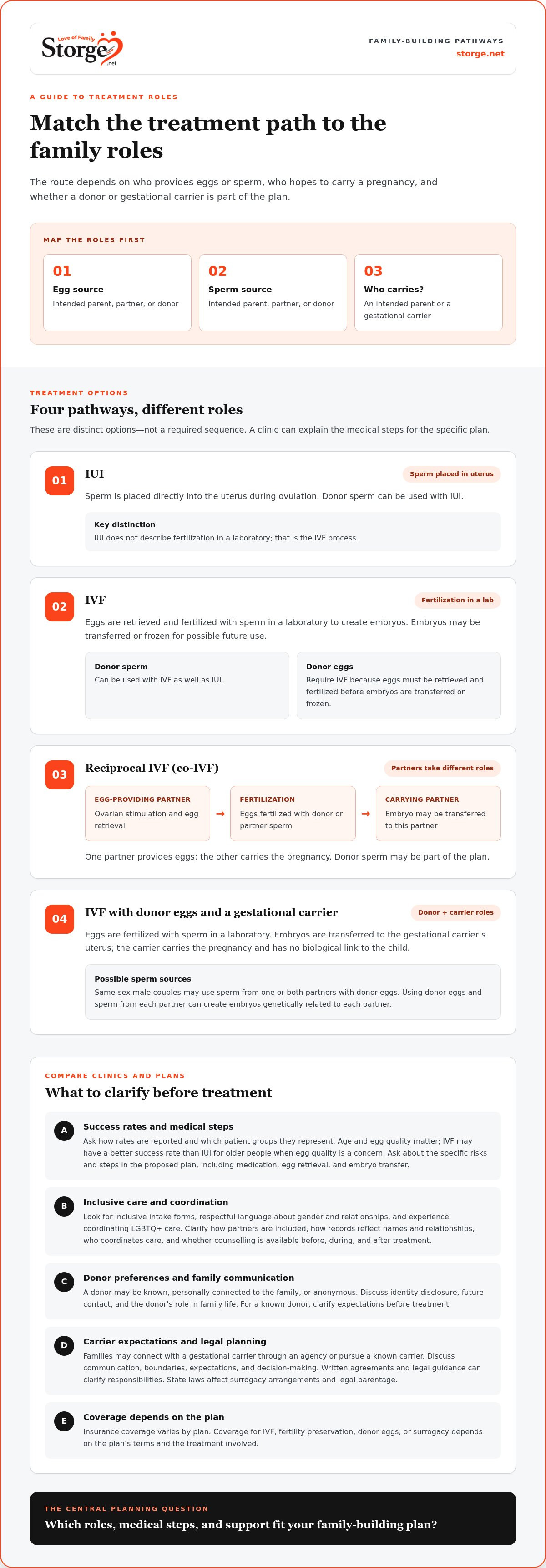
IUI and IVF offer different ways to use donor or partner sperm in family building. The choice starts with the intended parent’s reproductive goals, who may carry a pregnancy, and whether eggs or sperm will come from a donor. A fertility clinic can map those decisions into treatment steps, from insemination timing to embryo transfer.
For a person with a uterus, IUI places sperm directly into the uterine cavity during ovulation. A same-sex female couple may use donor sperm, with one partner carrying the pregnancy. IUI avoids laboratory fertilization, so the plan centers on ovulation timing and the sperm source. Donor sperm may come from a known provider or an anonymous donor.
IVF follows a different sequence. Eggs are fertilized with sperm in a laboratory to create embryos, which may then be transferred to a uterus or frozen. This approach may involve a partner’s sperm, donor sperm, or sperm from both partners. For a family using a gestational carrier, embryos are created through IVF before transfer to the carrier.
Reciprocal IVF gives two partners distinct roles: one provides eggs, and the other carries the pregnancy. Partners can discuss donor sperm preferences before treatment, including whether they are considering a known donor. Their fertility clinic can outline the egg retrieval, fertilization, embryo transfer, and carrier steps relevant to their plan.
For couples where neither partner has a uterus, IVF can combine sperm from one or both partners with donor eggs. The resulting embryo may be transferred to a gestational carrier or cryopreserved for future use. Using sperm from both partners may create embryos genetically related to each partner, depending on which sperm fertilizes each donor egg.
Age and egg quality can influence the choice between methods. IVF may have a better success rate than IUI for older people when egg quality is a concern. Preimplantation genetic testing, or PGT, may be used to select embryos. Ask the clinic how these considerations apply to your treatment plan rather than comparing methods without context.
Before an initial appointment, write down who may provide eggs or sperm, who hopes to carry, and whether donor conception is part of the plan. Add questions about the clinic’s sequence for IUI or IVF, embryo freezing, and transfer. These details help clarify the path to parenthood and the decisions each person will make.
How do IVF clinics support LGBTQ+ families and diverse family structures?
Support begins with how a fertility clinic records and discusses each family’s plan. For example, a couple may need one partner identified as the egg provider and the other as the intended carrier. Clear intake forms, respectful use of names and pronouns, and accurate communication help staff coordinate appointments around each person’s role and prevent confusion in treatment discussions.
Care coordination matters when treatment involves people who aren’t both receiving procedures. A clinic may communicate with intended parents, a donor, or a gestational carrier at different stages. Ask how appointments, treatment updates, and consent discussions are organized, and identify a main contact for questions. A simple communication plan clarifies who receives updates and how each person participates in decisions.
Donor conception brings practical and personal decisions into the care process. Intended parents may want to discuss donor information, future contact, and how they’ll talk with their child about conception. Raising these topics during planning helps families consider their preferences alongside medical steps and gives intended parents time to discuss how they want to share information within the family.
For transgender and gender-diverse patients, supportive communication includes using affirmed names and pronouns in records and appointments. Patients may also want clear explanations before procedures involving reproductive anatomy. Sharing language preferences and discussing treatment steps in advance can make appointments more respectful and easier to follow. A written note can help communicate preferences across clinic visits.
Emotional support can be part of treatment planning, especially when decisions involve donor relationships, family roles, or a gestational carrier. Patients can ask what counselling resources are available and how those conversations fit alongside medical appointments. Discussing emotional questions early can help intended parents identify concerns and make room for each person’s perspective.
Legal planning is another part of family building. State laws can affect how intended parents establish legal parentage, particularly when donor conception or a gestational carrier is involved. An attorney experienced in LGBTQ+ family law can help intended parents understand the parentage steps relevant to their arrangement. Medical treatment and legal parentage are separate processes, so families should plan for both.
Insurance is a practical part of access. Virginia Fertility & IVF says fertility-care insurance coverage varies by insurance plan. For LGBTQ+ families, coverage may depend on the plan’s terms and the treatment involved. Review how the plan addresses IVF, fertility preservation, donor eggs, and surrogacy, then compare covered care with the proposed treatment pathway.
Prepare for a clinic conversation by describing your family structure, outlining each person’s role, and listing questions about communication, emotional support, insurance, and parentage coordination. Bringing these priorities together can make it easier to understand how the clinic would support your family’s specific plan.
Storge: Storge PLUS Membership
Storge PLUS Membership is a next step for LGBTQ+ individuals and couples organizing fertility-related decisions. When you’re ready to explore options beyond treatment information, Storge can connect you with fertility clinic referrals and donor egg or sperm searches.
For plans involving legal parentage, Storge can connect you with attorney referrals. If you’re considering a gestational carrier, Storge also offers a search for gestational carriers. These resources can help bring related parts of your family-building plan into focus.
Each family’s path is personal. Contact Storge to explore which resource fits your next step.
Take your next step with clarity
Your family-building plan doesn’t need to be fully mapped before you begin. Start with the decision that feels most immediate, such as finding a clinic, exploring donor options, or understanding legal representation. A focused first step can make the rest of the process easier to organize.
As you compare IVF clinics for LGBTQ families, consider what support would help you move forward with confidence. Storge PLUS Membership offers a starting point for connecting with fertility resources, including Fertility Clinic Referrals and attorney referrals. Choose the support that fits your current priorities; you don’t need to solve every question at once.
If you’re ready to explore what comes next, contact Storge to get started. Your path can take shape one thoughtful decision at a time, with room for your family’s needs and hopes.
Frequently Asked Questions
How do I get started if I’m ready to begin building my family?
Start by writing down your preferred family-building roles and immediate questions. Note who may provide eggs or sperm, whether someone hopes to carry, and whether you’re considering a donor. Then organize an initial fertility appointment around those priorities. Storge offers Fertility Clinic Referrals and Storge PLUS Membership, which connects LGBTQ+ individuals and couples with fertility resources, including donors and gestational carriers.
Need to find an LGBTQ+ friendly provider?
Storge can connect you with fertility resources through Fertility Clinic Referrals. As you consider your needs, identify practical signs of affirming care, such as forms that accommodate different family structures and respectful use of names and pronouns. You might also clarify how you want partners included in conversations. Sharing these preferences early can keep initial discussions focused on your family-building goals.
Which IVF clinics in the United States are LGBTQ+-friendly and inclusive?
To compare IVF clinics for LGBTQ families, focus on how each clinic communicates with intended parents and coordinates care for donors or carriers. Storge offers Fertility Clinic Referrals to help connect families with fertility resources. Make a short list of priorities, such as inclusive intake processes, clear treatment explanations, and communication that recognizes each person’s role. These criteria help you assess fit beyond a clinic’s name.
How can same-sex female couples use IVF, including reciprocal IVF?
Same-sex female couples can use IVF with donor sperm, with one partner providing eggs and carrying, or consider reciprocal IVF. In reciprocal IVF, one partner provides eggs and the other carries the pregnancy. Before an appointment, discuss which roles feel right, whether donor sperm is part of the plan, and how each partner wants to participate in treatment decisions. Those preferences help shape a practical consultation.
What IVF options are available to gay male couples, including egg donation and surrogacy?
Gay male couples may use donor eggs and sperm from one or both partners to create embryos through IVF. A gestational carrier can carry an embryo when neither partner will carry the pregnancy. Couples may also consider whether they prefer a known or anonymous egg donor. Storge offers Donor Egg / Sperm Search and Surrogacy / Gestational Carrier Search to help families explore those resources.
What are the steps and timeline for IVF for LGBTQ+ intended parents?
IVF planning generally moves through consultation, selecting the reproductive material, treatment preparation, fertilization, and embryo transfer or freezing. The sequence depends on whether the plan includes donor eggs or sperm, reciprocal IVF, or a gestational carrier. Ask for a written outline of the steps relevant to your arrangement. That roadmap helps you coordinate appointments, decisions, and the people involved without assuming every family follows the same schedule.
How much does IVF cost for LGBTQ+ families in the United States, including donor and surrogacy costs?
Total costs depend on the treatment plan and the combination of IVF, medication, donor eggs or sperm, and gestational-carrier arrangements. These are separate components, so clarify which items are included in each estimate and how additional treatment may affect the total. Virginia Fertility & IVF says fertility-care insurance coverage varies by insurance plan. Review your plan’s terms alongside the steps involved in your family’s care.
What are the medical risks and success rates of IVF, donor eggs, and reciprocal IVF?
IVF risks relate to the specific steps involved, including medication, egg retrieval, and embryo transfer. Ask the clinic about risks and success rates for your proposed approach. IVF may have a better success rate than IUI for older people when egg quality is a concern.


