

Both LGBTQ+ intended parents may be listed on a child’s birth certificate after completing the required parentage process. The steps depend on state law: some states allow parentage to be established before birth, while others require action after delivery. Protecting parental rights in LGBTQ surrogacy may also involve a second-parent adoption, depending on where and how parentage is established.
It’s understandable to expect that welcoming a child together automatically gives both parents equal legal recognition. In practice, a birth certificate is only part of the picture. Planning for parentage can clarify which legal steps may apply to your family.
This guide explains how parentage orders, birth certificates, and adoption fit together, and why the laws of your home state, the gestational carrier’s state of residence, and the birth state matter. It also explores how LGBTQ+ people build families through surrogacy and other paths to parenthood, helping you understand the decisions that shape your next steps.
Key Takeaways
- Map the relevant laws across your home state, the gestational carrier’s state of residence, and the state where the birth will take place.
- Separate legal representation for intended parents and the gestational carrier supports clear agreements and parentage planning.
- A second-parent adoption may provide an additional path to legal recognition when a parentage order isn’t available or sufficient.
- Understand how pre-birth and post-birth orders guide the steps for establishing parentage and preparing the birth certificate.
- Storge PLUS Membership can connect LGBTQ+ individuals and couples with fertility resources as they consider surrogacy and other paths to parenthood.
Can Both LGBTQ Parents Be Listed on the Birth Certificate?
Both LGBTQ+ intended parents may be listed after completing the required parentage process. The relevant laws may include those of the parents’ home state, the carrier’s state of residence, and the state where the birth occurs.
Recognizing Non-Biological Parents
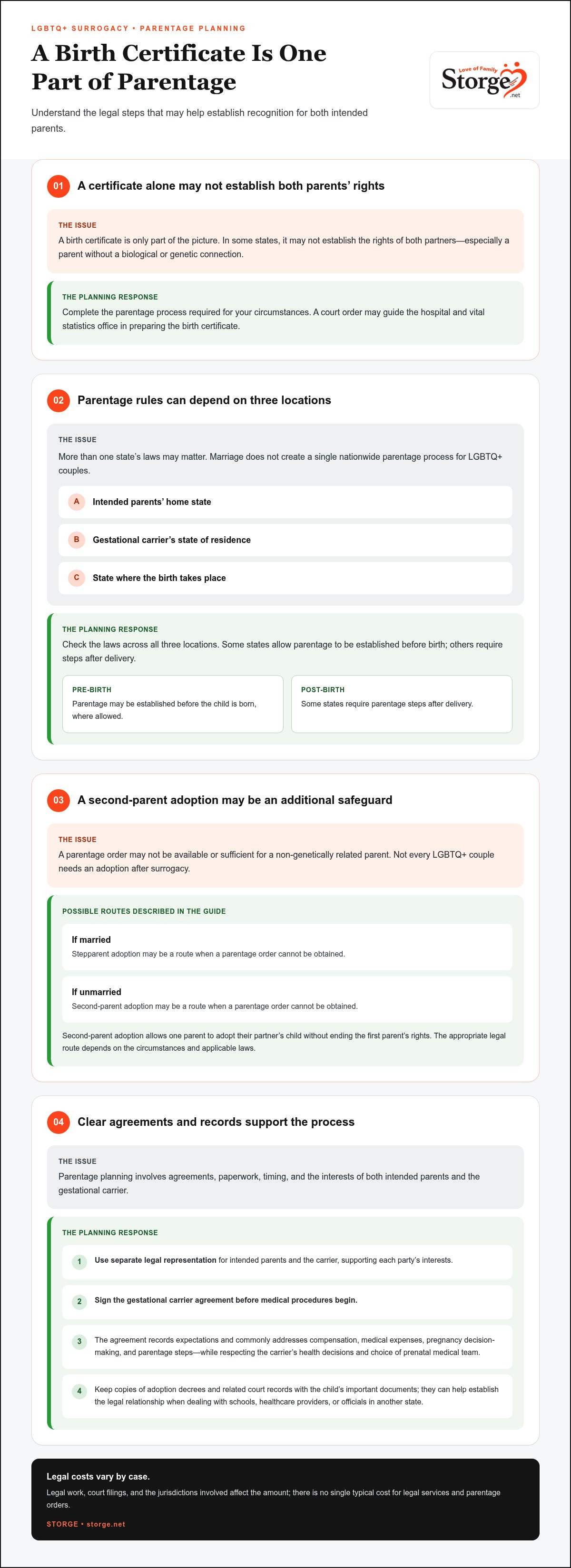
Legal parentage establishes who is recognized as a child’s parent, including a parent without a biological or genetic connection. This distinction matters because a birth certificate alone may not establish both partners’ rights in every state.
Some states allow parentage to be established before birth, while others require a post-birth process. Rules can also affect how a non-biological parent is recorded, so consider the laws in all three relevant locations before the birth.
Establishing Parentage for LGBTQ Intended Parents
Establishing parentage means completing the legal steps that recognize intended parents as a child’s legal parents. A court order may guide the hospital and vital statistics office in preparing the birth certificate.
Marriage does not create a single nationwide rule for LGBTQ+ couples. Married or unmarried, intended parents must follow the process available under the laws that apply to their circumstances. Some states permit pre-birth orders, while others require steps after delivery.
Plan for both partners’ legal recognition rather than assuming that a genetic connection or marriage settles parentage. Separate legal counsel for the intended parents can help address the required paperwork and timing.
Legal Support for Transgender and Non-Binary Parents
Legal support can help transgender and non-binary intended parents address how parentage documents identify each parent. Names, gender markers, and parent designations may differ across records, so discuss how the birth certificate and court paperwork will reflect each parent’s legal status.
For example, intended parents can raise documentation questions during parentage planning, before hospital records and vital statistics forms are completed. The relevant state process determines how those records are prepared and how a non-biological parent is recognized.
Contracts and Independent Legal Representation
A gestational carrier agreement records the parties’ expectations and outlines the process for establishing parentage. Agreements commonly address compensation, medical expenses, pregnancy decision-making, and parentage steps, while respecting the carrier’s right to choose a prenatal medical team and make decisions to safeguard their health.
Intended parents and the carrier should have separate legal representation when drafting the agreement. Independent counsel focuses on each party’s interests and helps ensure the required paperwork is completed accurately and made legally binding.
The cost depends on the case. Legal work, court filings, and the jurisdictions involved all affect the amount, so there is no single typical cost for legal services and parentage orders.
Sign the gestational carrier agreement before medical procedures begin. It sets out the parties’ responsibilities and the parentage process in writing before treatment starts.
Do LGBT Couples Need Second Parent Adoption After Surrogacy?
Not every LGBTQ+ couple needs a second-parent adoption after surrogacy. It may be an important safeguard when a non-genetically related parent cannot obtain a parentage order or state law requires another route to legal recognition.
Second-Parent Adoption as a Safeguard
Second-parent adoption is a legal process through which one parent adopts their partner’s child without ending the first parent’s rights. It can protect an unmarried, non-genetic parent when a parentage order isn’t available.
In some cases, a non-genetically related parent who cannot obtain a parentage order may pursue stepparent adoption if married, or second-parent adoption if unmarried. The appropriate route depends on marital status and the laws governing the child’s parentage.
Adoption can provide a formal record of the parent-child relationship and support a child’s legal connection to both parents. After surrogacy, the key question is whether the existing parentage process establishes both parents’ rights or adoption is needed as an additional safeguard.
Interstate Recognition of Adoption
Interstate recognition concerns how an adoption decree is treated when a family crosses state lines. This matters to LGBTQ+ families who may move, travel, or have connections to more than one state after a child’s birth.
Adoption and parentage laws vary by state, so understand where a decree is issued and how it relates to other parentage documents. Second-parent adoption is identified as the most accepted way to protect a family in a state without a parentage act, but the appropriate legal route still depends on the circumstances.
Keep copies of adoption decrees and related court records with the child’s important documents. These records can help establish the legal relationship when a family interacts with schools, healthcare providers, or officials in another state.
Adoption also serves a child-centered purpose: it can formalize a lasting legal relationship with the adults raising the child. In surrogacy cases, the focus is on ensuring the child’s family relationships are recognized, not treating a birth certificate as the only record that matters.
Discrimination can affect LGBTQ+ people seeking adoption or foster placements. Same-sex couples may encounter bias from agencies, birth parents, judges, or officials. LGBTQ+ people and couples may encounter discrimination when seeking foster-care or adoption placements.
State laws can also change available routes. New Hampshire passed HB 1162 just this year to expand access to adoption, confirmatory adoption, and judicial decrees for children born through assisted reproduction. For couples planning surrogacy, understanding these options before matching can help clarify how parentage may be established. A gestational carrier search can support families exploring this path to parenthood.
Pre-birth and post-birth parentage orders
A parentage order can establish intended parents’ legal status and guide how the birth certificate is prepared. Whether a court issues the order before or after delivery depends on the process available under the relevant state’s law.
Timing of Parentage Orders
A pre-birth order declares intended parents to be the child’s legal parents before birth. Where available, legal teams may file during the second or third trimester, giving the court time to address parentage before delivery.
California allows LGBTQ+ intended parents to obtain pre-birth parentage orders regardless of marital status or whether they use donor eggs or sperm. This illustrates why the governing state matters: the process can depend on where the birth occurs and how the family was formed through assisted reproduction.
In states where pre-birth orders are unavailable, legal teams may finalize post-birth orders shortly after delivery. Some jurisdictions require a court order after birth to establish or confirm intended parents’ rights, so the process may continue after the child is born.
The difference is timing: when the court formally recognizes the intended parents. A pre-birth order addresses parentage before delivery; a post-birth order addresses it afterward. Protecting parental rights in LGBTQ surrogacy means understanding which route applies and aligning the parentage process with the birth plan.
Birth Certificates and Parent Designations
A parentage order can direct the hospital and vital statistics office on what to do when the baby is born. It can declare intended parents to be legal parents before birth and help facilitate putting their names on the birth certificate after delivery.
The order and certificate serve related but distinct roles. The order establishes or confirms legal parentage, while the certificate records birth and parent information. Following the order’s directions helps connect these records and clarify how each parent is designated.
For LGBTQ+ families, a court order can provide a legal basis for recognizing a parent without a genetic connection. Protecting parental rights in LGBTQ surrogacy also means considering how transgender and non-binary parents’ names and gender designations will appear across court and birth records.
Keep the parentage order with the child’s birth certificate and other family records. If a post-birth order is required, the legal process continues after delivery until parentage is established or confirmed. Organizing these documents helps maintain a clear record of the parent-child relationship as the family completes the required steps.
State and country differences in surrogacy law
Surrogacy and parentage rules vary across U.S. states, and the United States has no federal laws regulating surrogacy. The laws of the intended parents’ home state, the gestational carrier’s state, and the birth state can all matter.
State Laws Affecting Surrogacy and Parentage
State law determines which surrogacy arrangements are recognized and how intended parents establish legal parentage. California’s law does not set requirements based on sexual orientation, gender identity, or marital status.
Other states take different approaches. Arizona prohibits surrogacy under a statute barring people from entering into or helping create a surrogacy contract. Florida’s gestational surrogacy statute applies to married couples, not other intended parents. These differences can affect whether an arrangement is legally available and which parentage process applies.
California allows LGBTQ+ intended parents to obtain pre-birth parentage orders regardless of marital status or donor egg or sperm use. There is no single federal rule establishing which states recognize these orders, so the birth state’s law is central to determining the available process.
State-by-State Legal Differences
Nevada permits gestational surrogacy regardless of intended parents’ marital status, sexual orientation, genetic connection, or medical need. Louisiana recognizes gestational carrier agreements only when intended parents are married and heterosexual, and both contributed their own gametes to the embryos.
These examples show why a couple’s relationship, genetic connection, and use of donation can matter differently across state lines. Before a pregnancy, intended parents can identify the states connected to the arrangement and understand how each treats the agreement and parentage.
Parentage Protections in New England
Several New England states have enacted comprehensive legislative parentage protections: Maine in 2016, Vermont in 2018, and Rhode Island in 2020. Connecticut’s Parentage Act is based on the Uniform Parentage Act of 2017.
As of March 2022, the Uniform Parentage Act of 2017 had been enacted in California, Connecticut, Maine, Rhode Island, Vermont, and Washington. Legislation to enact it was pending in Hawaii, Massachusetts, and Pennsylvania as of March 2022. These dates describe the legal status at that time, not later legislative changes.
Country rules add another layer. Surrogacy is illegal in most of the world; Canada prohibits commercial surrogacy but allows altruistic surrogacy for same-sex and LGBTQ+ couples. Spain prohibits surrogacy regardless of intended parents’ sexual orientation, while Germany prohibits it, and medical professionals who help someone pursue it may commit a criminal offense.
LGBTQ surrogacy and other paths to parenthood
Surrogacy is one of several ways LGBTQ+ people in the United States build families. Adoption, foster parenting, donor insemination, and parenting children from previous heterosexual relationships are also paths. The right fit depends on family goals, the role each person hopes to take, and the legal steps involved.
Gestational surrogacy involves an embryo created through in vitro fertilization and implanted in a carrier who has no genetic link to the child. In traditional surrogacy, the surrogate uses her own egg and is the child’s biological mother, which can make parentage more complex. These distinctions affect the family-building process and the legal questions intended parents should address.
Donor arrangements also need careful planning. Egg, sperm, and embryo donation each carry distinct legal considerations. A donor agreement can describe the donor’s rights and responsibilities, confidentiality, and any future contact, while setting out the parties’ understanding of parental roles. Complete donor agreements before medical procedures begin, so the written terms are in place before treatment.
Surrogacy agreements serve a related purpose. They commonly address compensation, medical expenses, pregnancy decision-making, and how intended parents will establish parentage. Sign the agreement before medical procedures begin, whether the carrier is a friend, family member, or someone matched through a search. Separate legal representation helps the intended parents and carrier each receive independent advice.
Parentage planning connects a family-building choice to legal recognition. LGBTQ+ intended parents commonly need to complete a donor agreement, a surrogacy agreement, and a parentage process. For example, a non-genetic parent may need a parentage order or, in some circumstances, second-parent adoption. The birth certificate is one record; the legal process establishes the parent-child relationship.
Legal outcomes can also shape how families understand donor relationships. On August 12, 2024, the Minnesota Court of Appeals ruled that a district court should have dismissed a paternity action brought against a same-sex married couple by their sperm donor. The court concluded the donor was precluded under Minnesota law from bringing a paternity action for their child. The case illustrates why donor agreements and location-specific parentage planning belong in conversations before treatment.
The Uniform Parentage Act of 2017 includes provisions addressing surrogacy, assisted reproduction, at-home insemination, and children with multiple parents. It offers a framework for thinking about diverse family structures, while state laws determine the applicable process. If you’re weighing surrogacy and donor options, explore donor and carrier search options as you consider which family-building path fits your plans.
Storge: Storge PLUS Membership
Storge PLUS Membership gives LGBTQ+ individuals and couples a starting point for connecting with fertility resources as they consider family building. If you’re planning surrogacy, exploring donor options, or preparing for parentage steps, Storge can connect you with relevant referrals and searches.
Attorney Representation Referrals can connect intended parents with independent legal representation for parentage planning. Fertility Clinic Referrals and Donor Egg / Sperm Search support other parts of the process, while Surrogacy / Gestational Carrier Search helps you explore a carrier match. These offerings provide connections and search support, not in-house legal services or medical procedures.
To explore resources for your family-building plans, visit storge.net or contact Storge.
Take the Next Step With Clarity
Building a family is personal, and the next step may be a conversation about what matters most to you both. Consider the support, relationships, and practical decisions you want to shape your path to parenthood. A thoughtful approach to protecting parental rights in LGBTQ surrogacy begins by making space for both partners’ priorities and questions.
Storge PLUS Membership connects you with fertility resources. Storge also provides Attorney Representation Referrals and Fertility Clinic Referrals, helping you explore relevant support as your plans take shape. These connections can help you consider how legal guidance and fertility care fit into your family-building journey.
When you’re ready to explore those options, contact Storge to discuss your options. You can move forward at a pace that feels right for your family, with your hopes and priorities guiding the way.
Frequently Asked Questions
How are parental rights established in LGBTQ surrogacy in the United States?
Parental rights are established through the parentage process available under relevant state laws. Depending on the state, a court may issue an order before birth or after delivery; adoption can provide another route for a non-genetic parent. When planning how both parents will be legally recognized, consider the laws of your home state, the gestational carrier’s state of residence, and the birth state.
When is a post-birth adoption or second-parent adoption needed after surrogacy?
A second-parent adoption may be needed when a non-genetic parent cannot obtain a parentage order or state law requires an additional step. For example, an unmarried parent may need second-parent adoption, while a married parent may pursue stepparent adoption in some circumstances. The need depends on the parentage process already completed and applicable state law, not simply on whether both parents appear on the birth certificate.
What legal steps should LGBTQ intended parents take before embryo transfer?
Before embryo transfer, intended parents should complete the gestational carrier agreement and any donor agreement, and arrange separate legal representation for themselves and the carrier. Agreements can address responsibilities, medical expenses, pregnancy decision-making, and the parentage process. The intended parents’ attorney can also plan for the court process available in the state. Completing these documents before medical procedures begin puts the parties’ expectations and legal arrangements in writing before treatment.
What happens to parental rights if the surrogate lives in a different state?
More than one state’s laws may affect the parentage plan: the intended parents’ home state, the carrier’s state of residence, and the state where the birth occurs. Those laws may differ on surrogacy agreements and when parentage can be established. A pre-birth process may be available in one state, while another requires action after delivery. The family’s legal plan should account for each state connected to the arrangement.
What are the risks of relying on a birth certificate alone to establish parentage?
A birth certificate records parent information, but it may not be the only document establishing legal parentage. A parentage order can separately establish or confirm intended parents’ legal status, and some jurisdictions require a court order after birth. A non-genetic parent may need an additional legal step even when listed on the certificate. Keeping relevant court documents with the certificate helps preserve a clear record of the parent-child relationship.
How can LGBTQ single parents establish legal parentage through surrogacy?
A single intended parent can establish parentage through the legal process available in the state connected to the surrogacy arrangement. The state’s rules, the type of surrogacy, and any donor arrangements shape which documents and court steps apply. A genetic connection isn’t the only factor: California, for example, allows LGBTQ+ intended parents to seek pre-birth parentage orders regardless of donor egg or sperm use. Planning before treatment can help clarify the route.
How do international travel and custody rights work for a child born through surrogacy?
International travel can raise additional parentage questions because countries differ in their laws and policies toward LGBTQ+ families and surrogacy. A court order, birth certificate, and surrogacy records can help document the parent-child relationship, but recognition abroad depends on the destination country’s rules. Before traveling, organize the records relevant to the child and both parents’ legal status, including any court documents establishing parentage.


