

The legal steps to parenthood can differ depending on where you live and where the surrogacy takes place. Legal considerations for LGBTQ surrogacy vary by state, and intended parents may face different rules for establishing parentage. Some states allow pre-birth orders, while others may require a court process or adoption after birth to establish both parents’ rights.
It’s understandable to want clarity before making decisions about a gestational carrier, donor, or embryo creation. Knowing how state laws and parentage procedures may affect your family can help you plan with greater confidence and identify questions to address early.
This guide explains how the states involved can shape the process, what a surrogacy agreement should address, and how donor arrangements and embryo creation fit into the legal picture. It also covers practical steps for planning parentage before birth and preparing for hospital and birth-certificate procedures.
Key Takeaways
- Map the laws that may apply where you live, where the gestational carrier lives, and where the child will be born.
- Identify early which legal steps will establish each intended parent’s rights, including whether a court order or adoption may be needed.
- Use a written agreement to clarify responsibilities, financial arrangements, communication, and expectations before the process begins.
- Record how donor involvement and embryo creation relate to each intended parent’s legal and genetic connection to the child.
- Coordinate legal planning with the fertility and birth-planning process so parentage steps are considered before transfer and delivery.
Are surrogacy and gestational carriers legal in every state for gay couples?
No. U.S. surrogacy laws vary by state, and the same arrangement can require different steps to establish parental rights. Traditional surrogacy carries additional parentage risks because the surrogate is genetically related to the child; a court order or adoption may be needed to establish an intended parent’s rights.
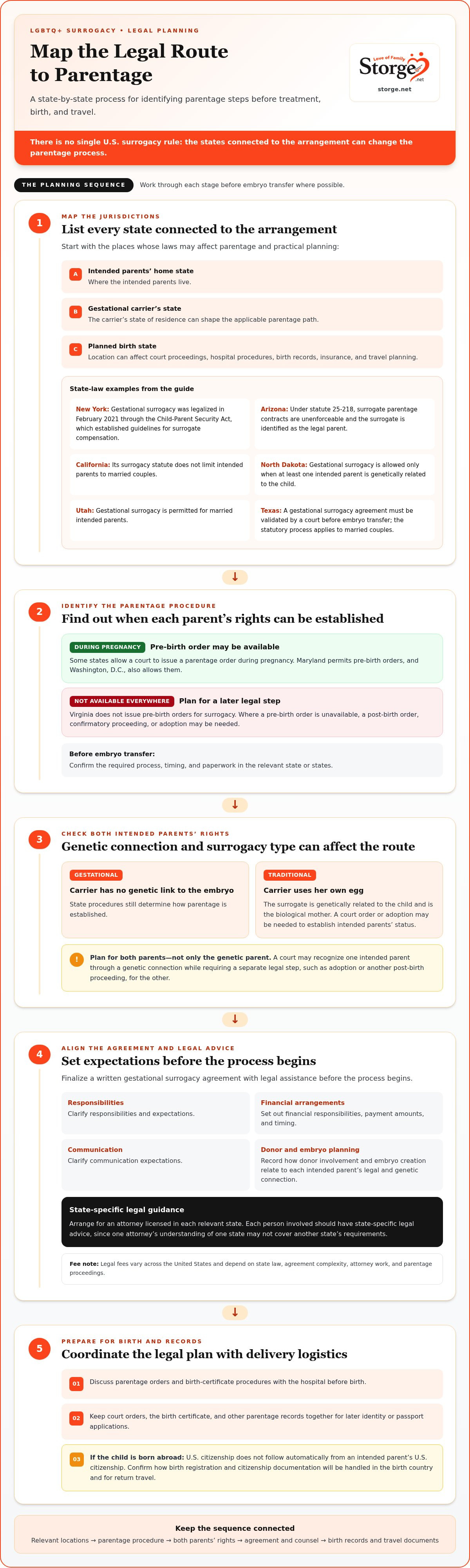
- Compare the laws in every state connected to the arrangement. Consider the intended parents’ residence, the carrier’s residence, and the state where birth will take place. New York legalized gestational surrogacy in February 2021 through the Child-Parent Security Act, which established guidelines for surrogate compensation, according to the New York State Legislature. Arizona takes a different approach: under statute 25-218, surrogate parentage contracts are unenforceable, and the surrogate is identified as the legal parent, according to the Arizona State Legislature. These differences can affect which parentage process applies.
- Ask early whether a pre-birth order is available. Some states allow a court to issue a parentage order during pregnancy, helping intended parents establish their legal status at birth. Maryland permits pre-birth orders, and Washington, D.C., also allows them. Virginia does not issue pre-birth orders for surrogacy. Where that option is unavailable, intended parents may need a post-birth order, confirmatory proceeding, or adoption. Identify the required process before embryo transfer so you understand the timing and paperwork.
- Plan for both parents’ rights, not only the genetic parent’s. A court may recognize one intended parent through a genetic connection while requiring a separate legal step for the other. In some states, adoption or another post-birth proceeding can establish the second parent’s rights. In traditional surrogacy, the surrogate uses her own egg and is the child’s biological mother, so an adoption or court order may be needed to establish the intended parents’ status. Gestational surrogacy uses an embryo to which the carrier has no genetic link, but state procedures still determine parentage.
- Coordinate birth records and travel documents before delivery. Discuss parentage orders and birth-certificate procedures with the hospital before birth. Keep court orders, the birth certificate, and other parentage records together for later identity or passport applications. For a child born abroad through surrogacy, U.S. citizenship does not follow automatically from an intended parent’s U.S. citizenship, according to the U.S. Department of State. Confirm how birth registration and citizenship documentation will be handled in the birth country and for your return travel.
What legal considerations should LGBTQIA+ intended parents know?
Build your plan around the states that govern the arrangement, rather than assuming there is one uniform U.S. rule. Location, relationship status, and legal guidance can all shape the path to parentage.
-
Review State and International Law Variations
Map the rules for each place involved before making fertility or travel plans. State laws differ: California’s surrogacy statute does not limit intended parents to married couples, while North Dakota allows gestational surrogacy only when at least one intended parent is genetically related to the child. Utah permits gestational surrogacy for married intended parents. International arrangements add another legal system, so compare the laws governing the arrangement and the child’s birth registration.
-
Consider Location and State-Law Implications
List the intended parents’ home state, the carrier’s state of residence, and the planned birth state. These locations can affect parentage proceedings, hospital procedures, insurance coverage, travel expenses, birth planning, and vital records. Texas, for example, requires a gestational surrogacy agreement to be validated by a court before embryo transfer, and its statutory process applies to married couples. Factor these requirements into decisions about where treatment and birth will occur.
-
Match With State Laws in Mind
Include the carrier’s state of residence in matching discussions, because the applicable law can shape how intended parents establish parental rights. A match that suits your family and communication preferences also needs a workable legal path. Identify whether the state’s rules accommodate your relationship status and genetic connection, then consider how they affect parentage steps. This helps align the match, fertility timeline, and legal planning before the arrangement proceeds.
-
Seek Guidance From State-Licensed Attorneys
Arrange for legal guidance from an attorney licensed in each relevant state. The attorney can explain local surrogacy rules, assess how the intended parents’ relationship and genetic connections affect parentage, and address legal steps before treatment. Each person involved should have state-specific legal advice, since one attorney’s understanding of one state may not cover another state’s requirements. Attorney representation referrals can help intended parents find legal representation as they plan.
Gestational surrogacy agreements
Finalize the gestational surrogacy agreement with legal assistance before the process begins. Legal fees vary across the United States and depend on state law, the agreement’s complexity, attorney work, and parentage proceedings.
-
Set Financial Terms and Surrogate Compensation
Set out financial responsibilities, payment amounts and timing, and how pregnancy-related expenses will be handled. A clear schedule helps everyone understand what the agreement covers and when payments are due. State rules can shape compensation terms, so the agreement should reflect the law governing the arrangement. Avoid relying on informal messages to define financial commitments. Review the terms together before signing, including how payments will be documented and how pregnancy-related costs will be addressed.
-
Arrange Separate Legal Counsel
Arrange independent legal representation for the intended parents and the gestational carrier before signing. Each person needs space to understand the terms and raise concerns without relying on another party’s attorney. California requires separate attorneys for intended parents and the carrier, plus a properly executed agreement before embryo transfer or the injectable medication that prepares for it. Treat this timing as part of the fertility plan, not paperwork to leave until after treatment milestones.
-
Create Agreements With Legal Protections
Ask counsel to define each party’s duties, obligations, and expectations in the written agreement. Address communication, pregnancy-related decisions, and how the parties plan to approach important medical issues. The gestational carrier retains autonomy over her medical care, so discuss these matters before signing. The agreement should also state that the intended parents will be the child’s legal parents at birth, while describing the legal steps required to establish parentage.
-
Review Legal Fees and Parentage Proceedings
Request a case-specific quote for legal work and clarify what it covers. Relevant factors include the states involved, the agreement’s complexity, attorney services, court filings, and whether a post-birth order or adoption is needed. Ask counsel to explain the expected sequence of parentage proceedings and the documents each person must prepare. This helps you plan legal work alongside embryo transfer and pregnancy, rather than treating parentage as an issue to address after birth.
Donor arrangements and embryo creation
For gestational surrogacy, decide whose sperm and egg will create the embryo, then document each donor arrangement before treatment proceeds.
- Choose the genetic and donor arrangement. A gestational carrier carries an embryo created with sperm and an egg from intended parents, donors, or both. For gay male couples, one common pathway uses one partner’s sperm and a donor egg, followed by IVF and embryo transfer to the carrier. Discuss which partner’s genetic connection matters to your family, and document the intended arrangement before moving forward. In many LGBTQ+ families, only one intended parent has a genetic connection to the child.
- Clarify each donor’s role in writing. If an egg or sperm donor is involved, establish a written agreement describing the donor arrangement and the parties’ expectations. Keep this separate from the gestational carrier agreement, since each document addresses a different relationship in your family-building plan. Have the terms reviewed before treatment so the documents reflect the actual donor, intended parents, and embryo-creation plan, rather than an earlier or alternative arrangement.
- Coordinate embryo creation with the legal plan. Before IVF begins, record the sperm source, egg source, intended parents’ connections, and plan to transfer an embryo to the gestational carrier. These details matter because genetic relationships can affect which parentage steps apply. Keep information consistent across the donor agreement, carrier agreement, and fertility records. If the plan changes, such as using another donor, update the documents to match.
- Consider what a genetic connection means for each parent. Decide how to document the child’s connection to the genetic parent while planning separately for the other intended parent’s legal recognition. A donor’s genetic contribution does not, by itself, resolve every parentage question. The relevant state’s rules and your family’s specific arrangement shape the legal process. Ask counsel to review the donor terms alongside the parentage plan before embryo transfer.
- Keep records aligned throughout the process. Organize signed donor contracts, the gestational surrogacy agreement, and fertility clinic records so names and roles remain consistent. If an agency helps coordinate donors or a carrier, clarify which records it handles and which documents the intended parents must retain. Preserve final signed copies and any updates. Accurate records make it easier to explain how the embryo was created and how each person’s role was defined.
Surrogacy legal considerations for same-sex couples
For same-sex couples, the legal plan must establish each intended parent’s relationship to the child. Use these steps to coordinate parentage, hospital procedures, and records across the states involved.
- Confirm how both parents will be recognized. Same-sex couples may face different parentage procedures depending on state law and genetic connection. Identify whether each parent will be named through a pre-birth order, a post-birth proceeding, or adoption. In Virginia, adoption may be required when neither married spouse is genetically related to the child born through surrogacy. Build the necessary steps into your timeline before birth, rather than assuming marriage alone establishes both parents’ rights.
- Plan for the birth certificate and hospital process. Contact the hospital in advance to coordinate parentage orders, intake, discharge, and birth-certificate completion. Virginia Vital Records will issue a birth certificate to married same-sex couples using surrogacy when one spouse is a genetic parent. Confirm that the hospital has the necessary order and documents before delivery, and keep copies accessible for both parents during admission and discharge.
- Prepare documents for travel and citizenship. Keep certified parentage orders and the child’s birth certificate with family records, especially if you will travel after delivery. The U.S. Department of State says a child born abroad through surrogacy does not automatically become a U.S. citizen simply because an intended parent is American. For international arrangements, account for the birth country’s registration process and the documents needed to establish the child’s identity and parentage.
- Include guardianship and continuity planning. Make guardianship provisions in wills and estate plans so a trusted person can care for the child if one or both parents die. A custody order can formally establish the intended parents’ authority to act for the child. Keep these documents aligned with the parentage order and birth certificate, and ensure the named guardian can locate them. Legal considerations for LGBTQ surrogacy also include planning for continuity if family circumstances change.
- Coordinate matching with the legal pathway. Consider the carrier’s state of residence when evaluating a match, since location affects how parental rights can be established. Discuss family structure, communication, and birth planning early, then align those expectations with the legal steps for the relevant states. Legal considerations for LGBTQ surrogacy should inform matching decisions from the outset. A gestational carrier search can help intended parents move toward a match while keeping location central to the planning conversation.
Storge: Storge PLUS Membership
Storge PLUS Membership can help you continue exploring family-building resources as you consider the legal steps. If you’re comparing donor options or looking for fertility support, Storge offers Donor Egg / Sperm Search and Fertility Clinic Referrals. Attorney Representation Referrals connect members with specialized legal professionals. These resources can support your planning while your attorney advises on agreements and parentage in the relevant state.
When you’re ready, explore Storge PLUS, donor resources, or legal referrals. Visit storge.net to learn more about the community and its family-building resources.
Move forward with a plan that feels like yours
Turn what you’ve learned into a shared plan. Talk with your partner about which decisions feel settled, which need more time, and what matters most in choosing a path to parenthood. A written list of priorities can help focus conversations with attorneys and fertility professionals on your family’s needs.
Legal considerations for LGBTQ surrogacy are part of a deeply personal process, not a measure of how prepared or committed you are. Move through each decision at a pace that leaves room for practical planning and emotional reflection.
Storge PLUS Membership, Attorney Representation Referrals, and Fertility Clinic Referrals can connect you with resources as you consider your next steps. Discuss your options with Storge when you’re ready to explore those resources. Your family’s path can take shape one thoughtful decision at a time.
Frequently Asked Questions
Does the non-genetic father need an adoption?
Sometimes, but the answer depends on state law and the family’s arrangement. In some states, the non-genetic parent may need a second-parent adoption or another court proceeding to establish parental rights. A genetic connection for one parent does not automatically establish the other parent’s status everywhere. For example, Virginia may require adoption when neither married same-sex spouse is genetically related to the child born through surrogacy.
What U.S. states allow gestational surrogacy for LGBTQ intended parents?
California, Connecticut, Delaware, Maine, Nevada, North Dakota, Oregon, and Rhode Island are identified as states that embrace compensated gestational surrogacy for gay couples. That does not mean every state applies identical rules. North Dakota, for example, allows gestational surrogacy only when at least one intended parent is genetically related to the child. Review the requirements that apply to the specific arrangement and locations involved.
How do surrogacy laws differ for same-sex couples and single LGBTQ parents by state?
State rules can distinguish between intended parents based on marital status, genetic connection, and the type of surrogacy arrangement. California’s statute does not limit intended parents to married couples. New York’s gestational surrogacy rules identify married or unmarried heterosexual couples and single intended parents genetically related to the child. These differences can affect whether a parentage order, adoption, or other proceeding is needed.
What parentage orders and legal steps establish LGBTQ intended parents as legal parents?
Depending on the state and arrangement, intended parents may use a pre-birth order, post-birth order, confirmatory proceeding, or adoption. A pre-birth order can establish parentage before delivery, while a post-birth process addresses legal recognition after birth. Keep court documents with the child’s birth records. Coordinating hospital paperwork and discharge procedures in advance can also help both parents prepare for delivery.
How do marriage, marital presumptions, and second-parent adoption affect LGBTQ surrogacy?
Marriage can matter because some state rules connect parentage recognition to marital status, while others focus on genetic relationships or court orders. A voluntary acknowledgment of paternity can allow a birth mother to designate a father, sometimes without a court proceeding. That route does not automatically establish both intended parents’ rights in every surrogacy arrangement. A second-parent adoption may provide a separate legal step for a non-genetic parent.
What are the legal requirements for surrogacy contracts and independent attorneys in the U.S.?
Requirements vary by state, so the agreement should follow the law governing the arrangement. California requires separate attorneys for intended parents and the gestational carrier, plus a properly executed agreement before embryo transfer or the injectable medication that prepares for it. The agreement should address financial responsibilities, payments, duties, and expectations. Independent counsel helps each person understand the terms that apply to their role.
How do egg or sperm donor rights and parentage laws affect LGBTQ surrogacy?
Donor arrangements and parentage are related but distinct legal questions. Written agreements can document the donor’s role and the intended parents’ expectations, while the gestational carrier agreement addresses the carrier arrangement. Genetic connection can affect which parentage steps apply to each intended parent. Keep donor agreements, fertility records, and surrogacy documents consistent about whose egg or sperm was used and how the embryo was created.
What happens to LGBTQ intended parents’ rights when a child is born in a different state?
The birth state can affect parentage proceedings, hospital procedures, birth-certificate documents, and how intended parents establish their rights. The parents’ residence and the carrier’s residence may also be relevant. Before delivery, coordinate the court order or other parentage paperwork with the hospital’s intake and discharge process. Keep copies of the final order and birth certificate together for later travel or identity-document applications.


