

What if the most critical document in your journey to parenthood isn't the birth certificate, but a contract signed months before your child is even conceived? For many, the legal side of family building feels like a maze of shifting state laws and complex terminology that can often overshadow the joy of the process. Understanding surrogacy contracts for LGBTQ parents is about more than just paperwork; it's your family's first line of defense and a clear declaration of your shared intent to bring a child into a loving home.
You likely feel that your path to parenthood should be defined by your love and commitment rather than a legal hurdle. It's completely normal to worry about how different state regulations or the rights of a gestational carrier might impact your future family security. This guide is here to help you move through these complexities with total confidence so you can build a secure legal foundation that stands the test of time. We'll walk through the "Intent-Based Parentage" framework, share tips for choosing an LGBTQ-competent attorney, and provide a checklist of essential contract protections to ensure your peace of mind.
Key Takeaways
- Discover why the "Intent-Based Parentage" framework is the modern gold standard for securing your legal rights as a parent long before your child arrives.
- Identify the essential contract clauses, including medical decision-making authority, that ensure your family's autonomy and protection throughout the surrogacy journey.
- Understanding surrogacy contracts for LGBTQ parents requires specialized legal support, so learn how to find and vet attorneys who truly understand the nuances of queer family building.
- Gain a clear roadmap of the drafting and negotiation process, moving from a simple "Letter of Intent" to a comprehensive Gestational Carrier Agreement with confidence.
- Learn how joining a supportive community like Storge PLUS can connect you with vetted legal professionals and experienced parents who have successfully navigated these legal waters.
The Vital Role of the Surrogacy Agreement in LGBTQ Family Building
In the journey toward parenthood, the gestational surrogacy agreement stands as the cornerstone of your future family. It is much more than a list of medical expectations or payment schedules. Instead, it serves as the legal blueprint that transforms a shared dream into a recognized reality. A surrogacy contract is a binding document that establishes parental rights before birth. Understanding surrogacy contracts for LGBTQ parents begins with recognizing this agreement as your family's first legal shield, providing legitimacy in a legal system that wasn't always built with queer families in mind.
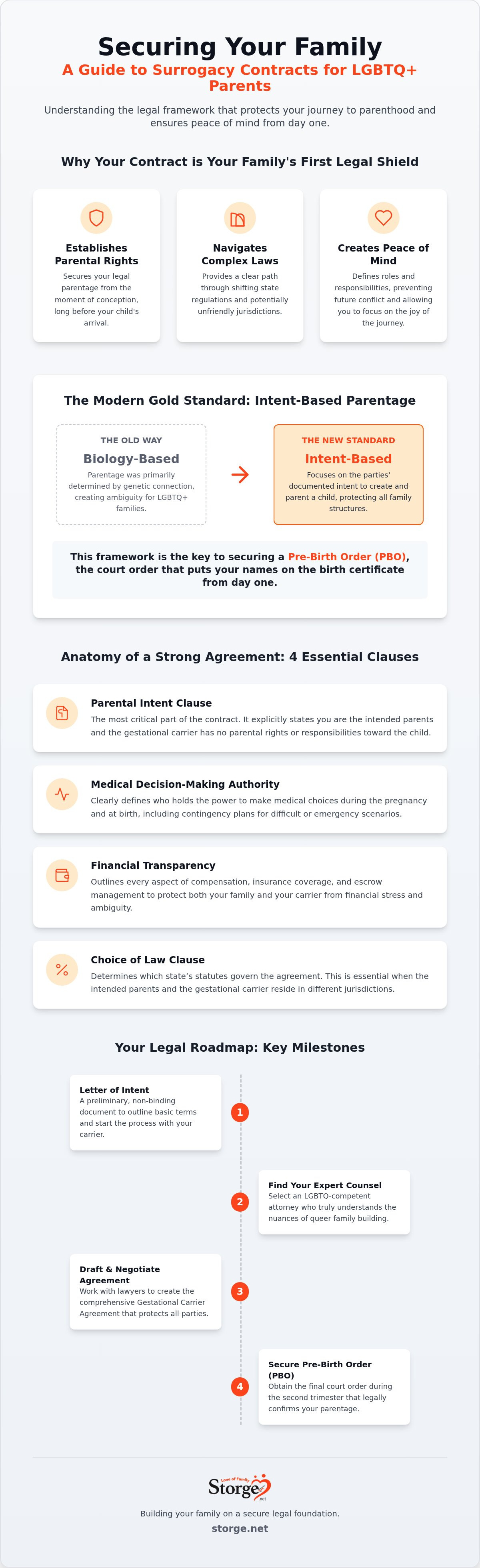
By 2026, the legal framework has shifted toward "Intent-Based Parentage," which is now the gold standard for LGBTQ families. This model moves away from strictly biological definitions of family. It focuses instead on the parties' original intent to create a child and parent them. States like Hawaii, through Act 298, and Massachusetts have recently updated their statutes to reflect this modern approach. Having a clear understanding of surrogacy laws helps you see why these contracts are so vital. They ensure that your role as a parent is protected regardless of genetic connection, shifting the focus from DNA to the love and commitment you've promised your child.
Establishing Legal Security from Day One
The contract is the primary tool used to secure a Pre-Birth Order (PBO). This court order, typically obtained during the second trimester, instructs the hospital and vital records to list you and your partner as the legal parents on the initial birth certificate. Without a robust contract, you might face legal ambiguity or even custody disputes in less friendly jurisdictions. These documents preemptively solve problems before they can arise, ensuring a smooth transition from the hospital to your home without the shadow of legal doubt.
Defining the Roles of Intended Parents
Every family structure is unique, and your contract should reflect that. For same-sex couples, the agreement explicitly clarifies the rights of the non-biological parent, granting them equal standing from the moment of conception. It also provides essential protections for single gay men, establishing them as the sole legal guardian without the need for additional adoption proceedings in many states. Understanding surrogacy contracts for LGBTQ parents means ensuring every party's role is documented to prevent future conflict. By clearly defining the gestational carrier as a collaborative partner rather than a legal parent, the contract removes any doubt about where the child’s home will be. This clarity fosters a relationship of mutual respect and trust between you and your carrier.
Essential Contract Clauses Every Queer Parent Needs to Know
Every surrogacy journey is a unique partnership built on trust, but the contract is what translates that trust into enforceable safety. The "Parental Intent" clause is widely considered the most critical sentence in your entire document. It explicitly states that you are the intended parents and that the gestational carrier has no parental rights or responsibilities toward the child. This clause acts as the primary evidence of your shared goal, ensuring that legal recognition follows your heart's intent rather than biological markers alone. Understanding surrogacy contracts for LGBTQ parents means looking past the standard templates to find language that specifically honors your family's identity.
Medical decision-making authority is another pillar of a strong agreement. You must clearly define who holds the power to make medical choices during the pregnancy and at the moment of birth. This includes contingency planning for difficult scenarios, such as multi-fetal reduction or emergency care for the carrier. While these conversations are emotionally heavy, addressing them now prevents confusion during a crisis. Financial transparency is equally vital. Your contract should outline every aspect of compensation, insurance coverage, and escrow management to protect both your family and your carrier from financial stress. A Choice of Law clause determines which state’s statutes govern the agreement, which is essential when the intended parents and the gestational carrier reside in different jurisdictions.
Parental Rights and Intent-Based Language
Inclusive language is more than a courtesy; it is a legal necessity. Your contract should use terms that accurately reflect your family structure, whether you are a same-sex couple, a trans parent, or a non-binary individual. This precision ensures that the document is a true reflection of your household. The gestational carrier must also explicitly waive any parental claims to the child. In some jurisdictions, even with a strong agreement, parents may choose to pursue second parent adoption to provide an extra layer of security that is recognized in every state and country. As you begin building your support network, finding an attorney who understands these nuances is the best way to ensure your rights are airtight.
Travel and International Recognition Clauses
For many families, the journey doesn't end at the hospital. If you live in a state or country with less-inclusive laws, your contract must include specific provisions for international recognition. This includes securing the rights for international travel with your infant and planning for the issuance of passports and citizenship documentation. These clauses are especially important for parents who may need to return to a jurisdiction where their parental rights could be challenged. By planning for these logistical steps during the drafting phase, you ensure that your transition into parenthood is defined by joy, not by bureaucratic hurdles.
Navigating the Legal Landscape: Finding LGBTQ-Competent Counsel
Finding the right guide is just as important as the journey itself. While a local family law attorney might be excellent at standard custody cases or divorces, Assisted Reproductive Technology (ART) law requires a highly specialized skill set. Understanding surrogacy contracts for LGBTQ parents involves recognizing that these documents must withstand scrutiny in a legal environment that is still evolving. You need an advocate who doesn't just know the law, but who has a deep track record in LGBTQ family building. This expertise ensures that every nuance of your specific family structure is protected from the very beginning, preventing the "one-size-fits-all" mistakes that generalists often make.
The Importance of Independent Counsel
It is a fundamental rule of surrogacy law that the intended parents and the gestational carrier must have their own separate lawyers. You cannot share an attorney, even if the relationship is perfectly harmonious and you feel like family. This requirement for independent legal representation protects the integrity and enforceability of the agreement. Understanding surrogacy contracts for LGBTQ parents means knowing that separate counsel is a non-negotiable safeguard for everyone involved. If a single lawyer represented both sides, the contract could be easily challenged in court later by claiming a conflict of interest or lack of informed consent. Managing the communication flow between these two legal teams is part of the process, ensuring that both parties are fully protected while moving toward the same goal.
Vetting for Inclusivity and Expertise
When you interview potential counsel, look beyond their legal credentials to find genuine empathy for your journey. Ask specific questions about their experience with same-sex parentage orders and their knowledge of the LGBTQ surrogacy legal process. A competent attorney should be familiar with the specific needs of trans and non-binary intended parents, ensuring that the language used in your contract is affirming and accurate. They should be able to explain how they handle the unique challenges that queer families face, such as navigating hospital staff interactions or securing international recognition for your child. Finding someone who feels like a steady guide rather than just a service provider will give you the peace of mind you deserve as you build your future.
The Drafting and Negotiation Process: What to Expect
The transition from a match to a legally binding partnership happens through a methodical drafting process. It begins with an initial consultation where you and your attorney establish a Letter of Intent (LOI). This document outlines the broad strokes of your agreement before the detailed legal work begins. Understanding surrogacy contracts for LGBTQ parents means preparing for a journey that moves from these high-level intentions to a granular, protective document called the Gestational Carrier Agreement (GCA). Once the GCA is drafted, it undergoes a rigorous review by your surrogate’s independent counsel to ensure her rights are equally protected.
After both legal teams reach an agreement, the process moves toward finalization and notarization. The final step is the issuance of a Legal Clearance letter to your fertility clinic. This letter is the green light the clinic needs to schedule the embryo transfer. Without it, the medical phase cannot proceed, making the legal foundation just as vital as the medical one. This methodical progression ensures that every party is fully informed and protected before the first medical procedure takes place.
From First Draft to Final Signature
In 2026, the timeline for finalizing a national surrogacy contract typically spans three to six weeks. Understanding surrogacy contracts for LGBTQ parents involves more than just reading the fine print; it's about navigating the emotional weight of seeing your family's future translated into dense legal text. Common sticking points often revolve around lifestyle restrictions or specific travel permissions for the carrier. Resolving these requires a balance of firm protection and mutual respect. If you are ready to find a legal partner who understands these complexities, you can access vetted attorney referrals through our community.
Managing Compensation and Escrow
Financial clarity is the best way to prevent friction in your relationship with your gestational carrier. Your contract will distinguish between Base Compensation and Variable Expenses, such as maternity clothing allowances or lost wage reimbursements. Using a professional escrow agent is a core pillar of a healthy journey. They act as a neutral third party, handling all payments so you can focus on the emotional bond with your carrier rather than the logistics of bank transfers. Clear documentation of these obligations ensures that money never becomes a source of tension as you wait for your child's arrival.
Building Your Legal Support Network through Storge PLUS
The legal phase of family building is often the most intellectually demanding part of the journey. You've learned about the clauses, the timelines, and the importance of intent, but the practical step of finding the right people to draft these documents can feel daunting. Understanding surrogacy contracts for LGBTQ parents is a journey that shouldn't be walked alone. Storge PLUS was created to bridge this gap, offering a membership that transforms a complex search into a streamlined, supported experience. By focusing on a community-driven referral model, we help you find the specialized expertise you need without the "search fatigue" that often plagues intended parents.
Once your legal foundation is secure, the focus shifts from the technicalities of the law to the joy of the surrogacy process for gay men. Having a trusted legal team in place allows you to lean into the excitement of the medical and emotional milestones ahead. Our platform serves as your steady guide, ensuring that every referral is vetted for both professional excellence and deep LGBTQ inclusivity.
Accessing Vetted Legal Referrals
In an industry that can sometimes feel unregulated and overwhelming, the value of a vetted referral cannot be overstated. Storge PLUS provides a direct connection to a screened network of surrogacy attorneys for gay couples and queer families. Our screening process goes beyond a simple background check; we look for professionals who demonstrate a genuine commitment to the nuances of ART law and inclusive family building. This network is continually shaped by community feedback, ensuring that the attorneys we recommend are not only legally proficient but also emotionally intelligent and supportive of your specific family structure.
Connecting with Experienced Intended Parents
While an attorney provides the legal framework, our community provides the emotional one. Storge PLUS members gain access to a network of parents who have navigated these same contracts and negotiations. There is immense wisdom in the "been there, done that" experiences of peers who can help you manage the emotional weight of reviewing legal texts. Whether you are looking for advice on how to handle a specific negotiation point or simply need reassurance during the waiting periods, the collective knowledge of our community offers a sense of belonging. These shared family-building stories remind you that while the legal roadmap is complex, the destination is a family built on a foundation of absolute certainty and love.
Building a Legacy of Legal Certainty
Securing your parental rights is the first great act of love you'll perform for your child. By focusing on the "Intent-Based Parentage" framework and ensuring every clause reflects your specific family structure, you're building a home founded on absolute legitimacy. Understanding surrogacy contracts for LGBTQ parents isn't just about navigating a checklist; it's about claiming your place in a legal landscape that now recognizes and honors your commitment. With the right roadmap and specialized counsel, the complexities of 2026 surrogacy law become manageable steps toward your ultimate goal.
You don't have to manage these transitions alone. Join Storge PLUS to access our vetted community of LGBTQ-friendly attorneys and surrogacy resources. Our national network provides the trusted connections and peer wisdom you need to move forward with peace of mind. Your dream of parenthood is valid, protected, and well within reach. We're here to walk beside you every step of the way as you turn that dream into a beautiful reality.
Frequently Asked Questions
Is a surrogacy contract legally binding in all 50 states?
No, surrogacy laws vary significantly across the United States. While states like Michigan updated their laws in 2024 to legalize compensated surrogacy and Hawaii modernized parentage laws in 2026, other states remain restrictive. It is vital to ensure your surrogate gives birth in a surrogacy-friendly jurisdiction where your agreement is legally enforceable. This choice of venue is the most important decision you'll make to protect your future family.
Do we need a second-parent adoption if both our names are on the birth certificate?
Even if both names appear on the birth certificate, many legal experts recommend a second-parent adoption or a judgment of parentage. A birth certificate is merely an administrative record, but a court order is a permanent legal judgment. This additional step ensures your parental rights are recognized in all 50 states and internationally, providing a vital layer of security if you ever move or travel to a less-inclusive region.
What happens if the gestational carrier changes her mind during the pregnancy?
In a properly executed gestational surrogacy agreement, the carrier has no genetic connection to the child and has legally waived all parental claims. Surrogacy-friendly states have clear statutes that protect intended parents, ensuring the carrier cannot change her mind and seek custody. The contract establishes your legal parentage from the start. This legal clarity is why choosing an LGBTQ-competent attorney is a core pillar of a safe and secure journey.
Can we include clauses about the surrogate's diet or lifestyle in the contract?
You can certainly include lifestyle and dietary provisions, but these should be discussed openly during the matching process. Common clauses address travel restrictions, tobacco use, and medical compliance. While these terms are part of the contract, the relationship is built on mutual trust. It is often more effective to partner with a gestational carrier whose daily habits and values already align with your expectations for a healthy pregnancy.
How much should we expect to pay for a comprehensive surrogacy contract?
Legal fees for surrogacy contracts depend on the complexity of the agreement and the state where your attorney is licensed. Intended parents are responsible for the costs of their own representation and the independent counsel for the surrogate. While we don't provide specific pricing, budgeting for specialized ART legal counsel is essential. Understanding surrogacy contracts for LGBTQ parents involves recognizing that high-quality legal work is a necessary investment in your family's long-term security.
What is a Pre-Birth Order and when do we need to file for one?
A Pre-Birth Order is a court document issued during the second or third trimester that names you as the legal parents before the baby is born. This order tells the hospital and vital records department exactly whose names belong on the birth certificate. Most attorneys begin the filing process around the 20th week of pregnancy. Having this order in place ensures a seamless hospital experience where you are recognized as the parents immediately.
Can a single gay man be the sole legal parent in a surrogacy agreement?
Yes, a single gay man can absolutely be the sole legal parent in a surrogacy agreement. The contract will be drafted to name you as the only intended parent with full legal and physical custody. Understanding surrogacy contracts for LGBTQ parents as a single individual means ensuring that all other parties, including the gestational carrier and egg donor, explicitly waive any potential parental rights. This creates a clear, undisputed legal path to fatherhood.
How do we handle the legal process if our surrogate lives in a different state?
If your surrogate lives in a different state, the laws of the state where the child will be born usually take precedence. You will need to work with an attorney licensed in that state to ensure the contract meets local requirements and to handle the parentage order. This cross-state process is common, but it requires careful coordination between your legal team and the carrier’s counsel to ensure your rights are fully protected.


