

Understanding LGBTQ fertility options starts with finding the paths that fit your family, from donor sperm and fertility treatment to gestational surrogacy, adoption, or co-parenting. Sperm for treatment may come from a known donor or a sperm bank. IUI and IVF are possible treatments, while reciprocal IVF can allow one partner to provide eggs and the other to carry the pregnancy.
Choosing a sperm donor can feel like one of the first big decisions, but it is only part of a larger family-building picture. Your priorities, the roles you hope each person will have, and the connection you want your child to have with a donor can all shape your choice.
This guide explains how fertility treatments work, what to consider when choosing a sperm donor, and how gestational surrogacy and other routes may fit different families. It offers a practical starting point for exploring your options with care and confidence.
Key Takeaways
- Understand how IUI, IVF, and fertility preservation can support different family-building plans.
- Consider donor factors that may shape your choice, including whether the donor is known or found through a sperm bank.
- Learn how gestational surrogacy works and what to consider when finding a carrier.
- Explore other paths, including reciprocal IVF, adoption, and co-parenting, to see which may align with your hopes for parenthood.
What Are the Fertility Treatment Options for LGBTQIA+ Individuals and Couples?
Understanding LGBTQ fertility options begins with identifying whose eggs or sperm may be used and who hopes to carry a pregnancy. IUI, IVF, donor sperm, and fertility preservation can each support different family-building plans.
Donor Sperm and Insemination
Donor sperm may come from a known donor or an accredited sperm bank. For same-sex female couples, IUI places sperm into the uterus through a catheter passed through the cervix. Clinics may screen donor sperm for infections and some inherited conditions. Under U.S. Food and Drug Administration policy, anonymous reproductive tissue donors must repeat testing after 6 months, and their samples are quarantined before donation. These steps can inform donor selection and treatment planning.
Fertility Preservation and Storage
Egg and sperm cryopreservation freezes reproductive cells for possible future use. Preserving fertility before hormone therapy or surgery may keep additional family-building options open. Sperm freezing stores a collected sample; sperm extraction may be considered when collection requires a procedure. Testing and storage costs depend on the tests needed, collection method, and storage arrangements. Understanding LGBTQ fertility options also means considering how preservation fits into future plans.
Options for Transgender and Nonbinary People
Transgender and nonbinary people may consider freezing eggs or sperm before hormone therapy or surgery. Those cells may later be used in fertility treatment, including IVF. Possible options depend on which reproductive cells a person can provide and whether they hope to carry a pregnancy. A clinic can discuss preservation timing and treatment pathways in light of each person’s family-building goals.
Medical Risks and Emotional Considerations
Medical considerations differ across insemination, IVF, fertility preservation, and sperm retrieval procedures. A clinic can explain the steps and procedure-specific risks before treatment. Emotional considerations may include donor identity, genetic connection, treatment roles, and timing. Individuals and couples can discuss these priorities together, including how they want to talk with future children about donor conception. Understanding LGBTQ fertility options means weighing practical treatment choices alongside personal hopes.
Gestational surrogacy
Gestational surrogacy allows intended parents to build a family with a carrier who has no genetic connection to the baby. For same-sex male couples, the process can involve donor eggs, IVF, and embryo transfer.
Donor Eggs for Same-Sex Male Couples
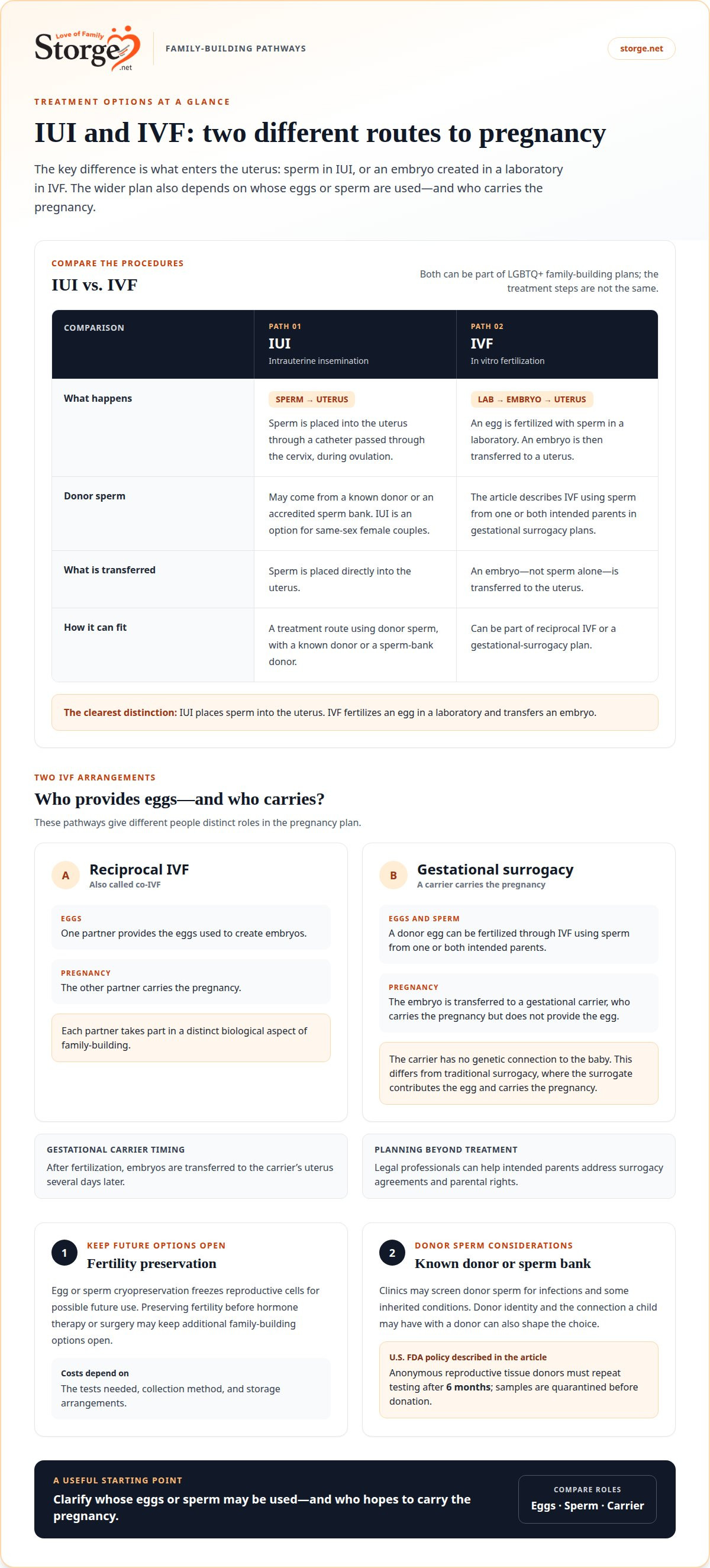
A donor egg can be fertilized through IVF using sperm from one or both intended parents, then transferred to a gestational carrier. This path can give either or both partners a biological connection to a child. Some couples use sperm from each partner to fertilize half the eggs, creating embryos for possible transfer. The carrier carries the pregnancy but does not provide the egg.
After fertilization, embryos are transferred to the carrier’s uterus several days later. The intended parents and carrier have distinct roles in this family-building arrangement. Intrauterine insemination is a different treatment, not the embryo transfer used in gestational surrogacy. Understanding this distinction can make discussions about treatment, donor eggs, and the carrier’s role clearer.
Contracts and Surrogacy Types
A legal contract may be needed when an arrangement involves an egg donor, known sperm donor, or gestational carrier. Legal professionals can help intended parents address surrogacy agreements and parental rights. Discussing these matters before treatment can clarify the roles and expectations involved in welcoming a child into the family.
In gestational surrogacy, the carrier isn’t genetically related to the baby. A traditional surrogate both contributes the egg and carries the pregnancy, so the genetic relationship differs. Most U.S. surrogacy arrangements use gestational carriers rather than traditional surrogates. If you’re considering this route, a gestational carrier search can help you explore a potential match as part of your family-building plan.
How do I find a gestational carrier?
Start by clarifying whether a gestational carrier is part of your path to parenthood. In reciprocal IVF, one partner provides eggs and the other carries the pregnancy. If neither intended parent plans to carry, IVF can create an embryo for transfer to a gestational carrier. The treatment plan helps define the kind of carrier arrangement your family is seeking.
IUI and IVF involve different steps. In IUI, donor sperm is placed in the uterus through a catheter during ovulation. IVF fertilizes an egg with sperm in a laboratory, then transfers an embryo to a uterus. When someone outside the intended-parent couple will carry the pregnancy, IVF can bring together a donor or intended parent’s egg and sperm before embryo transfer. A fertility clinic coordinates the medical treatment.
Co-IVF is another name for reciprocal IVF: one partner’s eggs are used to create embryos, and the other partner carries the pregnancy. This allows both partners to take part in distinct biological aspects of family building. It differs from a plan involving a gestational carrier, who carries an embryo created through IVF. Identifying who may provide eggs or sperm and who may carry the pregnancy helps clarify the treatment route.
Finding a carrier also requires planning beyond treatment. Intended parents may work with legal professionals on surrogacy agreements and parental rights. These discussions can clarify the intended roles of the carrier and parents before the pregnancy journey advances. In reciprocal IVF, one partner may carry the pregnancy; another family may plan to work with a gestational carrier. These are different paths, so the intended pregnancy arrangement should guide the search and related legal planning.
Parenthood options for LGBTQ+ people
There is no single route to parenthood for LGBTQ+ individuals and couples. A same-sex female couple might consider donor sperm and fertility treatment, while reciprocal IVF lets one partner provide eggs and the other carry the pregnancy. A same-sex male couple may explore donor eggs and a gestational carrier. Embryo donation is another third-party reproductive option. A suitable starting point depends on each person’s hopes, available reproductive cells, and desired role in pregnancy and parenting.
Adoption and fostering offer paths that don’t depend on fertility treatment. In the United States, same-sex couples are 4 times more likely than opposite-sex couples to have adopted children or stepchildren. For a partner whose loved one has a baby using a sperm or egg donor, second-parent adoption can establish legal parentage. This can matter to couples planning how both partners will be recognized in their family.
Co-parenting means two or more people team up to conceive and raise a child. This arrangement may involve friends or other intended parents sharing parenting roles, with or without fertility treatment. Because each co-parent’s role may shape family life and legal parentage, the people involved are advised to seek legal advice early. Discussing expectations before conception can help clarify how parenting responsibilities will be shared.
A fertility consultation can connect your choices with medical history, diagnostic testing, potential treatment, and financial considerations. The discussion may help you consider whether reciprocal IVF, donor options, adoption, or co-parenting aligns with your priorities. Gender identity and the roles each person hopes to take can also guide the conversation. For example, one partner may prioritize carrying a pregnancy, while another values a genetic connection.
If donor eggs or sperm are part of your plan, explore donor egg and sperm options as one part of your family-building decisions.
Storge: Fertility Clinic Referrals
Storge helps LGBTQ+ individuals and couples connect with fertility resources as they consider their next steps. If you’re weighing IUI, IVF, or fertility preservation, Storge’s Fertility Clinic Referrals can help you explore clinic options suited to your family-building plans. For donor-assisted treatment, Donor Egg / Sperm Search can support your search for a donor. Storge also offers Attorney Representation Referrals for people seeking legal support with family-building plans, alongside Storge PLUS Membership.
These resources can help once you have a clearer sense of the path you’re considering, whether it involves treatment, a donor, or legal support. Contact Storge to explore the fertility resources that may fit your plans.
Take Your Next Step at Your Own Pace
A fuller understanding of LGBTQ fertility options can help you move from broad possibilities toward a plan that reflects your priorities. You do not need to settle every decision at once. A useful next step is to identify what support you want now, such as finding a fertility clinic or considering how legal support fits your plans.
Storge offers Fertility Clinic Referrals, Attorney Representation Referrals, and Storge PLUS Membership to support different parts of the family-building journey. These resources can help you keep exploring with support that fits your needs, whether you’re still weighing possibilities or ready to focus on a particular path.
Contact Storge to discuss your options and consider what feels like a meaningful next step. Your path can take shape through thoughtful decisions, one at a time.
Frequently Asked Questions
How do I choose a sperm donor?
Start by deciding which donor qualities matter most to your family, such as whether you prefer a known or bank donor, identity preferences, and what information you hope to preserve for your child. Discuss your priorities with your partner or co-parent, if applicable. A clinic can explain how donor screening and treatment requirements relate to your plans. Keep the conversation focused on your family’s values and future expectations.
How do I get started if I’m ready to begin building my family?
Begin by writing down your priorities: who hopes to carry a pregnancy, whether a genetic connection matters, and which routes you’re open to exploring. An initial fertility consultation can review medical history, diagnostic testing, possible treatment, and financial considerations. If adoption, fostering, or co-parenting interests you, write down those questions too. A clear list helps make the first conversation focused and personal.
Need to find an LGBTQ+ friendly provider?
Look for a setting where staff use your name and pronouns respectfully and include your family structure in routine conversations. Consider whether intake forms let you describe partners, donors, and intended parents accurately. You can also ask how the clinic communicates with all intended parents during treatment. These details can help you assess whether the provider’s approach feels respectful and workable for your family.
What are my options for LGBTQ+ family building?
Your options can include assisted reproduction, adoption, fostering, or co-parenting. To narrow them down, consider whether you want to experience pregnancy, pursue a biological connection, or parent with another person or couple. Your preferred roles, medical circumstances, and legal parentage goals can all shape the decision. You can explore several routes before choosing the path that best reflects your priorities.
What fertility options are available to LGBTQ people in the United States?
In the United States, LGBTQ+ people may explore donor-assisted insemination, IVF, fertility preservation, gestational surrogacy, and embryo donation. Adoption, fostering, and co-parenting are other family-building routes. Which options fit depends on whether someone can provide eggs or sperm, hopes to carry a pregnancy, and wants a genetic connection. Treatment planning can take individual medical history and family goals into account.
How does IVF work for LGBTQ couples and individuals?
IVF involves fertilizing an egg with sperm in a laboratory and transferring the resulting embryo into a uterus. The egg, sperm, and person carrying the pregnancy can have different roles, depending on the family’s plan. Donor eggs or sperm may be part of treatment, and a gestational carrier may carry the pregnancy. A clinic consultation can help map treatment roles to your goals.


