

Insurance can shape which family-building paths feel within reach. In the United States, fertility-service coverage is uncommon nationally, and many insurers define infertility as being unable to conceive after one year of unprotected intercourse. Finding a welcoming fertility center for LGBTQ+ families means looking beyond that definition and checking how a policy treats specific treatments and donor-assisted care.
It’s understandable to want clear answers before making deeply personal decisions. This guide explains what insurance may cover, how donor eggs or sperm and gestational carriers can shape your options, and why LGBTQ+-specific expertise matters. You’ll also learn what can influence treatment costs and how to identify care that respects your family, identity, and plans.
Key Takeaways
- Review how your insurance policy treats fertility services and donor-assisted care, since coverage varies and may depend on how infertility is defined.
- Compare family-building paths such as donor sperm or eggs, reciprocal IVF, and gestational-carrier arrangements to see which fit your plans.
- Look for a clinic whose staff, forms, facilities, and care practices respect LGBTQ+ identities and accommodate your specific family-building plan.
- Consider specialist expertise, individualized success-rate estimates, treatment costs, timelines, and appointment demands when assessing your next steps.
Third-party IVF with donor eggs or sperm and a gestational surrogate
LGBTQ+-inclusive fertility centers may offer intrauterine insemination (IUI) with donor sperm, in vitro fertilization (IVF), and reciprocal IVF. In reciprocal IVF, one partner provides the egg while the other carries the pregnancy. These options help people match treatment to their bodies, relationships, and family-building plans.
For a person or couple using donor sperm, IUI places sperm into the uterus as part of treatment. A female couple may use sperm from an anonymous or known donor. Transgender women with female partners may use frozen sperm to inseminate a partner. A clinic can explain how donor sperm and the intended pregnancy plan shape the treatment pathway.
For gay men who have sperm, IVF can combine sperm with eggs from a donor, with a gestational carrier carrying the pregnancy. In split insemination, half the eggs can be fertilized with one partner’s sperm and the other half with the other partner’s sperm. Each egg is fertilized with sperm from only one person. In a gestational-carrier pregnancy, an embryo created through IVF using donor eggs and sperm is transferred to the carrier.
Donor and carrier screening are distinct steps. Egg and sperm donor screening includes a family-history review, medical testing, psychological testing, and potentially genetic testing. Donors must be cleared by the FDA to help ensure they do not have an illness that could pose a risk to a baby or gestational carrier. Screening also helps the clinic assess donor health before treatment proceeds. Carrier screening includes a history of a healthy pregnancy. A carrier may be found through a surrogacy agency or someone in the couple’s life.
Donor choice can also shape the next steps. Clinics may work with egg and sperm banks, or accommodate direct donations from known donors. A known donor and the intended parents may undergo psychological evaluation to support their relationship after the child’s birth. Clarifying these options helps families connect treatment choices with their hopes of conceiving and welcoming a child.
What are some of the challenges an LGBTQ+ person faces when trying to start a family?
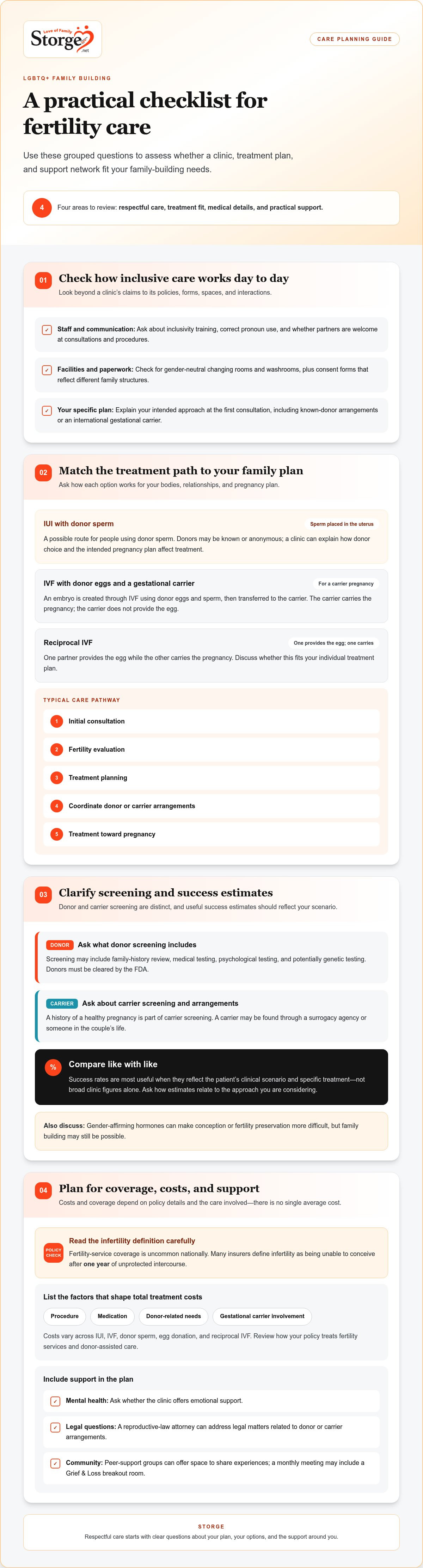
Clinic policies and everyday interactions can affect how safe patients feel discussing family building. Ask whether staff have inclusivity training, use correct pronouns, and welcome partners at consultations and procedures. Gender-neutral changing rooms and washrooms, along with consent forms that reflect different family structures, are practical signs of inclusive care. These details can shape whether patients feel respected throughout treatment.
Describe your specific plan at the first consultation, such as direct sperm donation from a known donor or treatment involving an international gestational carrier. Typical steps include an initial consultation, fertility evaluation, treatment planning, coordination of donation or carrier arrangements, and treatment toward pregnancy. Gender-affirming hormones can make conception or fertility preservation more difficult, but family building may still be possible.
Success rates are most useful when they reflect a patient’s clinical scenario and specific treatment, rather than broad clinic figures alone. Compare estimates for the same treatment and circumstances to see how they relate to your plans. Ask how the clinic explains its estimates for the approach you’re considering.
There’s no single average cost for IUI, IVF, donor sperm, egg donation, or reciprocal IVF. Total treatment costs depend on the procedure, medication, donor-related needs, and whether a gestational carrier is involved. Fertility-service coverage is uncommon nationally. Many insurers define infertility as being unable to conceive after one year of unprotected intercourse.
Emotional, legal, and financial support can help make decisions more manageable. Ask whether the clinic offers mental health support, and discuss how donor or carrier arrangements fit your plans. A reproductive-law attorney can address legal questions, while policy details shape financial planning. Peer-support groups can provide space to share experiences; a monthly meeting may include a Grief & Loss breakout room. Consider LGBTQ+ family-building support as you explore community resources and your next steps.
Egg donation and gestational carriers for male couples
For male couples, IVF with an egg donor and gestational carrier can offer a path to pregnancy. Either partner may provide sperm, or the couple may choose the partner with healthier sperm. Each egg is fertilized with sperm from only one man, so the couple and doctor can discuss whose sperm to use for each embryo. This decision connects medical information with each partner’s hopes for family building.
Egg donation and carrier arrangements involve separate decisions. Couples may consider an anonymous or known egg donor, then identify a carrier through an agency or someone in their lives. These routes create different practical and personal dynamics. A consultation can clarify how the intended parents, donor, and carrier will work together throughout treatment. The clinic coordinates the medical steps involved in IVF and embryo transfer.
A prior healthy pregnancy is part of gestational-carrier screening. This gives intended parents a concrete screening point to discuss with the clinic when considering a potential carrier. The carrier’s role is to carry the pregnancy, not provide the egg. Keeping those roles clear can help couples understand the treatment plan and the people involved before moving forward.
Before choosing a carrier, couples can compare working through an agency with asking someone they already know. Consider which approach fits your relationships and plans, then discuss the process with your doctor. A known carrier may be part of the couple’s community; an agency can be a route to meeting a potential carrier. Either way, medical screening and a clear understanding of the arrangement matter.
Lesbian couples may have different fertility options, including donor sperm, IUI, or reciprocal IVF, where one partner provides eggs and the other carries the pregnancy. Male couples typically need both donor eggs and a gestational carrier for this IVF pathway. Describing your family structure and preferred roles during consultation helps keep conversations focused on your plans, rather than assumptions about gender or parenthood.
LGBTQ+ fertility center and specialist expertise
Specialist expertise matters because reproductive plans can involve different bodies, treatments, and family roles. The Healthcare Equality Index scores practices across four areas, offering one lens on inclusive care. Also look for clinicians with experience supporting LGBTQ+ individuals, not just general fertility knowledge. Expertise should connect your medical history with your goals as intended parents.
Transgender individuals can preserve eggs, embryos, or sperm before beginning hormone therapy or transitional surgery. Discussing preservation early helps clarify which reproductive materials may be available for future treatment. Dr. Stephanie Rothenberg is recognized as a leader in transgender fertility preservation, while Dr. Darcy Broughton has published studies on IVF outcomes in nonbinary patients. Their work illustrates the value of relevant specialist experience.
Ask how a clinic evaluates your specific plan, such as insemination with donor sperm, reciprocal IVF, or fertility preservation. Fertility testing can inform treatment planning, and some same-sex female couples may be advised to receive diagnostic evaluations for both partners, even without an infertility history. A personalized plan should explain which evaluations relate to each partner’s role.
Review how the clinic discusses outcomes. Success-rate estimates should reflect a patient’s clinical scenario and the treatment being considered, rather than relying only on broad figures. Ask how the estimate applies to your age, diagnosis, and proposed treatment. Also discuss appointment frequency, timelines, and treatment costs, since visits may be frequent and arranged at short notice. Choosing a nearby clinic can make attendance more practical.
Specialist care also means respectful communication throughout the journey. Notice whether staff use your pronouns, include your partner, and describe donor and treatment options without assumptions. If care feels uncomfortable, patients can request another doctor at the same clinic or a referral elsewhere. If you’re comparing next steps, explore LGBTQ+ family-building resources for support finding care aligned with your plans.
Storge: Storge PLUS Membership
Storge PLUS Membership is a next step for LGBTQ+ individuals and couples organizing their family-building plans. Storge offers fertility clinic referrals, donor egg or sperm search, and attorney referrals, connecting readers with resources related to the choices discussed above.
If you’re comparing clinics, looking for donor options, or considering legal representation, these offerings can help you identify a practical place to begin. Fertility clinic referrals can support your search for care, while donor search can support plans involving donor eggs or sperm. Attorney referrals connect intended parents with legal representation.
Each family’s path is personal, and you can move at a pace that feels right for you. Visit Storge to explore your next step.
Take the Next Step on Your Terms
Finding a welcoming fertility center for LGBTQ+ families means more than choosing where treatment happens. It’s an opportunity to shape care around your identity, relationships, and vision for parenthood. Before your next conversation, consider what matters most to you: clear communication, inclusive policies, support for your family-building plan, or guidance through a decision that still feels uncertain.
You don’t need every answer before taking a first step. A conversation can help you organize priorities and identify useful resources as your plans develop. Storge offers Storge PLUS Membership, fertility clinic referrals, and attorney referrals for people seeking support along the way.
Contact Storge to discuss your options and explore a next step that feels right for your family. Your path can take shape one thoughtful decision at a time.
Frequently Asked Questions
Is any of this covered by insurance?
Fertility-service coverage is uncommon nationally, and benefits depend on the policy and treatment. Many insurers define infertility as being unable to conceive after one year of unprotected intercourse, which can affect coverage eligibility. Ask your insurer for a written breakdown of benefits, exclusions, and authorization requirements for diagnostics, medication, procedures, and donor-related expenses. This can help you plan for the specific care you’re considering.
Still Have Questions?
Storge offers educational guides and expert advice on fertility treatment, along with financial-planning tips and community resources. These can help you sort through questions between appointments, such as organizing next steps or finding peer support. Write down what remains unclear, including practical concerns about your family-building plan, so you can focus on the information and resources most relevant to you.
How can LGBTQ+ patients identify an affirming fertility clinic in the United States?
Finding a welcoming fertility center for LGBTQ+ families starts with looking at how a clinic handles real patient interactions, not just its public messaging. Review its intake forms and patient materials for inclusive language, and look for clear policies on respectful communication and partner involvement. During an initial conversation, notice whether staff address your family structure and treatment goals without making assumptions.
Which fertility clinics specialize in LGBTQ+ family building and have inclusive policies?
Look for clinics whose experience matches your specific plan, such as fertility preservation, donor-assisted insemination, reciprocal IVF, or treatment involving a gestational carrier. A clinic’s stated policies and clinical experience can help you assess that fit. Storge offers fertility clinic referrals for people seeking a clinic aligned with LGBTQ+ family-building needs, helping narrow the search around the care you’re pursuing.
What should same-sex couples and transgender patients ask a fertility clinic before choosing one?
Ask how the clinic coordinates care when partners have different medical needs, and who handles communication about testing and treatment decisions. Transgender patients can ask how clinicians incorporate current or past hormone therapy into fertility planning. Same-sex couples can discuss how the clinic coordinates donor-related steps with their intended treatment. These conversations can reveal whether the clinic understands the details of your plan.
How can patients verify a fertility clinic’s LGBTQ+ inclusivity, staff training, and patient reviews?
Compare the clinic’s written policies with what staff describe in conversation, and look for specifics about inclusivity training and how it informs patient care. Read several patient reviews rather than relying on one account. Notice recurring themes, such as respectful communication, consistent use of pronouns, or difficulties involving partners. Patient feedback adds context, while clinic policies show how inclusion is meant to work in practice.


