

Affirming care starts with clear communication and a care team that respects your identity. LGBTQ affirming hospital birth options include sharing your pronouns, preferred language, and family roles with the team, and identifying the support people you want present. A birth plan can make your needs and goals easier to communicate.
It’s understandable to want your child’s birth to feel safe and welcoming, not like a moment when you have to explain or defend who you are. Look for inclusive signals in a hospital’s forms and staff communication, and ask about LGBTQ+ care training and support. This guide covers how to communicate pronouns and family roles, prepare for gendered language in maternity care, and assess providers’ approach to affirming support, so you can make informed choices with greater confidence.
Key Takeaways
- Agree on the names, pronouns, and gender-neutral language you want your care team to use, and share relevant health information that can support respectful care.
- Use the hospital room whiteboard to clarify each support person’s role and preferred language, so staff have a visible reference during your stay.
- Use community referral networks to find perinatal providers, and ask about LGBTQ+ care training and queer staff as you assess potential support.
- Look for inclusive forms, safe-space signs, and affirming language on provider websites as clues to how a practice approaches LGBTQ+ care.
1. Challenges with gendered language and mainstream maternity care
Pregnancy care often uses words like “mother” and “woman,” which may not fit every patient’s gender or identity. Forms that use gender-neutral language can signal a more welcoming practice, but respectful care also means staff consistently use your name, pronouns, and preferred terms. Transgender people report real barriers: in a survey, 33% experienced harassment in a medical setting, while 25% had to teach providers about transgender care. When comparing LGBTQ affirming hospital birth options, look for care that addresses your identity as well as your medical needs.
How do hospitals support transgender and nonbinary people during pregnancy and birth? Support can include using your correct pronouns, discussing your healthcare needs respectfully, and making room for gender-neutral language such as “birthing person,” “patient,” or “parent.” Share your preferred name and pronouns with the care team at an appointment, then ask that staff use them consistently in conversation and records. You can also explain how you want staff to refer to your body and pregnancy.
Include relevant gender-affirming care in your medical history. For example, tell your care team about hormone treatments, chest binding, or gender-affirming surgeries when these details may help them plan your care. If you’re considering hormone therapy, discuss fertility preservation before pregnancy. You don’t need to teach staff the basics of transgender care; focus on information relevant to your care. A practical way to assess LGBTQ affirming hospital birth options is to notice whether staff handle these conversations respectfully.
Preventive gynecological care can still matter during a gender-affirming pregnancy journey. The Women & Infants Center recommends annual gynecological visits for people with female anatomy and says annual appointments for transgender and nonbinary individuals should include a pelvic exam, Pap smear, and breast or chest exam. Discuss which screenings suit your anatomy and care needs. If language or treatment feels disrespectful, raise the concern with a trusted hospital team member or patient advocate. Specific feedback, such as requesting “parent” instead of “mother,” gives staff a clear way to respond.
2. Communicating pronouns and family roles on a hospital whiteboard
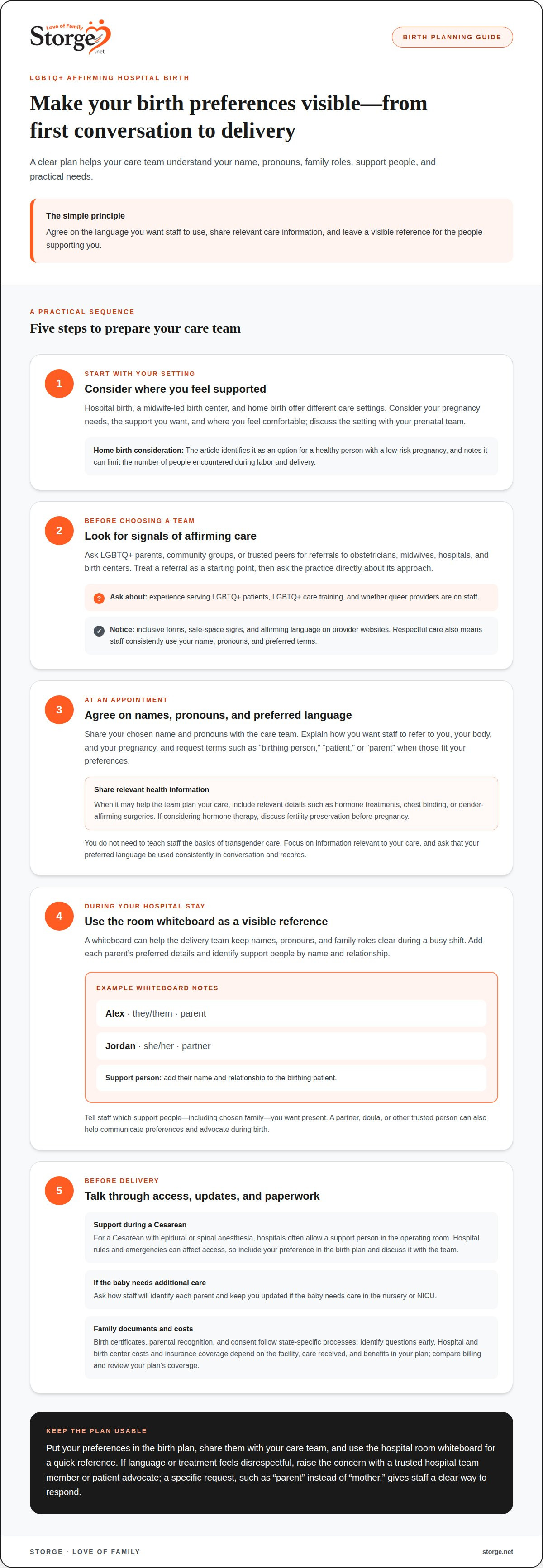
A room whiteboard gives the delivery team a visible reference during a busy shift. Write each parent’s name, pronouns, and preferred family role, such as “Alex, they/them, parent” and “Jordan, she/her, partner.” Add the support person’s name and relationship to the birthing patient. This can help prevent incorrect assumptions when staff enter the room.
How do hospitals handle chosen names, pronouns, partner access, and inclusive family language? Share your chosen name and pronouns with the care team, and request terms such as “parent” rather than gendered labels. Tell staff which support people, including chosen family, you want present during delivery. A partner, doula, or other trusted person can also help communicate your preferences and advocate during birth.
For a Cesarean delivery with epidural or spinal anesthesia, hospitals often allow a support person in the operating room. Hospital rules and emergencies can affect access, so include your preference in the birth plan and discuss it with your team. Ask how staff will identify each parent and keep you updated if the baby needs care in the nursery or NICU.
Birth certificates, parental recognition, and consent follow state-specific processes. The documents and steps relevant to your family depend on your state and circumstances, so identify these questions early and organize the information needed for your situation.
Hospital and birth center costs and insurance coverage depend on the facility, care received, and benefits in your plan. Compare how each setting bills for delivery and related services, and review your plan’s coverage for the setting you’re considering.
Books and online parenting resources can help prepare LGBTQIA+ families for pregnancy and new parenthood. Choose materials that recognize diverse family structures, including lesbian parents and families formed through assisted reproduction. For practical help exploring hospital choices, use hospital search support as you plan your delivery.
3. Finding queer-affirming obstetricians, midwives, doulas, and other perinatal providers
Personal referrals can make finding respectful prenatal care feel more concrete. Ask LGBTQ+ parents, local community groups, or trusted peers which obstetricians, midwives, and hospitals treated them with respect. A referral is a starting point, not a substitute for discussing your needs with the doctor. Ask whether queer providers are on staff and whether staff have LGBTQ care training.
Hospital birth, a midwife-led birth center, and home birth offer different care settings. Consider where you feel supported, what kind of birth support you want, and your pregnancy needs. Home birth can be an option for a healthy person with a low-risk pregnancy and can limit the number of people encountered during labor and delivery. Discuss with your prenatal team which setting fits your care.
To find LGBTQ-affirming hospitals and birth centers in the United States, start with community referral networks and recommendations from LGBTQ+ families. Then ask a prospective practice about its experience serving LGBTQ+ patients, queer staff, and staff training. These conversations can help you assess how providers approach respect, pronouns, and family structures before choosing your care team.
Community referral networks can also help you find a queer doula. Doulas may support LGBTQ+ parents during fertility appointments, explain procedures, and offer emotional support. During birth, a doula can remind staff to use a transgender client’s correct pronouns and speak up if questions become invasive or insensitive. Ask how a doula will support communication and your mental health during pregnancy and postpartum.
To find certifications or directories, use LGBTQ-focused community referral networks to identify potential providers, then assess their actual practices. Ask for specific examples of inclusive care and how staff respond to patient feedback. A visible label alone can’t show how a team communicates during delivery. Choose support that fits your family, whether you’re a lesbian couple, a solo parent, or parents using assisted reproduction.
LGBTQ-focused community referral networks can help identify potential providers. Ask practices how they support patients across pronouns and family structures, and how they respond to feedback.
4. Reviewing provider websites, forms and cultural competency signals
Start with the provider’s website. Look for language that recognizes LGBTQIA+ patients and different family structures, rather than describing every pregnant person as a woman or mother. For example, prenatal information that refers to “patients,” “parents,” or “birthing people” may better reflect your identity. Note whether the site discusses care for LGBTQ+ families directly or only displays a general statement about inclusion. When comparing LGBTQ affirming hospital birth options, treat website language as one clue, not the whole picture.
Forms offer another practical clue. Review intake fields for chosen name, pronouns, gender identity, and the names of partners or support people. A form that lets each parent describe their role can make family details easier to record. Notice whether questions invite relevant information without assuming sexual orientation, relationship status, or how a family came to be. Consider whether the form gives you space to explain what language feels respectful.
Look for visible signs of welcome, such as safe-space stickers or decals, inclusive forms, and symbols on staff name tags. Read the language around fertility, prenatal care, and becoming a parent. Specific references to lesbian, transgender, and nonbinary families offer more context than a broad welcome message alone. These signals can help you prepare focused questions about the care you may receive.
Assess the practice’s stated cultural competency by looking for information about LGBTQ care training and experience serving LGBTQ+ patients. Ask how many LGBTQ+ patients the practice serves, and whether staff have completed training for culturally sensitive care. You can also ask how staff respond when a patient requests a correction or raises a concern. Answers can reveal whether inclusive language is part of everyday practice.
Keep a short comparison note for each provider: the wording on forms, visible signals, stated training, and answers about patient experience. This makes it easier to weigh LGBTQ affirming hospital birth options against the needs of your family. If fertility care is part of your plans, explore fertility clinic referrals as you consider supportive prenatal care.
Storge: Storge PLUS Membership
Storge PLUS is a next step for LGBTQ+ individuals and couples seeking support as they build a family. If planning a hospital birth is part of a broader fertility journey, Storge can connect you with relevant resources through Fertility Clinic Referrals and Hospital Search. For families exploring donor conception, Donor Egg / Sperm Search can support the search process. Attorney Representation Referrals can help connect you with legal representation when family-building raises legal questions.
These resources can be useful at different stages, from considering fertility care to preparing for parenthood. Choose the support that fits the questions you’re working through; you don’t need to resolve every decision at once. To explore how Storge may fit your family-building plans, contact Storge.
Move toward a birth experience that feels like yours
Your choices deserve to reflect the family you’re becoming, not assumptions built into a standard process. As you consider LGBTQ-affirming hospital birth options, give yourself permission to make decisions at a manageable pace. You can keep refining what matters most as your plans take shape, including the support and communication that help you feel grounded.
It may help to write down the questions you want answered before taking your next step. A short list can focus conversations and help you notice what you need from the people supporting your family. You don’t need every detail settled before seeking guidance. Your next step can simply be learning what support is available for your path to parenthood.
Contact Storge about affirming birth support and explore whether its resources fit your family-building journey. You deserve care and support that honor who you are, and each thoughtful step can bring your plans into clearer focus.
Frequently Asked Questions
What questions should LGBTQ parents ask hospitals about labor, delivery, and postpartum care?
Ask who can stay with you during labor, a Cesarean delivery, and recovery, and how the hospital handles changes during emergencies. Find out how staff will communicate if your baby receives care in the nursery or NICU, and whether both parents can receive updates. For postpartum care, ask how feeding support, rooming arrangements, and follow-up communication can reflect your family’s needs.
What options exist for a non-birthing parent to be recognized on birth records and hospital forms?
Hospital forms and official birth records are separate matters, so ask the hospital what parent information it can enter in its own records. For the state birth record, available recognition routes depend on state law and family circumstances. Before delivery, gather the relevant paperwork and discuss state-specific parentage questions with an attorney. Clear hospital records can help staff identify both parents during your stay.
What discrimination risks or complaint processes should LGBTQ patients know about when choosing a birth facility?
Disrespectful language, incorrect names, or exclusion of a support person can affect a patient’s experience. Before admission, identify the hospital’s patient advocate or the staff member responsible for receiving concerns. If an incident occurs, record what happened, when, and who was present, then share the details with that contact. A clear account helps the hospital understand the concern and respond to the specific event.
How can someone assess a specific hospital's LGBTQ policies, staff training, and patient experiences?
Ask the hospital for its written nondiscrimination and visitation policies, then request examples of how staff training applies during registration and delivery. To understand patient experiences, look for feedback describing concrete interactions, such as respectful communication or support for both parents, rather than relying only on general ratings. Compare those accounts with the hospital’s answers and note whether its practices match the needs you’ve identified.
What LGBTQ-affirming maternity care certifications or directories are available?
Use LGBTQ-focused community referral networks to identify potential providers, then ask about their inclusive practices, staff training, and experience serving LGBTQ+ patients.


