

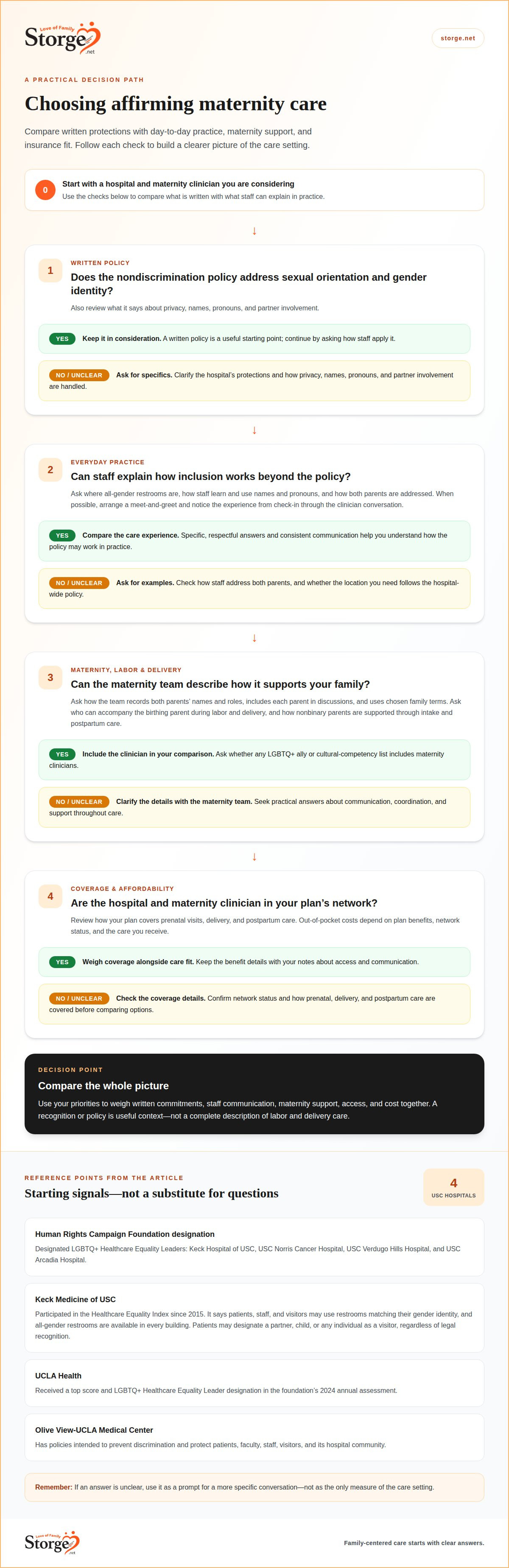
A supportive hospital is more than a name on a list. A hospital search for queer parents should consider written nondiscrimination policies, how staff recognize both parents, maternity care practices, and whether the hospital and clinicians fit your insurance and budget. The Human Rights Campaign Foundation designated Keck Hospital of USC, USC Norris Cancer Hospital, USC Verdugo Hills Hospital, and USC Arcadia Hospital as LGBTQ+ Healthcare Equality Leaders, providing a concrete starting point.
Choosing where to give birth can bring excitement alongside practical concerns: being addressed correctly, having your family recognized, and understanding potential costs. These concerns deserve clear answers, not assumptions. Review hospital policies and day-to-day practices, ask about parent and partner recognition, and compare insurance coverage and affordability. Look beyond policy statements to staff communication and the care environment, then weigh what matters most to your family.
Key Takeaways
- Look beyond a hospital’s public policy by considering staff communication, inclusive facilities, and how the care environment feels in practice.
- Compare maternity, labor, and delivery options by reviewing clinician experience and how the hospital supports each parent throughout care.
- Discuss how the hospital records parent information, uses names and pronouns, and recognizes a partner or support person during visits.
- Review your insurance network and likely out-of-pocket responsibilities as part of planning; Storge PLUS Membership can support your broader family-building journey.
How can queer parents find LGBTQ+-affirming hospitals in the United States?
Begin a hospital search for queer parents with written evidence, then consider how care works in practice. Look for a nondiscrimination policy that addresses sexual orientation and gender identity. Review what it says about privacy, names, pronouns, and partner involvement. A written policy is a useful starting point, while conversations can show how staff apply it.
The Human Rights Campaign Foundation designated four USC hospitals as LGBTQ+ Healthcare Equality Leaders: Keck Hospital of USC, USC Norris Cancer Hospital, USC Verdugo Hills Hospital, and USC Arcadia Hospital. Keck Medicine of USC says patients, staff, and visitors may use restrooms matching their gender identity, and that all-gender restrooms are available in every building. Olive View-UCLA Medical Center has policies intended to prevent discrimination and protect patients, faculty, staff, visitors, and its hospital community.
Use these details to guide a direct conversation with the hospital or a doctor’s office. Ask:
- Where are gender-neutral or all-gender restrooms located?
- How does the doctor support LGBTQ+ patients and families?
- How do staff learn and use patients’ names, pronouns, and family terms?
Ask for specific examples, such as how staff address both parents during appointments. A clear, respectful response can help you understand what care may feel like beyond the policy language. You can also ask trusted friends and family about their experiences. Their firsthand perspectives may suggest useful questions about communication and care.
Arrange a meet-and-greet visit when possible. Notice how the doctor and staff communicate, whether the environment feels comfortable, and how they respond to your questions. Consider the whole visit, from check-in to the clinician conversation. If a hospital has several locations, ask which site provides the care you need and whether its practices align with the hospital-wide policy. This approach helps you compare written commitments with real interactions before choosing where to receive care.
Which hospitals have LGBTQ+-affirming maternity, labor, and delivery care?
A hospital’s overall inclusion record can guide your search, but maternity practices deserve their own review. The Human Rights Campaign Foundation’s Healthcare Equality Index offers one signal: Keck Medicine of USC has participated since 2015. UCLA Health received a top score and LGBTQ+ Healthcare Equality Leader designation in the foundation’s 2024 annual assessment. These recognitions provide context, not a complete description of labor and delivery care.
Ask how the maternity team supports different family structures throughout prenatal visits, labor, delivery, and postpartum care. Look for practical answers about communication and coordination, not only welcoming language. Ask how staff record both parents’ names and roles, address each parent, and include a partner in discussions. If you plan to see a specific clinician, ask how they approach LGBTQ+ family needs.
Hospitals may provide lists of physicians who identify as LGBTQ+ allies or have completed LGBTQ+ cultural competency training. Ask whether the list includes maternity clinicians, and use it to guide conversations about experience and communication. You can also ask:
- How are both parents included in appointments and care discussions?
- How does the team use each parent’s name and chosen family terms?
- Who can accompany the birthing parent during labor and delivery?
- How does the team support nonbinary parents through intake and postpartum care?
Review insurance and affordability alongside clinical fit. Check whether the hospital and maternity clinician are in your plan’s network, and review how your plan covers prenatal visits, delivery, and postpartum care. Your out-of-pocket costs depend on plan benefits, network status, and the care you receive. Keep these details with your questions so you can weigh access, communication, and cost together.
During a visit or introductory conversation, notice whether answers are specific and consistent across staff. A hospital that can explain how its maternity team works with different parents gives you useful information for comparing care. Use your priorities to narrow the options, then choose the setting that best aligns with your family’s needs and coverage. A thoughtful maternity care search can help organize those priorities into a clearer decision.
How do hospitals accommodate two mothers, two fathers, and nonbinary parents?
For two mothers or two fathers, inclusive care begins with how staff recognize each parent. Ask how registration forms identify parents and what family terms staff use. You may want both parents listed by name rather than assigned assumptions about “mother” and “father.” Ask how the care team includes each parent in conversations, updates, and routine communication. Clear answers can help you understand what to expect during appointments and a hospital stay.
Keck Medicine of USC states that patients may designate a partner, child, or any individual as a visitor, regardless of legal recognition. This is a concrete example of a policy recognizing a patient’s chosen support person. Ask how visitor designation works in practice, including how staff receive the information and share it across departments. If your family relies on a particular support person, discuss that person’s role before admission.
If you’re a nonbinary parent, ask how staff record and use your name, pronouns, and preferred terms. You can raise practical questions such as:
- Can the parent’s chosen name and pronouns appear in routine staff communication?
- How can the parent correct an intake form that uses inaccurate family labels?
- How does the team refer to each parent during appointments and care discussions?
- How are visitor preferences shared with staff involved in the hospital stay?
Use a specific example, such as asking how staff would address both parents during a conversation about the baby’s care. Ask who can update information if a form or record uses the wrong term. These details help you assess whether a policy leads to consistent communication, rather than relying on a general promise of inclusion.
Before choosing a hospital, write down the names and terms your family wants staff to use. Share them during intake conversations and ask how the hospital records those preferences. For partners and support people, clarify whom the patient designates as a visitor. Comparing these processes can help you identify practical differences in family recognition, privacy, and communication.
Discrimination risks for queer parents in hospitals
Harmful experiences can begin before a clinical conversation. An intake form with only “mother” and “father” fields, for example, can misrepresent two mothers, two fathers, or a nonbinary parent. Staff may repeat those inaccurate labels during appointments or share them between departments. A parent then has to correct the record while also focusing on care.
Misgendering can involve incorrect names or pronouns, or assumptions about someone’s body and family role. A staff member might use an unwanted title for a nonbinary parent or refer to a same-sex partner as a friend. These interactions can undermine trust and make communication harder. A written policy helps set expectations, but how staff handle corrections matters too.
Look for practical warning signs during registration, phone calls, and visits:
- Staff repeatedly use an incorrect name or pronoun after a correction.
- Forms leave no clear way to record both parents or preferred family terms.
- A partner’s role is dismissed during routine conversations about care.
- Different departments give conflicting answers about who can participate.
Notice how staff respond when you raise a concern. A respectful response acknowledges the correction and uses your requested language going forward. For example, if a receptionist records the wrong parent label, request a correction and ask how it will be shared with the care team. Note the department and response. This gives you a clearer basis for comparing hospital practices and deciding what support your family needs.
Before a visit, prepare a short written note with names, pronouns, and family terms. Bring it to registration and use it to correct inaccurate forms. If the hospital’s response feels dismissive, raise the concern with the appropriate patient-support contact and describe the specific interaction. For a more considered hospital search for your family, compare how each hospital addresses these practical situations, not only its written statements.
Storge: Storge PLUS Membership
Storge PLUS Membership is one way to continue exploring support for your family-building journey. If comparing hospital policies, family recognition, and care environments feels complex, Storge’s Hospital Search can help you look for a hospital that fits your needs. It can sit alongside the practical questions you’re already considering, including how a hospital communicates with parents and accommodates your family.
Storge also offers Fertility Clinic Referrals, Attorney Representation Referrals, and Donor Egg / Sperm Search. These resources may support different parts of your path to parenthood. Choose the support that matches the decision in front of you, without feeling you need to plan every step at once.
To learn more, visit Storge online and explore the options available for your next step.
Choose care that fits your family’s next chapter
A hospital search for queer parents is also an opportunity to define what respectful care means for your family. Consider which practical details will shape your comfort, then use those priorities to guide conversations about coverage, affordability, communication, and parent recognition. Your needs may change as plans develop, so keep your questions and preferences together for future reference.
If family-building decisions are part of the picture, Storge offers Storge PLUS Membership, Attorney Representation Referrals, and Fertility Clinic Referrals. These resources can support different parts of the journey, from exploring care pathways to finding legal representation referrals. Focus on the question that matters most now and take the next step at a pace that feels right.
Contact Storge for support as you consider your options. You deserve thoughtful support as you build a path toward parenthood that reflects your family.
Frequently Asked Questions
What hospital services and family policies should queer parents compare?
Compare the maternity and newborn services you may need, family-recognition practices, and how insurance applies to the hospital and clinicians. For example, check whether prenatal, labor, delivery, and postpartum care align with your plan’s network rules. Consider registration and communication processes for both parents, too. Note which policies matter most to your family, then use the same criteria for each hospital.
How can queer parents check whether a hospital is safe and inclusive?
Look for consistency between a hospital’s written commitments and staff responses to practical situations. Try a specific scenario, such as updating a parent’s information after registration, and notice whether staff explain a clear process. Keep brief notes about interactions with different departments. Comparing responses can help you judge whether communication feels respectful and coordinated, rather than relying on a policy statement alone.
What questions should LGBTQ+ parents ask when choosing a hospital?
Ask how the hospital explains expected billing, who can answer insurance questions, and how charges may differ between the facility and clinicians. You can also ask who coordinates communication across departments and how to correct an inaccurate record during a stay. These questions can reveal practical processes and potential sources of confusion, helping you prepare follow-up questions before deciding.


